
Atom Element 600 B vs Elddis Autoquest GTV 260 and Auto-Trail V-Line 610 Sport: is the off-grid upgrade worth it?

Written by
Leo
Leo covers campervan technology, maintenance, kit, and ownership advice, with a clear, practical focus on how things work in real life.
The short answer
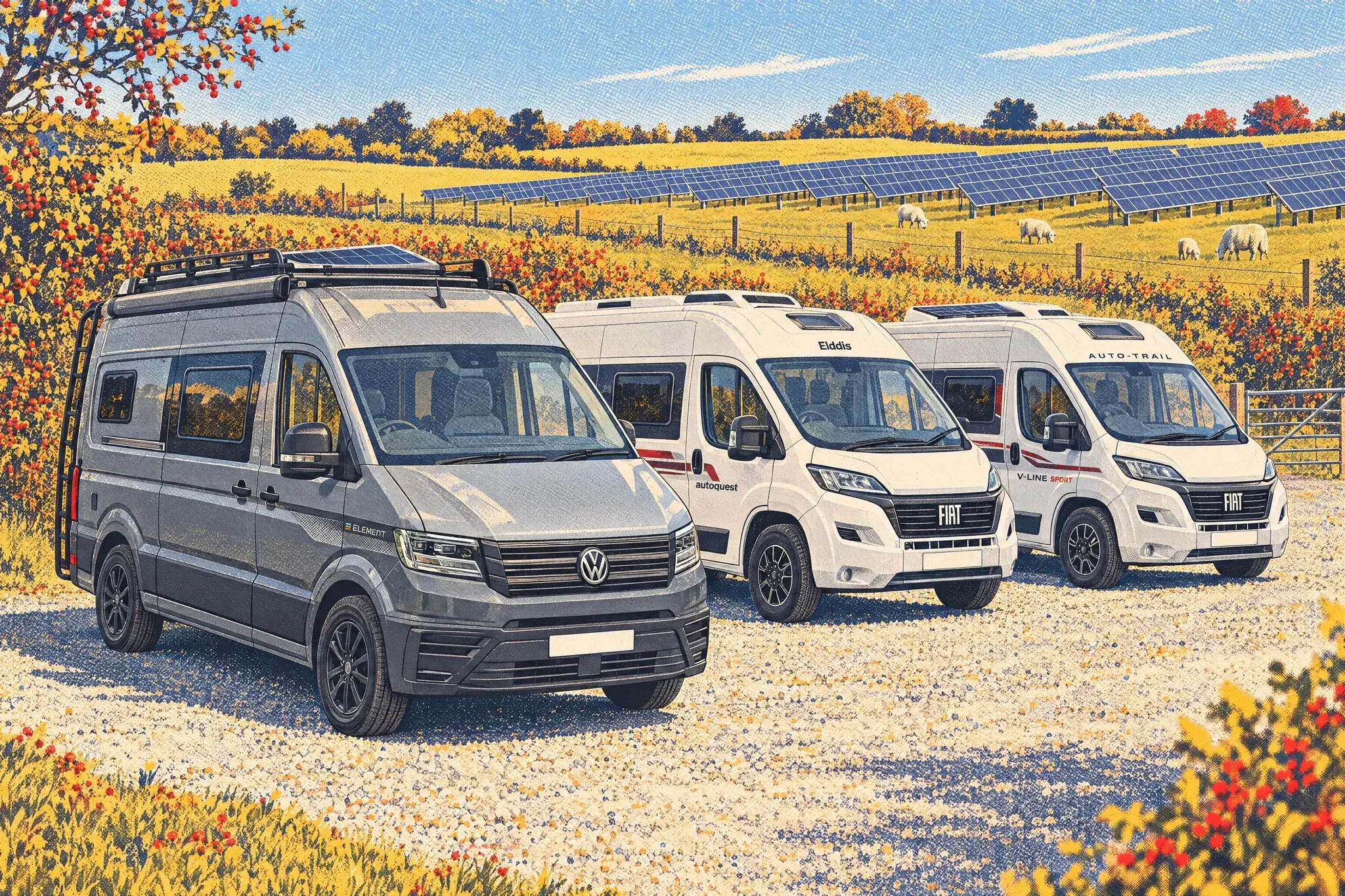
The Atom Element 600 B costs £68,925 on the road (£66,980 in Atom's winter sale, prices as listed on 5 October 2026) and brings 340Ah of lithium, a 3,000 W inverter and 200 W of solar as standard. The Elddis Autoquest GTV 260 is cheaper at £66,827 and includes an automatic, but has a 95Ah AGM battery and no solar. The Auto-Trail V-Line 610 Sport costs £80,260 with a 70Ah AGM. If you want to run 230 V kit away from hook-up, the Atom is the clear value pick; if you want an automatic and a big double bed, the Elddis is.

Four six-metre rear-lounge campervans, four very different ideas about where your money should go. The Atom Element 600 B puts its budget into a battery you could genuinely live off for a weekend. Its rivals put theirs into an automatic gearbox, a bigger bed, or a longer standard kit list. None of these is wrong. The job here is to work out which one matches the way you will actually use the van. All prices below are as listed by each maker on 5 October 2026 and will move, so treat them as a snapshot.
Two lines on Atom for anyone new to the name: it is a Trigano-owned UK brand launched in August 2026, building Volkswagen Crafter campervans at prices that start below many established ranges, according to Practical Motorhome. The Element is the higher of its two trim levels, sitting above the Core.
The four vans at a glance
- Atom Element 600 B: £68,925 on the road (£68,480 plus £445 charges), or £66,980 at the winter sale price. Volkswagen Crafter, 5.986 m long, 3,500 kg, 140 PS with a six-speed manual as standard. The 177 PS engine is £2,652 and the VW automatic is £2,628. Rear lounge with two facing benches. 340Ah lithium, 3,000 W inverter, 200 W solar as standard.
- Elddis Autoquest GTV 260: £66,827 according to Elddis. Fiat Ducato MultiJet 140, 3,500 kg, automatic gearbox and diesel heating as standard. Rear benches make one large double. 95Ah AGM battery and no solar panel as standard.
- Auto-Trail V-Line 610 Sport: £79,805 plus £455 on the road charges, so £80,260 according to Auto-Trail. Fiat Ducato, 5.99 m, 140 bhp manual as standard, with 140 bhp and 180 bhp automatics on Auto-Trail's options list. Rear lounge. 70Ah AGM and 200 W solar as standard. Auto-Trail is also a Trigano brand, so this is the Atom's in-house big sibling.
- Swift Merlin 122: £64,190, as reported by Practical Motorhome from Swift's launch. Fiat Ducato 2.2 140 bhp, 6 m. U-shaped rear lounge that makes a double or two singles, a 100Ah lithium battery and a 50-litre compressor fridge (Practical Motorhome reports the 112 and 122 get the 50-litre unit, the rest of the Merlin range 80 litres).
Read those four lines slowly and the story is already half told. The Atom is not the cheapest and it is not the most lavishly finished. What it has is roughly three and a half times the battery capacity of the next best van here, and a 3,000 W inverter as standard.
What the Element adds over the Atom Core
The Element 600 B costs £6,325 more than the Core 600 B, which puts the Core at roughly £62,600 on the road on the same date. For that £6,325 Atom lists the following as standard on the Element and not on the Core:
- 340Ah lithium leisure battery (the Core has a smaller battery)
- 3,000 W inverter
- Roof rack with awning and ladder
- 200 W rigid solar panel, with a second panel available for £349
- Wi-Fi
- Reversing camera
- LED headlights
- Alloy wheels
- External BBQ gas point
- Cab blinds
A note on figures: Practical Motorhome reported 300Ah and 400 W of solar when the range launched. Atom's own configurator now lists 340Ah and 200 W with the option of a second panel, and we have used Atom's current numbers throughout.
Here is the bit that settles the Core-or-Element question for most people. Adding the equivalent options to a Core through Atom's configurator comes to about £7,000, and even then the inverter and roof rack are not available to add. So the Element is both cheaper and better equipped than a fully optioned Core. If you want most of that list, the Element is the sensible way to buy it. If you only want one or two items, such as the £899 lithium upgrade, a Core with those options is cheaper and keeps the same van underneath.
Element 600 B or Element 600 G?
The Element 600 G is £665 less at £68,260 and swaps the rear lounge for two fixed single beds over a garage. That is a layout decision rather than a kit decision: the 600 G gives you a bed that is always made and a boot for bikes or chairs, while the 600 B gives you a sociable lounge that you convert each night. If you tour for weeks at a time and ride bikes, the G is worth a serious look. If you use the van for days out and weekends, the lounge usually wins.
What 340Ah and a 3,000 W inverter actually let you do
Battery numbers are easy to quote and hard to picture, so here is the plain version. A 340Ah lithium battery at nominal 12 V stores roughly 4 kWh of energy, and lithium lets you use most of that rather than the half or so you would sensibly take from an AGM battery of the same rating. A 95Ah AGM, like the Elddis's, gives you perhaps 45Ah to 50Ah of usable energy before you start shortening its life. The gap is not a bit bigger. It is a different category.
The 3,000 W inverter turns that stored 12 V power into 230 V mains sockets. That is what makes the Atom unusual at this price. It means you can, away from hook-up:
- Run a hair dryer, which typically draws around 1,500 W to 2,000 W, for the few minutes you need it
- Use a bean-to-cup or pod coffee machine, usually around 1,000 W to 1,500 W
- Charge laptops, camera batteries and e-bike batteries from ordinary plugs
- Run a small blender, a toaster or a travel iron without thinking about it
Two honest caveats. First, high-wattage kit is fine in short bursts, but anything that heats continuously, such as an electric fan heater or an electric kettle left boiling repeatedly, will pull the battery down quickly, so this is not a replacement for hook-up on a cold week. We are not going to invent run times, because they depend entirely on what you plug in, for how long, and how much sun the 200 W panel sees. Second, the Atom still cooks and heats on gas. The lithium and inverter are about convenience and 230 V appliances, not about going gas-free.
With a single 200 W panel, a bright summer day might put back a useful chunk of a day's modest use. In a grey British October it will not keep up with a coffee machine habit, which is where the £349 second panel starts to earn its keep. The battery is big enough that most couples will find the van outlasts their weekend without hook-up, and that is the point: capacity buys you the freedom to stop thinking about it.
The Element's battery is not there to run electric heating. It is there so a couple can park on a Friday, use their normal small appliances, and still have power on Sunday evening without plugging in.
The Elddis Autoquest GTV 260: what £66,827 buys instead
The Elddis makes a strong case of its own, and it does so by spending its money on things you use every single trip rather than only off grid. According to Elddis, the Autoquest GTV 260 comes with a Fiat Ducato MultiJet 140 at 3,500 kg, an automatic gearbox as standard, and diesel heating as standard. Its rear benches convert into one large double bed.
Put that against the Atom and the price comparison changes shape. On list price the Elddis is £2,098 cheaper than the Atom at full price, and just £153 cheaper than the Atom at its winter sale price. But a like-for-like Atom with the VW automatic costs £71,553, which makes the Elddis around £4,700 cheaper for an automatic van. If a self-shifting gearbox is a must for you, as it is for a lot of UK couples, that is real money.
Where the Elddis gives ground is exactly where the Atom is strongest. A 95Ah AGM battery and no solar panel as standard means the GTV 260 is a van built for campsites with hook-up, with a night or two off grid in between. There is nothing wrong with that if it describes your touring. Many owners do thirty nights a year, all on sites, and would never notice the difference. Solar and lithium can be added to most vans after purchase, but price a package comparable to the Atom's before assuming the Elddis stays cheaper.
The other Elddis advantage is the bed. Practical Motorhome reports that Atom's rear lounge makes up into singles, and Atom has not published bed dimensions, while Elddis describes one large double. If you and your partner want to sleep together in a proper double, the Elddis answers that question and the Atom currently does not.
The Auto-Trail V-Line 610 Sport: the £80,260 in-house alternative
Auto-Trail's V-Line 610 Sport is the closest layout match for the Atom. It is a 5.99 m Fiat Ducato rear-lounge campervan, Trigano's established take on the same idea, and its tech specification lists a 140 bhp 2.2-litre MultiJet with a six-speed manual as standard. Auto-Trail's 2027 price list offers 140 bhp and 180 bhp automatics as options, much as Atom offers an automatic and a 177 PS engine.
At £79,805 plus £455 on the road charges, it is £11,335 more than the full-price Atom Element and £13,280 more than the winter sale price. For that you get Auto-Trail's longer heritage, its finish and its dealer network, and a 200 W solar panel as standard. What you do not get is the battery: Auto-Trail lists a 70Ah AGM, the smallest leisure battery in this group.
This is the comparison that tells you most about Atom's intent. Trigano already sells a well-regarded Fiat rear lounge in this size. The Atom is not a cheaper copy of it. It is a differently prioritised van, with the kitchen, bathroom and lounge you need, a VW base, and the electrical system moved from the options list to the standard spec. If finish and brand maturity matter most to you, the V-Line is the more established product. If what you want is the layout plus genuine off-grid capability at the lowest price, the Atom gets there for a five-figure saving.
The Swift Merlin 122: a note on price and battery
The Swift Merlin 122 sits at £64,190 according to Swift, with a 100Ah lithium battery as standard. That makes it the cheapest van here and the only other one with lithium chemistry from the factory. 100Ah of lithium is a real step up from a 70Ah or 95Ah AGM in usable energy, though still well short of the Atom's 340Ah. Its U-shaped lounge makes a double or two singles, which answers the bed question the Atom leaves open, though its 50-litre fridge is smaller than the Atom's 70 litres. Swift has not said whether an inverter or solar panel is standard, so check before comparing off-grid ability. If your budget stops at £65,000, it deserves a test drive.
Layout, beds and payload: the things that matter beyond the battery
The rear lounge
All four vans here are rear-lounge panel van conversions of about six metres, which is longer than a standard car park bay, though on most streets they are perfectly manageable. The Atom's lounge is two facing benches, which is the classic UK layout for a reason: it is sociable, it faces the open rear doors on a good evening, and it converts to beds.
Beds
This is the Atom's biggest unanswered question. Practical Motorhome says the Atom beds are singles, and Atom does not publish bed sizes. We would not buy a campervan without lying on the made-up bed, and that advice applies double here. Ask Atom to make it up at its showroom near Hull, measure it, and check whether a double infill is offered or planned. The Elddis's large double is a known quantity by comparison.
Payload
Atom lists the Element 600 B at 2,810 kg in running order, which leaves about 690 kg to 3,500 kg on paper. That is a healthy figure for a six-metre van, and the Crafter's 3,500 kg plate keeps it inside a standard category B licence for drivers who passed after 1997. Remember that the running-order figure follows the industry convention, so you still need to subtract passengers, water beyond the standard allowance, gas, bikes and the contents of your cupboards. 690 kg should comfortably absorb a couple's touring kit. Add an awning, a rack of bikes and a full fresh tank and you are still likely to have room, but weigh the loaded van once at a public weighbridge and you will never have to wonder.
Driving
The Crafter and the Ducato are both thoroughly sorted bases and either will do the job without drama. The honest difference for most buyers is the gearbox: the Elddis is automatic as standard, while the Atom and the Auto-Trail charge extra. Atom's VW automatic at £2,628 is fairly priced for what it is, but it is still a cost the Elddis does not ask you to pay.
What we do not know yet
Atom is a new brand and its published information has gaps. Before you sign anything, confirm with Atom:
- Bed dimensions for the 600 B lounge singles, and whether a double conversion exists
- Fresh and waste water tank sizes, which Atom has not published and which matter a great deal if you are buying this van for its off-grid promise
- Overall height, which decides which car parks and barriers you can use
None of these are red flags, but a van sold on its ability to stay off hook-up should tell you how much water it carries, and we would push for that figure in writing.
So is the off-grid upgrade worth it?
Against the Core, yes, clearly, if you want the kit. The Element costs £6,325 more and gives you more than you could add to a Core for £7,000, including the two items you cannot option at all. Buy the Core only if you genuinely plan to live on hook-up and want the lowest price into a Crafter campervan.
Against the rivals, it depends on a single question: do you want to run 230 V appliances away from a campsite? If you do, the Atom Element is in a different league to anything else near its price. A 340Ah lithium battery and a 3,000 W inverter would be a serious aftermarket bill on any of the other three vans, and the Atom has them as standard at £68,925, or £66,980 in the sale.
If you do not, the Elddis Autoquest GTV 260 is the stronger buy for many couples: an automatic, diesel heating and a large double bed for £66,827, with the understanding that you will spend most nights plugged in. The Auto-Trail V-Line 610 Sport is the mature, well-finished version of the same layout at a price that reflects it, and it suits buyers who value brand history and dealer depth over battery size. The Swift Merlin 122 is the budget route into lithium.
Who the Atom Element 600 B suits
- Couples who park off grid for weekends and want their normal small appliances to work
- Remote workers who need laptops, Wi-Fi and reliable charging without a hook-up fee
- Buyers who like the idea of a VW base and a fresh brand at a price below the established ranges
- People who sleep happily in singles, or who are prepared to measure before they buy
Who it does not yet suit is anyone travelling with children. Atom has no four-seater in the range, though Practical Motorhome reports the company is looking at four-berth layouts. Until one arrives, a family should look elsewhere. For two people who want to switch the engine off, open the back doors and still make a proper coffee on Sunday morning, the Element 600 B is the most convincing answer in this group, and the one that asks the least of your wallet to get there. You can check the current spec and prices on Atom's own configurator, since they will have moved on from the October figures quoted here.
Common questions
How much does the Atom Element 600 B cost?
As listed by Atom on 5 October 2026, the Element 600 B is £68,925 on the road (£68,480 plus £445 charges), or £66,980 at its winter sale price. The 177 PS engine adds £2,652 and the VW automatic adds £2,628.
Is the Atom Element worth the extra over the Atom Core?
Yes if you want the kit. The Element is £6,325 more than the Core 600 B, but adding the same options to a Core costs about £7,000 and you still cannot add the 3,000 W inverter or the roof rack, so the Element is both cheaper and better equipped.
Can the Atom Element 600 B run a hair dryer or coffee machine off grid?
Yes. Its 340Ah lithium battery and 3,000 W inverter provide 230 V sockets without hook-up, so short bursts of high-wattage kit such as a hair dryer or coffee machine are fine. Cooking and heating still run on gas, and continuous electric heating would drain the battery quickly.
Is the Elddis Autoquest GTV 260 cheaper than the Atom Element 600 B?
Slightly. Elddis lists the GTV 260 at £66,827 with an automatic gearbox and diesel heating as standard, against £68,925 for the manual Atom. A like-for-like automatic Atom costs £71,553, but the Elddis has a 95Ah AGM battery and no solar panel as standard.
Does the Atom Element 600 B have a double bed?
Practical Motorhome reports that Atom's rear lounge makes up into single beds, and Atom has not published bed dimensions. If a double matters to you, ask Atom to make the bed up at its showroom and measure it before buying.
Can a family of four buy an Atom campervan?
Not yet. Atom has no four-seater in the range at present, though Practical Motorhome reports the company is looking at four-berth layouts.
The reachable bit
The camper you fall for is rarely the one you can afford. That gap is the whole reason Campervan.win exists. Right now we’re giving away the Sunlight Vanlife, worth around £65,000, and closing that gap is the point: capped entries so the odds stay honest, £10 a ticket, a maximum of five per person, £500 to a UK charity from every full draw, the winner picked by a public randomness beacon anyone can re-check, and one person driving away in the van itself.

Enjoyed this post?
Get more honest campervan guides like this one in your inbox.
You’re in!
Check your inbox. We’ve just sent you a welcome email.

About the author
Leo
Leo covers campervan technology, maintenance, kit, and ownership advice, with a clear, practical focus on how things work in real life.
Keep Reading
Related Reading
Thoughtful articles that build on what you’ve just read.
Campervan Buying Guides
10 min read
Swift Merlin 2027: nine layouts from £64,190 and how to pick the right one
Swift's all-new Merlin campervan arrives for 2027 with nine layouts on the Fiat Ducato panel van. We sort them into four families, work the payload sum on a four-seat version, and explain what the roof, the automatic and the prices mean for your choice.
Campervan Buying Guides
11 min read
Bailey Endeavour B68: the end-lounge Transit campervan where the pop-top costs 143 kg
Bailey's new Endeavour B68 puts a rear lounge in a 5.98 m Ford Transit campervan. We compare it with the B65 and B62, check the 1.86 m bed, and do the payload sums if you add the £7,500 pop-top.
Campervan Buying Guides
12 min read
New campervans under £60,000 for 2027: what the NEC shows and what the price leaves out
A fair look at the new 2027 campervans listed under £60,000 ahead of the Motorhome and Caravan Show at the NEC, with each price given as its maker words it, and the differences between ex-works, delivered and German-retail-based figures explained so you can compare real on-the-road totals.
Campervan Buying Guides
14 min read
Eura Mobil Vancona 2027: a €57,400 campervan with just 84 to 118 kg left for options
Eura Mobil's new Vancona is a well-equipped Fiat Ducato campervan from €57,400, but its 84 to 118 kg options allowance means you need to order it with the weight sheet open. We explain what the figure means, what the 4.25 t uprate costs you in licence terms, and which options to prioritise.