
Atom Element 600 G vs VW Grand California 600 and Eriba Car 602: twin singles, a garage and serious off-grid kit for £68k

Written by
Iris
Iris writes travel guides, road trips, and park-up features, with a focus on slower UK touring, living space, and how campervans are used day to day.
The short answer
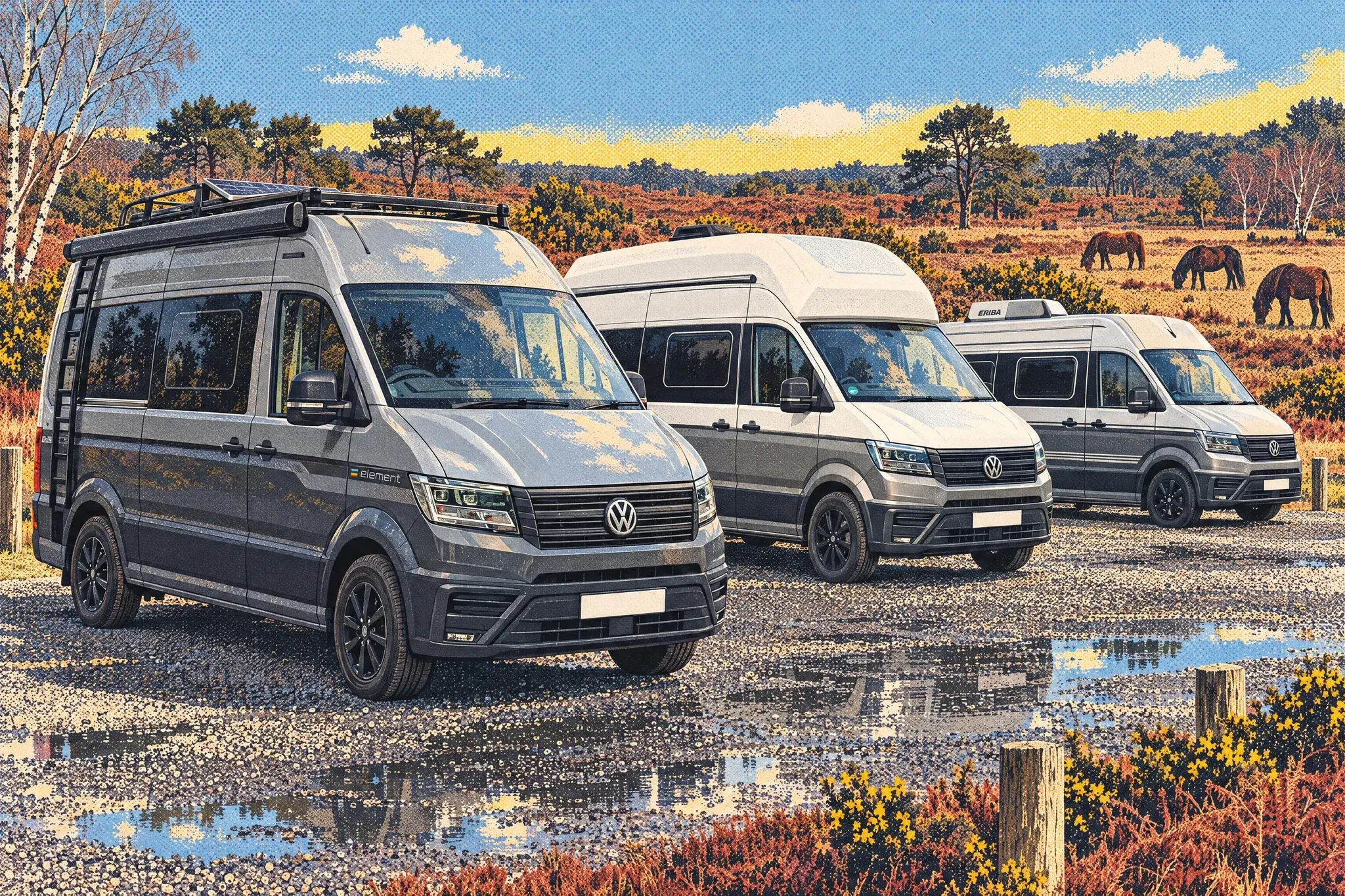
The Atom Element 600 G costs £68,260 on the road (as listed on 5 October 2026), with a 340Ah lithium battery, 3,000 W inverter, 200 W solar, roof rack and twin single beds over a large rear garage. It undercuts the Eriba Car 602 by about £6,250 and the VW Grand California 600 by nearly £16,000, but it is a two-seater with a manual gearbox and a shorter base-vehicle warranty than the VW.

Updated 6 October 2026: we have corrected the Grand California 600's drive options; in the UK, 4MOTION is offered on the 680 only.
The Atom Element 600 G is a six-metre VW Crafter campervan with two single beds over a big rear garage, a 340Ah lithium battery and a 3,000 W inverter, for £68,260 on the road. That is around £6,250 less than an Eriba Car 602 and nearly £16,000 less than a VW Grand California 600, the two obvious Crafter rivals. This piece sets out what you get for the money, what you give up, and who it genuinely suits. Every price here is as listed by its maker on 5 October 2026, so check before you sign anything.
What the Element 600 G is
Atom is a new UK campervan brand that sells direct to customers rather than through dealers, which is a big part of how it keeps prices down. It builds a small range of two-berth conversions on the VW Crafter, and the Element 600 G is the one Atom calls its expedition model.
The headline numbers, from Atom's own site and configurator:
- Price: £68,260 on the road, made up of £67,815 for the van plus £445 of charges. Atom's winter sale price at the time of writing is £66,315.
- Base vehicle: VW Crafter, front-wheel drive, 2.0 TDI, 140 PS with a six-speed manual as standard. The 177 PS engine is £2,652 and VW's automatic gearbox is £2,628.
- Size and weight: 5.986 m long, 3,500 kg maximum, with Atom quoting 2,810 kg in running order.
- Layout: two single beds at the rear, raised over a large garage. Two travel seats, two berths.
The "G" is for garage. Its sibling, the Element 600 B, swaps the garage for a rear lounge with facing benches and costs £665 more, so the two vans are really one van with two answers to the same question: do you want to carry things, or sit down?
The twin singles and the garage
Single beds over a garage is a layout most people associate with longer coachbuilt motorhomes, not six-metre panel vans. Fitting it into a Crafter means the beds sit high, which is what creates the storage space beneath. For two people it is a very practical way to live. Each person has their own bed, nobody climbs over anyone, and the garage swallows the kit that otherwise ends up on the floor: e-bikes, paddleboards, wetsuits, walking boots, a folding table and chairs, the levelling ramps and the hook-up lead.
There are two honest unknowns. Atom has not published the bed lengths, the garage dimensions or the fresh and waste tank capacities at the time of writing, and we are not going to guess. If you are tall, or you want to know whether a particular bike fits, measure it at a viewing with a tape in your hand. The overall height is also not listed, which matters for car parks and ferry pricing, and the Element's roof rack will add to it.
A garage layout is only as good as its payload. The space to carry things is the easy part; the legal weight to carry them is where buyers get caught out.
Payload: 690 kg on paper, less in practice
Atom lists the Element 600 G at 2,810 kg in running order against a 3,500 kg maximum, which leaves about 690 kg. For a six-metre van with this much kit already fitted, that is a reasonable figure. But treat it as the starting point of a sum, not the answer.
Mass in running order normally includes a driver allowance and most of a tank of fuel, and some makers also count gas and a travel fill of water, so ask Atom what its figure includes. It will not include the second person, food, clothes, bedding or anything in the garage. A rough tally for a typical two-person trip:
- Second traveller: 75 to 90 kg
- Fresh water: 1 kg per litre, so a full tank could be 80 to 100 kg depending on the size Atom has fitted
- Two e-bikes: 45 to 60 kg
- Gas, food, clothes, bedding, chairs, table, cables and tools: 100 to 150 kg without trying
That is 300 to 400 kg gone before you have put anything heavy on the roof rack or added the optional second solar panel. Fill the garage with a generator, tools, a second set of boards and a week's water, and the margin closes quickly. Our advice is simple: load it for a real trip, drive it to a public weighbridge, and get a printed ticket. It costs a few pounds and it tells you the truth about axle loads too, which the headline figure never does.
The off-grid kit, and what the numbers mean in use
This is where the Element earns its name. Standard fit includes a 340Ah lithium leisure battery, a 3,000 W inverter, a 200 W rigid solar panel (a second is £349), a roof rack with awning and ladder, Wi-Fi, a reversing camera, LED headlights, alloy wheels, an external BBQ point and cab blinds.
340Ah of lithium
At lithium's nominal 12.8 V, 340Ah is roughly 4.3 kWh of usable energy, and lithium lets you use nearly all of it without harm. For comparison, the 80Ah lithium battery the Eriba Car 602 lists as standard is about 1 kWh. In plain terms, the Atom carries around four times the stored energy. A compressor fridge, lights, water pump, phone and laptop charging might use 0.8 to 1.5 kWh a day depending on weather and habits, so the Atom has several days of ordinary living in the bank before the sun contributes anything.
The 3,000 W inverter
A 3,000 W inverter is big for a panel van. It will run a 2 kW kettle, a hair dryer, a small induction hob at a sensible setting, a coffee machine or a laptop charger without you thinking about it. Two cautions: a 3 kW fast-boil kettle is at the very edge, and high-draw appliances drain even a 340Ah battery faster than people expect. Ten minutes at 2 kW is about a third of a kilowatt-hour. It is still a long way from the nervous rationing you do with a small battery and no inverter.
200 W of solar
In British summer sun, a single 200 W panel might return 0.8 to 1.2 kWh on a good day and far less when it is grey. In winter it is a trickle. That is why the second panel at £349 is one of the cheapest useful options on the sheet if you plan to sit still for days. The Wi-Fi and the roof rack round out a van that is clearly aimed at people who park up somewhere remote and stay.
Within the Atom range: is the Element worth it over the Core?
Atom's Core 600 G is the same layout with a lighter specification, and it sits £6,320 below the Element at £61,940. The obvious question is whether you should buy the Core and add what you want.
On Atom's own option pricing, specifying a Core 600 G to match the Element costs about £7,000, and even then you cannot add the inverter or the roof rack, because they are not available on the Core. So the Element is slightly cheaper than a fully optioned Core and includes two of its most useful pieces of kit. If you want the off-grid capability, the Element is the sensible way in. If you mostly use campsites with hook-up and just want the layout, the Core is the honest saving.
The Element 600 B, at £665 more, replaces the garage with facing benches and a rear lounge. Pick it if you spend more time sitting in the van than hauling kit around. The G is the one to have if the kit is the reason you own a van in the first place.
Versus the VW Grand California 600
The Grand California 600 is the other Crafter campervan with a big name on the front, and it is built by Volkswagen itself. VW's UK site lists it at 5.98 m long, effectively the same length as the Atom, and it is a tall van at 2.97 m. The Grand California is automatic as standard, seats four, sleeps two with the option of four, and comes with a five-year VW warranty. 4MOTION all-wheel drive is offered on the longer 680, but not on the 600 in the UK. VW lists it from £84,208 on the road.
That is £15,948 more than the Atom. What does that money buy?
- Four travel seats. The Atom is strictly a two-seater. If you ever carry a third person, the conversation is over.
- Automatic gearbox as standard. Adding VW's automatic to the Atom costs £2,628, which narrows the gap to about £13,300.
- A five-year VW warranty on the whole vehicle, which is simpler than a split base-and-conversion cover.
- Factory-built finish and a dealer network for servicing, with the reassurance that implies.
- A fixed rear bed rather than twin singles, which some couples prefer and some do not.
- A published height. At 2.97 m you know exactly where you stand with car parks and barriers, which you cannot yet say for the Atom.
What the VW does not give you is the Atom's off-grid kit. A 340Ah lithium bank and a 3,000 W inverter are not part of the Grand California's standard story, nor is a roof rack with a ladder. If you want to go to Scotland in October and not see a hook-up for a week, the Atom's standard specification is simply better matched to that life. If you want the smoothest, most car-like six-metre camper with seats for four, the VW's extra money is spent on exactly that.
Versus the Eriba Car 602
The Eriba Car 602 is the other obvious Crafter rival at a similar price, but it pays to be clear about the layout. The 602 does not have beds over a garage. It uses a rear-lounge layout, which makes it a closer match for Atom's Element 600 B than for the 600 G. Eriba's Car 600 is the transverse-bed version of the same van. Twin single beds over a garage is genuinely unusual at six metres, and it is one of the things that sets the Atom G apart from both rivals in this piece.
On paper, the Car 602 is a VW Crafter 35 with 140 hp, 5.99 m long, and listed at £74,510. Eriba specifies an 80Ah lithium battery, diesel heating and no solar as standard, with a three-year warranty. Eriba lists its height as 2.70 m, and it can sleep up to four with the optional sleeping roof.
The Atom undercuts it by about £6,250 and carries roughly four times the battery capacity, plus 200 W of solar, which Eriba does not fit as standard, and a 3,000 W inverter. On raw off-grid numbers it is not close.
What Eriba adds is less easy to put in a table. The Car 602 is a distinctive, design-led van from a long-established maker with a proper dealer network and a mature spec sheet, and buyers know what they are getting on resale. The Atom is a new brand selling direct, with the advantages and the open questions that brings. If a rear lounge is what you are really after, the fairer fight is the Car 602 against the Element 600 B; if you want twin singles and somewhere to put the bikes, the Eriba is not answering the same question as the 600 G at all.
The Fiat-based alternatives
Two further vans are worth a glance for anyone not committed to a Crafter. Hymer's Yellowstone 600 is a Fiat-based van at £72,830 with an 80Ah lithium battery, so the same battery gap applies. Swift's Merlin 174, also Fiat-based with single beds, is closer on price at £67,190, but it is 6.36 m long, which is 37 cm more van to park and a different experience in a tight lane.
Warranty and buying direct
The Atom's cover is in two parts: two years from VW on the base vehicle, plus Atom's own three-year warranty on the conversion and three years of water-ingress cover. That compares with five years from VW across the whole Grand California, and three years on the Eriba. For the first two years the Atom is on a par; for years three to five the base vehicle is on you unless you buy extended cover.
Buying direct also means there is no local dealer to pop into. Ask Atom in writing how warranty work is handled, where habitation checks are done, and what the lead time is for parts specific to the conversion. The answers may be perfectly good, but you want them before you pay a deposit, not after.
Who the Element 600 G suits
This van makes most sense for a couple who already own the bikes, boards or boots, who want to park somewhere quiet for days at a time, and who would rather spend £68,000 on battery and storage than on a badge or a fourth seat. The twin singles and garage are a grown-up layout in a six-metre body, and the standard off-grid kit is well ahead of both Crafter rivals here, each of which costs more.
It is not the van for you if you ever need to carry more than two people. Atom has no four-seater yet, although Practical Motorhome reports the company is looking at four-berth models, so that may change. Nor is it the van if you want a factory-built vehicle with a single five-year warranty, a dealer round the corner and an automatic as standard; that is what the Grand California's extra £16,000 is for, and it is a fair price for people who value those things.
Before you buy, do three things: measure the beds and the garage, ask for the tank sizes and overall height in writing, and weigh the van loaded. Do that and the Element 600 G is a very honest amount of campervan for the money.
Common questions
How much does the Atom Element 600 G cost?
Atom lists it at £68,260 on the road, made up of £67,815 for the van plus £445 of charges, with a winter sale price of £66,315 at the time of writing (5 October 2026). The 177 PS engine adds £2,652 and VW's automatic gearbox adds £2,628.
How does the Atom Element 600 G compare in price with the VW Grand California 600 and Eriba Car 602?
VW lists the Grand California 600 from £84,208 and Eriba lists the Car 602 at £74,510, so the Atom is about £15,950 and £6,250 cheaper respectively. The VW adds four seats, an automatic and a five-year warranty; the Eriba adds an established dealer network but a much smaller 80Ah battery.
What off-grid equipment comes as standard on the Element 600 G?
A 340Ah lithium leisure battery, a 3,000 W inverter, a 200 W rigid solar panel, a roof rack with awning and ladder, Wi-Fi, a reversing camera and an external BBQ point. A second 200 W solar panel is a £349 option.
How much payload does the Atom Element 600 G have?
Atom quotes 2,810 kg in running order against a 3,500 kg maximum, leaving about 690 kg on paper. A second person, water, gas, food and a garage full of bikes can use 300 to 400 kg of that quickly, so weigh the loaded van at a public weighbridge.
Does the Atom Element 600 G seat four people?
No. It is a two-seat, two-berth van. Atom does not currently offer a four-seater, although Practical Motorhome reports the company is looking at four-berth models.
What warranty does the Atom Element 600 G have?
Two years from VW on the Crafter base vehicle, plus Atom's own three-year conversion warranty and three years of water-ingress cover. The VW Grand California carries a five-year VW warranty and the Eriba Car 602 a three-year warranty.
The reachable bit
The camper you fall for is rarely the one you can afford. That gap is the whole reason Campervan.win exists. Right now we’re giving away the Sunlight Vanlife, worth around £65,000, and closing that gap is the point: capped entries so the odds stay honest, £10 a ticket, a maximum of five per person, £500 to a UK charity from every full draw, the winner picked by a public randomness beacon anyone can re-check, and one person driving away in the van itself.

Enjoyed this post?
Get more honest campervan guides like this one in your inbox.
You’re in!
Check your inbox. We’ve just sent you a welcome email.

About the author
Iris
Iris writes travel guides, road trips, and park-up features, with a focus on slower UK touring, living space, and how campervans are used day to day.
Keep Reading
Related Reading
Thoughtful articles that build on what you’ve just read.
Campervan Buying Guides
10 min read
Swift Merlin 2027: nine layouts from £64,190 and how to pick the right one
Swift's all-new Merlin campervan arrives for 2027 with nine layouts on the Fiat Ducato panel van. We sort them into four families, work the payload sum on a four-seat version, and explain what the roof, the automatic and the prices mean for your choice.
Campervan Buying Guides
11 min read
Bailey Endeavour B68: the end-lounge Transit campervan where the pop-top costs 143 kg
Bailey's new Endeavour B68 puts a rear lounge in a 5.98 m Ford Transit campervan. We compare it with the B65 and B62, check the 1.86 m bed, and do the payload sums if you add the £7,500 pop-top.
Campervan Buying Guides
12 min read
New campervans under £60,000 for 2027: what the NEC shows and what the price leaves out
A fair look at the new 2027 campervans listed under £60,000 ahead of the Motorhome and Caravan Show at the NEC, with each price given as its maker words it, and the differences between ex-works, delivered and German-retail-based figures explained so you can compare real on-the-road totals.
Campervan Buying Guides
14 min read
Eura Mobil Vancona 2027: a €57,400 campervan with just 84 to 118 kg left for options
Eura Mobil's new Vancona is a well-equipped Fiat Ducato campervan from €57,400, but its 84 to 118 kg options allowance means you need to order it with the weight sheet open. We explain what the figure means, what the 4.25 t uprate costs you in licence terms, and which options to prioritise.