
Knaus Boxtime 600 ME (2027): twin singles in 6 m, and the payload figure to question

Written by
Iris
Iris writes travel guides, road trips, and park-up features, with a focus on slower UK touring, living space, and how campervans are used day to day.
The short answer
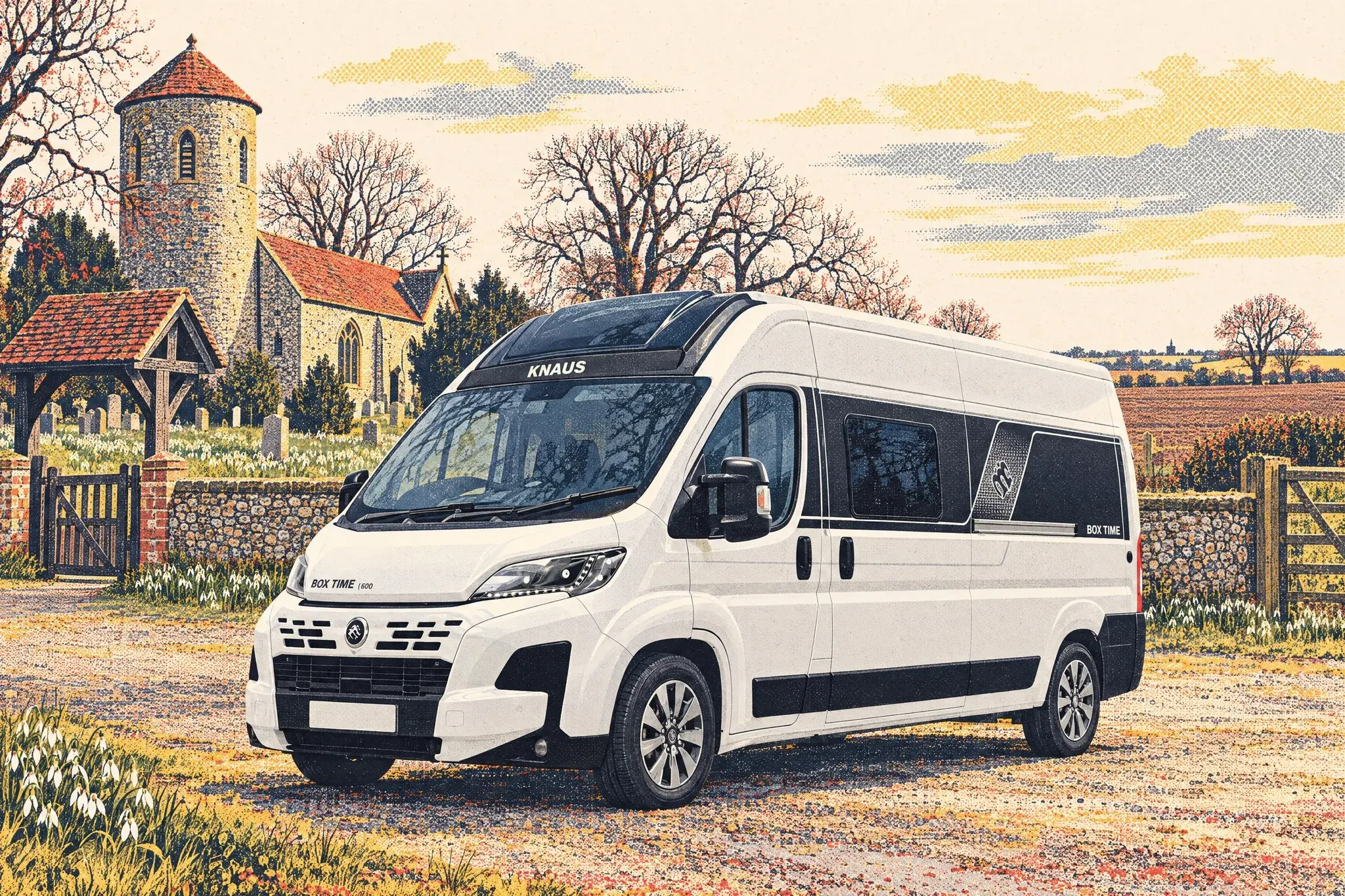
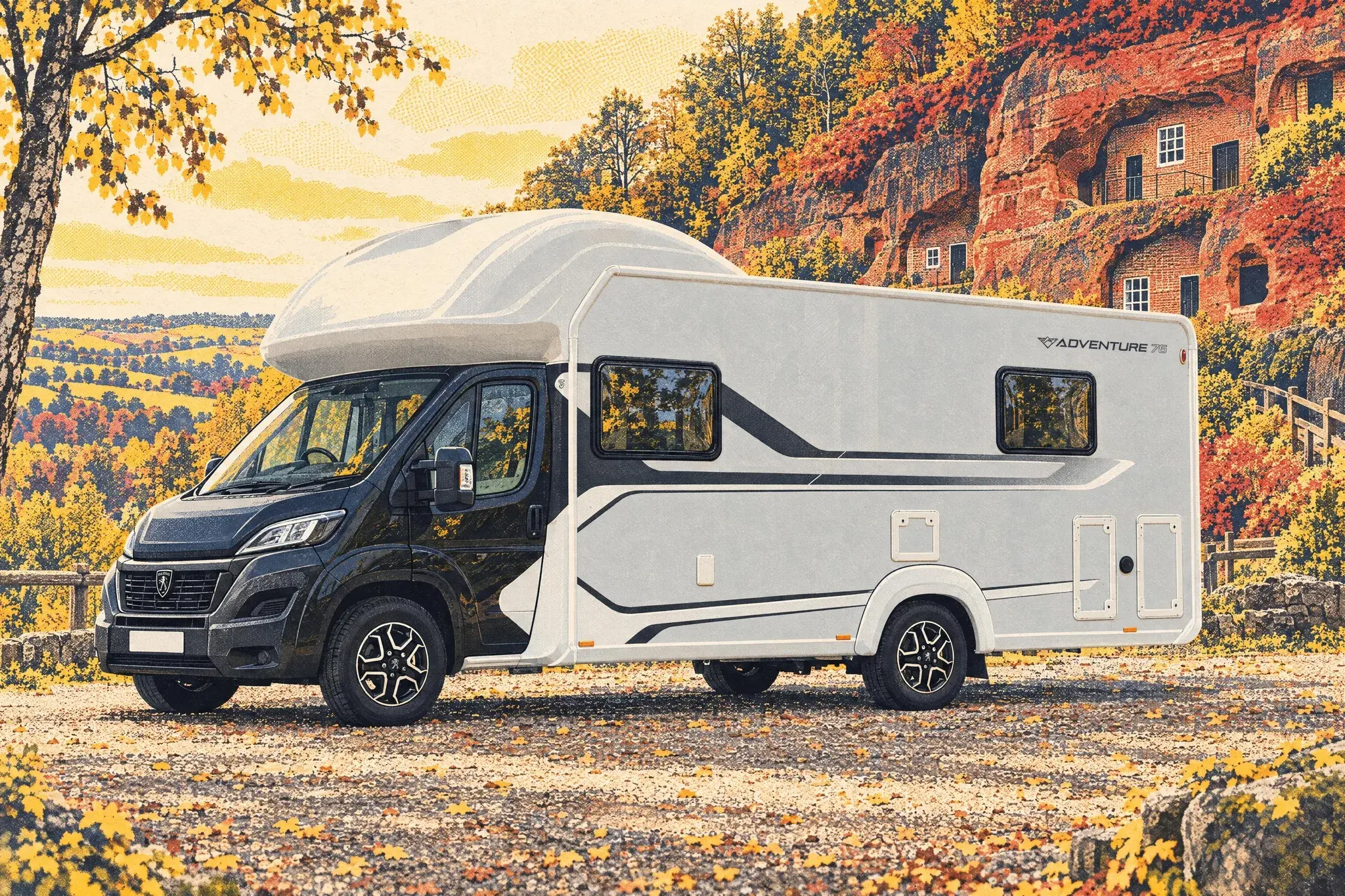
The Knaus Boxtime 600 ME (2027) is a 5.99 m, 3,500 kg campervan with lengthways twin single beds, listed by Knaus UK from £81,725 including VAT. Its declared running order of 2,820 kg leaves 680 kg before passengers, water and kit, but the UK page's 211 kg 'maximum payload' sits on the same line the German page labels as an options allowance (278 kg there), so ask Knaus or the dealer exactly what it covers.

Two single beds in a van under six metres long is a hard trick to pull off. Knaus's new Boxtime 600 ME does it, and at 3,500 kg it stays on a car licence. The price is from £81,725, and the number to ask about before you order is the 211 kg that Knaus's UK page calls 'maximum payload'.
What the Boxtime 600 ME is
The Boxtime is Knaus's lightweight campervan range, and the 600 ME is the new 2027 layout, shown at Caravan Salon Düsseldorf 2026 from 28 August to 6 September. In Knaus's layout codes, ME means lengthways single beds: two beds running front to back in the rear of the van, rather than one double across it.
Knaus's UK page (checked 6 October 2026) lists it from £81,725 including 20 per cent VAT, with registration, delivery and transport excluded unless stated, so the on-the-road figure will be higher. For that money the base is a Fiat with 103 kW (140 PS) and a manual gearbox. Dealer Harbour Creek lists a new 2027 Boxtime 600 MQ, a sister layout, on a Fiat Ducato chassis with 140 hp and an eight-speed automatic, so an automatic looks to be available in the range; ask whether it is offered on the 600 ME, and what it costs and weighs. Ask the dealer to confirm the UK van is right-hand drive before you get attached.
The headline figures from Knaus UK:
- Length 599 cm, width 205 cm, height 258 cm, wheelbase 403 cm
- Interior width 187 cm, interior height 190 cm
- Mass in running order 2,820 kg (range 2,679 to 2,961 kg), maximum 3,500 kg
- Two beds (up to five), two belted seats (up to four)
- Towing 2,500 kg
- 'Maximum payload' 211 kg
Roamworthy describes the 600 ME as a two-berth campervan of 5.99 m by 2.05 m by 2.58 m with a fixed twin-bed rear bedroom, which matches Knaus's own numbers. Knaus says the Boxtime's thermal and acoustic insulation gives a noticeably calm atmosphere inside, which is the kind of claim worth testing yourself at a show. Knaus is exhibiting at the Motorhome and Caravan Show at the NEC from 13 to 18 October 2026; ask whether the 600 ME is on the stand, because a brand being listed does not mean every layout travels.
What twin singles in six metres give a couple
Many vans of this length use a transverse double. It works, but the person on the inside climbs over the other to get out, and the bed width is capped by the van's inside width. Lengthways singles change the daily rhythm of the van.
Getting in and out
Each sleeper has their own side of the van and their own way out. Nobody is woken by a 3 am trip to the loo. Different bedtimes, different reading lights, one person who runs hot and one who runs cold: twin singles solve all of it without a word.
Two beds, up to five berths
Knaus lists two beds (up to five) and two belted seats (up to four). If you need to carry a third or fourth person, ask exactly which option adds the seats, which adds the berths, and what each weighs. More on why the weight matters below.
Living space in a 2.05 m body
The body is 205 cm wide. Inside, Knaus quotes 187 cm across and 190 cm of headroom. Someone around 6 ft (183 cm) stands upright with roughly 7 cm to spare; taller than that and you will want to stand in one at the NEC before you decide. The 2.58 m overall height is under the 3 m line at which a vehicle must display its height in the cab, but it is well above most car-park barriers, so the supermarket run needs planning like any high-top van.
What the UK page stops short of
The figures above are what Knaus's UK model page lists. For bed lengths, the heater, the fridge, tank capacities and the leisure battery, ask the dealer rather than assume. Ask for the bed dimensions in particular: with lengthways singles the length of each bed is the whole point, and a few centimetres decide whether a tall person sleeps straight or diagonally.
The 211 kg line that needs a question
Knaus's UK page labels 211 kg as 'Maximum payload'. The German page for the 88 kW (120 PS) version, at €70,450, gives 278 kg on the same line, labelled 'Maximale Masse der Zusatzausrüstung', which translates as the maximum mass of optional equipment. Those are two very different things.
The simple payload is the maximum laden weight minus the mass in running order: 3,500 kg minus 2,820 kg is 680 kg. An options allowance is something narrower. Under the EU type-approval rules, a maker must set aside a minimum pay-mass for the people and luggage the van is approved to carry (75 kg per belted seat, plus a luggage allowance based on the number of occupants and the length of the van). What is left after that is the budget for factory-fitted options, and that is what the German label describes. It is not what you, the owner, can load into the van.
The UK figure of 211 kg is lower than the German 278 kg, and it is worth asking the dealer why. What it does not tell you is whether 211 kg is the space left for options alone, or something closer to a real-world load figure. So ask Knaus or the dealer, in writing, exactly what the 211 kg covers and what has already been deducted to reach it. If the answer is 'options allowance', your working figure for people and kit is the 680 kg in the next section, less whatever options you tick.
A 'maximum payload' on a spec sheet is only useful once you know what has already been taken off it. Ask, and keep the answer with the order.
The weight sums for two people
The van figures below are Knaus's own; the packing weights are our illustrations. Where we have to assume a number for water, gas or kit, we say so; ask the dealer for the actual tank sizes.
The headline sum
Maximum 3,500 kg minus the declared running order of 2,820 kg leaves 680 kg. The running-order figure already includes a 75 kg driver, fuel at 90 per cent and whatever water and gas Knaus counts in its definition, so read Knaus's technical and legal notes before you add those again. If Knaus travels the fresh tank empty in running order, you add water in full; if it counts some, you add only the difference.
A realistic packing list for a couple
These are illustrative weights, not Knaus figures. Adjust them to your own gear.
- Second adult: 75 kg
- Fresh water, assuming an 80 litre fill: 80 kg (check the actual tank size and whether any is already counted)
- Gas, two full cylinders, roughly: 30 kg
- Clothes, bedding, food, pans, toiletries: 100 kg
- Chairs, table, levelling ramps, hook-up lead, tools and spares: 50 kg
- Two e-bikes and a rack: around 60 kg
That list comes to 395 kg. Against 680 kg, it leaves 285 kg. On the declared figure, then, a couple with e-bikes and a full tank is comfortably inside the plate before any factory options. So far, so good.
What the 2,679 to 2,961 kg range does to it
Knaus quotes the running order as 2,820 kg with a range of 2,679 to 2,961 kg. That is 141 kg either side, or five per cent of 2,820 kg each way, the tolerance the EU type-approval rules allow on a motor caravan's declared running-order mass. Your van may legitimately weigh anywhere in that band before you have ordered a single option.
- Light end, 2,679 kg: 3,500 minus 2,679 is 821 kg to play with. The 395 kg list leaves 426 kg.
- Declared, 2,820 kg: 680 kg. The list leaves 285 kg.
- Heavy end, 2,961 kg: 539 kg. The list leaves 144 kg.
The gap between the light and heavy ends is 282 kg. That is more than two e-bikes, a full water tank and a second adult (215 kg on our list), all swallowed by manufacturing variation you cannot see on the order form.
Now add options. If 211 kg really is the options allowance and you use all of it (whatever options Knaus offers; ask what each weighs), the heavy-end van has 539 minus 211, which is 328 kg left. The 395 kg packing list is then 67 kg over the 3,500 kg plate. The same options on the declared-weight van leave 680 minus 211, which is 469 kg, so the list fits with 74 kg spare. Two vans built to the same spec, one legal and one not, purely on tolerance.
Our advice: take the actual van to a weighbridge with the tanks and gas as you travel, before the first trip, and build your packing list from that number rather than from the brochure. And when you tick options, ask the dealer for the weight of each one so you know what you are spending.
Why 3,500 kg matters in the UK
Knaus plates the 600 ME at 3,500 kg, and in Britain that single number sets the licence and the tax.
Licence
A category B car licence covers a motor caravan with a maximum authorised mass of up to 3,500 kg, so anyone who passed their car test on or after 1 January 1997 can drive this van without C1. That is a big part of the appeal of a lightweight 6 m van with twin singles: it goes on an ordinary car (category B) licence. It can also tow a trailer of up to 3,500 kg MAM on category B, which comfortably covers Knaus's 2,500 kg towing figure, though a towbar and a loaded trailer's noseweight both come off that payload sum.
Speed limits
Motor caravan speed limits turn on unladen weight, never the plate. The dividing line is 3.05 tonnes (3,050 kg) unladen. Knaus's 2,820 kg is a running-order figure that already includes the driver and fuel, and unladen weight excludes both, so the 600 ME's unladen figure will be lower still and well under the line even at the 2,961 kg top of the range. Check the unladen weight on the V5C or certificate of conformity, and expect car limits: 30 mph in built-up areas in England, Scotland and Northern Ireland (20 mph on restricted roads in Wales), 60 mph on single carriageways, 70 mph on dual carriageways and motorways.
Tax, MOT and zones
At 3,500 kg or under, a motor caravan is taxed in class TC11: £375 a year for 2026 to 2027 if the engine is over 1,549 cc; check the engine size and fuel on the V5C. Check GOV.UK's motorhome tax rates for the live figure. The MOT is class 4 from three years old, whatever the weight. In London, a motor caravan at or under 3,500 kg falls under the ULEZ rather than the Low Emission Zone, which means Euro 6 for a diesel; a brand-new van should meet that, but put the registration into Transport for London's checker rather than assume. England's charging Clean Air Zones (Bath, Birmingham, Bradford, Bristol, Portsmouth, Sheffield and Tyneside) and Scotland's Low Emission Zones in Glasgow, Dundee, Aberdeen and Edinburgh each have their own vehicle classes, so use the official checkers for those too.
The sibling to compare it with
Knaus's camper van layouts page lists a Boxlife 600 ME (2027) alongside the Boxtime, with the same ME twin-single layout code and the same 600 length class. If the Boxtime's price or weight does not suit, that is the first van to put beside it on the configurator, comparing running order, payload lines and bed lengths like for like. A Facebook post on the Boxlife 600 ME Platinum Selection says prices start from £71,025 and gives a length of 5.99 m; a YouTube review lists a Fiat Ducato 3,500 kg chassis, a 2.2 litre Multijet (140 HP) engine and an eight-speed automatic; and Swiss listings site caravan24.ch gives a 599 cm overall length and a 3,500 kg permissible gross weight. Pull both technical data sheets and read the payload lines with the same questions in mind.
Questions to ask before you order
- What exactly does the 211 kg 'maximum payload' cover, and what has been deducted to reach it? Get it in writing.
- What does Knaus include in its 2,820 kg running-order figure: how much water, which gas cylinder, and anything else?
- What are the two bed lengths and widths?
- Which options add the extra belted seats and berths, and what does each weigh?
- What is the weight and price of every option you plan to tick, especially an awning, towbar, bike rack, battery upgrade and an automatic gearbox, if one is offered on the 600 ME?
- Is the UK van right-hand drive, and which heater, fridge, tanks and leisure battery does the UK specification carry?
- What are the registration, delivery and transport charges on top of £81,725?
- Can you weigh the actual van at handover, with tanks and gas as you will travel?
Bottom line
For a couple who tour properly, lengthways twin singles in a 5.99 m, 3,500 kg van is a useful combination, and the Boxtime 600 ME delivers it on a car licence with 190 cm of headroom. On Knaus's declared figures the weight sums work: 680 kg before options is enough for two adults, water, gas, e-bikes and a full wardrobe with room to spare. The caution is in the detail. A running-order range of 2,679 to 2,961 kg can move 282 kg of margin one way or the other, and a 'maximum payload' of 211 kg that reads as an options allowance on the German page is a line to question, not a limit to accept. Ask what it covers, weigh the van you are given, and the Boxtime 600 ME looks like a sound base for two.
Common questions
How much does the Knaus Boxtime 600 ME (2027) cost in the UK?
Knaus's UK page lists it from £81,725 including 20 per cent VAT, with registration, delivery and transport excluded unless stated, so the on-the-road price will be higher. The German page shows the 120 PS version at €70,450 including German VAT.
What does ME mean in the Knaus Boxtime 600 ME?
ME is Knaus's code for lengthways single beds: two beds running front to back in the rear of the van, rather than one transverse double. It lets each person get in and out of bed without climbing over the other.
How much can I carry in a Knaus Boxtime 600 ME?
Knaus quotes a maximum of 3,500 kg and a mass in running order of 2,820 kg, which leaves 680 kg before passengers, water, kit and options. The running order is quoted with a range of 2,679 to 2,961 kg, so the real figure for your van could be up to 141 kg either side, which is why a weighbridge visit is worth it.
Why does the UK page say 211 kg payload when the German page says 278 kg?
The German page labels that line as the maximum mass of optional equipment, an options allowance, not the full payload. The UK page labels 211 kg as maximum payload. Ask Knaus or the dealer exactly what the 211 kg covers and what has already been deducted to reach it.
Can I drive the Knaus Boxtime 600 ME on a car licence?
Yes. At a maximum authorised mass of 3,500 kg it is covered by a category B licence, including for drivers who passed their test on or after 1 January 1997. Category B also allows a trailer of up to 3,500 kg MAM, which covers Knaus's 2,500 kg towing figure.
Is the Knaus Boxtime 600 ME at the NEC show in October 2026?
Knaus is exhibiting at the Motorhome and Caravan Show at the NEC from 13 to 18 October 2026, but a brand being listed does not mean every layout is on its stand. Ask Knaus or the dealer whether the 600 ME is there before you travel.
The reachable bit
The camper you fall for is rarely the one you can afford. That gap is the whole reason Campervan.win exists. Right now we’re giving away the Sunlight Vanlife, worth around £65,000, and closing that gap is the point: capped entries so the odds stay honest, £10 a ticket, a maximum of five per person, £500 to a UK charity from every full draw, the winner picked by a public randomness beacon anyone can re-check, and one person driving away in the van itself.

Enjoyed this post?
Get more honest campervan guides like this one in your inbox.
You’re in!
Check your inbox. We’ve just sent you a welcome email.

About the author
Iris
Iris writes travel guides, road trips, and park-up features, with a focus on slower UK touring, living space, and how campervans are used day to day.
Keep Reading
Related Reading
Thoughtful articles that build on what you’ve just read.
New & Noteworthy
10 min read
Swift Carrera goes gas-free for 2027: 340Ah lithium, diesel heat and induction cooking
Swift has taken the gas out of its Carrera campervan for 2027, swapping bottles for a 340Ah lithium battery, diesel heating and an induction hob. Here is what that means across a real UK year, how it compares with the cheaper Merlin, and the one question to ask at the NEC.
New & Noteworthy
10 min read
British campervan converters at the NEC 2026: who builds on what, and for how much
A stand-by-stand map of the British campervan converters at the Motorhome and Caravan Show 2026: the vans they build on, their from-prices, seats, roofs and lead times, plus the four questions to put to every one of them.
New & Noteworthy
9 min read
Plug-in hybrid campervans at the NEC: what a PHEV gives you and why full EVs are rare
Four UK converters have hybrid campers at or around the Motorhome and Caravan Show this October, while fully electric campers remain scarce. Here is what a plug-in hybrid camper does well, what the sellers rarely tell you, and the questions to ask on the stand.
New & Noteworthy
13 min read
New for 2027 at the NEC: the motorhome and campervan debuts, hall by hall
A stand-by-stand tour of the motorhome and campervan debuts at the October 2026 NEC show, with hall numbers, prices, base vehicles and the one thing to check on each.