
VW Grand California 600 Dune deep dive: everything UK buyers need to know before ordering one

Written by
Martha
Martha writes about interiors, ownership stories, and the everyday realities of campervan life, with a focus on comfort, cost, and how vans are used over time.
The short answer
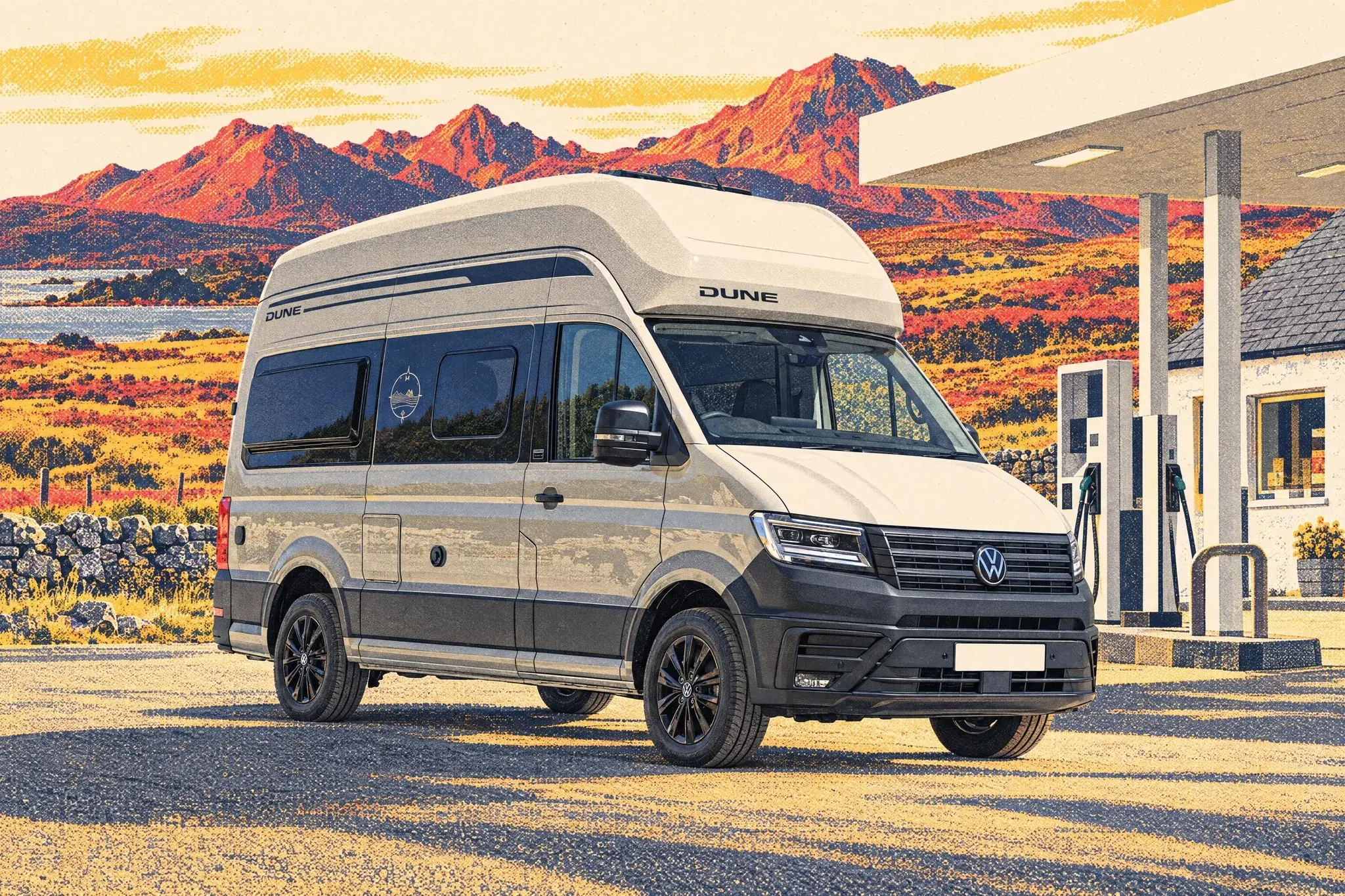
The VW Grand California 600 Dune is a six-metre, Crafter-based campervan with a fixed rear double, a wet room, four belted seats and a 163 PS diesel automatic. On VW's 30 September 2026 UK price list it costs £85,408 on the road at 3.5 tonnes, or £86,080 at 3.88 tonnes, which needs a C1 licence if you passed your car test on or after 1 January 1997. Payload at 3.5 tonnes is just 397 kg, so do the sums before ordering.

The Volkswagen Grand California 600 Dune is a six-metre campervan with a proper bathroom, a fixed double bed, four belted seats and a factory warranty, and in the UK it costs a little over £85,000 on the road. That is a lot of money for a van, and it buys a very specific thing. This is the long version: what it is, what it weighs, what it will really do to the gallon, where the sums get tight, and what to look at before you sign. We have kept the options to the ones that genuinely change the 600, because separate pieces cover the 680 Dune and the full option list, and we have dated every price.
What the Grand California 600 Dune actually is
Start with the basics, because the name hides a few of them. The Grand California is Volkswagen's factory-built campervan on the Crafter platform, which is VW's large van. The 600 is the shorter of the two bodies, at 5,986 mm long, and the 680 is the longer one. Both are panel van conversions, so they keep the Crafter's own steel body and its 2,040 mm width. That matters, because it means the Grand California is no wider than a big SUV, where many coachbuilt motorhomes of similar length are 2.2 m or more across.
The 600 and 680 differ in more than length. The 600 gets a raised GRP camping roof with an alcove over the cab, which lifts standing height inside to around 2.18 to 2.20 m. The 680 uses the Crafter's own high roof and is lower inside. That raised roof is also why the 600 can take the optional over-cab bed, which the 680 cannot. We will come to the bed, and to the reason your head may meet the bulkhead above the cab, later.
'Dune' is a trim package rather than a different van. In the UK it brings a single colour, Ascot Grey, with Dune decals on the front, sides and rear, black bumpers, 17-inch gloss black Lismore alloys, LED headlights with LED daytime running lights, automatic lights, Climatronic air conditioning in the cab, a rear camera and ambient lighting. The living area, the chassis and the engine are the same as the standard Grand California 600.
Where is it built? VW Austria's importer gives the plant as Volkswagen's Września factory in Poland, which is where the Crafter itself comes from. Some UK reviews say Hannover, which is the home of the smaller California. Either way, it is a Volkswagen-built vehicle with a Volkswagen warranty, sold and serviced through the Van Centre network rather than a motorhome dealer.
UK prices, dated, and how the Dune compares with the standard 600
Volkswagen UK's price list, issue dated 30 September 2026, gives these on-the-road prices:
- Grand California 600 Dune, 3,500 kg gross weight: £85,408
- Grand California 600 Dune, 3,880 kg gross weight: £86,080
The standard, non-Dune 600 is £1,200 less in each case. So the Dune costs £1,200 over the plain van, and the items it bundles would cost £2,256 if you ticked them individually on the standard 600. On paper, that is £1,056 of kit for free. The catch is paint. The Dune comes in Ascot Grey and nothing else, and it cannot be ordered with metallic or two-tone paint. If you had your heart set on a particular colour, the standard van is the only route, and you pay for the kit separately.
Earlier estimates, including our own before the official list arrived, put the UK Dune in the low-to-mid £90,000s. The actual list price came in lower than that. Prices move, so treat these as a snapshot of autumn 2026 and check the current list before you order.
The 3.88-tonne version is £672 more than the 3.5-tonne one. That small sum buys a very large difference in payload, and it also changes who is allowed to drive it. We will go through both carefully, because it is the single most important decision on the order form.
One more thing on the order form. The UK configurator (checked 6 October 2026) and price list give the 600 as front-wheel drive only. VW UK states that 4MOTION all-wheel drive is 'Only available with 680 model'. Germany does sell a 600 4MOTION, and you will see it in overseas videos, but at the time of writing you cannot order one here. If four-wheel drive is essential, the 680 Dune is the UK answer, and that is a different article.
Engine, gearbox and what it is like to drive
Every UK Grand California gets the same engine: a 2.0-litre TDI diesel making 163 PS (120 kW) at 3,600 rpm and 410 Nm of torque between 1,500 and 2,000 rpm, meeting Euro 6e. It drives the front wheels through an eight-speed automatic. There is no manual option listed. Earlier Grand Californias had a 177 PS version of this engine, so the current van is slightly down on peak power. In a vehicle this heavy, torque matters far more than the headline figure, and 410 Nm from just above idle is what gets three tonnes moving.
The fuel tank holds 75 litres and there is an 18-litre AdBlue tank, which is on the small side for a diesel that will be driven a long way, so expect to top up AdBlue between services rather than leaving it to the dealer.
What follows is review opinion, and we label it as such because driving impressions are personal. Parkers and carwow both praise the ride and describe the gearbox as excellent, which chimes with the reputation of this transmission in the Crafter. Parkers says the van feels a little top-heavy, and What Car? and Practical Motorhome both found it pushed about by crosswinds. Given it is nearly three metres tall and six metres long with a high roof made of GRP, that is no surprise, and it is worth remembering on the M6 on a windy day or crossing the Severn bridge. What Car? found it hesitant pulling away, which is a common trait of heavy diesels with automatic boxes managing a lot of mass from rest. carwow notes that front-wheel drive can get stuck on a wet field, which is a UK campsite reality rather than a flaw unique to this van. Any front-driven motorhome with its weight over the rear axle will spin its front wheels on wet grass. Carry grip mats, and read the pitch before you drive onto it.
Two more review grumbles are worth passing on. Parkers found that the kitchen worktop extension slid out while driving, and reported flimsy locker catches. Climate controls live only on the touchscreen, which several reviewers disliked. These are the kind of things you can check on a test drive, and we have put them in the viewing checklist at the end.
Fuel economy and range: what to actually expect
Volkswagen UK had not published an official fuel economy figure for the current engine at the time of writing; the brochure says it is 'yet to be confirmed'. So we are relying on what reviewers measured, and they are reasonably consistent.
- Parkers: 26 to 27 mpg in town, and over 32 mpg at a steady 65 mph.
- What Car?: 26 mpg overall.
- Practical Motorhome: about 30 mpg on motorways.
Put those together and a sensible planning figure for mixed UK touring is 26 to 30 mpg, with low thirties possible if you sit at 65 mph and keep the right foot calm. Speed is the big variable with a tall van: the difference between 60 and 70 mph is far larger than it would be in a car because of the frontal area.
Range follows from the 75-litre tank. That is about 16.5 UK gallons, so at 26 mpg you have roughly 430 miles, and at 32 mpg roughly 530 miles. In practice you will fill up well before the light comes on, so call it 350 to 450 miles between stops. For a van that encourages long drives to the far corners of Scotland, that is comfortable.
Diesel cost is the running-cost line that scales with how much you tour. At 28 mpg, every 1,000 miles uses about 36 gallons, or around 162 litres. Multiply by the price at your local forecourt and you have your touring fuel budget. There is no hybrid or electric Grand California, and nothing announced for the UK, so this is a diesel for the foreseeable.
Size: will it fit on your drive, in a car park and on a ferry?
The exact VW figures for the 600 are worth writing down, because they decide whether this van fits your life:
- Length: 5,986 mm
- Width: 2,040 mm body, 2,410 mm including mirrors
- Height: 2,970 mm (VW press data gives 2,971 to 3,094 mm depending on specification; VW Austria quotes about 3.06 m with a roof air conditioner fitted)
- Wheelbase: 3,640 mm
- Ground clearance: 210 mm
- Turning circle: 13.6 m according to VW UK (ADAC measured 14.2 m)
Length first. At a shade under six metres, the 600 slips under a threshold that matters in several places. Many ferry operators price by length band, and six metres is a common step. Some campsites and caravan club pitches have length limits, and some residential parking rules do too. If you have a six-metre allowance anywhere in your life, the 600 just makes it, whereas the 680 does not.
Width is the easy part. Two metres four is a large van, but it is no wider than the Crafter it is built on, so it goes anywhere a delivery van goes. Add the mirrors and you are at 2.41 m, which is the number that matters for width restrictions and tight lanes with stone walls on both sides. Fold the mirrors before you squeeze through a Cornish village.
Height is the one to respect. At 2.97 m, and more with options, you will not be going under any height barrier. Supermarket and retail park barriers are commonly set around 2.1 m. Multi-storey car parks are out. Some rural railway bridges and arches are marked under three metres, so get into the habit of reading every height sign and put the van's real height on a sticker on the dashboard, including anything you add to the roof. The 210 mm ground clearance is generous, which helps with campsite ruts and kerbs, but it does not change the fact that this is a tall, front-wheel-drive van rather than an off-roader.
The turning circle of 13.6 m is respectable for the length, and the eight-speed automatic plus rear camera make reversing into a pitch straightforward. Just be aware that ADAC's measured figure is a touch larger, so allow a little more room than the brochure suggests on a tight turn.
Standing height inside
The raised GRP roof gives 2.18 to 2.20 m of headroom in the living area. Six-footers stand up straight with room to spare. The one spot to watch is the alcove over the cab, where several reviewers banged their heads on the bulkhead when moving forward between the living area and the cab seats. Once you learn where it is, you duck without thinking, but it is a real thing on a first viewing.
Weights and payload: the sums that decide everything
This is the part of the article to read twice. Volkswagen gives the following for the 600:
- Kerb weight: 3,028 kg at 3.5 tonnes, or 3,031 kg at 3.88 tonnes, measured with the fuel tank 90 per cent full
- Payload: 397 kg at 3.5 tonnes, or 774 kg at 3.88 tonnes
- Axle limits (3.5-tonne version): 2,100 kg front, 2,100 kg rear
VW's payload figure already allows for a 75 kg driver, which is a kinder way of quoting it than some makers use. So the 397 kg is what you can add on top of the van, a tank of diesel and one 75 kg person at the wheel.
Now put a family in it. Three more people at 75 kg each is 225 kg. That leaves 172 kg for everything else: fresh water, gas, food, clothes, bikes, the awning, the camping chairs, the dog, and every option you ticked on the order form. Fill the 110-litre fresh water tank and you have used 110 kg of your 172 kg. You are now at 62 kg for the lot, and you have not put a gas bottle in yet.
That is not a theoretical problem. Overloading is a construction and use offence, it can invalidate insurance, and DVSA does check motorhomes at the roadside. Being over the plated weight is also a safety problem on a tall van that reviewers already describe as top-heavy. The usual real-world fix for a 3.5-tonne Grand California with four people in it is to travel with a part-full water tank and fill up at the site, which is what most experienced owners do anyway. But you need to know you are making that trade.
Options matter here too. Every option adds mass, and VW's payload figure is for the base van. The over-cab bed, the Off Grid Package with its extra battery and solar panel, a roof air conditioner, a towbar: each one comes straight off your 397 kg. Parkers put it bluntly: at 3.5 tonnes 'you'll be limited in your options choices'. We would go further and say that if you want the 600 with four people, water and a couple of options, the 3.5-tonne version is the wrong one unless you are disciplined about what goes in it.
Two people change the picture. A couple at 75 kg each uses 75 kg of payload beyond the driver allowance, leaving 322 kg for water, gas, kit and options. That is workable, and it is why the 3.5-tonne 600 suits couples far better than families.
The 3.88-tonne fix and the licence it needs
Volkswagen's answer to the payload problem is the 3.88-tonne version. It is the same van with the same 3,031 kg kerb weight, plated to a higher gross weight, and it costs £672 more on the September 2026 price list. Payload rises from 397 kg to 774 kg. Run the family sum again: four people, with three passengers at 75 kg, leaves 549 kg for water, gas, kit and options. That is a van you can actually fill with water and load for a fortnight without a spreadsheet.
The cost is not the £672. The cost is the driving licence. In the UK, a standard car licence (category B) covers vehicles up to 3,500 kg maximum authorised mass. Anything heavier needs category C1, which covers 3,500 to 7,500 kg. If you passed your car test before 1 January 1997, you were given C1 automatically, so the 3.88-tonne van is open to you with no further action, though you will need a medical to keep C1 when you renew your licence at 70. If you passed your car test on or after 1 January 1997, you do not have C1 and the 3.88-tonne Grand California is not legal for you to drive until you get it.
Getting C1 means a medical examination, a provisional entitlement added to your licence, a theory test and a practical test, usually with a few days of training in between. The course and tests typically run to several hundred pounds and can go past a thousand once training is included, and it takes days of your time. Plenty of people do it specifically for a motorhome, and the test itself is not a monster, but it is a real hurdle, and it applies to every driver you want to put on the insurance, not just the main one. If your partner passed after 1997 and wants to share the driving, that is two courses.
There is a towing wrinkle as well. On a C1 alone, you can tow a trailer up to 750 kg. For anything heavier behind the 3.88-tonne van you need C1+E. On a standard car licence with the 3.5-tonne van, current rules allow you to tow a trailer up to the van's own 2,500 kg braked limit, provided you stay within the van's own towing and nose weight limits.
So the decision tree is simple. Pre-1997 licence, or willing to take the C1 test: order the 3.88-tonne van, it is better in every practical way for £672. Post-1997 licence and no appetite for the test: order the 3.5-tonne van, keep the option list short, and manage your water.
Speed limits, towing and the no-roof-load rule
Speed limits for motorhomes in Great Britain depend on unladen weight. GOV.UK sets lower limits for motor caravans over 3.05 tonnes maximum unladen weight: 50 mph on single carriageways and 60 mph on dual carriageways, with 70 mph still allowed on motorways. Under 3.05 tonnes unladen, the limits are the same as a car.
Where does the Grand California 600 sit? VW's kerb weight of 3,028 kg includes 90 per cent of a 75-litre fuel tank, which is around 55 to 60 kg of diesel, and unladen weight for the speed limit rules is defined differently from a maker's kerb weight. The numbers are close enough that we are not going to tell you which side of the line your van falls on. Check the unladen weight on your own documents and, if you are still unsure, weigh the van empty at a public weighbridge. Do not assume either way, because a 10 mph difference on an A-road is the kind of thing a camera notices.
Towing limits are generous for a van this size. Braked towing is 2,500 kg at 3.5 tonnes and 2,000 kg at 3.88 tonnes, with 750 kg unbraked and a 100 kg nose weight limit. A small car on an A-frame or a trailer with a couple of motorbikes is well within reach, subject to the licence rules above. Note that the heavier-plated van has the lower towing limit, which catches people out.
And one hard rule: VW allows no roof load on the Grand California 600. That GRP camping roof is a living space ceiling, not a rack. If you were planning to carry kayaks or a roof box up there, this is not the van, and you will need a rear carrier or a trailer instead.
The cab, the seats and travelling four-up
Up front, the Grand California is a Crafter with better seats. Both cab seats swivel to face the living area, and they are the two best seats in the van for an evening. Every UK Grand California gets a digital cockpit, keyless entry, an alarm and a full set of driver assistance: adaptive cruise control, Front Assist autonomous emergency braking, Lane Keeping, blind-spot monitoring, and front and rear parking sensors. The Dune adds the rear camera and Climatronic. For a vehicle that spends hours at a time on motorways, adaptive cruise and blind-spot monitoring are the two systems you will value most, and they are standard.
Behind the cab is a rear bench with two three-point seat belts and Isofix mountings, giving four belted seats in total. This is where honest expectation management matters. Both Parkers and Practical Motorhome describe the bench as narrow. It is fine for two children, or two adults on a short hop, but two large adults on a five-hour run will not love it. The seating position is also relatively upright, as it needs to be to clear the kitchen alongside. If you are planning to travel four adults regularly, sit in the back for ten minutes at the viewing before you decide.
The living area is heated and ventilated from the cab on the move, and the swivel seats, bench and table make a four-person dining and lounging space when parked. A six-metre van with a wet room and a fixed bed does not have a huge lounge, so a lot of the Grand California's charm comes from the sliding door being open and the awning being out. In a British summer that works a great deal of the time. In a British November it works less often, which is why we spend a whole section on heating further down.
The rear bed: size, comfort and the body bulges
The main bed is a fixed transverse double across the back of the van, so you sleep side to side rather than front to back. VW quotes it at 1.93 m by 1.36 m, give or take 3.5 cm, which in old money is a bed about 6 ft 4 in long and 4 ft 6 in wide, roughly a standard UK double in width and slightly longer than most. The length is helped by moulded bulges in the body sides at mattress level, which carwow highlights as the trick that makes a crosswise double work in a 2.04 m wide van.
Does a tall adult fit? The reviews split, and we report them as opinion. Parkers found that taller adults may need to curl up a little. What Car? felt that people over six feet would struggle. Practical Motorhome says six-footers fit. Our reading is that the headline 1.93 m is the mattress between the bulges at its widest point, and that where your head and feet actually land depends on how you lie and how much the side cushions intrude. If you are over six feet, lie on it at the viewing with your shoes off and your head where you would really put it, not in the middle of the showroom conversation.
Being fixed, the bed never needs making up, which is the single biggest day-to-day advantage this van has over a pop-top camper. The space under it is the van's main storage, reached from the rear doors as a boot-like garage, with room for folding bikes, an awning, chairs and luggage. Remember every kilogram of it counts against the payload.
The over-cab bed: option 7N6, £2,754, 600 only
Because the 600 has the raised camping roof with an alcove over the cab, it can be ordered with a second bed up there. On VW's September 2026 UK price list, option 7N6 costs £2,754, and it is only available on the 600, not the 680.
The bed is L-shaped: 1.60 m by 1.22 m on the left and 1.90 m by 1.22 m on the right, with a maximum load of 150 kg. Volkswagen describes it as 'space for two children', and that is the honest way to think of it. There is a 0.70 m by 0.85 m skylight above it, a ladder, and two reading lights. Children love it, and it turns the 600 into a genuine four-berth with every sleeping space fixed, so nothing needs making up at night. That is a rare thing in a six-metre van.
The cost is not only money. Practical Motorhome points out that with the over-cab bed folded down, adults cannot stand up in the lounge, so the van needs to go into night mode in a fairly fixed order: adults finished in the living area, then the bed comes down and the children go up. Parkers notes that without the option, the alcove is a large storage shelf, which is how many owners prefer to use it. Top Gear's verdict on the option was that 'a tent for the kids would be cheaper', which is true, though a tent does not help in February.
Our view: if you have two children under about twelve and plan to tour as a four, the over-cab bed is the thing that makes the 600 work for you, and £2,754 is reasonable for a factory-fitted third and fourth berth to match the four belted seats. If you are a couple, skip it and enjoy the storage. If you have teenagers, measure them against 1.60 m and 1.90 m and be realistic about how long the arrangement has left. And whichever you choose, remember the option's weight comes off your payload, which is one more nudge towards the 3.88-tonne van for families.
The kitchen: what you get and what you do not
The galley runs along the side of the van opposite the sliding door. You get a 0.98 m worktop with two fold-out extensions, a two-burner gas hob, a sink, and a 70-litre pull-out compressor fridge with a freezer compartment. There is no oven and no grill, which is normal for a van this size and this layout, and which some British buyers consider a deal-breaker. If you cannot live without an oven, you will be looking at a portable countertop one that runs on hook-up, or a different van.
The fridge is a drawer unit and it pulls out far enough that VW says you can reach it from outside with the sliding door open. That is a lovely idea on a sunny evening by the awning. It is less lovely in the UK, for a reason we will explain in the sliding door section below.
A 0.98 m worktop is short, which is why the two extensions exist. Reviewers liked the extra space but Parkers found one of the extensions slid out on its own while driving. That is exactly the kind of thing to test at the viewing: push the extensions in, give them a shove, and ask how they latch. The locker catches have also been described as flimsy, so open and close every one with the same question in mind.
The two-burner hob is gas, and it stays gas even if you choose the diesel heating option. Compressor fridges are the right choice for a van that will spend time off hook-up, because they do not need gas or level ground and they work properly in warm weather, but they draw from the leisure battery continuously, which is the other reason the power section below matters.
The wet room: a real bathroom in six metres
The thing that separates the Grand California from a pop-top camper is the bathroom. The 600 has a wet room of 0.82 m by 0.82 m behind the kitchen, with a Thetford cassette toilet, a basin whose tap pulls out on a hose to become the shower, and two floor drains so the water gets away whichever way the van is leaning.
Eighty-two centimetres square is compact. You can shower in it and you can use the loo in it, and you will touch the walls doing either. But it is a proper room with a door, which for many people is the difference between a weekend camper and a van they will actually live in for a fortnight. The cassette toilet empties through an outside hatch at any chemical disposal point, and the Thetford system is the industry standard, so spares and the right fluids are everywhere.
Hot water for the shower comes from the 10-litre tank in the heater, which is enough for a quick, sensible shower and not enough for a long one. It reheats fairly quickly on gas or mains, so two people showering in sequence is a wait-a-bit arrangement rather than a problem.
Heating, water and four seasons in the UK
The Grand California is sold as a year-round van, and the spec supports that, with some caveats that apply to any campervan in a British winter.
Water: 110 litres of fresh water in a tank VW describes as frost-protected, and a 90-litre waste tank. Ask at the viewing whether the waste tank and its pipework are protected too, because that is where motorhomes usually freeze first, and VW's UK material does not spell it out. A common winter habit is to leave the waste tap open over a bucket so nothing sits in the tank overnight.
Heating: a combined 6 kW water and air heater that runs on gas or mains electricity and holds 10 litres of hot water. Practical Motorhome identifies it as a Truma unit, which is reassuring, because Truma service agents are widespread in the UK. Six kilowatts is plenty for a six-metre van, and blown air through ducts keeps the floor and the bathroom warm rather than just the lounge. For £720, option 6J1 changes the heater to run on diesel and mains instead of gas and mains. The hob stays on gas, so you still carry a bottle, but you are no longer burning it for heat.
Our honest view on that option for UK use: if you will use the van in winter, especially off hook-up, the diesel heater is the better choice. Gas is fine on a campsite with electric hook-up, where you can run the heater on mains anyway. Off-grid in January, a gas heater can empty a bottle in a few cold nights, and finding a refill or exchange on a Sunday in the Highlands is not fun. Diesel heat draws from the 75-litre fuel tank, which you refill at every petrol station in the country. The trade-offs are the £720, slightly more noise at the pump, and an additional electrical draw for the fan, which brings us to the battery. If you are a summer-and-shoulder-season camper who mostly uses hook-up, the standard gas heater is perfectly good and £720 cheaper.
Cab air conditioning is standard on the Dune (Climatronic). Cooling the living area needs the optional roof air conditioner, which adds height to around 3.06 m and takes payload, and is covered in the options article. In most British summers you will not miss it. In a heatwave on a Cornish pitch with no shade you might.
Power: the standard battery, the Off Grid Package and what they really give you
The standard leisure battery is a single 12 V AGM unit of 92 Ah, of which about 46 Ah is usable before you start shortening its life, according to New Atlas. That is roughly 550 watt-hours. A compressor fridge running round the clock, LED lights, the water pump, the heater fan and two phones on charge will use a meaningful chunk of that overnight. Our view is that the standard battery is comfortable for a night off hook-up and a frugal second night, and that it is really designed around a van that moves most days and plugs in most nights, which is how the Crafter's alternator keeps it topped up.
The Off Grid Package, £1,740 on the September 2026 UK price list, replaces the AGM with two 40 Ah lithium iron phosphate (LiFePO4) batteries, giving about 64 Ah usable, and adds a solar panel on the roof. VW's UK brochure quotes the panel at 104 W; the configurator says 110 W. Either way it is a modest single panel. Lithium batteries can be run much deeper than AGM without harm, charge faster and weigh less, so the usable capacity rises by around 40 per cent even though the nameplate figure falls. The solar panel will put a useful amount back in on a long summer day and very little in December.
What that means in practice: with the Off Grid Package, two or three nights off hook-up in summer is realistic if you are sensible, and the panel keeps the fridge alive while the van sits on your drive. Without it, plan on hook-up or daily driving. If you are a festival, wild-camping or Scottish-lay-by sort of tourer, the £1,740 is well spent. If you are a campsite-with-hook-up person, keep the money.
There are four 230 V sockets in the van, live when on hook-up. Everything, heating, water levels, battery state and lighting, is controlled from a 5-inch touchscreen in the living area and from the California app on your phone, which lets you warm the van up before you walk back to it on a cold evening. The same touchscreen is where the climate controls live, which reviewers found fiddly on the move. It is a small complaint, but a persistent one.
The sliding door is on the driver's side: what that means in the UK
This is a detail that surprises people at the showroom, so it deserves its own section. VW UK's specification lists a 'Manual side sliding door on driver's side'. In a right-hand-drive van, that puts the sliding door on the offside, the right-hand side of the vehicle. When you park on the left of a British road, the door opens onto the road, not the pavement.
The likely reason is that the Grand California's interior was designed around a left-hand-drive van, where the sliding door on the passenger side faces the pavement. The layout is not flipped for the UK, so the door stays on the same side of the van and ends up on the road side here. Practical Motorhome says plainly that the layout is not handed for the UK. carwow's write-up suggests otherwise, so we are flagging the disagreement; the VW UK spec line is the strongest source we have, and it says driver's side.
Does it matter? On a campsite pitch, not at all, because you choose which way you park and the awning is on the door side. For the reach-in fridge drawer and the fold-out table, you set up on the door side and it is fine. On a street, in a lay-by or on a seafront, it matters a bit: you step out into the carriageway rather than onto the kerb, and children in the back do the same. It is not a safety issue if you are paying attention, but it is a habit to build. Check it on the actual van at your viewing rather than taking anyone's word for it, including ours, because specifications can change between model years.
The Dune package and the kit every UK Grand California gets
To restate the Dune list in one place, for the UK: Ascot Grey paint as the only colour, Dune decals front, sides and rear, black bumpers, 17-inch gloss black Lismore alloy wheels, LED headlights with LED daytime running lights, automatic headlights, Climatronic cab air conditioning, a rear-view camera and ambient interior lighting. On the standard van those items total £2,256 as options, and the Dune premium is £1,200.
What you give up is any paint choice, and the ability to specify metallic or two-tone finishes. Ascot Grey with black bumpers and black wheels is a handsome combination, but it is the only one. Decals can be removed if you tire of them, though removing factory graphics is a careful job and worth asking a detailer about rather than attacking with a hairdryer.
Standard on every UK Grand California, Dune or not: adaptive cruise control, Front Assist, Lane Keeping, blind-spot monitoring, front and rear parking sensors, keyless entry, an alarm, and a digital instrument cluster. That is a strong safety and convenience list for a van, and it means the Dune premium is purely about style and the camera, climate and lighting items, not about safety kit you would otherwise miss.
Reliability, recalls and the warranty
The Grand California has been on sale since 2019, so there is a track record. On the mechanical side it is a Crafter, which is a high-volume commercial vehicle with a parts and service network to match. The 2.0 TDI and eight-speed automatic are proven in daily fleet use. That does not make it immune to faults, but it does mean any VW Van Centre can work on the running gear, and the camping systems use mainstream suppliers such as Truma and Thetford.
Recalls are public record and worth knowing. Parkers counts two UK safety recalls for the Grand California, both relating to early window installations. One of them, recall reference R/2022/178, covered 115 vans whose roof window cover could come loose, as reported by Van Life Matters. Those were early builds, and recalls on a factory campervan are a sign the system works rather than a reason to panic. If you are buying a used Grand California, enter the registration into the GOV.UK recall checker and ask the seller for evidence that the work was done.
Warranty and aftercare is where Volkswagen's offer is strong. The 5 Plus Promise on the Grand California gives five years or 124,000 miles of cover, five services, three MOTs and five years of AA breakdown cover. For a vehicle at this price, having servicing and MOTs bundled for the first five years takes a real chunk out of the ownership budget, and five years of breakdown cover on a van you will take to the far end of the country is worth having. Ask the Van Centre to confirm exactly what the habitation side of the warranty covers and what the annual habitation check involves, because that is the part of a campervan warranty where conditions usually apply, and we would rather you read the terms than take a summary from us.
Finance: VW's representative PCP, dated
Few people pay £85,000 in cash, so here is Volkswagen's own representative PCP example from the UK configurator, checked on 6 October 2026, for orders placed by 5 January 2027:
- Term: 48 months
- Mileage: 10,000 miles a year
- Volkswagen deposit contribution: £5,000
- Representative APR: 5.9 per cent
- Customer deposit: £19,643.84
- 47 monthly payments of £601.90
- Optional final payment: £44,620.17
Add those up and the total you would pay to own the van outright at the end is £92,553.31. That is more than either cash price, and the difference is the cost of borrowing at 5.9 per cent even after the £5,000 contribution. There is no 0 per cent offer on the Grand California at the time of writing. The final payment is large, as PCPs on expensive vehicles tend to be, so think about what you will do at month 48: pay it, refinance it, or hand the van back. Your own quote will differ with your deposit, mileage and the exact van, and you should ask the Van Centre for a figure based on your real numbers rather than the representative example.
Two practical thoughts. First, PCP mileage caps and a touring van are an awkward pair. Ten thousand miles a year disappears quickly if you tour properly, and excess mileage charges apply if you hand it back. Price a higher allowance up front. Second, personal contract hire and hire purchase are also commonly available on this van, and a straightforward bank loan is worth comparing. Nobody can promise what the van will be worth at month 48, which is why the final payment deserves real thought.
Who the 600 Dune suits, and who it does not
Pulling all of that together, here is our honest view of the people this van is right for.
It suits
- Couples who want a fixed bed and a real bathroom in a van that still parks like a van. At 3.5 tonnes, two people have around 322 kg of payload to play with, which is comfortable. The 600 fits a six-metre pitch, a ferry's cheaper band and a lot of driveways.
- Families with two younger children who will take the 3.88-tonne van and the over-cab bed. Four belted seats, four fixed berths, 549 kg of payload for the lot. Someone needs a C1 licence, and that someone needs to be every driver you plan to insure.
- People who value a manufacturer warranty, bundled servicing and a dealer on every bypass over a bespoke conversion. The 5 Plus Promise and the Crafter underpinnings are the Grand California's quiet strengths.
- Year-round tourers who tick the diesel heater and, if they camp off-grid, the Off Grid Package. Specified that way, it is a genuine four-seasons van.
It suits less well
- Four adults, or two adults and two teenagers, at 3.5 tonnes. The payload sum does not work with water on board, the rear bench is narrow, and the over-cab bed is sized for children.
- Anyone who needs an oven, a roof rack or four-wheel drive. There is no oven, no roof load is allowed, and in the UK 4MOTION is only on the 680.
- Anyone who wants a colour other than Ascot Grey. The standard 600 is the route for that.
- Anyone with a post-1997 licence who needs the 3.88-tonne payload but will not take the C1 test. That is a genuine fork in the road, and it is better to face it before ordering than after.
The simplest way to think about the Grand California 600 Dune: it is a brilliantly engineered two-person van that can carry four, rather than a four-person van. Order it with that in mind and it rarely disappoints.
Your viewing checklist
Take this to the Van Centre. It is written around the specific things reviewers and owners have raised, so it is not a generic list.
- Confirm the plated weight on the actual van. Look at the VIN plate, not the brochure. Then ask for the unladen weight for the speed limit rules and, if nobody can tell you, plan a weighbridge visit after delivery.
- Do your own payload sum with the options you want. Ask the dealer for the weight each option adds. If the answer is vague, assume it is more than you hope.
- Check which side the sliding door is on. Stand on the road side of the van and imagine your street. Then check the fridge drawer reaches out through that door.
- Lie on the rear bed, shoes off, head where you would really put it. If you are over six feet, this is the single most important test in the van.
- If you are ordering the over-cab bed, fold it down. See what the lounge becomes with it deployed, and get your children up the ladder to try it.
- Sit in the rear bench for ten minutes. Then decide whether the people who will travel there can do five hours in it.
- Shove the worktop extensions and every locker catch. Reviewers found an extension slid out while driving and the catches were flimsy. Yours may be fine; find out.
- Walk from the cab to the back a few times. Learn where the bulkhead above the cab is before it finds you.
- Operate the heating and climate from the touchscreen and the app. Decide whether screen-only climate controls bother you on the move.
- Ask about winter protection for the waste tank and pipes, not only the fresh tank.
- Ask for the habitation warranty terms in writing, and what the annual habitation check costs after the five bundled services end.
- Check the recall history if the van is pre-registered or used. GOV.UK's recall checker takes a registration number and a minute.
- Drive it on a dual carriageway in some wind if you can, and pull away from a junction a few times. Decide for yourself whether the top-heavy feel and the hesitation reviewers mention would bother you.
- Get a finance quote on your own deposit and realistic mileage, not the representative 10,000 miles a year, and compare it with a plain loan.
The bottom line
On VW UK's 30 September 2026 price list the Grand California 600 Dune is £85,408 at 3.5 tonnes or £86,080 at 3.88 tonnes, front-wheel drive only, with the 163 PS 2.0 TDI and eight-speed automatic. It is a six-metre Crafter-based van with a fixed transverse double, a 0.82 m square wet room, a 70-litre compressor fridge, a 6 kW heater, 110 litres of fresh water and four belted seats, built to Volkswagen standards and covered by a five-year warranty with servicing, MOTs and breakdown cover bundled in.
Its real-world economy is in the high twenties, its height rules out barriers and car parks, and its sliding door opens onto the road in Britain. None of those is a surprise once you know. The thing to get right is weight. At 3.5 tonnes, 397 kg of payload is enough for two people and a measured kit list, and not enough for a loaded family. The 3.88-tonne van fixes that for £672, if every driver has, or will get, a C1 licence. Make that decision first, add the over-cab bed only if you have children small enough to use it, choose the diesel heater if you will tour in winter and the Off Grid Package if you will camp without hook-up, and the 600 Dune is one of the most complete small motorhomes you can buy in the UK with a manufacturer's badge on the front. Just read the small print on the weight before you fall for the decals.
Common questions
How much does the VW Grand California 600 Dune cost in the UK?
On Volkswagen UK's price list dated 30 September 2026, the Grand California 600 Dune is £85,408 on the road at 3.5 tonnes and £86,080 at 3.88 tonnes. The standard, non-Dune 600 is £1,200 less in each case.
Do I need a special licence to drive the Grand California 600 Dune?
The 3.5-tonne version can be driven on a standard car licence. The 3.88-tonne version needs category C1, which drivers who passed their car test before 1 January 1997 already have; anyone who passed on or after that date must take a medical, theory and practical test to add C1.
How much payload does the Grand California 600 have?
VW quotes 397 kg at 3.5 tonnes and 774 kg at 3.88 tonnes, and both figures already allow for a 75 kg driver. With three more 75 kg passengers, the 3.5-tonne van leaves just 172 kg for water, gas, kit and options, which is why families usually choose the 3.88-tonne version.
What fuel economy does the Grand California 600 really get?
VW has not published an official figure for the 163 PS engine, but reviewers measured 26 to 27 mpg in town and around 30 to 32 mpg on motorways at 65 mph. With a 75-litre tank that gives a realistic range of roughly 430 to 530 miles.
Is the Grand California 600 Dune available with four-wheel drive in the UK?
No. VW UK lists 4MOTION as 'Only available with 680 model', so the UK 600 Dune is front-wheel drive only, even though Germany sells a 600 4MOTION.
Is the over-cab bed on the Grand California 600 worth it?
Option 7N6 costs £2,754, is only available on the 600, and gives an L-shaped bed of 1.60 by 1.22 m and 1.90 by 1.22 m rated to 150 kg that VW describes as space for two children. It makes sense for families with younger children; couples usually prefer to keep the alcove as storage.
The reachable bit
The camper you fall for is rarely the one you can afford. That gap is the whole reason Campervan.win exists. Right now we’re giving away the Sunlight Vanlife, worth around £65,000, and closing that gap is the point: capped entries so the odds stay honest, £10 a ticket, a maximum of five per person, £500 to a UK charity from every full draw, the winner picked by a public randomness beacon anyone can re-check, and one person driving away in the van itself.

Enjoyed this post?
Get more honest campervan guides like this one in your inbox.
You’re in!
Check your inbox. We’ve just sent you a welcome email.

About the author
Martha
Martha writes about interiors, ownership stories, and the everyday realities of campervan life, with a focus on comfort, cost, and how vans are used over time.
Keep Reading
Related Reading
Thoughtful articles that build on what you’ve just read.
Campervan Buying Guides
10 min read
Swift Merlin 2027: nine layouts from £64,190 and how to pick the right one
Swift's all-new Merlin campervan arrives for 2027 with nine layouts on the Fiat Ducato panel van. We sort them into four families, work the payload sum on a four-seat version, and explain what the roof, the automatic and the prices mean for your choice.
Campervan Buying Guides
11 min read
Bailey Endeavour B68: the end-lounge Transit campervan where the pop-top costs 143 kg
Bailey's new Endeavour B68 puts a rear lounge in a 5.98 m Ford Transit campervan. We compare it with the B65 and B62, check the 1.86 m bed, and do the payload sums if you add the £7,500 pop-top.
Campervan Buying Guides
12 min read
New campervans under £60,000 for 2027: what the NEC shows and what the price leaves out
A fair look at the new 2027 campervans listed under £60,000 ahead of the Motorhome and Caravan Show at the NEC, with each price given as its maker words it, and the differences between ex-works, delivered and German-retail-based figures explained so you can compare real on-the-road totals.
Campervan Buying Guides
14 min read
Eura Mobil Vancona 2027: a €57,400 campervan with just 84 to 118 kg left for options
Eura Mobil's new Vancona is a well-equipped Fiat Ducato campervan from €57,400, but its 84 to 118 kg options allowance means you need to order it with the weight sheet open. We explain what the figure means, what the 4.25 t uprate costs you in licence terms, and which options to prioritise.