
Electric campervans in 2026: what UK buyers can and can't get, from VW's ID. California Cruise to the Eifelland Relax

Written by
Leo
Leo covers campervan technology, maintenance, kit, and ownership advice, with a clear, practical focus on how things work in real life.
The short answer
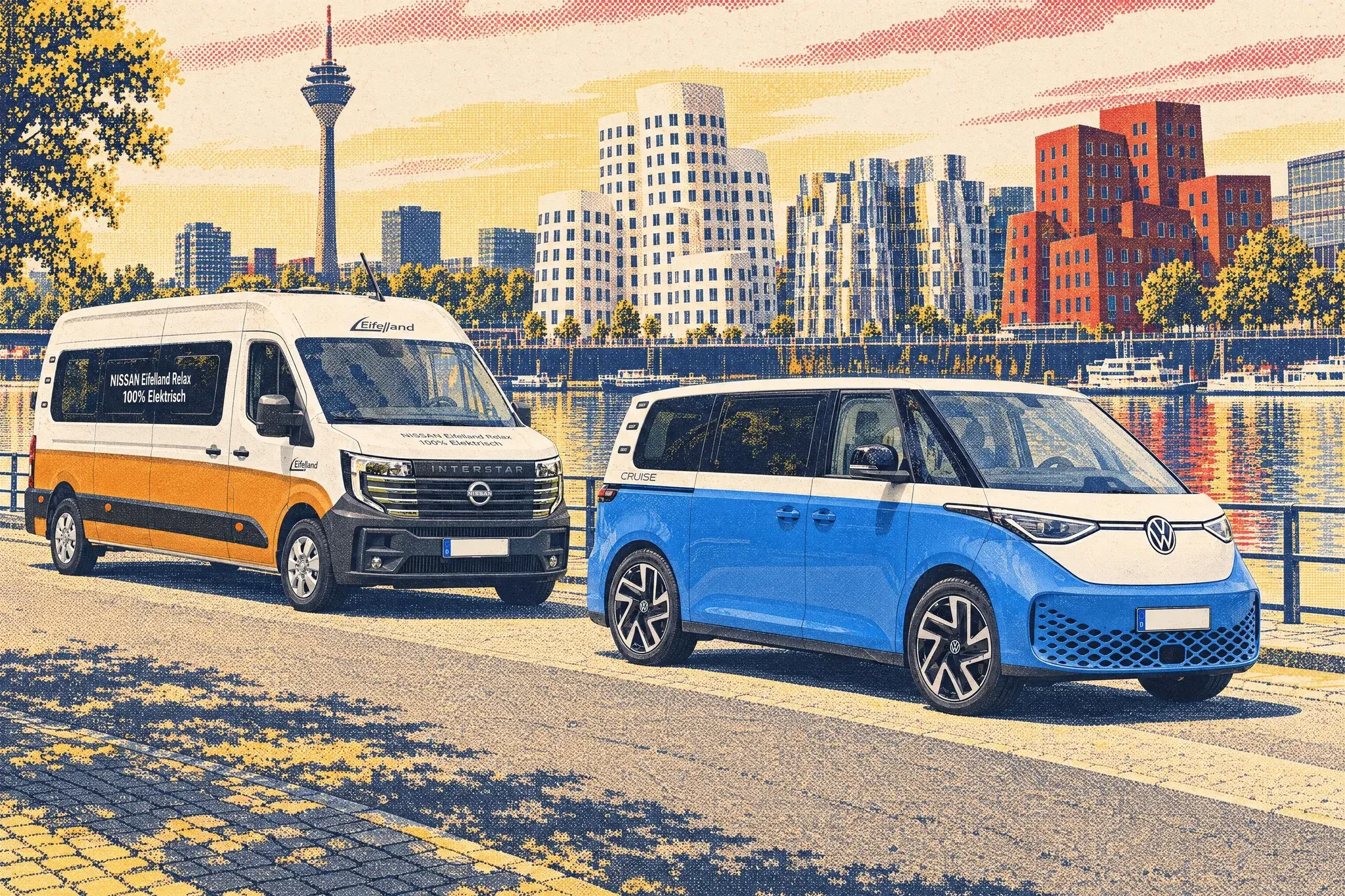
Neither headline electric camper from Caravan Salon 2026 is confirmed for the UK. VW UK says the ID. California Cruise (an ID. Buzz Pro with a bed, blinds and 2,000 W vehicle-to-load) will not go on sale in Britain, and the Eifelland Relax on the Nissan Interstar-e has no confirmed UK availability.

Two electric campervans have made the headlines this summer. One is Volkswagen's ID. California Cruise, the first electric California, which had its world premiere at Caravan Salon 2026 in Düsseldorf. The other is the Eifelland Relax, a German conversion of the electric Nissan Interstar-e, announced by Nissan Germany on 28 July 2026. Both are real, both have euro prices, and neither is confirmed for a UK showroom. This piece sets out what each one actually is, what the UK position is, and the arithmetic behind the question every electric-camper sceptic asks: how much range does a warm night cost?
The short version
- VW ID. California Cruise: an ID. Buzz Pro with a 2.03 m bed, blinds and 2,000 W of vehicle-to-load power. No kitchen, no pop-top. €60,761 in Germany. Deliveries from early 2027. VW UK says it will not be sold in Britain.
- Eifelland Relax: a four-seat conversion of the Nissan Interstar-e with an 87 kWh battery, a roughly 1.90 x 1.60 m bed, a 90 L fridge and a Truma Eezy heater run from the drive battery. From €89,900 including VAT in Germany. UK availability not confirmed.
- What you can do in the UK now: both donor vehicles are sold here, so a UK conversion of an ID. Buzz or Interstar-e is the realistic path while the factory products stay on the Continent.
VW ID. California Cruise: what it is, and what it is not
Volkswagen Commercial Vehicles gave the ID. California Cruise its world premiere at the show, and VW describes it as the first of a new all-electric California family, with more electric California models promised by 2028. It is built on the ID. Buzz Pro. According to electrive, that means a single rear-mounted 210 kW motor driving the rear wheels, which is about 286 PS.
Battery figures are where the coverage disagrees. Electrive lists 79 or 86 kWh; EV Powered says 79 or 82 kWh. VW's own specification is 79 kWh for the standard-wheelbase ID. Buzz Pro and 86 kWh for the long-wheelbase version. Reports on the ID. Buzz Pro from electrive and heise put its WLTP range between roughly 460 and 498 km depending on pack, and VW quotes DC charging of up to 185 kW for the 79 kWh standard-wheelbase van and 200 kW for the 86 kWh long-wheelbase van. Those are ID. Buzz numbers, not camper numbers, so expect a converted and loaded van to do a little less.
A bed, blinds and a big plug, rather than a kitchen
The important thing to understand is that the Cruise is not an electric California Ocean. VW's own release describes a bed of 2.03 x 1.20 m with a 9 cm mattress, plus blinds. One UK outlet quotes a 1.30 m bed width, but VW's figure is 1.20 m, so that is the one to trust. There is no kitchen and no pop-top roof, which means two sleeping places rather than four, and no built-in cooking.
What it does have is power. VW quotes vehicle-to-load at 2,000 W continuous and 3.6 kW peak, delivered from the drive battery. That is enough for a portable induction hob, a kettle or a 230 V heater, one at a time, without a separate leisure system. VW also says the Cruise can hold its cabin temperature for up to 48 hours. VW has not explained the detail of how that is achieved, so we will not guess, but it is the clearest sign that VW sees the drive battery as the camper's energy source rather than a bolt-on gas and leisure-battery set-up.
Heise's summary is fair: it sleeps two and asks buyers to accept a camper that camps a little less. For a couple who want a quiet, electric overnight stop and will cook outside or eat out, that trade may be fine. For anyone used to an Ocean's kitchen and roof bed, it is a different vehicle.
Can a UK buyer get the California Cruise?
Not as things stand. EV Powered reported on 1 September 2026 that VW UK had confirmed the California Cruise will not go on sale in Britain, while hinting at related product news in the coming months. Electrifying reports the same position. So the German price of €60,761 is not a UK price, and any sterling figure you see in UK coverage is a currency conversion, not a list price.
That hint from VW UK is worth watching. VW has said more electric California models are coming by 2028, and the ID. Buzz is already on sale in Britain in right-hand drive. If you want something like the Cruise sooner, the practical route is to treat the ID. Buzz as a candidate donor vehicle for a UK conversion. You would not get VW's own warranty on the camper parts or its 48-hour temperature claim, but you would get a bed in an electric van you can actually register here.
Eifelland Relax: a proper camper on the Nissan Interstar-e
The Eifelland Relax is the more complete camper of the two, and the figures below come from Nissan Germany's release of 28 July 2026. It is a van conversion built by Eifelland, a German converter, on the electric Nissan Interstar-e, so it keeps the van's own body. The Relax was previewed at CMT Stuttgart in January 2026, and Nissan's release puts it on stand A09 in Hall 15 at Caravan Salon.
The drivetrain
- 87 kWh battery
- 105 kW (143 PS) and 300 Nm
- WLTP range up to 410 km, which Nissan states for the base van only and says the camper's figure may differ
- DC charging up to 130 kW; 22 kW AC charging as standard
Note that 143 PS in a van plated at 3,500 kg is modest, and 300 Nm is what you would expect from a working van rather than a quick one. It will be fine on A-roads and motorways; nobody is buying it for overtaking.
The camper side
- Four seats
- Bed about 1.90 x 1.60 m
- 90 L fridge
- About 2.6 cubic metres of storage
- Truma Eezy parking heater, powered from the drive battery by vehicle-to-load
Nissan's release does not mention a gas system. The heater is a 230 V Truma Eezy running off the van's battery, and with no gas mentioned it is reasonable to expect the whole camper to lean on the drive battery for energy. Nissan's release lists an induction hob and a sink alongside the 90 L fridge.
Weight, payload and price
Nissan quotes 3,065 kg in running order, a 3,500 kg maximum and a payload of up to 435 kg. That is the figure to think hardest about. Four adults at 75 kg each is 300 kg, leaving around 135 kg for water, food, bedding, chairs and everything else. As a two-up tourer it is comfortable; as a four-person holiday van you will need to pack with a set of scales in mind.
Price is from €89,900 including VAT in Germany. Again, that is a German price including German VAT, not a UK price.
Can a UK buyer get the Eifelland Relax?
The Nissan Interstar-e van itself is sold in the UK. Eifelland's conversion is not confirmed for the UK. So, as of now, there is no confirmed UK dealer, no confirmed UK price and no confirmed UK or right-hand-drive version to point to.
Your realistic options are either a personal import (left-hand drive, plus the paperwork, tax and registration work that comes with bringing a converted vehicle in from the EU) or a UK converter building something similar on an Interstar-e bought here. The second route gets you a right-hand-drive van with a UK warranty on the base vehicle, and it is where we would expect the first British electric large-van campers to come from.
Heating overnight from the drive battery: the real sums
This is the question that decides whether an electric camper makes sense in a British spring or autumn. The good news is that it is simple arithmetic, and the numbers are smaller than most people fear.
Truma rates the Eezy at 450, 900 or 1,800 W on 230 V. The Eifelland has 87 kWh to draw from. Promobil's test car ran the Truma Eezy and the hob only on shore power, with Nissan saying production vans will run both from the drive battery; Promobil measured about 24 kWh per 100 km on average (about 40 at 120 km/h) and estimates a bit over 300 km of real range. Assume a ten-hour night with the heater running flat out at each setting, which is a worst case because the thermostat will cycle it on and off once the van is warm.
- 450 W for ten hours: 4.5 kWh, about 5% of the pack.
- 900 W for ten hours: 9 kWh, about 10% of the pack.
- 1,800 W for ten hours: 18 kWh, about 21% of the pack.
To turn that into range, use Nissan's base-van figure of 410 km from 87 kWh. That works out at roughly 21 kWh per 100 km, or about 4.7 km per kWh, so:
- 450 W all night costs around 21 km (13 miles) of WLTP range.
- 900 W all night costs around 42 km (26 miles).
- 1,800 W all night costs around 85 km (53 miles).
Three caveats. First, real consumption in a loaded camper in cold weather will be higher than WLTP, so each kWh buys you fewer real miles than the figures above; the percentage of battery used stays the same, though. Second, converting DC battery power to 230 V AC is not free, so allow perhaps another 10% on top of what the heater draws. Third, on a cool but not freezing night, a well-insulated van will not need 1,800 W continuously; the mid setting with the thermostat cycling is a more likely average, which puts a typical night at around 5 to 10% of the pack, not 20.
Two nights off grid with the heater on medium and the thermostat cycling will cost you somewhere around 10 to 20% of an 87 kWh battery, plus whatever the fridge draws. That is not nothing, but it is a long way from the dead-by-morning fear.
The same logic applies to the VW. Its 2,000 W continuous vehicle-to-load output would run a 230 V heater at 1,800 W with a little in hand, and at 450 or 900 W the range cost per night is similar in kWh terms, just against a 79 kWh pack rather than 87. On a pitch with hook-up, of course, the van is charging and the heater's draw is a rounding error.
Campsite charging: what to expect
Campsite electric hook-up is the obvious hope for electric campers, and it is also where expectations most need managing. UK pitch supplies are single-phase, usually capped at 16 A (about 3.7 kW), with plenty of sites limiting pitches to 10 A (about 2.3 kW) and some to 6 A. Pitch bollards are single-phase, so the Eifelland's 22 kW AC charger is irrelevant there; it comes into its own at public 22 kW posts, where 87 kWh takes roughly four hours from empty.
Here is what a hook-up can and cannot do for an 87 kWh van:
- From near-empty to full at a sustained 16 A: about 24 hours, before losses.
- At 10 A: nearer 38 hours.
- A ten-hour overnight at 10 A: about 23 kWh, roughly a quarter of the pack and around 100 km of WLTP range.
- A ten-hour overnight at 16 A: about 37 kWh, roughly 40% of the pack.
So a hook-up is an overnight top-up, not a charging strategy. Arrive with 60%, leave with 85 to 100%, and that is a useful habit. Trying to refill from flat on a pitch is not.
Two practical points matter more than the maths. The first is that pitch bollards were specified for kettles, lights and a small battery charger, and a van pulling the full rated current for ten hours is a different load on a shared supply. A growing number of sites ban EV charging from the bollard, some charge a metered supplement, and some have installed dedicated EV charge points instead. Ask when you book, every time. The second is cable: a standard three-pin granny charger is normally limited to 10 A, and the pitch socket is a blue 16 A commando outlet, so you need either a portable charger with the right plug or a proper adapter, not an improvised one.
Rapid charging on the road is the real refuel. The Eifelland's 130 kW peak should take 10 to 80% in something like 35 to 45 minutes if both the charger and the van deliver near their rated figures, and longer in winter. VW quotes up to 185 kW for the 79 kWh ID. Buzz Pro and 200 kW for the 86 kWh long-wheelbase version, which is quicker still.
Licence and weight: the 4.25 t change
Since 10 June 2025, a standard GB car (category B) licence covers zero-emission vehicles up to 4.25 tonnes, rather than the usual 3.5 tonnes, although drivers who passed before 1 January 1997 already hold C1 (to 7.5 t), so the 4.25 t change matters for post-1997 licences. That does not matter for the Eifelland, which is plated at 3,500 kg, nor for the ID. Buzz. It matters a great deal for what comes next: an electric large-van camper carrying a big battery, a full kitchen, water and four people would quickly outgrow 3,500 kg, and converters now have 750 kg of headroom to use without their customers needing a C1 licence.
Two cautions. The payload sum still has to work on the plate the van actually carries, so a 3,500 kg Eifelland with 435 kg of payload is what it is unless it is re-plated. And in GB, motor caravans over 3.05 tonnes unladen weight face lower speed limits (50 mph on single carriageways, 60 mph on dual carriageways and 70 mph on motorways). Nissan's 3,065 kg is a running-order figure that includes a 75 kg driver, whereas GB unladen weight excludes the driver and, for electric vehicles, the traction battery (Road Traffic Act 1988 s.190; GOV.UK's vehicle weights explained guidance). On that basis the Eifelland sits well under the 3.05 t threshold, so car speed limits (60 mph, 70 mph and 70 mph) should apply, and even a 4.25 t electric camper may still be under 3.05 t unladen once the battery is excluded. Check the V5C or certificate of conformity for your own van rather than assuming.
What a UK buyer can realistically do now
- Wait for VW UK's news. VW has said more electric Californias are coming by 2028 and VW UK has hinted at related product news. If you want VW's own electric camper with VW's warranty, patience is the honest advice.
- Convert an ID. Buzz. It is on sale here in right-hand drive, which makes it a candidate donor vehicle for a UK conversion. You will not get VW's bed, blinds and temperature-hold package, but you can get close.
- Convert an Interstar-e. Nissan sells the van in the UK, and a UK converter can fit a bed, a fridge and a 230 V heater run from vehicle-to-load, much as Eifelland has. Keep a firm eye on payload.
- Plan charging like a tourer, not a commuter. Rapid charge on the move, top up on hook-up overnight where the site allows it, and budget around 5 to 10% of the pack for a heated night.
The bottom line
This summer brought two serious answers to the electric camper question: VW's ID. California Cruise, premiered at Caravan Salon 2026, and the Eifelland Relax, announced by Nissan Germany on 28 July 2026. The ID. California Cruise is a clever, simple two-berth that treats the drive battery as the camper's power station, and the Eifelland Relax is a fuller four-seat conversion that suggests, on the numbers, an 87 kWh van can heat itself for a weekend without a gas bottle. The frustration for UK buyers is that neither is on sale here: VW UK has said no to the Cruise for Britain, and Eifelland's UK availability is unconfirmed. The donor vans are here, the licence rules now allow heavier electric campers, and the heating sums work. The factory products are the missing piece, and on VW's own timeline that gap looks like a couple of years rather than a decade.
Common questions
Can I buy the VW ID. California Cruise in the UK?
No. EV Powered reported on 1 September 2026 that VW UK had confirmed the California Cruise will not go on sale in Britain, though it hinted at related product news in the coming months. Any sterling price you see for it is a currency conversion of the German price, not a UK list price.
How much range does heating an electric campervan overnight use?
Using Truma's Eezy ratings and the Eifelland's 87 kWh battery, ten hours at 450 W uses about 5% of the pack, at 900 W about 10%, and at 1,800 W flat out about 21%. Against the base van's 410 km WLTP figure that is roughly 21, 42 and 85 km respectively, and a thermostat cycling on a cool night will usually land at the lower end.
Can I charge an electric campervan from a campsite hook-up?
Only slowly, and only if the site allows it. UK pitches are usually capped at 16 A (about 3.7 kW) and often 10 A, so an overnight adds roughly a quarter to 40% of an 87 kWh battery, and a full charge from empty would take a day or more. Many sites ban or meter EV charging from the bollard, so always ask first and use a proper charger with a 16 A commando plug.
Is the Eifelland Relax coming to the UK?
It is not confirmed. The Nissan Interstar-e van it is built on is sold in the UK, but Eifelland's conversion is ordered through its own channels in Germany and there is no UK dealer, price or right-hand-drive version announced.
Do I need a special licence for an electric campervan over 3.5 tonnes?
Since 10 June 2025 a standard GB car (category B) licence covers zero-emission vehicles up to 4.25 tonnes. The Eifelland Relax is plated at 3,500 kg anyway, but the change gives converters room to build heavier electric campers that still fall within a car licence. Speed limits depend on unladen weight, which in GB excludes the driver and, for electric vehicles, the traction battery, so even a 4.25 t electric camper may still be under the 3.05 t threshold for lower motor caravan limits; check the V5C or certificate of conformity. MOT class still follows the vehicle's weight.
The reachable bit
The camper you fall for is rarely the one you can afford. That gap is the whole reason Campervan.win exists. Right now we’re giving away the Sunlight Vanlife, worth around £65,000, and closing that gap is the point: capped entries so the odds stay honest, £10 a ticket, a maximum of five per person, £500 to a UK charity from every full draw, the winner picked by a public randomness beacon anyone can re-check, and one person driving away in the van itself.

Enjoyed this post?
Get more honest campervan guides like this one in your inbox.
You’re in!
Check your inbox. We’ve just sent you a welcome email.

About the author
Leo
Leo covers campervan technology, maintenance, kit, and ownership advice, with a clear, practical focus on how things work in real life.
Keep Reading
Related Reading
Thoughtful articles that build on what you’ve just read.
New & Noteworthy
12 min read
Knaus Boxtime 600 ME (2027): twin singles in 6 m, and the payload figure to question
Knaus's new Boxtime 600 ME squeezes two lengthways single beds into a 5.99 m van from £81,725. We lay out what that layout gives a couple, run the weight sums with Knaus's own figures, and explain why the 211 kg 'maximum payload' line needs a question before you sign.
New & Noteworthy
10 min read
Swift Carrera goes gas-free for 2027: 340Ah lithium, diesel heat and induction cooking
Swift has taken the gas out of its Carrera campervan for 2027, swapping bottles for a 340Ah lithium battery, diesel heating and an induction hob. Here is what that means across a real UK year, how it compares with the cheaper Merlin, and the one question to ask at the NEC.
New & Noteworthy
10 min read
British campervan converters at the NEC 2026: who builds on what, and for how much
A stand-by-stand map of the British campervan converters at the Motorhome and Caravan Show 2026: the vans they build on, their from-prices, seats, roofs and lead times, plus the four questions to put to every one of them.
New & Noteworthy
9 min read
Plug-in hybrid campervans at the NEC: what a PHEV gives you and why full EVs are rare
Four UK converters have hybrid campers at or around the Motorhome and Caravan Show this October, while fully electric campers remain scarce. Here is what a plug-in hybrid camper does well, what the sellers rarely tell you, and the questions to ask on the stand.