
Knaus Sky TI moves to the VW Crafter for 2027: what UK couples get from £107,985, and the 3,850 kg catch

Written by
Iris
Iris writes travel guides, road trips, and park-up features, with a focus on slower UK touring, living space, and how campervans are used day to day.
The short answer
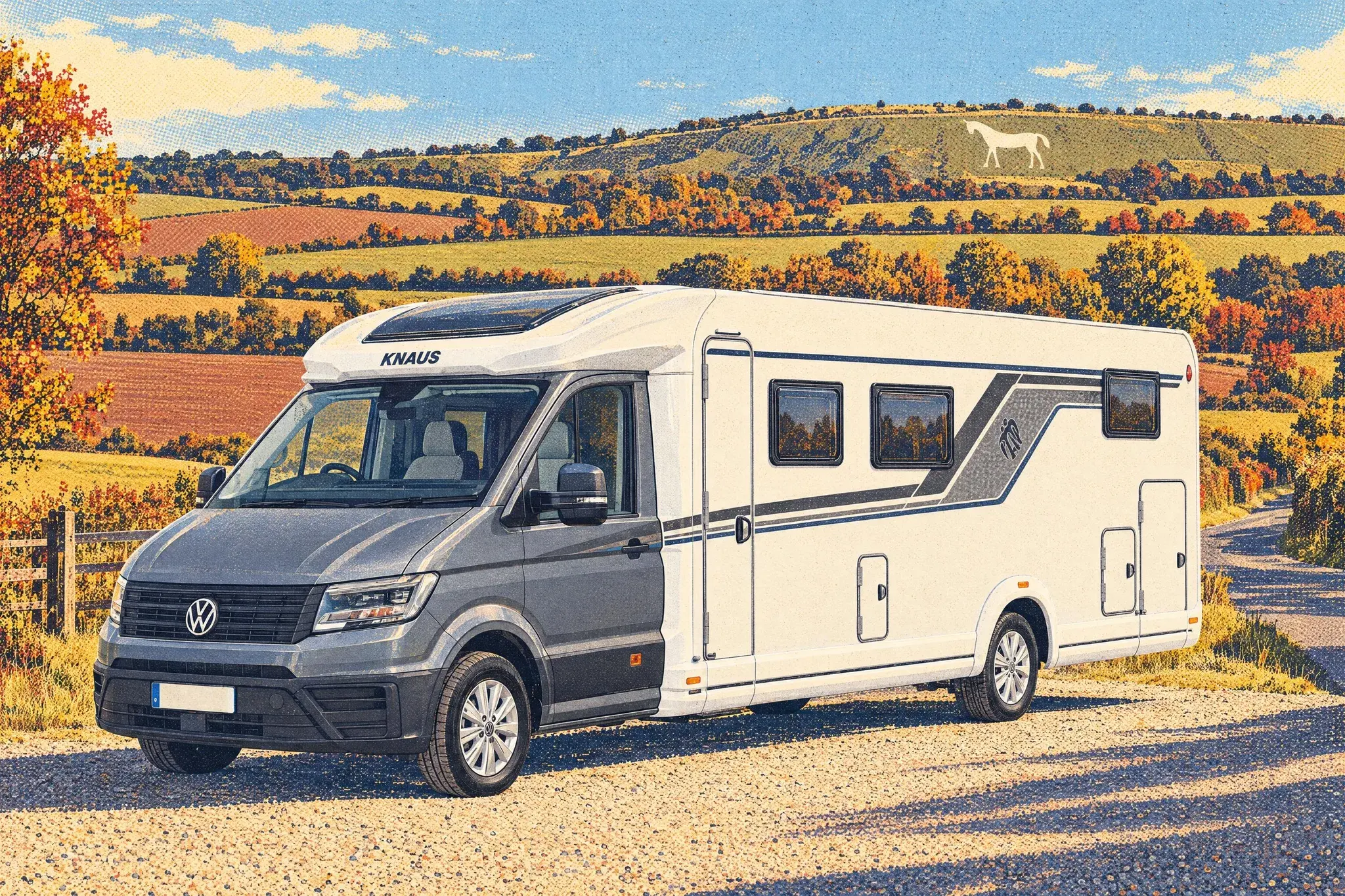
For 2027 the Knaus Sky TI low-profile motorhome moves from a Fiat base to a Volkswagen Crafter chassis with an automatic gearbox as standard. UK prices start at £107,985 for the 650 MEG, with the 700 DEG at £110,995 and 700 DX at £111,485. The UK 700 DEG is plated at 3,850 kg, so drivers who passed their car test on or after 1 January 1997 need a C1 licence to drive it.

Knaus has moved its Sky TI low-profile motorhome from a Fiat base to a Volkswagen Crafter for the 2027 model year, and it has arrived in the UK with a starting price of £107,985. That is the short version. The longer version involves a wider rear track, an automatic gearbox as standard, a 7.6 m four-berth that weighs more than many UK drivers are licensed to drive, and a payload line on the spec sheet that does not mean what it looks like it means.
What has actually changed
The Sky TI has been one of Knaus's core semi-integrated (low-profile) ranges for years, and until now it sat on a Fiat chassis. Earlier Fiat-based listings showed a 2.2-litre 140 hp engine with a six-speed manual gearbox as standard and an eight-speed automatic as an option.
For model year 2027, Knaus UK now lists the range as "Sky TI VW". German title promobil reports that the van has moved to a Volkswagen Crafter flat-frame chassis and that the German starting price is €99,900. Autozeitung reports that the production version was unveiled at the Caravan Salon in Düsseldorf, which ran from 28 August to 6 September 2026. Knaus's own UK site describes a VW chassis with an automatic transmission, which it credits for precise handling and ride comfort. Belgian dealer Vanomobil lists a Crafter base with automatic as standard, gives the 650 MEG at 6.99 m and the 700 DEG and 700 DX at 7.50 m, and quotes a width of 2.32 m.
So this is not a facelift. It is the same model name on a different donor vehicle, with a different driveline philosophy. That changes how it drives, how it carries weight, and what licence you need.
Why the Crafter base matters
Three things stand out from the coverage so far.
A wider rear track
According to promobil, the rear track on the Crafter chassis is "a good 20 cm" wider than on the Fiat version. On a body that is around 2.3 m wide, that matters. A wider stance under a wide, tall body generally means less lean in bends and less of that side-to-side rocking you feel on a windswept dual carriageway. Reviewers will have the final say once UK road tests appear, but the geometry is on the van's side.
A flat-frame chassis and a double floor
Knaus UK lists a double floor as a feature of the range. A flat-frame chassis is a natural partner for that, because the floor structure can sit lower and more evenly across the whole length without working around a conventional ladder frame. The practical benefits of a double floor are familiar to anyone who has used one in winter: tanks and pipework sit inside the heated envelope, there is underfloor storage, and the living floor stays warmer underfoot.
Automatic as standard, no all-wheel drive
Knaus UK describes an automatic gearbox as part of the package. For the UK 700 DEG, Knaus UK quotes 120 kW, which is 163 PS, paired with that automatic. One thing to be aware of: autoevolution reported a 140 hp engine in standard spec when the model was first announced, which may reflect a different market's base specification.
Promobil also notes there is no all-wheel-drive version of the Sky TI. If you had hoped for a 4Motion motorhome, this is not it.
The three UK layouts and what they cost
Knaus UK (checked 6 October 2026) lists three layouts with recommended retail prices including 20 per cent VAT:
- 650 MEG: £107,985, 699 cm long, plated at 3,500 kg
- 700 DEG: £110,995
- 700 DX: £111,485, 777 cm long, plated at 3,850 kg
Knaus UK publishes full specification tables for all three layouts. Across the range Knaus UK quotes lengths of 699 to 777 cm, a width of 230 cm and a height of 287 cm, and a maximum permitted mass of 3,500 to 3,850 kg depending on the layout. All three are, on those figures, big motorhomes. A width of 2.3 m is wider than any family car, and 2.87 m of height rules out most height barriers and a fair few multi-storey car parks.
Standard across the range, according to Knaus UK, are a 157-litre compressor fridge, the double floor and a separate shower. An electric front lift-up bed is available as an option. Practical Motorhome reports Truma diesel heating as standard with Alde wet central heating as an option. That is worth knowing if you tour in the cold: Alde is a popular choice for winter use and it adds cost and weight, so factor it in early rather than at the handover.
Inside the UK 700 DEG
The 700 DEG is the mid-priced layout at £110,995, so it is a good place to look at the detail.
- Length: 759 cm, on a 449 cm wheelbase
- Width: 230 cm outside, 218 cm inside
- Height: 287 cm outside, 199 cm inside
- Engine: 120 kW / 163 PS with automatic gearbox
- Mass in running order: 3,207 kg (quoted range 3,046 to 3,367 kg)
- Effective vehicle mass (base model including standard options): 3,435 kg
- Technically permissible maximum laden mass: 3,850 kg
- Seats and berths: 2 belted seats as standard, 4 belted maximum; 3 beds, 4 berths
- Towing: 2,000 kg
Two notes on those figures. First, 199 cm of internal headroom is generous: a person of 1.90 m (6 ft 3 in) clears it, and anyone under 1.95 m will not be stooping. Second, the standard van has two belted seats, with four as the maximum. If you plan to travel as a family of four rather than as a couple, make sure the van you are quoted has the extra belted seats specified, because they are not the default.
About those beds
Knaus UK lists the 700 DEG as three beds and four berths. The 700 DEG has longitudinal single beds and the 700 DX has the queen bed: promobil, Autozeitung, camping-car.com and Knaus's own DEG and DX codes agree on this, with Practical Motorhome the outlier in describing both as island-bed layouts. Autozeitung's description of the German 700 DEG gives twin single beds of 198 x 78 and 197 x 78 cm with an optional 200 x 130 cm drop-down bed. A UK dealer listing describes fixed separate beds plus make-up beds. If the bed layout is the thing that decides your purchase, and for most couples it is, check the actual van at the show.
The 3,850 kg catch: your licence
This is the part that will decide whether the 700 DEG is even on your shortlist.
Knaus UK plates the UK 700 DEG at a technically permissible maximum laden mass of 3,850 kg. The UK licence rule is simple and unforgiving: a standard category B car licence allows you to drive a vehicle with a maximum authorised mass of up to 3,500 kg. Anything above that needs category C1, which covers vehicles between 3,500 and 7,500 kg.
Who has C1 depends on when you passed your test:
- Passed your car test before 1 January 1997: you were given C1 automatically. You keep it until you turn 70, after which you must renew the entitlement every three years, with a D4 medical.
- Passed on or after 1 January 1997: you have category B only. To drive a 3,850 kg motorhome legally you would need to take a C1 test, which means a medical, a theory test and a practical test in a suitably heavy vehicle.
For a couple where both partners share the driving, both need to clear this bar. If one of you passed in 1995 and the other in 2003, only one of you can legally drive a 3,850 kg van, and that gets old quickly on a long tour.
Is a 3,500 kg plating offered?
Knaus UK quotes the range's maximum mass as 3,500 to 3,850 kg. The 3,500 kg layout is the 650 MEG; the 700 DEG and 700 DX are both plated at 3,850 kg. Whether a 3,500 kg version of the 700 DEG is offered for the UK, and whether it would be a factory specification or a paper downplate, is not stated.
If it were, the next question is whether it would be any use. That takes us to payload.
Reading the payload figures properly
Knaus UK's 700 DEG page shows a line reading "maximum payload" of 214 kg. Taken at face value that looks alarming for a 7.6 m four-berth. It is not what it appears to be.
On Knaus specification pages, this line refers to the weight of optional equipment the van can be fitted with before it eats into the minimum passenger-and-luggage allowance the maker has to leave free under EU rules. In other words, it is the budget for factory extras such as heavier heating systems, awnings, solar and so on. It is not the total you can load into the van.
The figure that tells you what you can really carry is simpler: the maximum permitted mass minus what the van actually weighs. Using Knaus UK's numbers for the 700 DEG at 3,850 kg:
- Knaus UK gives an effective vehicle mass of 3,435 kg for the base model including its standard options, which leaves about 415 kg.
- Before equipment, the bare starting point is 3,850 kg minus the quoted 3,207 kg mass in running order, or 643 kg, dropping to 483 kg at the top of the running-order range (3,367 kg).
Mass in running order includes a notional driver and fuel, so from that remainder you still subtract your passenger, the weight of any options beyond the base spec, a full water tank if you travel with one, gas, bedding, food, clothes, bikes and the rest. For a touring couple, about 415 kg is a workable margin. It is one of the genuine advantages of the 3,850 kg plating.
What a 3,500 kg plate would leave
Now run the same sums at 3,500 kg, assuming such a plating were available for the UK 700 DEG:
- 3,500 kg minus Knaus UK's 3,435 kg effective vehicle mass leaves about 65 kg.
- Before equipment, the bare running-order sums would leave 293 kg, or 133 kg at the top of the running-order range.
A single 75 kg passenger would use up more than that 65 kg on its own. That is not a usable margin for a van of this size. If you need category B compliance, do not assume the shorter 650 MEG solves the problem: it is the one to be most careful with. Knaus UK's own table plates it at 3,500 kg with a mass in running order of 3,107 kg and an effective vehicle mass of 3,302 kg, and shows its maximum payload as minus 161 kg, so it has no payload left at the base spec.
The 3,850 kg plating is what makes the 700 DEG usable as a load-carrying four-berth. Downplating to 3,500 kg would get round the licence question but leave very little to carry.
Other knock-ons of being over 3,500 kg
The licence is the big one, but a heavier plating ripples into a few other corners of ownership. None of them is a dealbreaker; all of them are worth knowing.
- Speed limits: in England, motorhomes with an unladen weight over 3,050 kg are limited to 50 mph on single carriageways, 60 mph on dual carriageways and 70 mph on motorways. Unladen weight is not the same as mass in running order, but a van this size is very likely to be over 3,050 kg empty, so plan on the lower limits.
- Vehicle tax: motorhomes over 3,500 kg fall into the private HGV tax class (TC10) rather than the private light goods class. Private HGV tax is £177 a year, against £375 for petrol and diesel cars over 1,549 cc, so being over 3,500 kg is cheaper to tax, not a cost.
- Crossings and clean-air schemes: some toll crossings and city schemes treat vehicles over 3,500 kg as heavy vehicles with different charges or emissions requirements. Check each one before you route through it.
- Insurance: tell your insurer the plated weight. Some policies have weight ceilings or assume category B driving.
Price in context
Knaus UK prices the Sky TI VW at £107,985 to £111,485 including VAT, depending on the layout. The German list price promobil quotes, €99,900, is not directly comparable: it includes 19 per cent German VAT but is for a 140 PS base van, while the UK base has the 163 PS engine with bundled options, and exchange rates move. What the UK number buys you, on Knaus UK's spec, is the automatic gearbox, the 163 PS engine, the double floor, the separate shower and the 157-litre fridge as standard. Alde heating and the electric lift-up bed are extra.
If you are weighing it against the outgoing Fiat-based Sky TI, remember the old van's standard gearbox was a manual with the automatic as an option, so a like-for-like comparison should add the automatic to the Fiat price.
What to check before you commit
Knaus is exhibiting at the NEC in Birmingham from 13 to 18 October 2026, which is the obvious place to see the Sky TI VW in the metal. Go with a list:
- Right-hand drive. Knaus UK publishes UK prices and UK specs, but the listing does not state right-hand drive in so many words. Confirm it before you order.
- Licence. Check which category each driver in your household holds, and when you each passed your test. If either of you is category B only, look closely at the plated weight and payload of whichever layout you are considering.
- Engine output. Confirm the UK van is the 120 kW / 163 PS unit Knaus UK lists, given the 140 hp figure reported elsewhere.
- Bed layout. Look at the beds, measure them if you can, and ask what the optional drop-down bed adds and weighs.
- Belted seats. Two are standard, four is the maximum. If you need four, specify them.
- Options and weight. Ask for a build sheet with the weight of each option, especially Alde heating, so you know where the running-order mass will land.
- A weighbridge plan. Whatever the paperwork says, weigh the finished van loaded for a trip before your first long tour.
You can start with the official UK listing at knaus.com/en-gb, then talk to a UK Knaus dealer for the written confirmations above.
The bottom line
The move to the Crafter is a genuine step, not a badge swap. A wider rear track, a flat-frame chassis supporting a proper double floor, and an automatic gearbox as standard are the sort of changes you feel on every drive and every cold night. For a couple who tour for weeks at a time, the UK 700 DEG at £110,995 offers a lot of standard kit and, at 3,850 kg, a real payload margin of about 415 kg on Knaus UK's effective vehicle mass of 3,435 kg for the base model.
The catch is exactly that plating. If you passed your car test on or after 1 January 1997 and do not hold C1, the 700 DEG as listed is not a van you can legally drive without taking a further test. A 3,500 kg version, if offered, would solve the licence problem but leave only about 65 kg to carry, which is not much for a van this size. Decide which side of that line you sit on first. Everything else about the Sky TI VW is a pleasant conversation to have afterwards.
Common questions
What base vehicle is the 2027 Knaus Sky TI built on?
For the 2027 model year the Sky TI moves from a Fiat chassis to a Volkswagen Crafter chassis with an automatic gearbox as standard, according to Knaus and German coverage from promobil. Promobil reports a flat-frame chassis with a rear track around 20 cm wider than the Fiat version, and no all-wheel-drive option.
How much does the Knaus Sky TI VW cost in the UK?
Knaus UK lists the 2027 Sky TI VW from £107,985 including VAT for the 650 MEG, with the 700 DEG at £110,995 and the 700 DX at £111,485. The German starting price reported by promobil is €99,900.
Do I need a C1 licence to drive the Knaus Sky TI 700 DEG?
The UK 700 DEG is plated at 3,850 kg, so anyone who passed their car driving test on or after 1 January 1997 would need a category C1 licence to drive it. Drivers who passed before that date usually have C1 already, though it must be renewed with a medical from age 70.
What does the 214 kg 'maximum payload' on the Knaus spec sheet mean?
On Knaus specification pages that line is the allowance for optional equipment, not the total you can load. The real carrying margin is the maximum permitted mass minus the van's actual weight: for the 700 DEG at 3,850 kg, Knaus UK gives an effective vehicle mass of 3,435 kg for the base model including its standard options, which leaves about 415 kg.
Is the Knaus Sky TI VW available in right-hand drive?
Knaus UK publishes UK prices and specifications for the Sky TI VW, but its listing does not explicitly state right-hand drive, so confirm this with a UK Knaus dealer before ordering.
Where can I see the new Knaus Sky TI VW in the UK?
Knaus is exhibiting at the NEC in Birmingham from 13 to 18 October 2026, which is the first obvious chance to see the Crafter-based Sky TI in person and check the bed layout, seating and weights.
The reachable bit
The camper you fall for is rarely the one you can afford. That gap is the whole reason Campervan.win exists. Right now we’re giving away the Sunlight Vanlife, worth around £65,000, and closing that gap is the point: capped entries so the odds stay honest, £10 a ticket, a maximum of five per person, £500 to a UK charity from every full draw, the winner picked by a public randomness beacon anyone can re-check, and one person driving away in the van itself.

Enjoyed this post?
Get more honest campervan guides like this one in your inbox.
You’re in!
Check your inbox. We’ve just sent you a welcome email.

About the author
Iris
Iris writes travel guides, road trips, and park-up features, with a focus on slower UK touring, living space, and how campervans are used day to day.
Keep Reading
Related Reading
Thoughtful articles that build on what you’ve just read.
New & Noteworthy
12 min read
Knaus Boxtime 600 ME (2027): twin singles in 6 m, and the payload figure to question
Knaus's new Boxtime 600 ME squeezes two lengthways single beds into a 5.99 m van from £81,725. We lay out what that layout gives a couple, run the weight sums with Knaus's own figures, and explain why the 211 kg 'maximum payload' line needs a question before you sign.
New & Noteworthy
10 min read
Swift Carrera goes gas-free for 2027: 340Ah lithium, diesel heat and induction cooking
Swift has taken the gas out of its Carrera campervan for 2027, swapping bottles for a 340Ah lithium battery, diesel heating and an induction hob. Here is what that means across a real UK year, how it compares with the cheaper Merlin, and the one question to ask at the NEC.
New & Noteworthy
10 min read
British campervan converters at the NEC 2026: who builds on what, and for how much
A stand-by-stand map of the British campervan converters at the Motorhome and Caravan Show 2026: the vans they build on, their from-prices, seats, roofs and lead times, plus the four questions to put to every one of them.

New & Noteworthy
9 min read
Plug-in hybrid campervans at the NEC: what a PHEV gives you and why full EVs are rare
Four UK converters have hybrid campers at or around the Motorhome and Caravan Show this October, while fully electric campers remain scarce. Here is what a plug-in hybrid camper does well, what the sellers rarely tell you, and the questions to ask on the stand.