
VW Grand California Dune 600 vs 680: which to choose and exactly how we would spec each one

Written by
Iris
Iris writes travel guides, road trips, and park-up features, with a focus on slower UK touring, living space, and how campervans are used day to day.
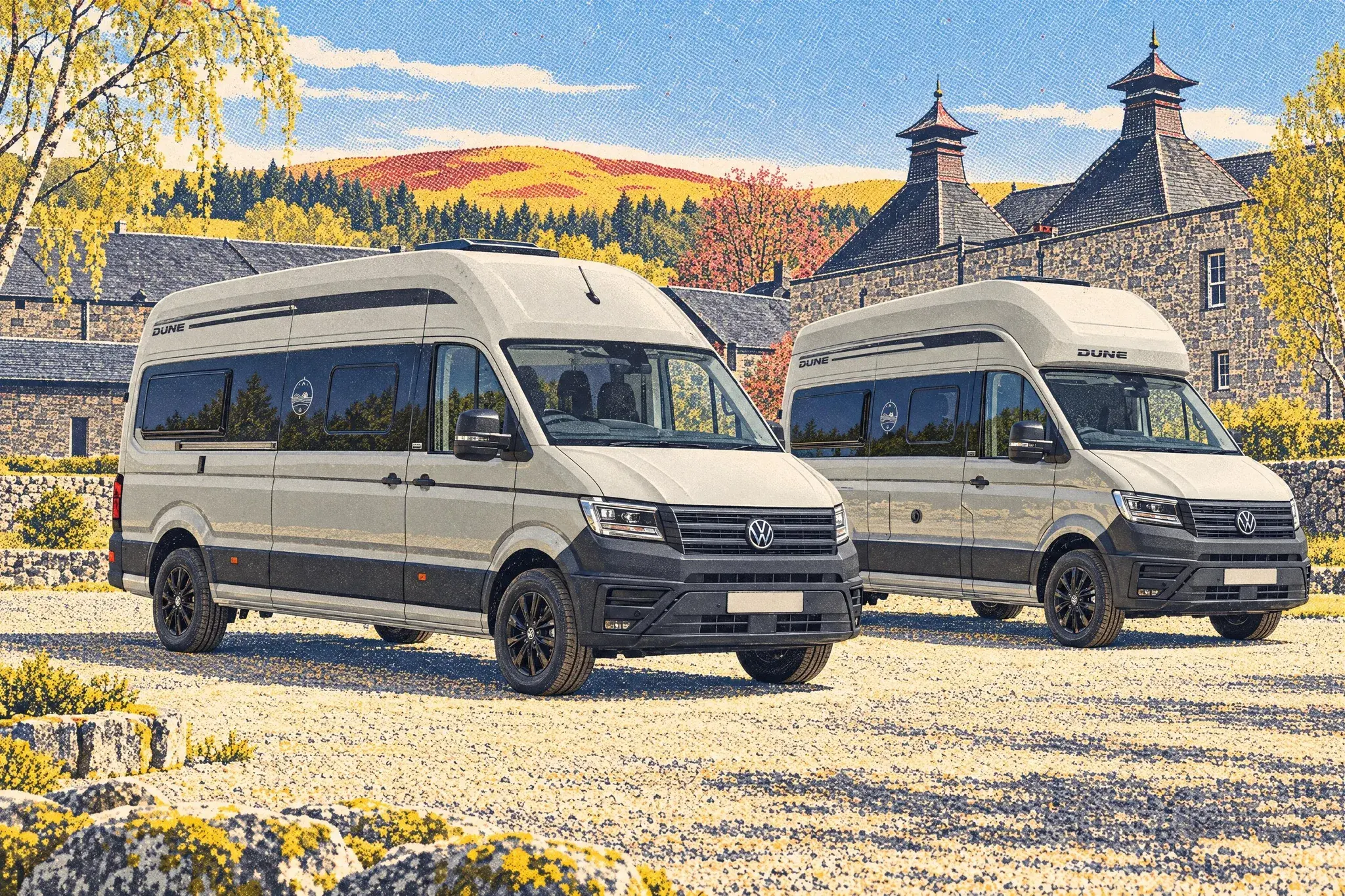
The short answer
The VW Grand California Dune is a special edition of VW's Crafter-based camper, on sale in the UK from £85,408 on the road in 6 m (600) and 6.8 m (680) lengths, with an eight-speed automatic, a wet room, a kitchen and Dune styling. 4MOTION is offered only on the 680 in the UK. We would spec both with diesel heating and air conditioning, and add the roof bed to make the 600 a four-berth. Volkswagen's current finance offer is a 5.9% APR PCP, not 0%.

Updated 6 October 2026: Volkswagen UK has published Grand California Dune prices and specifications, so we have added them and corrected the details below, including that 4MOTION is offered only on the 680 in the UK.
Volkswagen's Grand California Dune is on sale in the UK, and it is a camper with its own shower and toilet in a van you can still park on a street. It comes in two lengths, and it sleeps two or four depending on which one you pick. This guide covers what the Dune edition actually adds, how the 600 and 680 differ in real use, exactly how we would spec each one and why, what is known (and not known) about 0% finance, and what else you could buy for similar money. Where a fact rests on a single source, we say so, and where we could not verify something, we tell you that too.
What the Grand California Dune actually is
The Grand California is Volkswagen Commercial Vehicles' big camper. It is a panel van conversion built on the VW Crafter, which Volkswagen UK confirms on its own Grand California pages. That matters: it keeps the Crafter's steel body, so it is 2,040 mm wide excluding mirrors. A coachbuilt motorhome with its own habitation body is usually 2.2 m or wider, so the Grand California is noticeably slimmer than most motorhomes of the same length, even though it is far bigger than any car.
The Dune is a styling and equipment special edition of that van, and Volkswagen UK lists it in both the 6 m and 6.8 m versions. Volkswagen UK describes it as bringing "a bold new look" with unique Dune decals and black exterior detailing. Underneath, it keeps the standard Grand California formula: a wet room with shower and toilet, a kitchen, and a large fixed sleeping area, with four travel seats. It is on sale in the UK now: Volkswagen UK published Dune prices in its Grand California price list of 30 September 2026.
Two things worth saying plainly up front. First, the Dune is not a new generation of the Grand California; it is the existing van with a new look and a revised equipment package. Second, the mechanical choices are simpler than they look: every version has an eight-speed automatic gearbox (there is no manual), and in the UK 4MOTION all-wheel drive is offered only on the 680. The 600 is front-wheel drive only.
600 versus 680: the differences that change how you live in it
The two numbers are rough lengths in centimetres, but the layouts are quite different, and that is what should drive your choice.
Grand California 600
- Length: 5,986 mm, so it sits just under 6 m. That is the figure that matters for ferry price bands and for a lot of campsite pitch limits.
- Width: 2,040 mm without mirrors.
- Height: about 2.97 m (Parkers lists 2,970 mm), the extra height being the raised alcove over the cab that houses the over-cab bed. It will not fit under a 2.1 m car park barrier, and you need to think about low branches on campsite lanes. Confirm the exact figure for your build on the quote.
- Bed: a transverse (crossways) double at the rear, 1.93 x 1.36 m according to Volkswagen UK. Volkswagen describes the 600 as a "crossways sleeper".
- Extra beds: the 600 can be ordered with an over-cab bed (a £2,754 option) that pulls out above the cab seats, which is what takes it from two berths to four. Volkswagen says it holds up to 150 kg and suits two children. We would include it in most builds, and explain why below.
- Gross vehicle weight: 3,500 kg as standard, which keeps it driveable on a standard category B car licence, or 3,880 kg in a version that costs £672 more and needs C1. At 3,500 kg Volkswagen quotes a payload of just 397 kg, already allowing for the driver.
Grand California 680
- Length: 6,836 mm, so call it 6.8 m. It is identical in width to the 600.
- Height: about 2.84 m (Parkers lists 2,840 mm). It is still a tall high-roof van, with the Crafter's own high roof along its whole length; it is a little lower than the 600 because it has no raised alcove over the cab, and it is lower inside too, with 1.97 to 2.03 m of standing height against 2.18 to 2.20 m in the 600. Again, check the exact figure for your build.
- Bed: a lengthways rear double, 2.00 x 1.67 m on the right and 1.90 x 1.67 m on the left, so its real gain over the 600 is width rather than length. It is a two-berth: Volkswagen's "sleeps 2 to 4" covers the range as a whole, and the over-cab bed that makes four berths possible is offered only on the 600.
- Gross vehicle weight: 3,880 kg, according to Volkswagen UK. This is the single most important number on the 680 for UK buyers, because it takes the van over 3,500 kg.
The licence question on the 680
If you passed your car test on or after 1 January 1997, your standard licence covers vehicles up to 3,500 kg. The 680 at 3,880 kg needs category C1. If you passed before that date, you almost certainly have C1 already (check the back of your photocard for the C1 entitlement and any expiry linked to medical renewals from age 70). If you do not have C1, the cost and time of gaining it should be in your sums before you fall for the longer bed.
Weight can also affect speed limits. In Great Britain the lower limits for motor caravans (50 mph on single carriageways and 60 mph on dual carriageways, with 70 mph on motorways) depend on unladen weight, not gross weight: they apply above 3,050 kg unladen. Volkswagen UK quotes kerb weights, with 90% fuel, of 3,028 kg for the Dune 600 and 3,202 kg for the Dune 680, and the Caravan and Motorhome Club says the 680 falls under the lower limits. Either length avoids them only while its unladen weight stays under 3,050 kg, so check the figures on the V5C and the plate before assuming either way.
Which size suits which buyer
- Choose the 600 if: you are on a post-1997 licence (and so need the 3.5-tonne version), you want to take children or occasional guests, you use ferries where the 6 m band saves money, and you are happy sleeping across the van (taller sleepers should lie on a demonstrator before ordering).
- Choose the 680 if: you are two adults who tour for long stretches, you want a proper lengthways bed and more storage, you hold C1, and you are relaxed about an extra 80 cm of parking and manoeuvring.
Engine, gearbox and drive
There is one engine, a 2.0-litre TDI diesel with 163 PS and 410 Nm, according to Volkswagen UK's brochure, paired with an eight-speed automatic gearbox. Earlier Grand Californias had 177 PS. Expect a relaxed, torque-led touring engine rather than a quick one.
Front-wheel drive is standard. In the UK, 4MOTION all-wheel drive is available only on the 680, as a separate version that costs £8,064 more and adds 117 kg. We would only recommend it if you genuinely plan on wet grass pitches, gravel tracks, mountain passes in shoulder season or winter ski trips. The 680's 3,880 kg gross weight leaves room for that extra weight: Volkswagen quotes a payload of 603 kg with front-wheel drive and 486 kg with 4MOTION.
What it costs in the UK
Volkswagen UK published its Grand California price list on 30 September 2026. On the road, the Dune costs £85,408 for the 600 at 3.5 tonnes, £86,080 for the 600 at 3.88 tonnes, £88,186 for the 680 and £96,250 for the 680 4MOTION. That is £1,200 more than the matching standard Grand California on every version; the standard 600 starts at £84,208.
For that £1,200, the Dune adds LED headlights, Climatronic automatic air conditioning, a rear-view camera, ambient lighting and black 17-inch alloys, which together would cost £2,256 as options on the standard van. The catch is colour: the Dune comes only in Ascot Grey, so there is no metallic or two-tone paint. Options then go on top. The configurator on Volkswagen's UK site will give you the exact figure for the build you want, and that is the number to trust over anything in a snippet or a forum.
Rule of thumb: never commit to a camper on its headline price. Build it the way you would actually live in it, then look at the total. The difference between "from" and "as you want it" is often five figures.
Our recommended Grand California 600 Dune build
The 600 is the one most UK buyers will choose, so we have been careful here. The aim is a van that works for two adults most weekends, takes two more people a few times a year, and is comfortable in a British October without plugging into a hook-up.
1. Weight first: 3.5 or 3.88 tonnes
In the UK the 600 is front-wheel drive only, so the big decision is its weight. At 3,500 kg the Dune 600's payload is 397 kg, and Volkswagen's figure already allows for the driver. Three passengers at 75 kg each take 225 kg of that, leaving about 172 kg for water, gas, food, bikes and every option on this list. The 3.88-tonne version costs £672 more and raises the payload to 774 kg, but needs a C1 licence if you passed your test on or after 1 January 1997. If you have C1 and will travel as four with the options below, take the 3.88-tonne van. If you need to stay on a car licence, keep the options light and travel light.
2. Heating: the diesel-fired heater, no question
Make sure the build includes diesel heating for the living area and hot water. A diesel heater draws from the van's own fuel tank, so you never run out of warmth because a gas cylinder emptied at 2 am, and you never go hunting for a refillable gas point in rural Wales. It is also the setup that makes genuine off-grid winter touring possible. In the UK it is a £720 option: it runs the heating and hot water on diesel or mains electricity, while the two-burner hob stays on gas. We would tick it before anything else.
3. Air conditioning: cab and living area
Volkswagen UK lists Climatronic air conditioning as part of the Dune package. For the living space, we would also add the roof-mounted air conditioner, a £2,328 option. British summers now bring genuine heatwaves, a large metal roof heats up fast on an open pitch, and a roof unit also helps dry the air on damp spring mornings. The trade-offs are real: it runs only on mains hook-up, replaces the rear skylight, and adds about 32 kg and height, taking the 600 to about 3.06 m, according to Volkswagen's Austrian price list. On a 3.5-tonne 600 that 32 kg comes out of a small payload. For the typical UK owner who mixes campsite stays with the odd wild night, we think it earns its place. If you never use hook-up, spend the money on battery capacity instead.
4. The over-cab bed: yes, make it a four-berth
This is the big one. Ordering the 600 without its over-cab bed saves money and a little weight, but it locks you into a two-berth. It costs £2,754. With the over-cab bed fitted you get two more sleeping places above the cab seats, and the van can take a small family; reviewers describe it as best suited to children. Even couples should think about it if grandchildren or friends will ever come along. A four-berth 6 m van with a wet room is rare.
5. The rest of the build
- Solar and lithium: the Off Grid Package (£1,740) adds a roof solar panel and swaps the standard AGM leisure battery for two 40 Ah lithium batteries. It keeps the leisure battery topped up in storage and makes two or three nights off-grid realistic in summer.
- Awning: the Thule wind-out awning (£1,008) is one of the most used items on any camper. It doubles your living space the moment it stops raining.
- Driver assistance: front and rear parking sensors are standard on every Grand California, and the Dune adds the reversing camera. A 3 m tall, 6 m long van is easy to drive but hard to see out of the back of, and a single kerbed rear corner costs more than the camera.
- Bike carrier: the rear-door rack is £570; only if you will use it. It adds length and sits in the rear-door swing. Weigh the loaded van before you fill it.
Why this is the right 600
Specced this way you get a van that stays on a normal car licence, fits a 6 m ferry band, sleeps four, and is warm in January and cool in July. The compromises are the crossways bed (lie on it first) and the payload: with four people and these options on board, the 3.5-tonne van has very little left for kit, which is why we would choose the 3.88-tonne version if you hold C1.
Our recommended Grand California 680 Dune build
The 680 is a different proposition. It is a two-person long-haul tourer, so we would build it for comfort and independence rather than flexibility.
1. Drive: this is where 4MOTION makes more sense
With a 3,880 kg gross weight the 680 has more payload headroom than the 600: 603 kg with front-wheel drive, or 486 kg with 4MOTION, which costs £8,064 more and adds 117 kg. If you are buying a 680 you are probably planning long European tours, and the ability to get off a soggy aire or over an Alpine pass in October is worth having. If your touring is strictly UK campsites, front-wheel drive is still the sensible saving.
2. Heating: diesel, as on the 600
Everything we said about the 600 applies with more force here. A couple doing six weeks through Scandinavia or Scotland in spring wants heat and hot water from the fuel tank, not from a gas cylinder with a connector that may not fit the local supply. Specify the diesel heater.
3. Air conditioning: Climatronic plus a roof unit
Southern Europe in July is exactly where this van is likely to end up, and a roof air conditioning unit turns an afternoon on a Spanish campsite from an endurance test into a nap. The roof unit (£2,328) runs only on mains hook-up. Because the 680 sits lower than the 600, it should leave you with less total height to worry about (about 2.96 m with the unit, according to Volkswagen's Austrian price list), but confirm the overall height of your exact build before you tick the box.
4. The rest of the build
- Solar and battery: prioritise the Off Grid Package (£1,740), with its larger solar panel on the 680. Two-person long-distance touring is where off-grid capability pays back most.
- Awning, sensors, camera: same logic as the 600, and even more important with 6.8 m to place.
- Windows and storage: the 680 can have two extra side windows (£744), and its layout adds a tall wardrobe and a 1.40 m kitchen worktop. Spend time with a demonstrator working out where bikes, chairs and wet gear will live before you tick extras.
Why this is the right 680
You end up with a genuinely comfortable two-berth with a bed you can lie straight in, warmth and cooling from the van's own systems, and, with 4MOTION, more grip on soft pitches. The price is the C1 licence requirement, possibly lower speed limits if its unladen weight exceeds 3,050 kg, and the extra length when you reach a tight village car park.
Will there be 0% finance, and when?
Here is the honest version. At the time of writing we have not seen any announcement from Volkswagen Commercial Vehicles or Volkswagen Financial Services of a 0% APR offer on the Grand California Dune, in the UK or anywhere else. Instead, Volkswagen UK's configurator shows a representative Solutions PCP at 5.9% APR with a £5,000 Volkswagen contribution, for orders by 5 January 2027. On a Dune 600 at 3.5 tonnes, its example is a £19,643.84 deposit, 47 payments of £601.90 and a final payment of £44,620.17, over 48 months at 10,000 miles a year. If anyone tells you a 0% deal is coming on a specific date, ask them to show you it in writing.
What we can offer is context. Volkswagen publishes its current finance offers on the offers section of its UK vans website and through Van Centres, and they change from time to time. We would not expect a newly launched special edition to be first in line for one, but that is our judgement, not Volkswagen's.
Our practical advice:
- Build the van on the configurator and save the quote, so you have a fixed reference price.
- Ask your Van Centre to put the current finance offers in writing, with the representative APR, deposit, term and any deposit contribution.
- If no 0% offer exists, compare the dealer's finance against a personal loan or a specialist motorhome finance broker. Interest rates on secured motorhome finance are often lower than on unsecured loans, but check the total amount payable, not the monthly figure.
- Be clear about what a factory order date means for finance. An offer that is live when you order may not be the one that applies when the van arrives months later, so ask how the quote is protected.
If a 0% offer does appear later in the year, it will be a genuine saving, but it is only worth waiting for if you can tolerate the extra wait and the risk of a price rise in the meantime. If not, the sensible move is to buy on the best representative rate you can find and not build your plans around a deal nobody has promised.
Alternatives for the money
A van at this level deserves a proper comparison. Every one of these has strengths, and the right answer depends on what you actually do with it.
Hymer Grand Canyon S
Built on the Mercedes-Benz Sprinter, this is the Grand California's most direct rival: a premium German panel van conversion on a big-name commercial base. Hymer UK lists the Grand Canyon S 600 from £91,630, so it starts above the Grand California. Its draw is the Mercedes base and Hymer's long-standing reputation for camper interiors. The Grand California counters with VW dealer network coverage and a lower starting price. Compare layouts and drive options on a like-for-like quote before deciding.
Adria Twin Supreme
Adria's Twin range is built on the Fiat Ducato and is long established. Adria UK lists the Twin Supreme from £76,499, around £7,700 below the Grand California's starting price, though specification and options move the gap. You give up the VW badge and the Crafter cab, and you gain a wide choice of layouts, including ones with lengthways beds. It is the value benchmark in this class.
Hymer Yellowstone
Hymer's Fiat Ducato-based Yellowstone gets you into a Hymer for less than the Grand Canyon S. Hymer UK lists the Yellowstone 600 from £72,830 on the road, with an 80Ah lithium battery as standard, so it costs less than both the Adria and the Grand California.
Auto-Trail Expedition
A British-built option on the Fiat Ducato, the Expedition range gives you a UK dealer network and a much lower entry point: Auto-Trail lists the 6 m Expedition 66 from £56,214. It does not have the Grand California's factory-integrated feel, but for buyers who want a right-hand-drive van designed from the start for UK buyers, it is a serious contender for less money.
VW California Ocean
Worth mentioning because many people compare the two. The current California is built on the smaller Multivan, has a pop-top rather than a high roof, and has no fixed toilet or shower. It is cheaper, low enough for most car-park barriers, and is the better choice if you want a daily driver that happens to be a camper. If you want a shower and a proper bathroom, it is not an alternative at all; the Grand California is.
How to use this list
If the VW badge and dealer network matter to you, the Grand California is the obvious pick in this group. If you prefer a Mercedes base and are happy to pay a little more, test a Grand Canyon S before signing. If budget is the deciding factor and you can live without the VW cab, the Adria Twin or Hymer Yellowstone will put money back in your pocket for fuel, ferries and a year of campsites, and the Auto-Trail Expedition goes further still.
Before you order: a checklist
- Lie on the bed. The 600's crossways bed is the layout's defining compromise. If you are tall, test it with the van's own mattress and bedding, not a showroom display.
- Check the licence. 680 means C1 on a post-1997 licence. Check your photocard today.
- Check the door side. Volkswagen UK lists the sliding habitation door on the driver's side, so on UK roads it opens on the offside, towards the traffic when you park on the left. See whether that suits how you camp.
- Get the payload in writing. On the 600 especially, ask what the unladen weight is for your exact build, including the over-cab bed, air conditioning and awning, and subtract it from 3,500 kg. Then decide if that is enough for people, water, gas, food and bikes. The unladen figure also tells you whether the lower motor caravan speed limits apply.
- Measure where you will keep it. At roughly 3 m tall and 6 m long for the 600, and 6.8 m long for the 680, driveways, storage yards and height barriers all need checking.
- Ask about delivery timing and price protection. Factory orders on new editions can take months. Ask how the quoted price and any finance offer are protected during that wait.
- Get insurance quotes before you order. A high-value VW camper is an attractive target; a tracker and secure storage can materially change the premium.
The bottom line
The Grand California Dune is not a reinvention. It is a well-sorted Crafter-based camper with a sharper look, an automatic gearbox and, on the 680, the option of 4MOTION, now on sale in the UK from £85,408. The 600 is the sensible choice for most UK buyers: specify it with diesel heating, a roof air conditioning unit alongside the Climatronic system, and the over-cab bed, and you have a four-berth, 6 m, car-licence camper with a wet room, which is a rare combination. The 680 is a superb two-person tourer if you hold C1 and value a straight bed over flexibility; build it with diesel heating, air conditioning and, if you travel far, 4MOTION.
On price, trust the configurator, not the headline. On finance, assume there is no 0% offer until Volkswagen publishes one, and buy on the best written rate you can find. And whichever size you choose, spend an hour in a demonstrator before you spend a penny. Once you have read the small print, it is all in your favour.
Common questions
What is the VW Grand California Dune?
It is a special edition of Volkswagen's Crafter-based Grand California camper, with unique Dune decals and black exterior detailing. It is sold in the UK in 6 m (600) and 6.8 m (680) lengths with an eight-speed automatic gearbox, front-wheel drive, and 4MOTION all-wheel drive on the 680 only, plus the standard wet room, kitchen and fixed bed.
Can I drive the Grand California 680 on a normal car licence?
Only if you passed your test before 1 January 1997 and still hold C1 entitlement. Every 680 has a gross vehicle weight of 3,880 kg, which is over the 3,500 kg limit of a post-1997 category B licence. The 600 is fine on a standard licence in its 3,500 kg form, but not in the 3,880 kg version.
How many people can sleep in the Grand California 600?
Two in the cross-wise rear bed as standard, or four if you order the over-cab bed, a £2,754 option that Volkswagen says suits two children. We recommend adding it, because it makes the van family-capable.
Is there a 0% finance offer on the Grand California Dune?
No. As of 6 October 2026, Volkswagen UK's representative offer is a PCP at 5.9% APR with a £5,000 Volkswagen contribution for orders by 5 January 2027. Ask your Van Centre to put any deal in writing.
How much does the Grand California Dune cost in the UK?
Volkswagen UK's price list of 30 September 2026 gives on-the-road prices of £85,408 for the Dune 600 at 3.5 tonnes, £86,080 for the 600 at 3.88 tonnes, £88,186 for the 680 and £96,250 for the 680 4MOTION. That is £1,200 more than the standard Grand California.
What are the main alternatives to the Grand California?
The Mercedes Sprinter-based Hymer Grand Canyon S and Westfalia James Cook are the closest premium rivals, while the Fiat Ducato-based Adria Twin Supreme, Hymer Yellowstone and Auto-Trail Expedition offer similar layouts for less money.
The reachable bit
The camper you fall for is rarely the one you can afford. That gap is the whole reason Campervan.win exists. Right now we’re giving away the Sunlight Vanlife, worth around £65,000, and closing that gap is the point: capped entries so the odds stay honest, £10 a ticket, a maximum of five per person, £500 to a UK charity from every full draw, the winner picked by a public randomness beacon anyone can re-check, and one person driving away in the van itself.

Enjoyed this post?
Get more honest campervan guides like this one in your inbox.
You’re in!
Check your inbox. We’ve just sent you a welcome email.

About the author
Iris
Iris writes travel guides, road trips, and park-up features, with a focus on slower UK touring, living space, and how campervans are used day to day.
Keep Reading
Related Reading
Thoughtful articles that build on what you’ve just read.
New & Noteworthy
12 min read
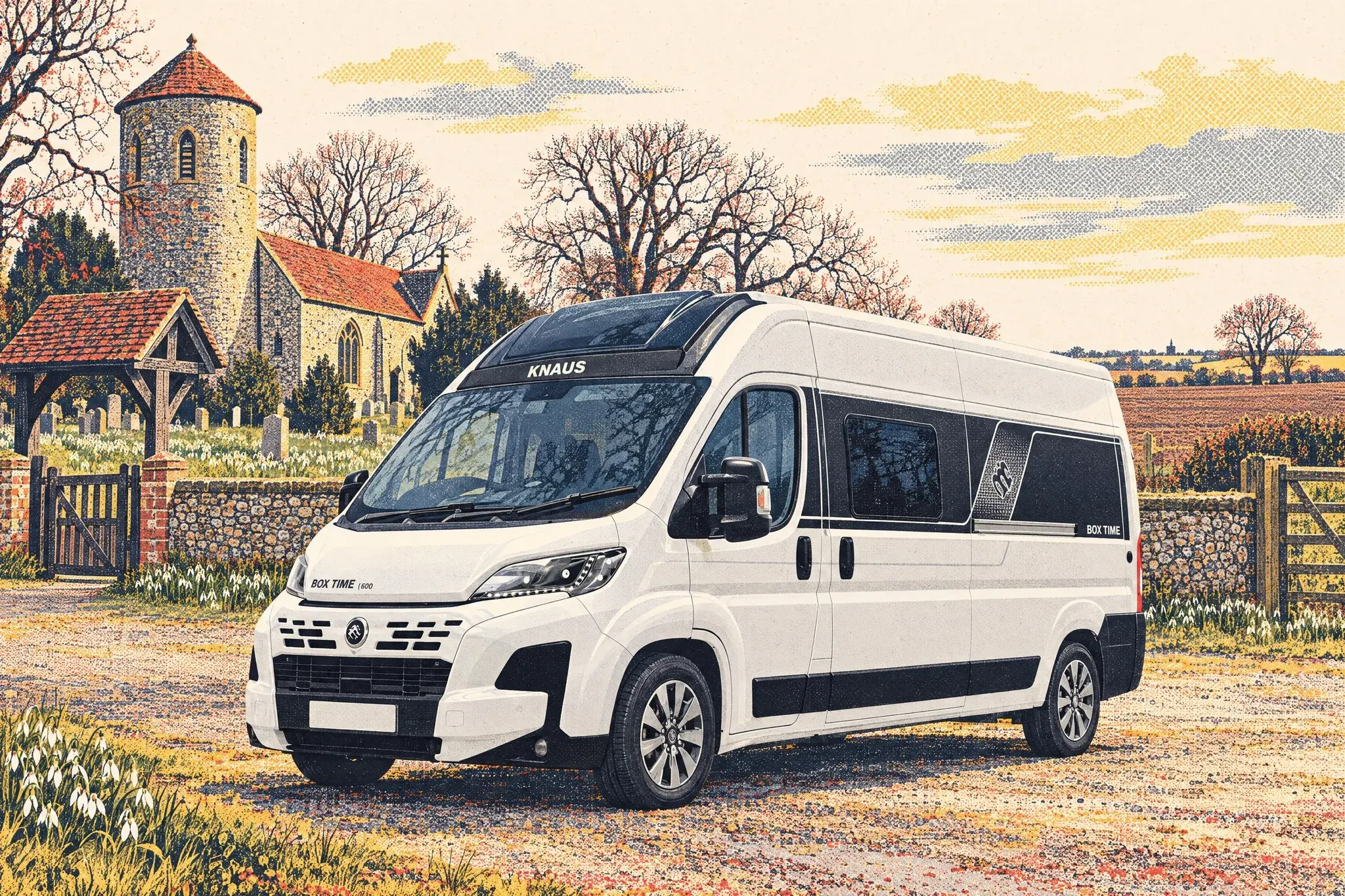
Knaus Boxtime 600 ME (2027): twin singles in 6 m, and the payload figure to question
Knaus's new Boxtime 600 ME squeezes two lengthways single beds into a 5.99 m van from £81,725. We lay out what that layout gives a couple, run the weight sums with Knaus's own figures, and explain why the 211 kg 'maximum payload' line needs a question before you sign.
New & Noteworthy
10 min read
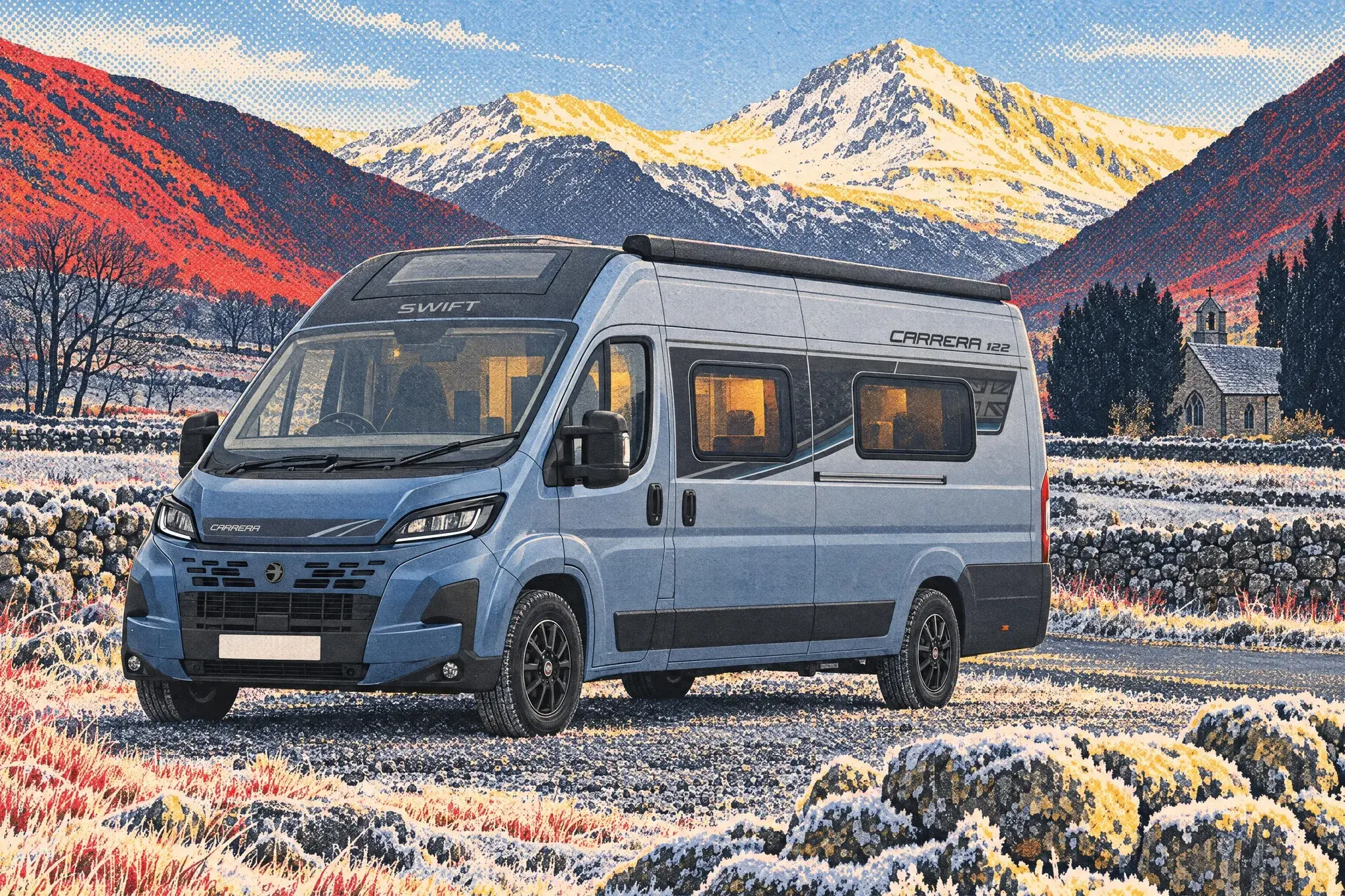
Swift Carrera goes gas-free for 2027: 340Ah lithium, diesel heat and induction cooking
Swift has taken the gas out of its Carrera campervan for 2027, swapping bottles for a 340Ah lithium battery, diesel heating and an induction hob. Here is what that means across a real UK year, how it compares with the cheaper Merlin, and the one question to ask at the NEC.
New & Noteworthy
10 min read
British campervan converters at the NEC 2026: who builds on what, and for how much
A stand-by-stand map of the British campervan converters at the Motorhome and Caravan Show 2026: the vans they build on, their from-prices, seats, roofs and lead times, plus the four questions to put to every one of them.
New & Noteworthy
9 min read
Plug-in hybrid campervans at the NEC: what a PHEV gives you and why full EVs are rare
Four UK converters have hybrid campers at or around the Motorhome and Caravan Show this October, while fully electric campers remain scarce. Here is what a plug-in hybrid camper does well, what the sellers rarely tell you, and the questions to ask on the stand.