Alex Honnold's Campervans: A Decade in a Van, Three Rigs, and a Foundation That Started on the Road
Written by
Oliver
Oliver is the founder of Campervan.win and writes about campervans, travel, and the life-changing freedom that comes with getting out on the road.
The short answer
Alex Honnold, the climber who free-soloed El Capitan in the Oscar-winning Free Solo, lived in a van for over a decade before van life was ever a hashtag, and his story is a lovely reminder of what it is really about. He started in a 2002 Ford Econoline E150 he bought in 2007 (a Goal Zero power station and roof solar, nearly 200,000 miles over nine years), upgraded around 2016 to a Dodge Ram ProMaster, and now runs a Forged Vans build with 900 watts of solar on the roof. From 2012 he donated a third of his income to solar projects, which grew into the Honnold Foundation. His point is a freeing one: the van is not the thing, it is what gets you there. Here are his three rigs, and the decade on the road behind them.

You probably know Alex Honnold as the man who climbed El Capitan without a rope. Three thousand feet of vertical granite in Yosemite National Park, no harness, no safety net, just hands and shoes and a level of composure that made neuroscientists genuinely curious about how his brain works. The documentary Free Solo captured that climb, won an Academy Award in 2019, and turned Honnold into one of the most recognised athletes on the planet.
What a lot of people missed, or at least did not dwell on, was where Honnold went afterwards. He climbed down. He walked back to the car park. And he got into his van.
That van was not a prop. It was not a brand partnership or a weekend hobby or a photogenic backdrop for social media. It was where he lived. It had been where he lived for over a decade by that point. A decade of waking up in car parks, cooking on a single burner, sleeping on a crash pad, and driving to wherever the weather and the rock were good. Long before van life was a hashtag, before Instagram made it aspirational, before custom builds with marble countertops and ambient lighting became a thing, Honnold was already doing it. He was just doing it with a lot less marble and a lot more chalk dust.
His story matters here because it is one of the most honest accounts of living in a van that exists in public life. Not romanticised. Not curated. Just a bloke who needed to be mobile, chose the simplest vehicle he could find, and got on with it for years. The vans he has owned along the way tell their own story about what works, what does not, and what changes when your life changes around you.
The beginning: a minivan and a bicycle
Before the vans, there was something even simpler. Honnold grew up in Sacramento, California. His father, who had encouraged him to stay in education, passed away from a heart attack while Honnold was in his first year studying civil engineering at UC Berkeley. His parents had divorced around the same time. The combination knocked his focus sideways, and climbing, which had been part of his life since he was eleven, became the thing that still made sense.
He dropped out of university and spent time driving around California in his mother's old minivan, heading to Joshua Tree, Los Angeles, wherever the climbing was. That minivan died on him eventually, and for a stretch he lived on a bicycle and in a tent. No vehicle at all. Just a young man with a harness and a chalk bag, sleeping rough and climbing every day.
That period matters because it puts everything that followed into context. When Honnold eventually bought a van, it was not because van life looked appealing. It was because he had already tried the alternative and it was worse.
Van one: the 2002 Ford Econoline E150
In 2007, Honnold bought a 2002 Ford Econoline E150. If you have seen Free Solo, you have seen this van. It is the one parked in Yosemite Valley, doors open, gear everywhere, Honnold sitting in the front seat eating blueberries with the calm detachment of someone who has just spent the morning doing something that would make most people physically sick with fear.
The Econoline was not a conversion in any meaningful sense. It was a panel van with a bed platform, a Coleman camp stove bolted to a counter, a cooler instead of a fridge, and a five gallon water jug that Honnold would tip up when it ran low because plumbing was apparently a bridge too far. The bed was not quite long enough for him, so he slept at an angle. The storage was tight enough that he could only carry one season of gear at a time. Summer kit or winter kit. Whichever was not in the van lived at his mother's house.
He slept on a crash pad in a sleeping bag. No sheets. No mattress. Just the pad he would have been using at the crag anyway, repurposed as a bed. He later admitted that this arrangement was not ideal for having a girlfriend, which may be the most understated observation in the history of campervan living.
The electrical system was a Goal Zero Yeti 400 portable power station, charged by two roof mounted solar panels. That was it. No split charge relay, no mains hook up, no inverter. Just solar and a battery box. For a man who spent most of his time outdoors and whose electrical needs amounted to charging a phone and a laptop, it was enough.
The Econoline racked up close to 200,000 miles over nine years. It took him across the United States, through every climbing season, to every crag and boulder field and big wall that mattered. It was basic in a way that would make most modern van lifers wince. And it worked perfectly for what he needed it to do.
There is a lesson in that van, and it is not about minimalism for its own sake. It is about clarity of purpose. Honnold did not need a comfortable home. He needed a way to be near rock. The Econoline did that job for nine years, and he never once described it as a lifestyle choice. It was logistics.
Van two: the 2016 Dodge Ram ProMaster
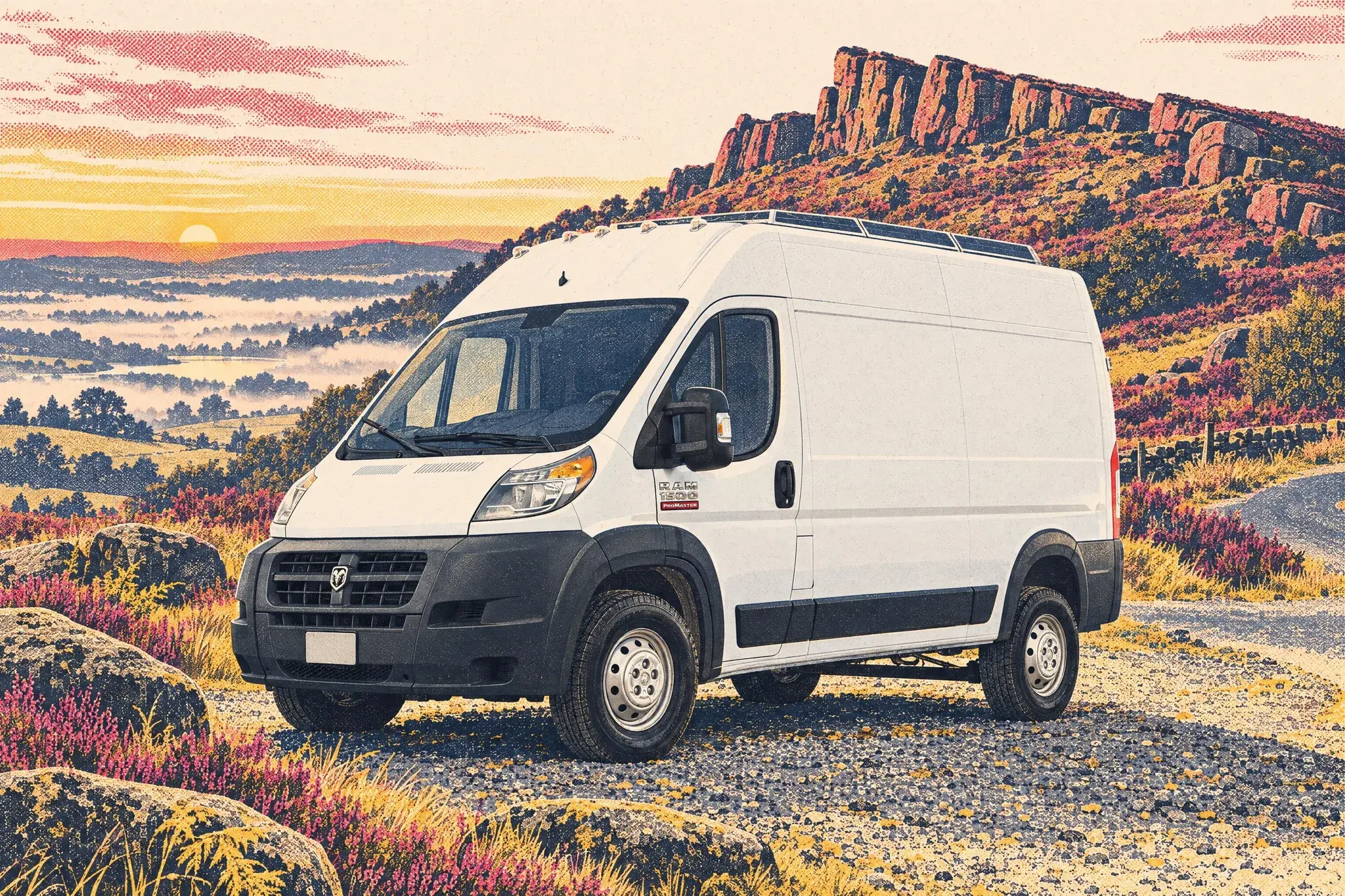
Around 2016, Honnold upgraded to a 2016 Dodge Ram ProMaster. The build was done by fellow professional climber Mason Earle, and the difference was immediately obvious. The ProMaster was taller, wider, and built with the kind of thoughtful details that only someone who understands van living from the inside would think to include.
He could stand up. That alone was a significant upgrade. The bed was a proper full length bed with actual sheets and a comforter rather than a sleeping bag on a crash pad. There was a three burner propane stove, an oven, a sink, and a fridge. The old cooler and camp stove setup was gone. The kitchen was modest by campervan standards but genuinely functional in a way the Econoline's never was.
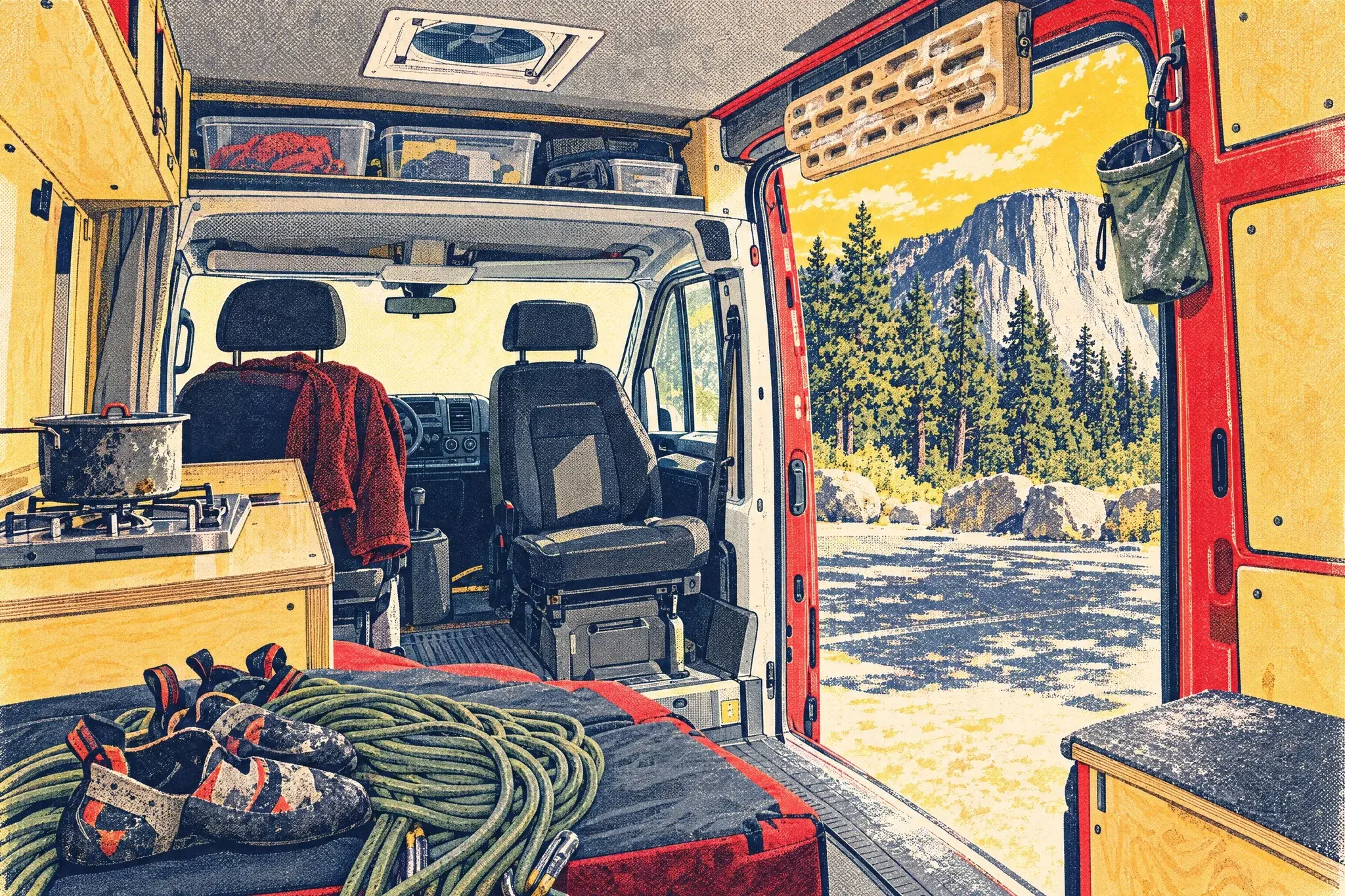
The gear storage was transformed. A massive pull out rear drawer, custom sized to fit a crash pad, held climbing hardware: cams, draws, shoes, chalk, bolts, pitons, a drill, and what Honnold described as enough random aid climbing gear to fill a drawer that needed to be a big drawer. The old van could only carry one season of equipment. The ProMaster could carry everything.
There were details in the build that showed a climber's hand. Repurposed Black Diamond cam lobes served as drawer latches, keeping everything shut while driving. An etched outline of El Capitan decorated the inside of the van doors. The propane tank was mounted externally, with a carbon monoxide detector fitted inside, because the builder insisted on doing things properly even if Honnold admitted he would not have bothered.
The ProMaster was the van from the peak of Honnold's public profile. It was parked in Yosemite when he free soloed El Capitan in June 2017, completing the 2,900 foot Freerider route in three hours and fifty six minutes. It appeared in Free Solo and in the press coverage that followed. It became, without Honnold intending it, one of the most famous campervans in the world.
But here is the telling detail. Even with the upgrade, even with the fridge and the oven and the proper bed, Honnold's view of van life did not change. He told interviewers repeatedly that he did not find van life particularly appealing. He did not love living in a vehicle. He loved climbing, and the van was the most comfortable way to climb all the time.
That honesty is rare. Most people who talk about van life publicly are selling something, whether it is a product, a brand, a dream, or just a version of themselves that looks good in warm light with the door open. Honnold never did that. He talked about van life the way a plumber talks about a work van. It is the thing that gets you to the thing.
The van gets wrecked, and life changes
A few years ago, Honnold wrecked the ProMaster. The van from Free Solo, the one that had been parked in Yosemite Valley during arguably the greatest athletic achievement of its generation, was gone. He described it with characteristic understatement: we all make mistakes sometimes.
But the timing turned out to be strangely apt. Shortly after the accident, Honnold discovered that his wife Sanni McCandless was pregnant with their first child. They needed a different van. One with space for a car seat.
In the years between the ProMaster and the new build, Honnold had also bought a house in Las Vegas. Though in a detail that surprises nobody who has followed his story, he continued living in the van for a while because the house had no furniture. Even with a fixed address, the van remained central to how he operated. He estimated he spent about half his time in the van, always returning to Yosemite, always following the climbing.
Van three: the Forged Vans solar build
The current van was built by Arjan de Kock of Forged Vans, a South African born climber turned van builder based in Colorado whose client list reads like a directory of professional climbing. De Kock grew up touring the African continent with his family in a vehicle similar to a Westfalia, sleeping on mattresses in the savanna under the stars. He moved to the United States after losing his family's grape farm during the pandemic, and turned his obsession with outdoor vehicle builds into a business. He has since customised around forty vans, mostly for climbers and skiers, working largely alone.
De Kock built Honnold's van with his values and climbing style at its centre. The headline feature is the solar system. The entire roof is covered with 900 watts of solar panels, powering all of the van's electricity. There is no gas stove this time. An induction hob runs off the solar power, which Honnold says is faster and eliminates the issue of burning gas in a confined space. For a man whose foundation exists to bring solar energy to underserved communities around the world, powering his own van entirely from the sun has an obvious symmetry.
A fingerboard is installed in the doorway for training when the weather shuts down a climbing day. The rear gear storage is built around the specific dimensions of a crash pad. The van is designed for a family now, with space for a car seat and the practical requirements of travelling with small children. Honnold and McCandless have two children, and the van needs to work for all of them.
De Kock's approach to the build reflects something that the wider campervan industry often misses. He works one on one with each client, building around their specific needs rather than producing a generic layout. For Honnold, that meant prioritising solar capacity, training features, gear access, and the kind of robust simplicity that suits someone who uses a van as a tool rather than a showpiece.
The Honnold Foundation: what started in the van
While living in the Econoline, Honnold started thinking about what to do with the money he was earning from climbing sponsorships. He was living cheaply. His expenses were fuel, food, and climbing gear. The van was paid for. There was not much to spend money on.
He started researching global issues and kept coming back to two things: poverty and climate change. The intersection, he realised, was energy. An estimated billion people worldwide lacked access to basic electricity. Without power, there were no sewing machines, no rice mills, no way to build the economic foundations that lift communities out of poverty. And the energy that could reach those communities without adding to the climate problem was solar.
In 2012, Honnold began donating a third of his annual income to solar energy projects. That commitment grew into the Honnold Foundation, co-founded with his climbing partner Maury Birdwell. The idea was conceived on the drive home from a climbing trip. With Yosemite as their office and the van as their headquarters, they built the framework for a nonprofit that would fund grassroots solar energy projects in marginalised communities worldwide.
The foundation has grown considerably since those early days. It employs a small team and manages a multi-million dollar budget, with the majority going directly to grants. It has funded over seventy core projects across dozens of countries. The work ranges from installing rooftop solar on a remote island in the Amazon to building the largest solar installation in West Virginia in partnership with former coal mining communities. In Puerto Rico, the foundation led a significant investment in the town of Adjuntas, helping to create a cooperatively managed, community owned microgrid that provides reliable power to local businesses after Hurricane Maria left residents without electricity for months.
The foundation's approach is deliberately trust based. It funds grassroots organisations with established histories in the communities they serve, provides unrestricted grants, and offers ongoing support rather than one off funding. It prioritises workforce development alongside infrastructure, training local people in solar installation and maintenance so that projects become self sustaining rather than dependent on outside expertise.
There is a direct line from the van to the foundation. The solar panels on the Econoline's roof were Honnold's first practical experience of living off grid with solar power. The simplicity of that system, charging a phone and a laptop from two panels and a portable battery, demonstrated what solar could do at the smallest scale. The foundation works at a larger scale, but the principle is the same: accessible, affordable energy that reduces environmental impact and improves lives.
What Honnold's van life teaches the rest of us
There is a temptation to treat Honnold's van story as aspirational. The free spirited climber, living simply, following his passion, unburdened by mortgages and office politics and all the other weight that most people carry. And there is something to that. He proved, over more than a decade, that you can live a full and extraordinary life from a very small space.
But the more honest reading is more useful. Honnold did not romanticise van life. He was consistently clear that he did not love living in a vehicle. He loved what the vehicle allowed him to do. The van was a means, never an end. And when his life changed, when he got married, had children, bought a house, the van changed too. It became a tool he used half the time rather than all the time. It became bigger, more capable, more suited to a family. The crash pad bed became a proper mattress. The Coleman stove became an induction hob. The upgrade was not a betrayal of the original idea. It was the same idea, adapted.
For anyone considering a campervan, that perspective is worth more than a thousand Instagram posts. The question is not whether a van looks good with the door open and a sunset behind it. The question is whether a van gets you closer to the thing you want to do. For Honnold, that was climbing. For you, it might be surfing, or walking, or just being somewhere quiet with a cup of tea and no particular agenda. The vehicle is the enabler. The life is the point.
His progression through three vans also mirrors something that a lot of campervan owners experience. You start with whatever you can afford. It is rough, it is basic, it works. Then you upgrade, because you have learned what matters and what does not. The fridge matters. The bed length matters. Standing height matters. The shower, apparently, still does not matter that much, even in the third van.
And along the way, if you are paying attention, you figure out what your version of enough looks like. Honnold found it early. For most of us, it takes a bit longer. But a campervan is a good place to start looking.
From the Econoline to Taipei 101
In January 2026, Honnold stood on top of Taipei 101, one of the tallest buildings in the world, having free soloed the entire structure without ropes in an hour and thirty one minutes while millions watched live on Netflix. He was forty years old, a father of two, and still the most audacious climber on the planet.
After the climb, his wife Sanni met him on a balcony below the spire. She told him she had been having a panic attack the entire time. He took a selfie.
Somewhere, a van with 900 watts of solar on the roof and a fingerboard in the doorway was waiting to take him to the next climb. It is still the same story. The van is not the point. The van is what gets you there.
And if owning a campervan of your own still feels like a stretch, well, that is exactly why we run Campervan.win. Someone has to make these things accessible.
Common questions
Did Alex Honnold really live in a van?
Yes, for over a decade, long before van life was a hashtag. The climber who free-soloed El Capitan lived out of a van, waking up in car parks, cooking on a single burner and driving to wherever the rock and weather were good. He was doing it with a lot less marble and a lot more chalk dust than the modern Instagram version.
What vans has Alex Honnold owned?
Three main rigs. He started with a 2002 Ford Econoline E150 bought in 2007, fitted with a Goal Zero Yeti 400 power station and two roof solar panels, which covered close to 200,000 miles over nine years. Around 2016 he upgraded to a 2016 Dodge Ram ProMaster, and he now runs a Forged Vans build with 900 watts of solar on the roof.
What van was Alex Honnold living in when he climbed El Capitan?
His 2016 Dodge Ram ProMaster, which was parked in Yosemite when he free-soloed El Capitan in June 2017, completing the 2,900-foot Freerider route in three hours and fifty-six minutes. The climb featured in the documentary Free Solo, which won an Academy Award in 2019.
What is the Honnold Foundation?
It is Alex Honnold's solar-energy charity, which grew out of his van life. From 2012 he began donating a third of his annual income to solar energy projects, and that giving became the Honnold Foundation, which supports solar access for communities. The simple, low-power, solar-run life on the road fed directly into the cause.
What does Alex Honnold's van life teach the rest of us?
That the van is not the point; the van is what gets you there. His decade on the road was about reaching the climbs cheaply and simply, with a single burner, a crash pad and a few solar panels, rather than about the vehicle itself. It is a useful corrective to a van-life culture that can fixate on marble countertops and ambient lighting.
The reachable bit
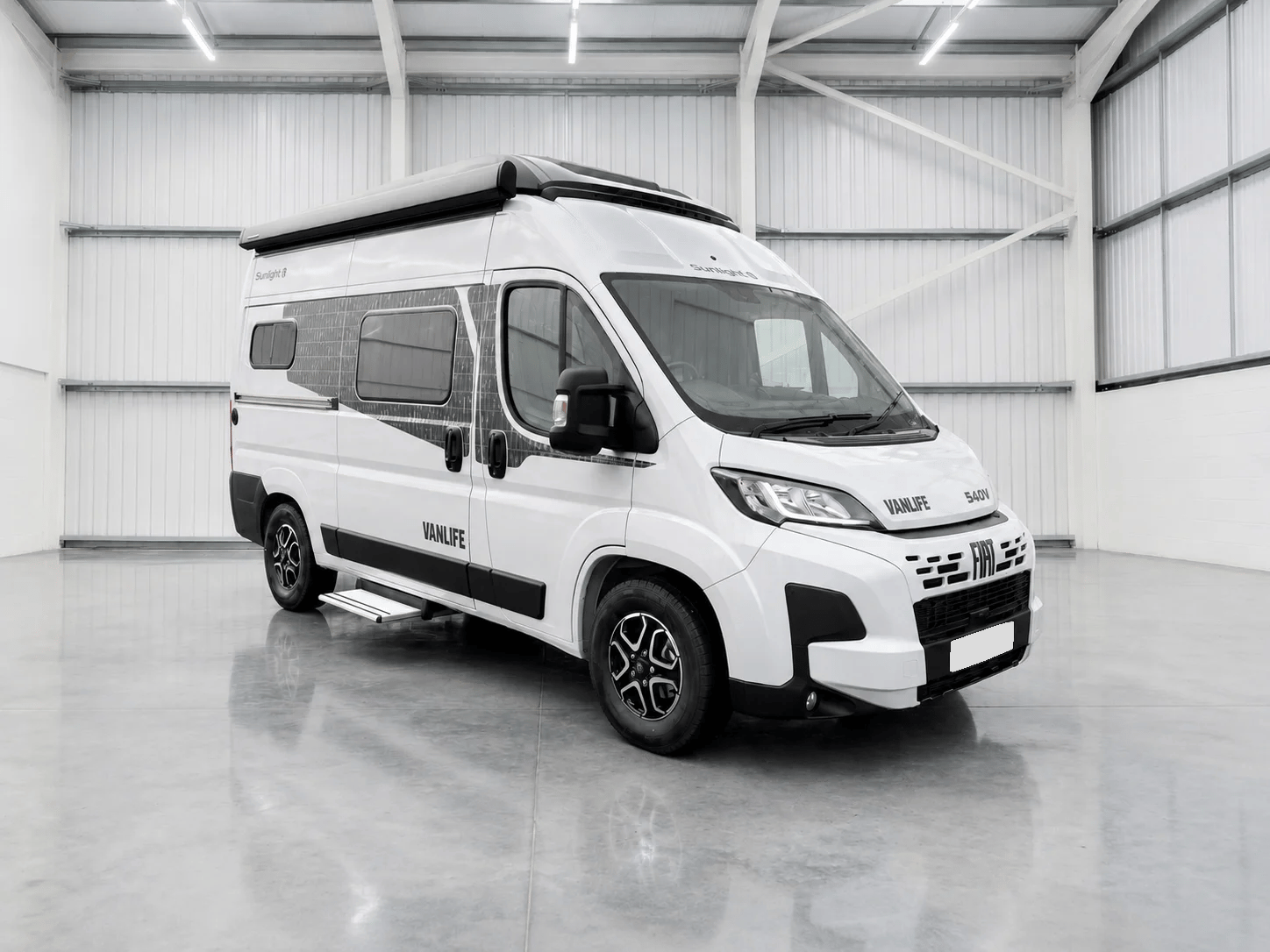
The camper you fall for is rarely the one you can afford. That gap is the whole reason Campervan.win exists. Right now we’re giving away the Sunlight Vanlife, worth around £65,000, and closing that gap is the point: capped entries so the odds stay honest, £10 a ticket, a maximum of five per person, £500 to a UK charity from every full draw, the winner picked by a public randomness beacon anyone can re-check, and one person driving away in the van itself.
Enjoyed this post?
Get more honest campervan guides like this one in your inbox.
You’re in!
Check your inbox. We’ve just sent you a welcome email.
About the author
Oliver
Oliver is the founder of Campervan.win and writes about campervans, travel, and the life-changing freedom that comes with getting out on the road.
Keep Reading
Related Reading
Thoughtful articles that build on what you’ve just read.
TV & Movie Campervans
10 min read
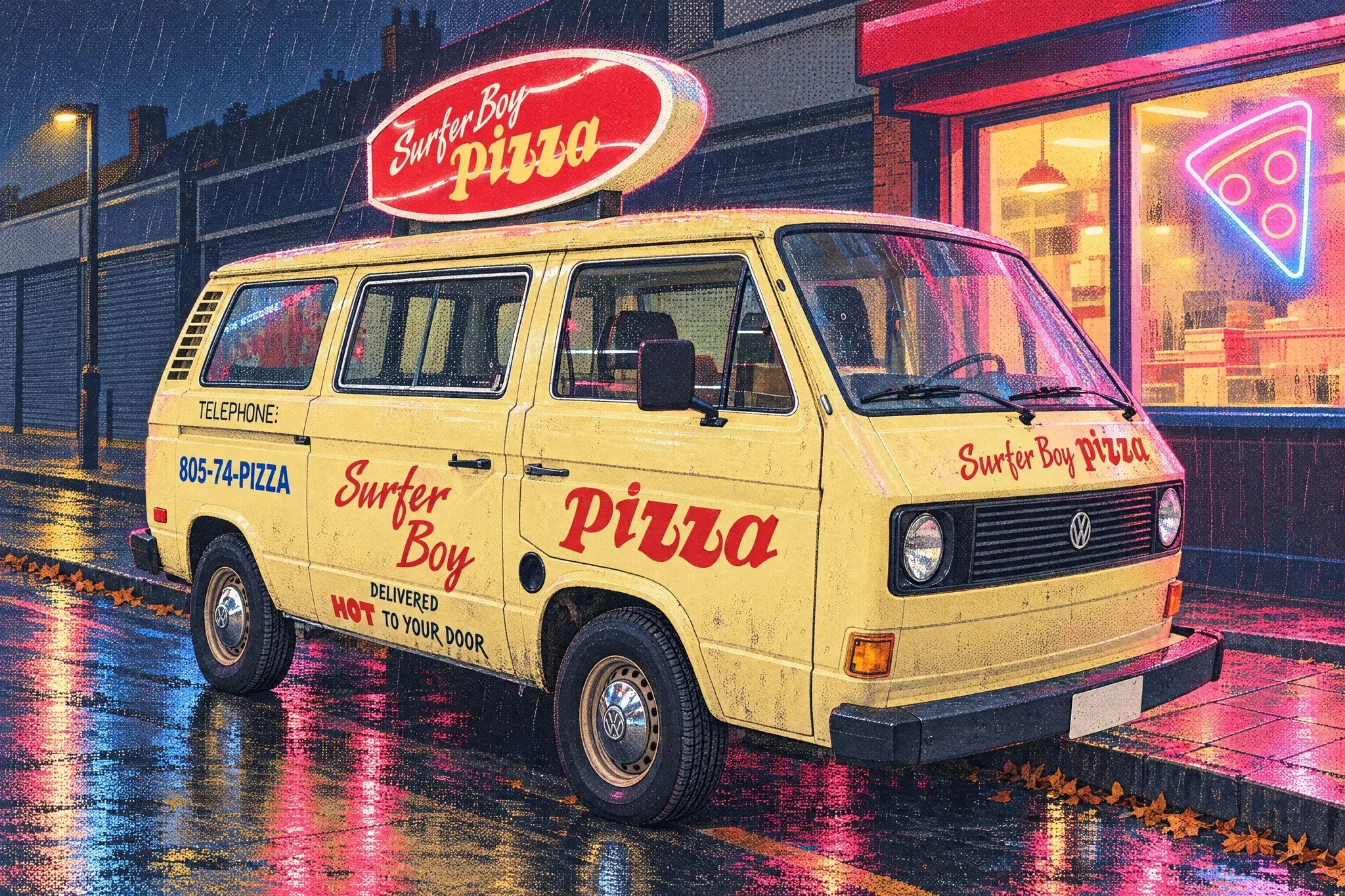
The Surfer Boy Pizza campervan in Stranger Things: the VW that stole season 4
Stranger Things season 4 gave us one of the most memorable campervan shaped vehicles on TV: the Surfer Boy Pizza van. This post covers what the van actually is in real life, why a VW T3 was the perfect choice for the show, what it might be like to drive, and how popular it became through model kits, Funko figures, a remote control version and even a Transformers crossover.
TV & Movie Campervans
10 min read
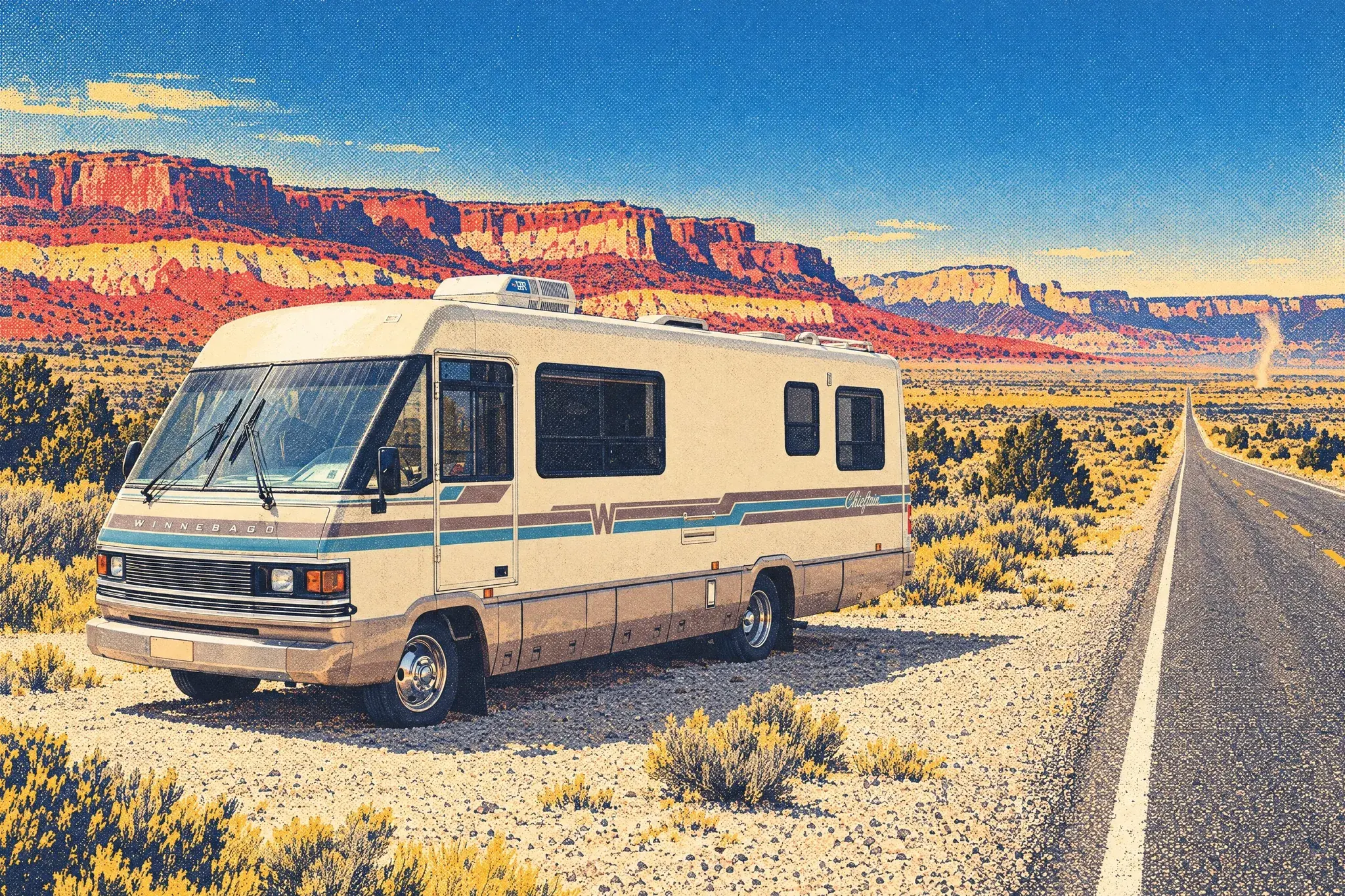
Paul and the rented motorhome that makes American touring look both ridiculous and irresistible
Paul is a modern classic road film for anyone who has ever daydreamed about hiring a huge American motorhome and disappearing into the desert. The motorhome is the punchline, the sanctuary, and the temptation all at once. Here is what the film’s RV actually was, why it works so well on screen, and what it gets right about the reality of touring on an American scale.
New & Noteworthy
12 min read
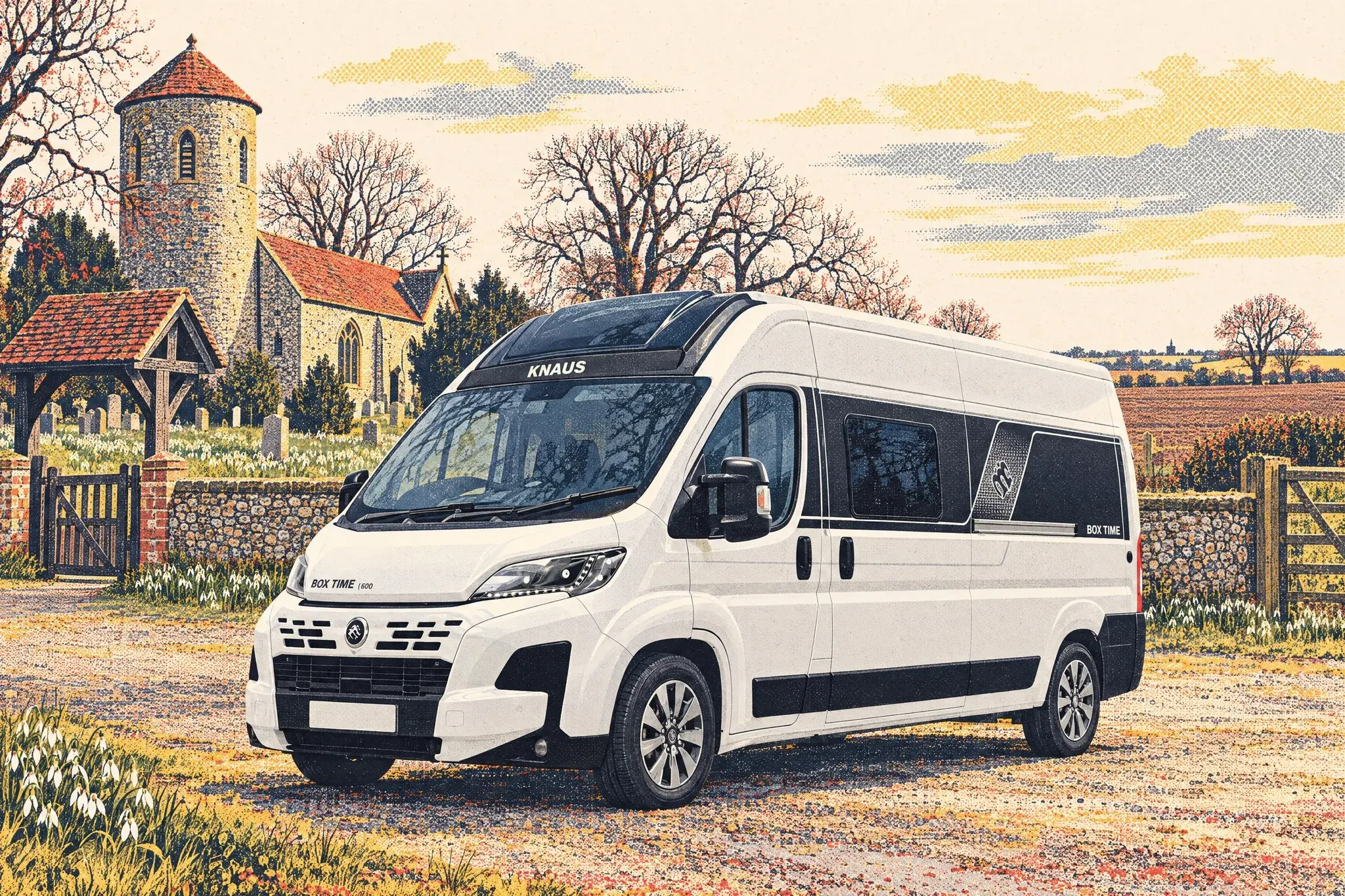
Knaus Boxtime 600 ME (2027): twin singles in 6 m, and the payload figure to question
Knaus's new Boxtime 600 ME squeezes two lengthways single beds into a 5.99 m van from £81,725. We lay out what that layout gives a couple, run the weight sums with Knaus's own figures, and explain why the 211 kg 'maximum payload' line needs a question before you sign.
New & Noteworthy
10 min read
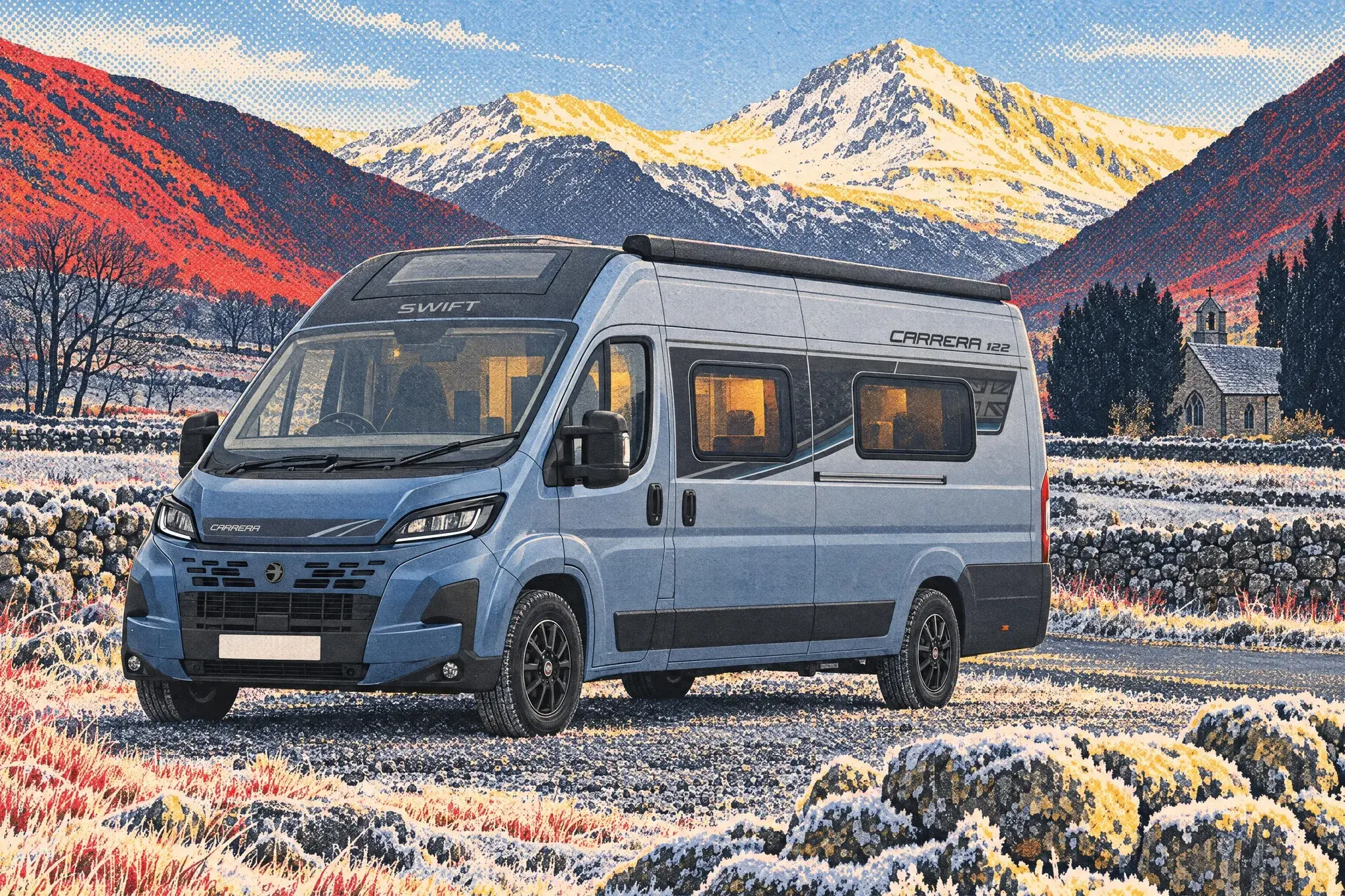
Swift Carrera goes gas-free for 2027: 340Ah lithium, diesel heat and induction cooking
Swift has taken the gas out of its Carrera campervan for 2027, swapping bottles for a 340Ah lithium battery, diesel heating and an induction hob. Here is what that means across a real UK year, how it compares with the cheaper Merlin, and the one question to ask at the NEC.