
Auto-Trail Adventure 2027: the overcab is back, and two options change your licence

Written by
Martha
Martha writes about interiors, ownership stories, and the everyday realities of campervan life, with a focus on comfort, cost, and how vans are used over time.
The short answer
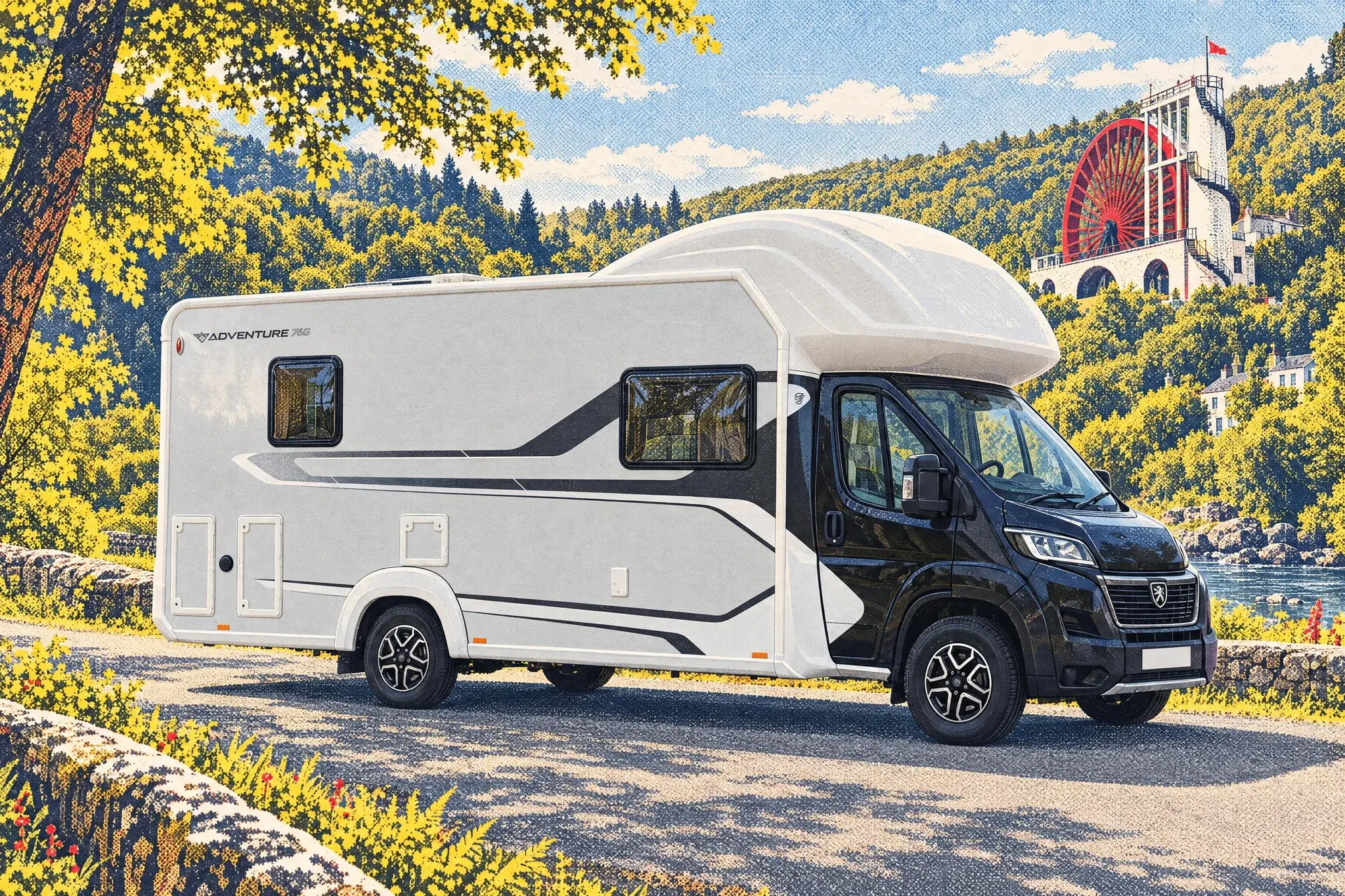
The 2027 Auto-Trail Adventure is an overcab coachbuilt on a Peugeot Boxer in four layouts (64, 74, 76 and 76G), all four-berth with four travel seats as standard. The 7.29 m models list at £71,000 ex-works plus £455 on the road. Two options, six belts (3,650 kg) and the 180bhp automatic (4,400 kg), take it above 3,500 kg, which means C1 for post-1 January 1997 drivers and Private HGV tax.

Auto-Trail has built a new motorhome with a bed above the driver's seat. The 2027 Adventure is an overcab, or Luton, coachbuilt range on a Peugeot Boxer, and it makes its public debut at the Motorhome and Caravan Show at the NEC this month. For a family of four it is an appealing idea: a permanent bed over the cab leaves the back of the van free to be a lounge, an island bed or a garage. The longer models list at £71,000 ex-works plus £455 on the road, which is keen money for a new coachbuilt. But two lines in the options list quietly move the van above 3,500 kg, and that changes who can drive it and what it costs to tax.
What the new Adventure is
The range comes in four layouts: the 64 with an end washroom, the 74 with an island bed, the 76 with a rear lounge, and the 76G with a transverse bed over a garage. Practical Motorhome reported on 2 October 2026 that the range would be unveiled at the NEC, that every layout is a four-berth with four travel seats, and that all come with a three-way Thetford fridge and Truma CombiNeo heating. Auto-Trail's own show page says the Adventure is built on the Peugeot Boxer chassis in two lengths, has 200W of solar as standard, uses a new Luton overcab bulkhead, and is laid out for four travellers. Auto-Trail's 2027 leaflet says every vehicle offers four berths and four travelling seats as standard, and that the range is built on the Peugeot chassis with an all-new bodyshell.
Auto-Trail's 2027 price list, dated 1 September 2026, names the standard engine as a Peugeot Boxer 140bhp manual, lists MTPLM figures of 3,500, 3,650 or 4,400 kg, and gives the Peugeot base-vehicle warranty as two years plus one year of Peugeot Roadside Assistance. Ask the dealer for the written warranty terms, so you know exactly what is covered.
One point of naming to clear up. Auto-Trail already sells a panel-van campervan called the Adventure 65, which its website describes as a 6.36 m four-berth with a pop-top roof bed and a Fiat engine. That is a different vehicle. The new coachbuilts share the Adventure name but not the body, the base or the bed arrangement, so check that any listing you read is for the overcab range.
Auto-Trail's show page says the Adventure launch is the highlight of its stand in Hall 8, stand 8.30, with the 64, 76 and 76G on show. The 74 is not named as being on the stand, so if the island bed is the one you want, ask before you travel.
Why an overcab works for four
A low-profile coachbuilt that sleeps four usually does it with a drop-down bed over the lounge, or by converting the dinette every night. An overcab gives you a permanent bed over the cab that never needs making up, and in a family it tends to become the children's den: their bedding stays where it is, their books and torches live up there, and the adults get the rear of the van to themselves. Because the upstairs bed is permanent, the floor plan behind the cab does not have to double as sleeping space, and that is how Auto-Trail gets four quite different layouts out of one bodyshell.
Adventure 64: end washroom
The shorter of the two, with the washroom across the back. On a van this length that typically means the living space sits between the cab and the washroom. Ask the dealer how the downstairs bed is made up. Ask for the bed dimensions of your layout in writing, especially if anyone sleeping downstairs is tall.
Adventure 74: island bed
A walk-around bed at the rear is the layout most couples ask for in a coachbuilt, because you can each get out of bed without climbing over the other. Pairing it with the fixed overcab bed means four fixed sleeping places with no nightly conversion at all.
Adventure 76: rear lounge
A rear lounge is the sociable choice: a big seating area, which on a wet afternoon in the Lakes is worth a great deal. Ask the dealer how the downstairs bed is made up, so you know how it compares with the 74 at bedtime.
Adventure 76G: transverse bed over a garage
A bed across the rear with a garage beneath it is the layout for bikes, kayaks, surfboards and the mountain of kit that four people generate. The trade-off is a bed you climb up to, and a garage that is only useful if the payload lets you fill it.
What it costs
Auto-Trail's price list puts the 7.29 m models at £71,000 ex-works including VAT, with on-the-road charges of £455 on top. That gives £71,455 on the road for the 74, 76 and 76G. Auto-Trail's 2027 price list gives £68,500 for the 64, ex-works including VAT, which with the £455 charges matches the £68,955 dealer figure. Leisure Kingdom lists the manual 64 at £68,955 on the road and the manual 74, 76 and 76G at £71,455. That makes the 64 £2,500 cheaper than the longer models. Spinney lists a six-speed manual 76G at £71,000 on the road, £455 under the list-plus-OTR figure. Continental lists automatics at £75,450 for the 64 and £77,950 for the 74, 76 and 76G. Both of Continental's automatic figures sit £6,495 above the equivalent manual prices, which is more than the £2,850 the list charges for the 140bhp automatic alone, so ask exactly what engine, gearbox and packs that figure includes.
Practical Motorhome lists three packs: Premium at £1,395, Drivers at £1,395 and Lifestyle at £2,250. Get the itemised contents of each pack and, just as important, the weight of each. Elite Motorhomes is advertising a free Premium Pack, which it values at £1,395, on the Adventure for the show, and Continental says it will include a free Premium Pack on all orders placed during the show. If you are ordering this month, that is worth having, but a free pack still weighs what it weighs.
The two licence traps in the options list
At its standard 3,500 kg plate the Adventure sits inside a category B car licence. Two options change that, and neither is flagged as a licence decision on the page.
Six belts means 3,650 kg
The price list offers a six-belt option at £995 on the 76 and 76G only, with a note that the 3,650 kg GVW upgrade is required and comes free of charge. There is no six-belt option on the 64 or 74. So a six-seat Adventure is always a 3,650 kg Adventure. Anyone who passed their car test on or after 1 January 1997 holds category B only, which covers a motor caravan up to 3,500 kg; to drive a 3,650 kg van legally they need C1, which means applying for provisional entitlement with forms D2 and D4, a doctor-completed medical, a theory test and a practical test in a suitably heavy vehicle. Drivers who passed before 1 January 1997 already hold C1 under acquired rights until their 70th birthday, after which keeping it means a postal renewal with a D4 medical every three years.
The 180bhp automatic means 4,400 kg
The price list offers a 180bhp 8-speed automatic with a 4,400 kg heavy chassis, and states that the Adventure 64 is not available with it. Auto-Trail's price list puts it at £6,355 including VAT. The same licence logic applies, but with a much bigger weight: 4,400 kg is 900 kg above the car-licence limit. The upside is that the heavy chassis should improve the payload picture, which is the strongest argument for choosing it if someone in the family holds C1. The 140bhp 8-speed automatic at £2,850 keeps the standard plate, and Isofix is a separate £149 option.
Tax and speed
Going above 3,500 kg revenue weight moves the van into the Private HGV tax class, TC10, which for 2026 to 2027 is £177 a year. At or under 3,500 kg it is TC11, £375 a year for an engine over 1,549 cc. So the heavier plate is £198 a year cheaper to tax, not dearer. Check GOV.UK for the live rates before relying on them. Speed limits are a separate question, decided by unladen weight, not the plate: at or under 3.05 tonnes unladen you get car limits; over that it is 50 mph on single carriageways and 60 mph on dual carriageways. Unladen weight excludes fuel, water and the driver, so it is lower than the running-order figure. Read it off the V5C or the certificate of conformity rather than guessing from the brochure.
Payload at 3,500 kg is the decisive number
A four-seat, four-berth coachbuilt on a 3,500 kg plate lives or dies by its mass in running order, so ask for the figure for your layout before you sign. What we do have is Auto-Trail's own definition. Auto-Trail's own weight guidance says its running-order figure includes the fresh tank at 100 per cent of its reduced travel volume, a full 16 kg aluminium gas bottle, fuel at 90 per cent and a 75 kg driver, and that the figure carries a tolerance of plus or minus 5 per cent.
Four adults at 75 kg each is 300 kg, but the driver is already counted, so 225 kg goes on top of the running-order figure. Auto-Trail's worked example shows a 2,910 kg running-order figure, a 225 kg allowance for three passengers, 100 kg of factory options and a payload of 265 kg, with the 5 per cent tolerance equal to 146 kg either way. That example is generic rather than an Adventure figure, but it shows the shape of the sum: on a 3,500 kg van, every pack, awning, bike rack and automatic gearbox comes straight out of what the family can carry. Auto-Trail says the number of belted seats can be reduced by option choices and that some options require the load capacity to be increased. Auto-Trail's minimum-payload formula is 10 kg multiplied by the number of belted seats plus the length in metres, which for a four-seat 7.29 m van is around 113 kg. That is a legal floor, not a comfortable family allowance.
Before you order, ask the dealer for three numbers in writing: the mass in running order for your exact layout, the weight of every option and pack you have ticked, and the payload that remains with four people aboard.
If the answer leaves you with less than you need, the 3,650 kg plate adds 150 kg of plated weight, and the 4,400 kg chassis adds 900 kg, though the heavier chassis and 180bhp automatic will weigh more themselves, so ask for that version's running-order figure too. Both bring the licence question back into play.
Height and the cost of the bed up top
Dealer listings give the Adventure's height as 3.10 m. Anything over 3 m must display its height in the cab, so expect a height sticker and get used to checking it against every barrier and bridge. The Luton box also sits in the airflow above the cab, and however well the new bulkhead is shaped, a 3.10 m slab of motorhome uses more fuel into a headwind than a low-profile does, so budget cautiously for fuel. Ferry operators generally price by length and height bands, so check where 7.29 m and 3.10 m land on the crossings you use. The payoff for all of it is the permanent bed, and for a family that is often a fair trade.
The 64 or the 7.29 m models?
The 64 is the shorter van, around 6.37 m against 7.29 m for the 74, 76 and 76G. It is £2,500 cheaper on the dealer figures, easier on narrow lanes and campsite pitches, and keeps four berths and four belts. Against that, it has the end washroom layout only, cannot be ordered with six belts or the 180bhp automatic, and gives up the island bed, rear lounge and garage. A shorter body should also weigh less, which helps payload at 3,500 kg, but confirm that with the running-order figure rather than assuming it. If your family is settled at four and you want the most manoeuvrable version, the 64 is the sensible start. If you ever expect to carry six, only the 76 and 76G take the six-belt option, and only the 76G has the garage.
What to confirm in writing before you order
Early listings for a brand-new range do not always agree, and the Adventure already has a few loose ends.
- Berths and belts. Two dealer listings quote six berths or six belts for the 76 and 76G. Auto-Trail's standard is four and four, and six belts is a paid option that brings the 3,650 kg plate with it. Auto-Trail's price list offers six belts but no six-berth option, so if a listing says six sleep, ask where the extra two sleep and get it on the order.
- Length. Auto-Trail's leaflet shows the two lengths as 6.34 m and 7.25 m on its range page but 6.37 m and 7.29 m on its spec page and the price list. A few centimetres matters for a drive or a storage bay, so take the spec-sheet figure and measure the real van.
- Gearbox. Continental lists its 64 as an automatic while the description says six-speed manual. Have the gearbox and power output named on the order form.
- Plated weight. 3,500, 3,650 or 4,400 kg, written down, next to the licence category it needs.
- The missing figures. Running order and what it includes, payload with your options fitted, bed sizes, leisure battery capacity, and fresh and waste tank sizes. Ask the dealer for each of them in writing.
The bottom line
The Adventure brings back a layout that families have missed: a fixed bed over the cab, four belted seats, 200W of solar and Truma heating, for £71,455 on the road in the long body. The overcab shape costs you height and fuel, and the real test of the standard 3,500 kg van is how much payload survives once four people and a pack or two are aboard. Treat the six-belt option and the 180bhp automatic as licence decisions first and specification decisions second, and do not order until the running-order figure is in your hand.
Common questions
What base vehicle is the 2027 Auto-Trail Adventure built on?
Auto-Trail says the new Adventure overcab range is built on the Peugeot Boxer chassis in two lengths, with a 140bhp manual as the standard engine and 8-speed automatic options on the price list.
How much does the Auto-Trail Adventure cost?
Auto-Trail's 2027 price list puts the 7.29 m models (74, 76 and 76G) at £71,000 ex-works including VAT, plus £455 on-the-road charges, so £71,455. Dealers list the shorter 64 at £68,955 on the road in manual form.
Can I drive the Auto-Trail Adventure on a car licence?
At the standard 3,500 kg plate, yes. The six-belt option requires the 3,650 kg upgrade and the 180bhp automatic comes with a 4,400 kg chassis, and either needs C1 if you passed your car test on or after 1 January 1997.
How many does the Auto-Trail Adventure sleep and seat?
Auto-Trail says every Adventure has four berths and four travelling seats as standard. A six-belt option is offered on the 76 and 76G only; the price list shows no six-berth option, so confirm sleeping places in writing.
Why does an overcab motorhome suit a family?
The bed over the cab is permanent, so nobody converts a dinette each night and the rear of the van can be a lounge, an island bed or a garage. The cost is height, around 3.10 m on dealer listings, and more wind resistance.
What should I ask the dealer before ordering an Adventure?
Get the mass in running order and what it includes, the weight of every option, the payload left with four aboard, the plated weight, the gearbox and the bed and tank sizes, all in writing.
The reachable bit
The camper you fall for is rarely the one you can afford. That gap is the whole reason Campervan.win exists. Right now we’re giving away the Sunlight Vanlife, worth around £65,000, and closing that gap is the point: capped entries so the odds stay honest, £10 a ticket, a maximum of five per person, £500 to a UK charity from every full draw, the winner picked by a public randomness beacon anyone can re-check, and one person driving away in the van itself.

Enjoyed this post?
Get more honest campervan guides like this one in your inbox.
You’re in!
Check your inbox. We’ve just sent you a welcome email.

About the author
Martha
Martha writes about interiors, ownership stories, and the everyday realities of campervan life, with a focus on comfort, cost, and how vans are used over time.
Keep Reading
Related Reading
Thoughtful articles that build on what you’ve just read.
Motorhome Buying Guides
14 min read
Family motorhomes at the NEC for 2027: belts, beds and the payload sum that decides them
The 2027 family layouts at the NEC sleep four to seven, but the numbers that decide whether they work for your family are the belted seats, the Isofix points and the weight left once everyone is aboard. We do the sums model by model.
Motorhome Buying Guides
10 min read
Buying a motorhome at the NEC: what you commit to when you sign on the stand
A plain-English explainer on what a signature on a show stand at the NEC commits you to: cancellation rights that are not as clear as people think, what happens to a deposit, why withdrawing from finance does not cancel the van, why Section 75 rarely covers a motorhome deposit, and your rights if the van arrives faulty.
Motorhome Buying Guides
9 min read
NEC show offers 2026: how to judge the Auto-Sleepers, Auto-Trail and Marquis deals
The October 2026 NEC show offers from Auto-Sleepers, Auto-Trail dealers and Marquis Leisure, decoded: what each free pack is worth to you, what it weighs, what a heavier plate means for your licence and tax, and the questions to settle before you sign.
Motorhome Buying Guides
15 min read
Coachman Sportivo 565 TRAQ: what £146,500 of 4x4 Sprinter buys, and who can drive it
The Coachman Sportivo 565 TRAQ puts a 4x4 Mercedes Sprinter under a Swedish-built, winter-ready coachbuilt at £146,500. We weigh what four-wheel drive adds on wet grass, gravel and snow against the £25,669 premium, the 4,100 kg weight and the C1 licence many drivers will need.