
Coachman Sportivo 565 TRAQ: what £146,500 of 4x4 Sprinter buys, and who can drive it

Written by
Martha
Martha writes about interiors, ownership stories, and the everyday realities of campervan life, with a focus on comfort, cost, and how vans are used over time.
The short answer
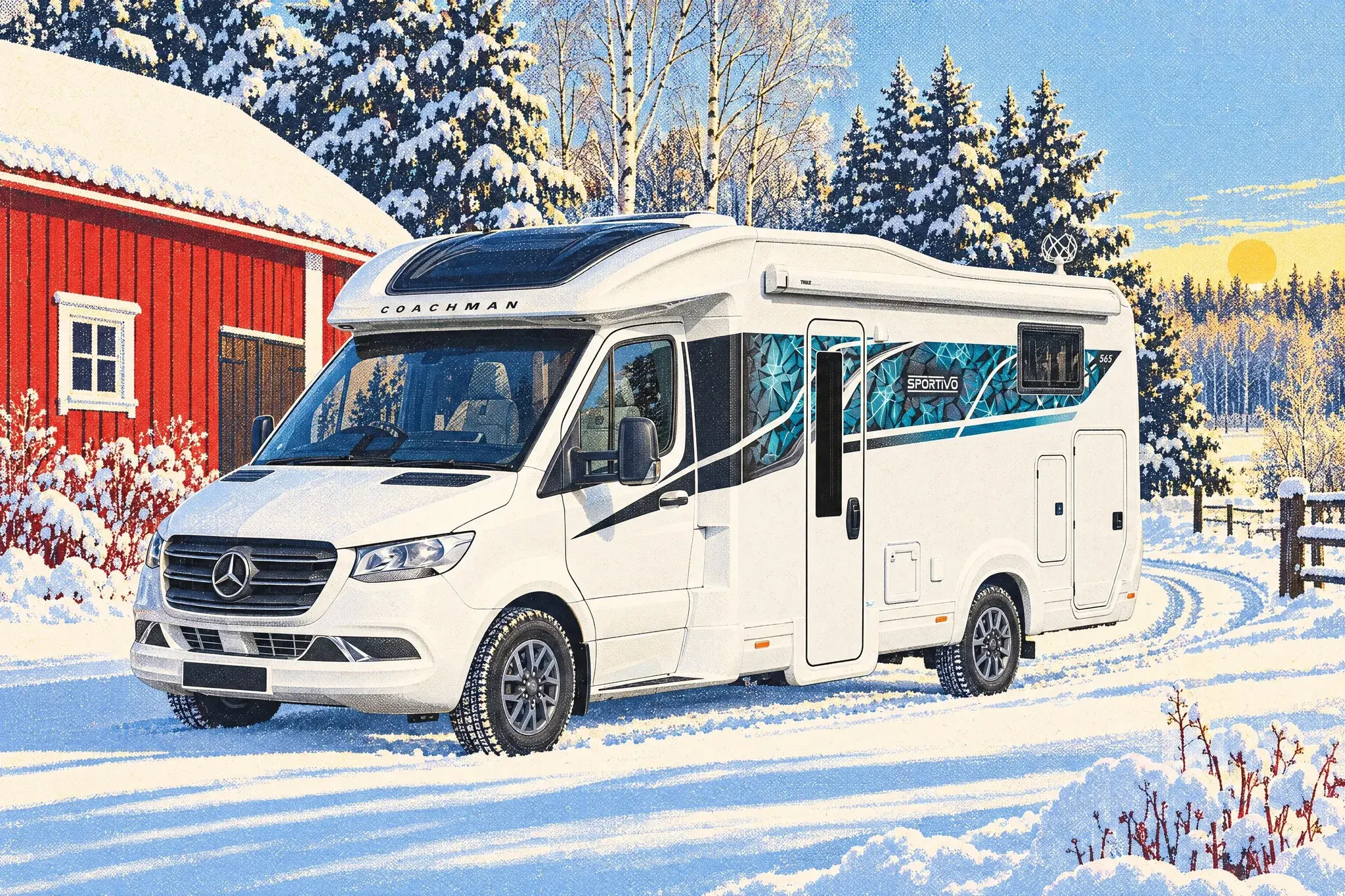
The Coachman Sportivo 565 TRAQ is a two-berth, 7,445 mm Mercedes-Benz Sprinter 4x4 motorhome built by KABE in Sweden, priced at £146,500, £25,669 above the two-wheel-drive Sportivo 565. Its 4,100 kg plated weight gives around 758 kg of payload but means drivers who passed their car test on or after 1 January 1997 need a C1 licence. It suits winter and remote-pitch touring couples, not mainly hardstanding campsite users.

A 4x4 motorhome is one that can pull itself off a soggy field without waiting for a tractor. That is the headline promise of the new Coachman Sportivo 565 TRAQ: a Mercedes-Benz Sprinter with four-wheel drive, a 4,100 kg chassis, Alde heating under the floor, and a £146,500 price tag. It costs £25,669 more than the two-wheel-drive Sportivo 565, and because it weighs more than 3,500 kg a lot of drivers will need a C1 licence before they can take it home.
Where the TRAQ comes from
Coachman is a Hull company, founded in 1986 and marking its 40th year with the launch of its 2027 Collection. Its motorhomes, though, are built in Sweden by KABE, which owns Coachman. That matters here, because the TRAQ name and its four-wheel-drive option come from KABE. KABE's own semi-integrated Novum TRAQ 750 LGB, shown at CMT Stuttgart in January 2026, has the same 7,445 mm length and the same pair of 1,960 x 780 mm single beds as the Sportivo TRAQ, with four-wheel drive as an option.
At Caravan Salon Düsseldorf 2026 (28 August to 6 September) KABE went further with the Imperial TRAQ i830, which it billed as a world first: a fully integrated A-class motorhome with optional Mercedes all-wheel drive on the new Sprinter. KABE's figures for it are 8,320 mm long, 2,329 mm wide and 3,065 mm tall, on a 5,500 kg chassis, with a 190 hp engine and the 9G-Tronic automatic. Reisemobil International quoted a price of €268,595, with all-wheel drive a €13,250 option on top. KABE-badged motorhomes are not sold in the UK, so the Sportivo 565 TRAQ is how KABE's four-wheel-drive layout reaches British buyers, as a coachbuilt on an AL-KO chassis rather than a fully integrated A-class like the i830.
Coachman says the choice of base vehicle for the Sportivo was never in doubt, and that the third-generation Sprinter is the natural platform for a motorhome that takes no shortcuts. Whatever you think of the marketing, the Sprinter is a sensible pick for a van this heavy: it is offered with factory four-wheel drive and a nine-speed automatic, which is what the TRAQ needs.
The Sportivo 565 TRAQ on paper
According to Coachman's Sportivo page (checked 6 October 2026), the 565 TRAQ, one of the new models in the 2027 range, is £146,500, a price that includes first registration, vehicle excise duty and number plates, is effective from 28 August 2026 and excludes Northern Ireland. The core figures from Coachman's Sportivo page are:
- Base vehicle: Mercedes-Benz Sprinter with 4x4 and a 9-speed automatic gearbox.
- Length: 7,445 mm.
- Berths: 2. Travelling seats: 2.
- Beds: fixed single beds, 1,960 x 780 mm.
- MTPLM (plated weight): 4,100 kg on a 4,100 kg AL-KO chassis.
- Mass in running order: 3,342 kg.
- Heating: Alde wet central heating with underfloor heating, plus a heated garage.
The feature list includes Alde wet central heating and hot water, 90 litre fresh and waste tanks, a 65 litre fuel tank, a 150 watt roof solar panel, 16 inch alloy wheels and an EN1645 Grade 3 classification for heating and insulation, cold-chamber tested. Coachman's page says the rear beds in the 565 and 565 Compact can be raised to give extra garage height, while the TRAQ already has the extra height built in. Read that as the garage being designed for bulky winter kit from the start.
For context, Coachman prices the two-wheel-drive Sportivo 565 at £120,831 on its 3,500 kg chassis and the 565 Compact at £118,631, and Coachman's feature list says extra travelling seats are a Compact-only item. So the TRAQ is strictly a two-up van: two people travel, two people sleep. If you need to carry more than one passenger, the Compact is the Sportivo to look at.
What Motorhome described the standard Sportivo 565 as a lightweight luxury motorhome on a Mercedes at 3,500 kg and also mentioned a four-wheel-drive Traq derivative. The TRAQ is that derivative, and it is not lightweight any more.
Two things on the spec sheet that do not match
Two figures for the TRAQ are quoted differently in different places. Neither is a reason to walk away, but both are a reason to get the number in writing before you sign.
190 hp or 170 hp?
Coachman's feature list and page text describe a 190 HP 4x4 Sprinter engine for the TRAQ only, but the spec table on the same page says 170 HP. The dealer Raymond James Caravans also describes a new 190 HP 4x4 Sprinter engine fitted only on the TRAQ. The balance of what Coachman has written points to 190 hp for the TRAQ, with the standard 565 keeping the 170 hp Sprinter engine, and a spec table that may simply not have been updated. Even so, ask for the engine output on the order form. With an extra 600 kg of plated weight to move, 20 hp is not nothing.
4,100 kg or 4,500 kg?
Coachman's own page lists a 4,100 kg AL-KO chassis for the TRAQ. The dealer Raymond James Caravans lists the TRAQ at 4,500 kg, and at least one other online listing also gives 4,500 kg. We use Coachman's 4,100 kg figure throughout this piece because the maker's own page outranks a dealer listing. Either figure puts the van above 3,500 kg, so the licence, tax class and speed-limit position are the same whichever is right. What changes is payload: a 4,500 kg plate on the same 3,342 kg running-order mass would give 1,158 kg rather than 758 kg. Ask the dealer to show you the plated weight on the actual vehicle, and if an uprate to 4,500 kg is available, ask what it costs and whether it changes anything on the chassis.
What 4x4 adds in UK use
Most British touring happens on tarmac and hardstanding. A two-wheel-drive Sprinter with decent tyres and a pair of grip mats copes with the great majority of campsites, which is why four-wheel-drive motorhomes are rare. The TRAQ's case rests on the days when that is not enough.
Wet grass pitches
The classic British failure: a week of rain, a grass pitch that looked fine when you arrived, and a four-tonne motorhome that will not move on Sunday morning. A two-wheel-drive van has one axle doing all the pulling, and once its driven tyres have dug in you are relying on grip mats, the warden and a tractor. Driving all four wheels changes that picture on the kind of soft, level grass most UK sites use. It does not make mud irrelevant, and a 7.4 m coachbuilt still has long overhangs that will ground before the tyres lose grip on a bank. On flat wet grass, though, this is where owners will feel the premium most often.
Gravel tracks and farm lanes
Certificated locations, farm sites and forest car parks often sit at the end of loose, rutted or steep access tracks. Four-wheel drive gives you traction on the loose stuff and confidence pulling away on a gravel incline. Four-wheel drive does not shorten a 7.4 m coachbuilt's rear overhang, and we have not seen a ground-clearance figure for the TRAQ, so ask the dealer for one; on these tracks the limit is likely to be the body, not the drivetrain. Think of the TRAQ as a motorhome that will not get stuck on a reasonable track, not as a vehicle for exploring beyond one.
Snow and winter touring
This is the strongest argument for the TRAQ, and the rest of the spec backs it up. Alde wet heating with underfloor heating, a heated garage for skis or wet boots, and the Grade 3 EN1645 cold-chamber rating are the hallmarks of a van built for a Swedish winter, which is what KABE builds for at home. Add four-wheel drive and you have a van that can get out of a snowy aire in the Alps or a Highland car park under its own power. Two cautions: four-wheel drive helps you go, not stop, so winter tyres (or chains where local rules require them) matter just as much; and we have not seen a fuel-consumption figure for the TRAQ, so budget for a heavier, four-wheel-drive van using more diesel than the 565.
What it does not do
The TRAQ is not an off-roader with a kitchen. It is a 7,445 mm, 4,100 kg coachbuilt with a Sprinter cab, and it will behave like one on narrow lanes, at car-park height barriers and on a green lane with ruts deeper than its sump. Buy it for traction, not for adventure in the Land Rover sense.
Who can drive it: the licence question
A category B (car) licence covers a motor caravan with a maximum authorised mass of up to 3,500 kg. The TRAQ is plated at 4,100 kg, so a car licence alone is not enough.
- If you passed your car test before 1 January 1997, your licence carries C1 (vehicles from 3,500 to 7,500 kg) as acquired rights. That entitlement lasts until your 70th birthday. From 70 the licence is renewed every three years, and keeping C1 means renewing by post with a D4 medical completed by a doctor each time.
- If you passed your car test on or after 1 January 1997, you hold category B only. To drive the TRAQ you need to gain C1: apply for provisional entitlement with forms D2 and D4 (the D4 medical completed by a doctor), then pass a theory test and a practical test in a suitably heavy vehicle. That is time and money on top of the purchase price, and worth starting before the van is built rather than after.
Two things do not help here. The 4,250 kg rule that lets category B holders drive heavier vehicles in Great Britain applies only to zero-emission vehicles, and the TRAQ is a diesel. And downplating the TRAQ to 3,500 kg to dodge the rule would leave 3,500 kg minus 3,342 kg, which is 158 kg of payload before you have added a passenger, water or a bike, so it is not a realistic option for a touring van.
Northern Ireland has its own licensing, and Coachman's prices exclude Northern Ireland anyway, so readers there should check both the licence position with the DVA and the price with a local dealer.
Speed limits, tax, MOT and clean-air zones
Speed limits
On GOV.UK's speed limits for motor caravans, the dividing line is 3.05 tonnes unladen weight. That is never the plated weight. Unladen weight is the vehicle with its body and normal fittings but without driver, passengers, load, fuel or water, so it is lower than the mass in running order. Coachman's spec page explains that its running-order figure includes a 75 kg driver allowance (anything over that comes out of payload) and fuel at 90 per cent of tank capacity. Take the driver, roughly 50 kg of diesel and the full gas cylinder Coachman counts off 3,342 kg and you are left with roughly 3,200 kg. That is above 3,050 kg but not by much, and type-approval rules allow a declared running-order figure to differ from the real van by up to 5 per cent, so the TRAQ looks likely, but not certain, to sit in the heavier class. The figure that counts is the unladen weight on the V5C or certificate of conformity, so check it. If it is over 3.05 tonnes, the limits are 30 mph in built-up areas (20 mph on restricted roads in Wales unless signed otherwise), 50 mph on single carriageways, 60 mph on dual carriageways and 70 mph on motorways. Speed cameras enforce the posted limit for the road, not the vehicle-class limit, but the lower limit still applies to you.
Vehicle tax
A motor caravan over 3,500 kg revenue weight is taxed as a Private HGV (tax class TC10) at £177 a year for 2026 to 2027. The 3,500 kg Sportivo 565, with an engine over 1,549 cc, falls into Private or Light Goods (TC11) at £375 a year. So the TRAQ is £198 a year cheaper to tax than its lighter sibling, which is one of the few places the extra weight works in your favour. Coachman's price already includes the first year's VED. Check GOV.UK's motorhome tax rates for the live figures before you rely on them.
MOT
Motor caravans are tested in class 4 whatever their weight, from three years old, so the TRAQ's 4,100 kg plate makes no difference to the MOT.
London and other clean-air zones
At over 3,500 kg gross weight, a motor caravan in London is covered by the Low Emission Zone rather than the ULEZ. A brand-new diesel Sprinter should be fine, but use Transport for London's vehicle checker with the registration rather than assume. England's Clean Air Zones in Bath, Birmingham, Bradford, Bristol, Portsmouth, Sheffield and Tyneside each have their own vehicle classes, and Scotland's Low Emission Zones in Glasgow, Edinburgh, Aberdeen and Dundee set their own standards, so use the official checker for any zone you plan to drive through.
Height
Coachman gives the TRAQ's overall height as 2,880 mm including the optional roof air conditioning, so it is under the 3 m mark above which the height must be displayed in the cab. Keep the figure to hand for car parks, barriers and ferries.
Payload: what 758 kg buys you
Plated weight minus mass in running order gives the payload: 4,100 kg minus 3,342 kg is 758 kg. For a two-berth van with two travelling seats, that is a comfortable figure, and it is one of the practical gains of the heavier chassis.
Spend it carefully, though. Coachman's running-order figure already includes a 75 kg driver and fuel at 90 per cent, so do not count those twice, but the second person comes out of payload, as does anything the driver weighs over 75 kg. Coachman's running-order figure also counts one full LPG cylinder, but its water and toilet tanks are designed to be travelled empty, so any water you carry comes out of payload: a full 90 litre fresh tank is about 90 kg. Then add the winter kit the heated garage is designed for, which tends to be heavy: skis, boots, a couple of e-bikes, levelling ramps, snow chains. Even so, 758 kg leaves plenty of margin for two people, which is more than can be said for many 3,500 kg vans. For comparison, Coachman lists the standard 565 at 3,020 kg in running order on its 3,500 kg plate, a 480 kg payload, so the TRAQ carries 278 kg more.
Is the £25,669 premium worth it?
The TRAQ costs £146,500 against £120,831 for the two-wheel-drive 565, a difference of £25,669. For that you get four-wheel drive, the 190 hp engine (subject to the confirmation above), the 4,100 kg chassis and its payload, and a garage with the extra height already built in. Against it, add the C1 process if you passed your test on or after 1 January 1997, the lower speed limits, and the fuel use of a heavier four-wheel-drive van. The £198 a year tax saving is real but small next to the purchase gap.
It suits you if
- You tour in winter, to the Alps, Scandinavia or the Highlands, and want a van that is as capable at getting going as it is at staying warm.
- You favour certificated locations, farm sites and grass pitches over hardstanding, and have been towed off at least once.
- You already hold C1, or you are willing to gain it before delivery.
- There are two of you, and the pair of fixed single beds and heated garage fit how you travel.
Stick with the 565 if
- Most of your nights are on hardstanding or well-drained club sites, where grip mats and a two-wheel-drive Sprinter will see you through.
- You passed your car test on or after 1 January 1997 and do not want the C1 process.
- You need to keep to 3,500 kg for any other reason.
- You need more than two travelling seats, in which case the 565 Compact, which lists extra travelling seats, is the one to look at.
Before you order
- Get the engine output (190 hp or 170 hp) confirmed in writing on the order.
- Get the plated weight confirmed as 4,100 kg (or whatever the delivered van will carry), and ask whether a 4,500 kg plate is an option.
- Ask for the van's own certificate of conformity, which records its weights: type-approval rules allow the real running-order mass to differ from the declared 3,342 kg by up to 5 per cent, and every kilogram over comes out of payload.
- Ask for the unladen weight, so you know which speed limits apply before your first trip.
- Check your own licence date. If it is on or after 1 January 1997, start the C1 process now.
- Price the options you want against the payload: Coachman lists the roof air conditioning at 30 kg and £2,400, the electric awning at 25 kg and £2,100 and the tow bar at 32 kg and £2,100.
- Decide on the AL-KO HY4 levelling system before you order: it is a £7,550 option and adds 68 kg.
- Note the overall height of 2,880 mm (with the air conditioning) for car parks, barriers and ferries.
- If you want to see one, the Motorhome and Caravan Show at the NEC runs from 13 to 18 October 2026; ask Coachman whether the TRAQ is on the stand rather than assuming it is.
The bottom line
The Sportivo 565 TRAQ is a specialist, and a well thought-out one. KABE has taken its Swedish winter know-how, put it on a four-wheel-drive Sprinter with a nine-speed automatic, and sized it for a British couple rather than the 8.3 m, 5,500 kg Imperial it showed at Düsseldorf. For winter tourers and grass-pitch regulars who hold C1, the £25,669 over the standard 565 buys a van that will get itself out of trouble and keep its garage warm while it does so. For everyone else, the standard 565 does the same job on tarmac for a lot less money and without a licence test. Decide which kind of touring you do, confirm the two figures Coachman's page leaves unclear, and the choice makes itself.
Common questions
Do I need a special licence to drive the Coachman Sportivo 565 TRAQ?
Yes if you passed your car test on or after 1 January 1997. The TRAQ is plated at 4,100 kg, above the 3,500 kg category B limit, so you need C1, gained through a D4 medical, provisional entitlement, a theory test and a practical test. Drivers who passed before 1 January 1997 already hold C1 as acquired rights until age 70.
How much more does the TRAQ cost than the standard Sportivo 565?
The TRAQ is £146,500 against £120,831 for the two-wheel-drive Sportivo 565, a premium of £25,669. Both prices include first registration, VED and plates, are effective from 28 August 2026 and exclude Northern Ireland.
What is the payload of the Sportivo 565 TRAQ?
On Coachman's figures, 4,100 kg MTPLM minus a 3,342 kg mass in running order leaves 758 kg. The running-order figure already includes a 75 kg driver, fuel at 90 per cent and one full gas cylinder, so passengers, water and kit come out of the 758 kg.
Is the TRAQ 190 hp or 170 hp?
Coachman's page text and feature list say a 190 HP 4x4 Sprinter engine is fitted to the TRAQ only, and dealer Raymond James says the same, but Coachman's spec table on the same page shows 170 HP. Ask for the engine output in writing before you order.
What speed limits apply to the Sportivo 565 TRAQ?
GOV.UK bases motor caravan limits on unladen weight, not plated weight. The TRAQ looks likely to be over 3.05 tonnes unladen, which would mean 50 mph on single carriageways, 60 mph on dual carriageways and 70 mph on motorways, but check the unladen figure on the V5C.
Is a 4x4 motorhome worth it in the UK?
For most campsite touring on hardstanding, no; a two-wheel-drive Sprinter with grip mats copes. Four-wheel drive earns its money on wet grass pitches, loose farm tracks and snow, which is why the TRAQ makes most sense for winter and remote-pitch tourers.
The reachable bit
The camper you fall for is rarely the one you can afford. That gap is the whole reason Campervan.win exists. Right now we’re giving away the Sunlight Vanlife, worth around £65,000, and closing that gap is the point: capped entries so the odds stay honest, £10 a ticket, a maximum of five per person, £500 to a UK charity from every full draw, the winner picked by a public randomness beacon anyone can re-check, and one person driving away in the van itself.

Enjoyed this post?
Get more honest campervan guides like this one in your inbox.
You’re in!
Check your inbox. We’ve just sent you a welcome email.

About the author
Martha
Martha writes about interiors, ownership stories, and the everyday realities of campervan life, with a focus on comfort, cost, and how vans are used over time.
Keep Reading
Related Reading
Thoughtful articles that build on what you’ve just read.
Motorhome Buying Guides
12 min read
Auto-Trail Adventure 2027: the overcab is back, and two options change your licence
Auto-Trail's new Adventure coachbuilt puts a permanent bed over the cab of a Peugeot Boxer and prices the long models at £71,000 ex-works. Here is why that layout suits a family of four, and the weight, licence and payload questions to settle before you sign.
Motorhome Buying Guides
14 min read
Family motorhomes at the NEC for 2027: belts, beds and the payload sum that decides them
The 2027 family layouts at the NEC sleep four to seven, but the numbers that decide whether they work for your family are the belted seats, the Isofix points and the weight left once everyone is aboard. We do the sums model by model.
Motorhome Buying Guides
10 min read
Buying a motorhome at the NEC: what you commit to when you sign on the stand
A plain-English explainer on what a signature on a show stand at the NEC commits you to: cancellation rights that are not as clear as people think, what happens to a deposit, why withdrawing from finance does not cancel the van, why Section 75 rarely covers a motorhome deposit, and your rights if the van arrives faulty.
Motorhome Buying Guides
9 min read
NEC show offers 2026: how to judge the Auto-Sleepers, Auto-Trail and Marquis deals
The October 2026 NEC show offers from Auto-Sleepers, Auto-Trail dealers and Marquis Leisure, decoded: what each free pack is worth to you, what it weighs, what a heavier plate means for your licence and tax, and the questions to settle before you sign.