
Buying a motorhome at the NEC: what you commit to when you sign on the stand

Written by
Arthur
Arthur writes buying guides, comparisons, and in-depth explainers to help readers choose the right campervan or motorhome with confidence.
The short answer
Signing an order form on an NEC stand is a binding purchase with no automatic 14-day cancellation right: a stand may count as the dealer's business premises, and a van built to a non-standard specification would be exempt anyway. Get cancellation terms, deposit terms and a delivery date in writing. Withdrawing from finance does not cancel the van, and Section 75 does not cover deposits on vans priced over £30,000.

A show stand is a lovely place to fall for a motorhome and a poor place to read small print. The Motorhome and Caravan Show runs at the NEC Birmingham from 13 to 18 October 2026, and plenty of people will sign an order form there with the lights bright, the music on and a show price in the window. None of that is a problem. The problem is signing without knowing what the signature commits you to, because the rules on cancelling, deposits, finance and faults are less tidy than most buyers assume. This is an explainer rather than legal advice: if you already have a dispute, take it to Citizens Advice.
Get three documents before the pen comes out
Three pieces of paper tell you nearly everything. Ask to see all of them before you sign, and if the stand is busy, take them away and read them over a coffee. A good deal will still be a good deal half an hour later.
The order form
It should state the exact model and layout, the base vehicle and engine, every option with its price, the total, the deposit, when the balance is due, an estimated delivery date and the cancellation terms. The National Caravan Council's best-practice guide for dealers (April 2024) says dealers should explain what will happen to any deposit paid in the event of a cancellation and should agree an estimated delivery date with the buyer. If the form says 'to be confirmed' against delivery, or says nothing about cancellation, ask for both in writing on the form itself.
The finance documents
If you are borrowing, you are signing a second contract with a lender, and it is separate from the purchase. Ask for the pre-contract information and the agreement, and read the total amount payable, the APR, the term and whether it is hire purchase or a loan. Hold onto the thought that this is a different contract from the order form, because it matters later.
The warranty terms
A new motorhome usually comes with more than one warranty from more than one company: the base vehicle maker covers the van it built, the motorhome maker covers the habitation and the body, and there is often a separate, longer promise about water ingress. Ask for the written terms for each, and ask when the habitation service has to be done to keep the cover alive.
Can you cancel an order signed on a stand?
Do not assume you can. The Consumer Contracts (Information, Cancellation and Additional Charges) Regulations 2013 give a 14-day cancellation right for contracts made off-premises, meaning away from the trader's business premises. The question is whether a show stand counts as business premises. Regulation 5 says business premises include any movable retail premises where the activity of the trader is carried out on a usual basis, and the government's December 2013 guidance gives market stalls as the example, provided the business is carried on there on a usual basis.
Whether a motorhome dealer's stand at the NEC is a market stall in that sense has not been settled for UK motorhome shows. The EU Court of Justice looked at a similar question in 2018 (case C-485/17, decided before Brexit) and held that a trade-fair stand used for a few days each year can count as business premises if a consumer could reasonably assume the trader is carrying out its activity there. A dealer with a branded stand selling vans at the NEC every autumn arguably fits that description. On the other hand, Citizens Advice publishes a template cancellation letter that covers agreements made at a trade show within the 14-day cooling-off period, so the position is not one-way either.
There is a second limit. Regulation 28 takes goods made to the consumer's specifications or clearly personalised outside the cancellation right. The same government guidance reads that narrowly, though: goods put together to order from a standard range, such as a sofa in a fabric and colour chosen from those on offer, are not bespoke. So a van built in a layout, colour pack and options from the maker's usual list is unlikely to be excluded, while a truly non-standard request, such as a finish the maker does not normally offer, may be.
So get the dealer's own cancellation terms in writing before you sign, and treat any cooling-off period as something the dealer has granted rather than something the law has handed you.
What happens to your deposit
A deposit is not automatically lost if you pull out, and it is not automatically refunded either. Which? sums up the general position: a business is generally only entitled to keep or receive an amount sufficient to cover its actual losses. If the dealer can sell a stock van to the next visitor at the same price, its loss may be small. If it has ordered a factory build in your specification, the loss may be larger. The cancellation terms on the order form are what you have agreed to, which is why you want them in front of you before signing rather than after.
Delivery works in your favour. Under section 28 of the Consumer Rights Act 2015, if no delivery date has been agreed, the goods must be delivered not more than 30 days after the contract. And if the goods still have not come by a further reasonable deadline you set, or the trader refuses to deliver, you can end the contract, and the trader must without undue delay reimburse all payments made under the contract. A written estimated delivery date protects both sides, which is exactly why the NCC guide asks dealers to agree one. The same guide says dealers must not pressure buyers to act quickly to place a deposit, so if you feel hurried, it is fine to walk a lap of the hall and come back.
Finance has its own cooling-off period, and it is not the same thing
This is the one buyers most often mix up. Under section 66A of the Consumer Credit Act 1974, you can withdraw from a regulated credit agreement by giving the lender notice within 14 days beginning with the day after the relevant day. You then have 30 days to repay the credit plus the interest that has built up. On hire purchase, once you have repaid, ownership passes to you on the same terms as would have applied had you not withdrawn. The right does not apply to credit exceeding £60,260, which rules out a fair number of new motorhomes financed in full.
Withdrawing from the finance does not cancel the purchase. Citizens Advice puts it plainly: if you want to keep the goods you will need to pay for them another way, and returning the vehicle to the garage does not end a hire purchase agreement unless both the garage and the finance company agree to it. Sign an order form and a finance agreement on the stand, withdraw from the finance a week later, and you still owe the dealer the price of the van under the order form. Two contracts, two sets of rules.
Why Section 75 will not cover most motorhome deposits
Paying a deposit by credit card feels like a safety net, and for many purchases it is. Section 75 of the Consumer Credit Act makes the card provider jointly liable with the trader for a breach of contract or misrepresentation. But section 75(3)(b) excludes any single item with a price not exceeding £100 or more than £30,000. As Which? explains, it is the value of the goods you are buying that is key, not the amount paid on the card. A £1,000 card deposit on a £65,000 motorhome is a payment towards a £65,000 item, so Section 75 does not apply. For a van priced under £30,000 it can. Either way, the written cancellation terms are your real protection for a deposit, not the card.
If the van arrives faulty
The Consumer Rights Act 2015 applies to a new motorhome as it does to any other goods, and these rights sit alongside the warranties rather than replacing them. The ones to know:
- Short-term right to reject. Section 22(3) gives you 30 days to reject goods that do not conform to the contract and get your money back.
- Repair or replacement. Section 23(2) says it must be done within a reasonable time and without significant inconvenience to you.
- Final right to reject. Section 24(5) gives you this after one repair or one replacement that has not put things right.
- The six-month presumption. Under section 19(14), a fault that appears within six months of delivery is presumed to have been there at delivery, unless it is shown otherwise.
- Deduction for use. For a motor vehicle, section 24(10) allows a deduction for the use you have had even within the first six months, so a final rejection of a motorhome will not always mean every penny back.
In practice: inspect the van thoroughly at handover, report every fault to the dealer in writing with dates, and keep copies. Your statutory rights are against the dealer who sold you the van, or the finance company if you bought it on hire purchase, so that is where the first letter goes.
Warranties: read the body cover and the service window
Makers' terms differ in ways that matter later. The pages below were checked on 10 October 2026.
- Swift offers a 3-year SuperSure warranty, a 6-year body shell warranty and a 10-year extended body shell warranty for the first owner only, covering water ingress through any permanently sealed seam joints, according to its coachbuilt warranty page.
- Auto-Trail covers water ingress through the body's fixed seams and seals for 5 years from the date of first registration under its Body Integrity Warranty, and most other conversion faults for the first 36 months. Auto-Trail's terms say the base vehicle is covered by its own maker, Fiat for 2 years and Ford for 3 years.
- Bailey lists a 6-year Bodyshell Integrity Warranty and a 3-year Manufacturer's Warranty, with a 3-year Bodyshell Integrity Warranty on its campervans, and says the base vehicle has an independent warranty.
The habitation service is the condition that catches people. The NCC says it should be done annually by a member of its Approved Workshop Scheme. Swift's window runs from 90 days before to 60 days after each anniversary of purchase; Auto-Trail's is plus or minus 30 days of each anniversary of registration. Purchase and registration can be different dates, so write the right one in the diary and book early, because workshops fill up.
Where to go if things go wrong
Start with Citizens Advice, which is free and will tell you which of the rules above applies to your case. If the dealer is a member of the National Caravan Council, there is a second route: the NCC runs a free informal dispute service for customers of its members, open once the dealer has given its final decision in writing (it does not take complaints that consumer law covers, such as faulty goods), and dealer members are expected to comply with its best-practice guide, with sanctions running from a written warning to termination of membership. Ask on the stand whether the dealer is a member, and check at thencc.org.uk (ncc.org.uk is an unrelated construction directory).
The bottom line
Buying at the NEC is a perfectly good way to buy a motorhome. You can compare layouts side by side, talk to people who know the vans and often get a keen price. Just sign with your eyes open:
- Get the order form with the exact spec, price, deposit, estimated delivery date and cancellation terms written down.
- Treat the finance as a separate contract: withdrawing from it does not cancel the van.
- Do not count on Section 75 for a deposit on a van priced over £30,000.
- Collect the warranty terms for the base vehicle and the habitation separately, and note the service window.
- If the van arrives faulty, tell the dealer in writing, and know your 30-day and final rights to reject.
Do that and the only surprise on delivery day should be how much kit you manage to squeeze into the rear locker.
Common questions
Can I cancel a motorhome order I signed at the NEC show?
Not automatically. The 14-day cancellation right for off-premises contracts may not apply because a show stand can count as the dealer's business premises, and a van built to a non-standard specification is excluded anyway. Get the dealer's cancellation terms in writing before you sign.
Will I lose my deposit if I pull out of a motorhome order?
It depends on the written terms and the dealer's real loss. Which? says a business is generally only entitled to keep an amount sufficient to cover its actual losses, and the NCC asks dealers to explain what happens to a deposit on cancellation before you sign.
If I withdraw from the finance, does that cancel the motorhome purchase?
No. Section 66A of the Consumer Credit Act lets you withdraw from a regulated credit agreement within 14 days and repay within 30, but the order form is a separate contract and you still owe the price of the van. Citizens Advice says you would need to pay for it another way.
Does paying a motorhome deposit by credit card protect me under Section 75?
Usually not. Section 75 excludes any single item priced over £30,000, and it is the price of the goods that counts, not the amount paid on the card, so a card deposit on a £50,000 motorhome is not covered.
What are my rights if my new motorhome arrives with faults?
Under the Consumer Rights Act 2015 you have a 30-day short-term right to reject, then a right to repair or replacement within a reasonable time, and a final right to reject after one failed repair or replacement. For a motor vehicle a deduction for use can be made even within the first six months.
Do I have to get a habitation service to keep the warranty?
Makers set service conditions, so read the terms. The NCC says a habitation service should be done annually by an Approved Workshop Scheme member; Swift's window is 90 days before to 60 days after each anniversary of purchase and Auto-Trail's is plus or minus 30 days of each anniversary of registration.
The reachable bit
The camper you fall for is rarely the one you can afford. That gap is the whole reason Campervan.win exists. Right now we’re giving away the Sunlight Vanlife, worth around £65,000, and closing that gap is the point: capped entries so the odds stay honest, £10 a ticket, a maximum of five per person, £500 to a UK charity from every full draw, the winner picked by a public randomness beacon anyone can re-check, and one person driving away in the van itself.

Enjoyed this post?
Get more honest campervan guides like this one in your inbox.
You’re in!
Check your inbox. We’ve just sent you a welcome email.

About the author
Arthur
Arthur writes buying guides, comparisons, and in-depth explainers to help readers choose the right campervan or motorhome with confidence.
Keep Reading
Related Reading
Thoughtful articles that build on what you’ve just read.
Motorhome Buying Guides
12 min read
Auto-Trail Adventure 2027: the overcab is back, and two options change your licence
Auto-Trail's new Adventure coachbuilt puts a permanent bed over the cab of a Peugeot Boxer and prices the long models at £71,000 ex-works. Here is why that layout suits a family of four, and the weight, licence and payload questions to settle before you sign.
Motorhome Buying Guides
14 min read
Family motorhomes at the NEC for 2027: belts, beds and the payload sum that decides them
The 2027 family layouts at the NEC sleep four to seven, but the numbers that decide whether they work for your family are the belted seats, the Isofix points and the weight left once everyone is aboard. We do the sums model by model.
Motorhome Buying Guides
9 min read
NEC show offers 2026: how to judge the Auto-Sleepers, Auto-Trail and Marquis deals
The October 2026 NEC show offers from Auto-Sleepers, Auto-Trail dealers and Marquis Leisure, decoded: what each free pack is worth to you, what it weighs, what a heavier plate means for your licence and tax, and the questions to settle before you sign.
Motorhome Buying Guides
15 min read
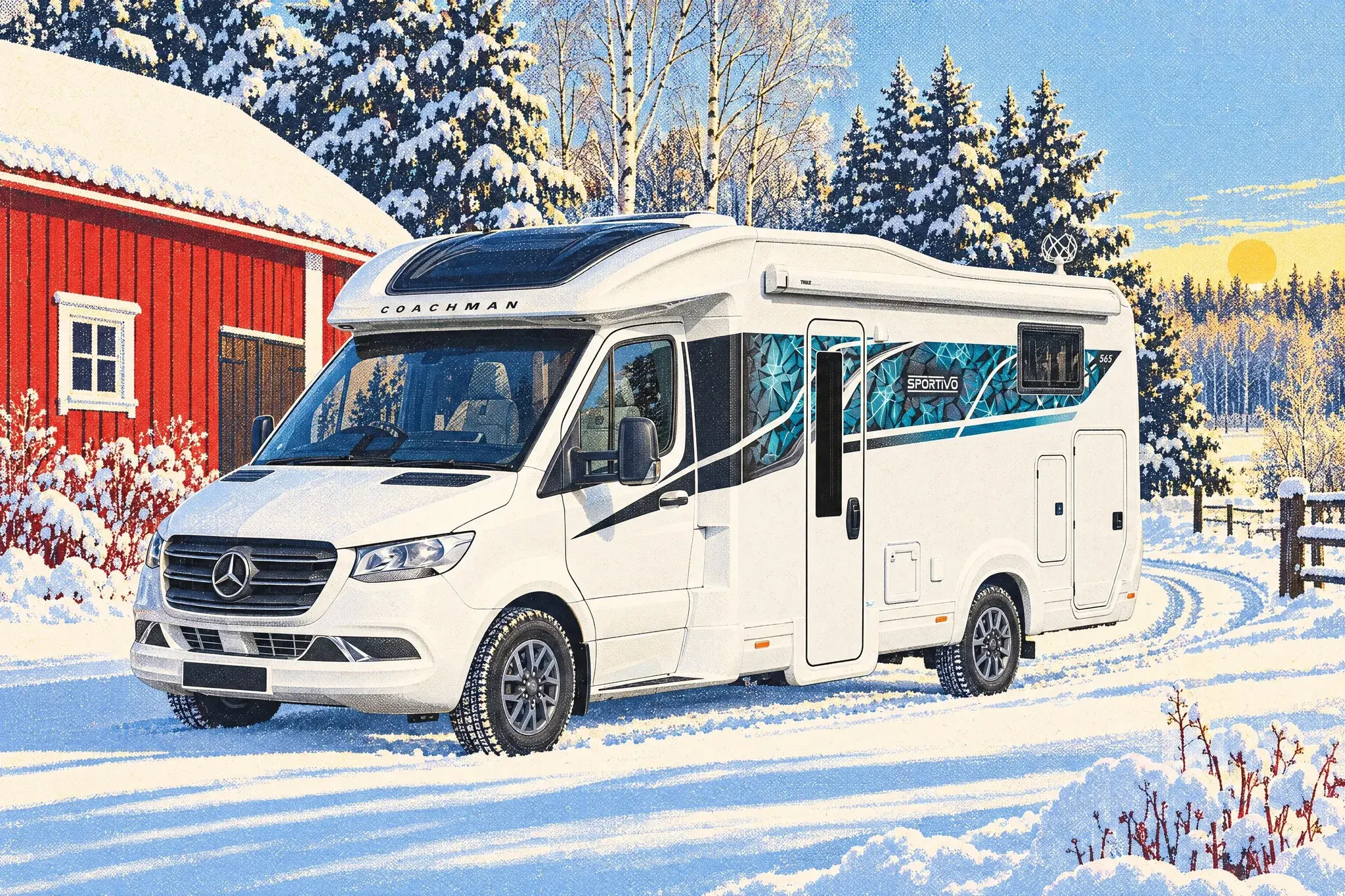
Coachman Sportivo 565 TRAQ: what £146,500 of 4x4 Sprinter buys, and who can drive it
The Coachman Sportivo 565 TRAQ puts a 4x4 Mercedes Sprinter under a Swedish-built, winter-ready coachbuilt at £146,500. We weigh what four-wheel drive adds on wet grass, gravel and snow against the £25,669 premium, the 4,100 kg weight and the C1 licence many drivers will need.