
Family motorhomes at the NEC for 2027: belts, beds and the payload sum that decides them

Written by
Iris
Iris writes travel guides, road trips, and park-up features, with a focus on slower UK touring, living space, and how campervans are used day to day.
The short answer
A family motorhome is decided by three numbers, not one: belted travel seats, Isofix points and payload. Under the retained EU rules each passenger counts as 75 kg, so a family of four needs 225 kg of payload before water, gas or luggage. At the 2027 NEC show the published payloads run from 340 kg (Bailey Ascent 75-4DL) to 590 kg (McLouis Fusion 360), and several six-belt or automatic options push the plate past 3,500 kg and into C1 licence territory.

Beds and seats are different numbers. A motorhome that sleeps six might have only four seatbelts, and a seatbelt is not the same thing as an Isofix point for a child seat. Then there is the number nobody prints on the banner: how much weight is left once your family has climbed in. The Motorhome and Caravan Show runs at the NEC from 13 to 18 October 2026, and the 2027 family layouts there are priced from about £63,000 to about £84,000. The brochure figures below let you do the sums before you queue for the steps.
Berths, belts and Isofix are three different numbers
Makers' pictograms show three counts: belted travel seats, berths and dining places. A cutlery or table icon means dining places, not seats. Read the seat count first, because that is how many people can travel in a designated (belted) travel seat. A six-berth van with four belts carries four on the road, whatever it sleeps at night.
This year's show vans make the point for you. A dealer lists the Swift Voyager 574 as six berths and four travelling seats. The Roller Team Zefiro 746 is listed as “Six Berths. Five Travel Seats.” Auto-Trail's Imala 736G sheet reads “Seatbelts 4-6 (inc. driver)” and “Sleeps 4-6”. Elddis gives the Autoquest GT 70DS and 74DS as five berths with seats shown as “4/5”. None of that is a trick; it is simply how coachbuilts work. But if two of your six are children in car seats, the third number matters as much as the first two.
Isofix is that third count, and it is often an option or tied to particular seats. Auto-Trail lists Isofix as a £149 option on the Adventure and a cost option on the Imala. Bailey's Ascent 69-4 has front bunks that convert into twin Aguti travel seats with Isofix. Swift fits Aguti travel seats with Isofix on four-berth Voyagers. Elddis fits an Isofix child seat bracket for the third and fourth seats facing the direction of travel. Marquis lists rear Isofix travel seats on the Benimar Primero 284, and McLouis puts Isofix on the Fusion 360's rear forward-facing seats. Elddis, Swift and Bailey all have stands at the NEC this year.
The payload sum behind every family van
Regulation (EU) 1230/2012, as retained in GB law, sets the arithmetic. The mass representing each passenger is 75 kg. Mass in running order (MRO, also written MIRO) already includes the driver at 75 kg and fuel at least 90 per cent full. And every motor caravan must leave a minimum pay-mass for passengers and luggage, worked out from n (passengers plus driver) and L (length in metres). Bürstner's weights guide works the example for a 6 m motorhome with four permitted seats: 10 kg x (4 + 6) = 100 kg of luggage allowance, and 3 x 75 kg = 225 kg for the passengers.
So a family of four needs at least 225 kg of payload for the three people who are not the driver, before a drop of water, a gas cylinder, bikes, an awning or a single bag. Payload is simply the plated weight (MAM, MTPLM or “plated weight” all mean the same legal maximum) minus MRO. Two cautions before you trust a brochure figure. First, the type-approval rules allow the real running-order mass of a motor caravan to differ from the declared figure by up to plus or minus 5 per cent, which on a 3,000 kg van is about 150 kg either way. Second, makers differ on what they count in MRO beyond the driver and fuel, so ask whether water and gas are in it unless the maker publishes its definition, as Swift and Bailey do (see below). Fresh water is the easy one to picture: 100 litres weighs 100 kg.
One more trap. A maker's “payload for optional equipment” or “optional equipment mass” is the budget left for factory options after the minimum pay-mass for passengers and luggage. It is not what your family can carry.
The 2027 family models, with the sum done
For each van below we take the maker's own payload at 3,500 kg, subtract 225 kg for three passengers, then note the formula's minimum luggage allowance for four people at that length. What is left is your budget for water, gas and everything else. Seats and berths are quoted exactly as each source words them. Where a stand number is given it is the brand's stand, so ask whether the particular layout is on it.
Auto-Trail Adventure 74, 76 and 76G (Hall 8, stand 8.30)
Auto-Trail's 2027 leaflet says every Adventure offers four berths and four travelling seats as standard, on a Peugeot Boxer 140bhp manual, with the 7.29 m models at £71,000 ex-works including VAT plus £455 on the road, so £71,455 before options. Isofix is a £149 option. Six belts are a £995 option on the 76 and 76G only, and that option needs the 3,650 kg plate, which means C1 for anyone who passed the car test on or after 1 January 1997. Ask on the stand for the Adventure's mass in running order and payload, and what the running-order figure includes. With six belts in use, five passengers alone account for 375 kg.
Auto-Trail Imala 736G
The 2027 Imala sheet gives the 736G as “Seatbelts 4-6 (inc. driver)” and “Sleeps 4-6”, 7,258 mm long on a Fiat Ducato 140 manual, with plates of 3,500, 3,650 or 4,400 kg and a mass in running order of 3,075 kg. The beds are a rear double of 2.17 x 1.32 m, a front double of 1.86 x 1.04 m and an optional drop-down of 1.23 x 1.93 m. Isofix is a cost option and the price is £81,461 ex-works including VAT, so budget for on-the-road costs on top.
The sum at 3,500 kg: 3,500 minus 3,075 leaves 425 kg. Take off 225 kg for three passengers and 200 kg remains. The formula's luggage minimum for four people in a 7.26 m van is about 113 kg, which leaves under 90 kg for water, gas, awning and bikes. At 3,650 kg the payload becomes 575 kg, or 350 kg after passengers, and at 4,400 kg it is 1,325 kg; both of those plates need C1 for drivers who passed on or after 1 January 1997. The six belts come from rear-facing three-point belts on the double dinette, a £995 option on Auto-Trail's 2027 price list that needs the 3,650 kg plate, so for anyone who passed their test on or after 1 January 1997, six belts mean C1. Ask what the 3,075 kg includes beyond driver and fuel.
Bailey Ascent 69-4 and 75-4DL (Hall 19, stand 25)
Bailey's model page gives the Ascent 69-4 at £81,899 on the road, four berths and four designated travelling seats, 6.976 m long, MRO 3,071 kg and payload 429 kg. The clever bit is that the twin Aguti travel seats with Isofix are built into the front lounge, which also makes up the double bed, and Bailey lists the same seats on its other four-berth Ascents. The sum: 429 kg minus 225 kg leaves 204 kg; the luggage minimum for four at this length is about 110 kg, so around 94 kg remains for water, gas and kit. The 75-4DL is £83,999, again four berths and four seats, with a 340 kg payload, which is 115 kg after passengers before anything else goes in. Bailey says its running-order figure includes a 75 kg driver, fuel at 90 per cent and 10 kg of gas, with the fresh tank empty, so any water you carry comes out of the payload.
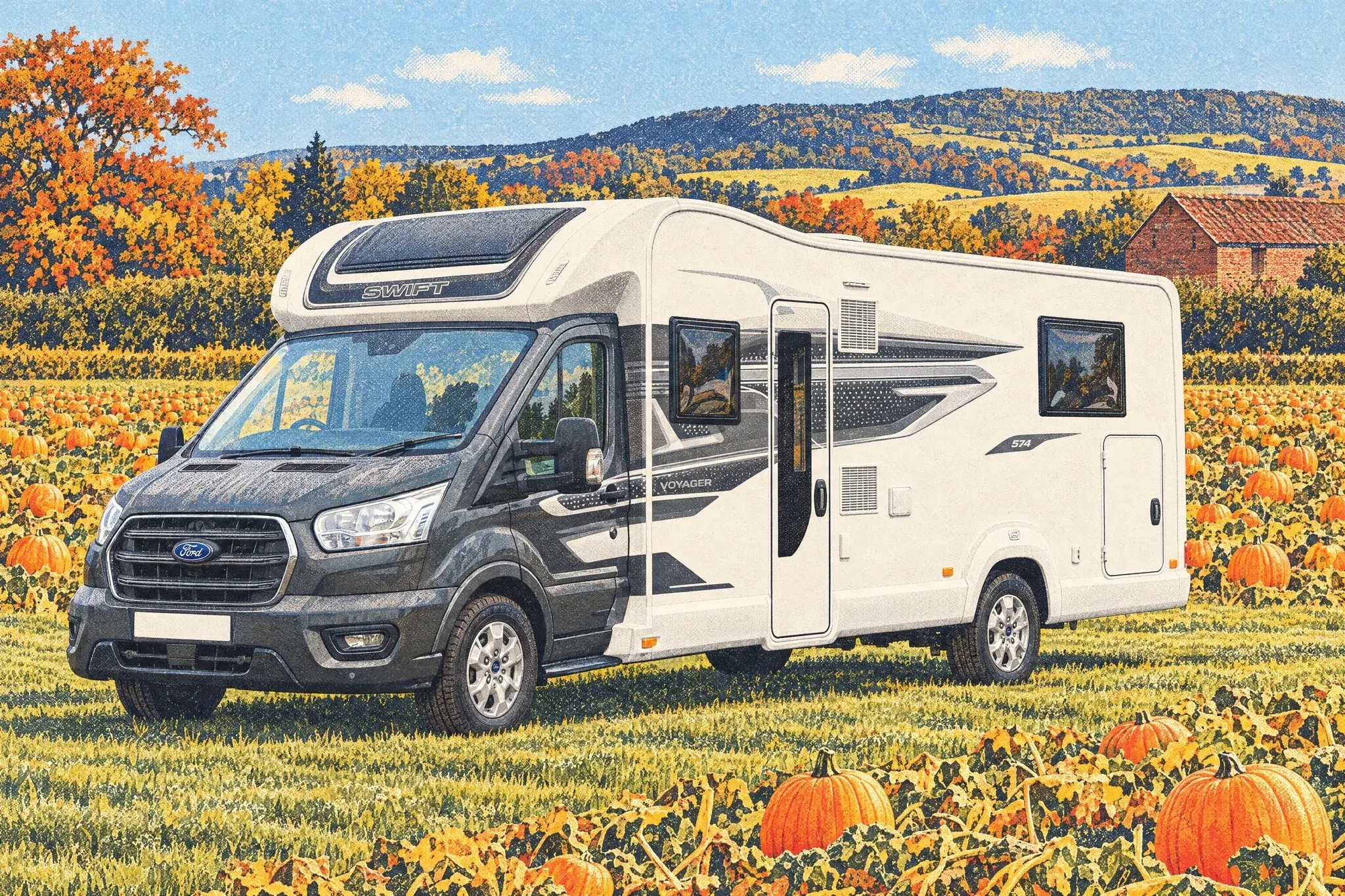
Swift Voyager 574 and 540 (Hall 6, stands 6.25, 6.33 and 6.39)
Swift's Voyager page and 2027 quick guide give the 574 on a Ford Transit 130bhp six-speed manual, from £81,690 on the road, 7.73 m long, with a maximum payload of 343 kg that Swift marks as estimated. Aguti travel seats with Isofix come on four-berth models, and a dealer lists the 574 as six berths and four travelling seats. The sum is tight: 343 kg minus 225 kg leaves 118 kg, and the formula's luggage minimum for four people in a 7.73 m van is about 117 kg. In other words the estimated figure sits right at the regulatory floor for a family of four, with no water or bikes counted. Swift's technical page says its mass in running order includes a 75 kg driver, engine coolants, AdBlue and windscreen washer fluid at 100 per cent, fuel at 90 per cent and an 11 kg LPG allowance, with the fresh water tank empty, so any water you carry comes out of the 343 kg. Swift also says the automatic upgrade increases the overall weight to 3,550 kg, and that single step takes a driver who passed on or after 1 January 1997 into C1. The shorter Voyager 540, from £78,495 and 7.01 m, carries 488 kg, which is 263 kg after passengers and roughly 150 kg once the luggage minimum is set aside. If you love the 574, ask for a weighbridge ticket on the specification you would order.
Elddis Autoquest GT 70DS and 74DS (Hall 20, stand 20.19)
Elddis gives both as five berths with seats “4/5”, 7.0 and 7.4 m long, manual, plated at 3,500 kg, with payloads of 519 kg and 479 kg. The 70DS MIRO is printed as “2980 (2831 - 3129)”, which is the 5 per cent tolerance written out, and the Isofix bracket serves the third and fourth seats facing the direction of travel. On Elddis's 2027 price list they are £74,027 and £75,027. Elddis's website footnotes its prices as based on German retail prices while the price list describes them as RRP including VAT and on-the-road costs, so confirm the UK on-the-road figure before you compare.
The sum on the 70DS: 519 kg minus 225 kg leaves 294 kg, with a luggage minimum of about 110 kg, so around 184 kg for water, gas and the rest. If the van came in at the top of its printed range, 3,129 kg, payload would fall to 371 kg and the figure after passengers to 146 kg. The 74DS: 479 kg minus 225 kg leaves 254 kg. Elddis lists the fifth belted seat as an option, so check it is fitted to the exact van you are pricing.
Benimar Primero 284 (Marquis Leisure, Hall 8, stand 8.26)
Marquis lists the Primero 284 at £69,995 on the road as a six-berth, six-seat van on a Fiat Ducato 140bhp manual, 7,390 mm long, plated at 3,500 or 3,650 kg, with rear Isofix travel seats. Payload at 3,500 kg is 562 kg with the manual gearbox and 517 kg with the automatic. For a family of four that is 337 kg after passengers with the manual and 292 kg with the automatic. Fill all six seats and the arithmetic changes: five passengers are 375 kg, leaving 187 kg (manual) or 142 kg (automatic), and the formula's luggage minimum for six people in a 7.39 m van is about 134 kg. Six aboard an automatic 284 at 3,500 kg leaves very little for water. The 3,650 kg plate solves that and brings the licence question with it.
McLouis Fusion 360
McLouis gives the Fusion 360 from £76,995 on the road, with five designated passenger seats, four berths, a Peugeot Boxer 140bhp manual, 6.99 m, MRO 2,910 kg and payload 590 kg at 3,500 kg, with Isofix on the rear forward-facing seats. That is the most generous published payload here: 590 kg minus 225 kg leaves 365 kg for a family of four, or 290 kg with all five belts used. Note the mismatch the other way round: five can travel but four can sleep. Ask whether it is on the stand.
Chausson C656
Chausson's UK site lists the C656 starting from £62,990 and calls it the seven-berth overcab in less than 7 metres: 6.96 m, a MIRO of 2,910 kg plus or minus 5 per cent, and a 140 hp manual. That tolerance means the real running-order mass could be anywhere from about 2,765 kg to about 3,055 kg. Chausson's own sheet leaves 82 kg for optional equipment, and that is the factory-options budget after the minimum pay-mass, not your luggage. The seat count appears only as a “7” beside an icon, so confirm the number of belted seats before you count on seven travelling. If seven did travel, six passengers would be 450 kg on their own. Ask whether it is on the stand.
Roller Team Zefiro 746
A dealer listing gives the Zefiro 746 at £75,135 on the road, “Six Berths. Five Travel Seats.”, on a Ford Transit 165bhp and plated at 3,500 kg. Six sleep, five travel. The listing gives no running-order or payload figure, so ask for both, and ask whether it is on the stand.
The licence and tax lines these vans cross
A category B car licence covers a motor caravan up to 3,500 kg MAM. Anyone who passed the car test before 1 January 1997 also holds C1 (3,500 to 7,500 kg) as an acquired right, which lasts until their 70th birthday and then needs renewal by post with a D4 medical every three years. Anyone who passed on or after 1 January 1997 has category B only, and a motorhome over 3,500 kg means applying for provisional C1 (forms D2 and D4, the medical completed by a doctor), then a theory test and a practical test in a suitably heavy vehicle. The 4,250 kg allowance for category B applies to zero-emission vehicles only; every van above is diesel.
The traps at this show are specific. The Voyager 574 automatic goes to 3,550 kg. The Adventure's six-belt option goes to 3,650 kg. The Imala offers 3,650 or 4,400 kg plates and the Primero 284 offers 3,650 kg. Each is a sensible choice for payload and each puts a driver who passed on or after 1 January 1997 into C1 territory. Downplating later gets round the licence but usually leaves very little payload. Two consolations if you do go heavier: vehicle tax gets cheaper, not dearer, because a motor caravan over 3,500 kg revenue weight is taxed as a Private HGV at £177 a year for 2026 to 2027 against £375 for a van at or under 3,500 kg with an engine over 1,549 cc (check GOV.UK for live rates). And the lower speed limits for heavier motor caravans turn on 3.05 tonnes unladen, not on MRO or the plate; unladen excludes driver, fuel and water, so a 3,071 kg or 3,075 kg running-order figure does not by itself mean car limits are lost. Check the unladen weight on the V5C or certificate of conformity. In London, a motor caravan over 3,500 kg gross weight falls under the Low Emission Zone (Euro VI) rather than the ULEZ.
Belts, child seats and what the law says
A seatbelt must be worn where one is fitted, and the driver is responsible for passengers under 14. Children under three must use a child seat. Children aged three to twelve, or under 135 cm, must use one where available. No law bans an adult from an unbelted seat, but the NCC advises that only designated travel seats should be used on the move in motorhomes built after October 2007, and insurers may require it. For a family, the practical reading is simple: count the designated (belted) travel seats, count the Isofix points, and buy for the number of people who will be in the van on the motorway, not the number who will be asleep in it at the campsite.
What to ask on the stand
- How many designated (belted) travel seats, and which of them have Isofix as standard rather than as an option?
- What is the mass in running order for this exact specification, and does it include water and gas as well as the driver and fuel?
- What is the payload at 3,500 kg, and what does it become with the options I want (automatic, awning, solar, bike rack)?
- Which options or seat packs move the plate above 3,500 kg, and what does that do to my licence?
- Is the price quoted ex-works or on the road, and what does the on-the-road charge add?
- Can the dealer provide a weighbridge ticket before handover?
The bottom line
Do the sum for the family you have, not the family in the brochure photo: 75 kg per passenger beyond the driver, the formula's luggage minimum for the length, then water and gas on top. On the published figures the McLouis Fusion 360, the Benimar Primero 284 (manual) and the Elddis Autoquest GT 70DS leave the most room at 3,500 kg; the Swift Voyager 574 and the Bailey 75-4DL are the ones to weigh rather than assume. Every van here has a layout a family could love. The one that works is the one whose belts, Isofix points and payload still add up after everyone is in.
Common questions
How much payload does a family of four need in a motorhome?
Under the retained EU rules each passenger counts as 75 kg and the driver is already in the mass in running order, so three passengers need 225 kg. The regulation also requires a luggage minimum of 10 kg per person plus 10 kg per metre of length, roughly 110 kg for a 7 m four-seater, and water, gas and kit come on top.
Is a six-berth motorhome always a six-seat motorhome?
No. Berths, belted travel seats and dining places are three different counts on a maker's pictograms, and a six-berth van with four belts carries four people on the road. Check the seat count first and the Isofix count second.
Which 2027 family motorhomes at the NEC need a C1 licence?
Any that are plated over 3,500 kg: the Swift Voyager 574 with the automatic upgrade goes to 3,550 kg, the Auto-Trail Adventure 76 and 76G with the six-belt option need the 3,650 kg plate, and the Imala 736G and Benimar Primero 284 offer 3,650 kg plates. Drivers who passed the car test on or after 1 January 1997 need C1 for these; earlier passers hold it as an acquired right until 70.
Is it illegal to carry a child in a motorhome seat without Isofix?
Isofix is a fitting method, not a legal requirement in itself. Children under three must use a child seat, children aged three to twelve or under 135 cm must use one where available, and a seatbelt must be worn where one is fitted. The NCC advises using only designated travel seats on the move in motorhomes built after October 2007, and insurers may require it.
Why do two makers quote such different payloads for similar vans?
Mass in running order depends on what each maker counts (driver and fuel are required, water and gas vary), the type-approval rules allow the real figure to differ by up to 5 per cent either way, and options such as an automatic gearbox add weight. Elddis prints the tolerance range on its sheet; always ask what the figure includes.
The reachable bit
The camper you fall for is rarely the one you can afford. That gap is the whole reason Campervan.win exists. Right now we’re giving away the Sunlight Vanlife, worth around £65,000, and closing that gap is the point: capped entries so the odds stay honest, £10 a ticket, a maximum of five per person, £500 to a UK charity from every full draw, the winner picked by a public randomness beacon anyone can re-check, and one person driving away in the van itself.

Enjoyed this post?
Get more honest campervan guides like this one in your inbox.
You’re in!
Check your inbox. We’ve just sent you a welcome email.

About the author
Iris
Iris writes travel guides, road trips, and park-up features, with a focus on slower UK touring, living space, and how campervans are used day to day.
Keep Reading
Related Reading
Thoughtful articles that build on what you’ve just read.
Motorhome Buying Guides
12 min read
Auto-Trail Adventure 2027: the overcab is back, and two options change your licence
Auto-Trail's new Adventure coachbuilt puts a permanent bed over the cab of a Peugeot Boxer and prices the long models at £71,000 ex-works. Here is why that layout suits a family of four, and the weight, licence and payload questions to settle before you sign.
Motorhome Buying Guides
10 min read
Buying a motorhome at the NEC: what you commit to when you sign on the stand
A plain-English explainer on what a signature on a show stand at the NEC commits you to: cancellation rights that are not as clear as people think, what happens to a deposit, why withdrawing from finance does not cancel the van, why Section 75 rarely covers a motorhome deposit, and your rights if the van arrives faulty.
Motorhome Buying Guides
9 min read
NEC show offers 2026: how to judge the Auto-Sleepers, Auto-Trail and Marquis deals
The October 2026 NEC show offers from Auto-Sleepers, Auto-Trail dealers and Marquis Leisure, decoded: what each free pack is worth to you, what it weighs, what a heavier plate means for your licence and tax, and the questions to settle before you sign.
Motorhome Buying Guides
15 min read
Coachman Sportivo 565 TRAQ: what £146,500 of 4x4 Sprinter buys, and who can drive it
The Coachman Sportivo 565 TRAQ puts a 4x4 Mercedes Sprinter under a Swedish-built, winter-ready coachbuilt at £146,500. We weigh what four-wheel drive adds on wet grass, gravel and snow against the £25,669 premium, the 4,100 kg weight and the C1 licence many drivers will need.