
Hymer Redwood Review: Premium Campervan, Accessible Price. But Watch the Options List.

Written by
Leo
Leo covers campervan technology, maintenance, kit, and ownership advice, with a clear, practical focus on how things work in real life.

The short answer
The Hymer Redwood is a premium German compact campervan new for 2026, slotting below the Mercedes-based Grand Canyon S, on the Fiat Ducato 2.2 140hp at 5.99 metres, from a genuinely accessible £63,970, which is the lovely part: a proper Hymer that does not require remortgaging the house. Standard kit is better than you would expect (swivel seats, a 90-litre compressor fridge, a Travel Lounge rear bench, good insulation), in two layouts: the 600 with a wardrobe-and-compact bathroom, the 601 with Hymer's larger Vario bathroom. The one thing to watch is the options list: an automatic gearbox, diesel heating, the pop-top (around £4,200) and equipment lines like Sport (£2,650) or Explorer (£3,270) add up fast, so configure with a clear head. Here is the full review, and how to spec it well.

There is a particular moment, usually about three clicks deep into a campervan configurator, when the initial thrill of an affordable starting price gives way to a slow, creeping dread. You arrived at the page full of optimism. The base price looked reasonable. Genuinely reasonable. And then you ticked the box for an automatic gearbox. And then diesel heating, because of course you want diesel heating. And then the infotainment package, because who wants to drive across Europe with a basic DAB radio and no sat nav. And suddenly the number at the bottom of the screen has grown by ten thousand pounds and you are sitting at your kitchen table wondering whether you really need heated seats or whether a thick jumper would do.
The Hymer Redwood is the latest campervan to play this particular trick on you. But here is the thing. Even after you have played the options game, even after you have ticked every box that a sensible person would tick, it still represents something unusual in the campervan market. A Hymer. A proper, premium, German-engineered Hymer. At a price that does not immediately require you to remortgage the house.
Whether it stays that way once you have finished configuring it is a different matter.
What exactly is the Hymer Redwood
The Redwood is new for 2026 and it slots into Hymer's line-up below the Grand Canyon S, which sits on a Mercedes Sprinter chassis and costs considerably more. The Redwood is built on the Fiat Ducato 2.2-litre 140 horsepower platform, measures 5.99 metres long, 2.08 metres wide and 2.60 metres tall, and it comes in two layouts. The 600 and the 601. Both have a transverse rear double bed and four travel seats. In standard form the Redwood is a two-berth with a fixed roof; the pop-top sleeping roof that turns it into a four-berth is an optional extra, and an important one we will come back to.
It replaced the old Hymer Columbia, though Hymer would probably prefer you did not dwell on that. The name change is deliberate. Redwood is positioned as a fresh start, a modern campervan aimed at younger, more design-conscious buyers who want Hymer quality without the Hymer price tag that traditionally accompanies it.
And on that front, it delivers. The UK starting price is £63,970. For a Hymer. Read that again if you need to.
The two layouts: 600 versus 601
The difference between the 600 and the 601 is essentially the bathroom. They share the same exterior dimensions, the same chassis, the same base price, and the same rear bed arrangement. But the 600 has a space-optimised compact bathroom with an integrated wardrobe and a folding door, while the 601 gets Hymer's Vario bathroom with a sliding partition wall that creates a more defined shower space.
If you tend to shower in your campervan regularly, the 601 is probably the better choice. If you are the sort of person who showers at the campsite and uses the onboard facilities mainly for teeth-brushing and the occasional emergency, the 600 gives you a wardrobe in return for a slightly more modest wet room. Neither is wrong. It depends entirely on how you use the van.
Both layouts share the same rear bed, which measures 195 by 157 centimetres. That is a genuine double. Not a squeeze-together-and-hope double. A proper, comfortable, nobody-needs-to-sleep-with-their-knees-bent double. The disc spring mattress system beneath it is a cut above the foam slabs you find in some competitors, and there is decent under-bed storage accessible through the rear doors.
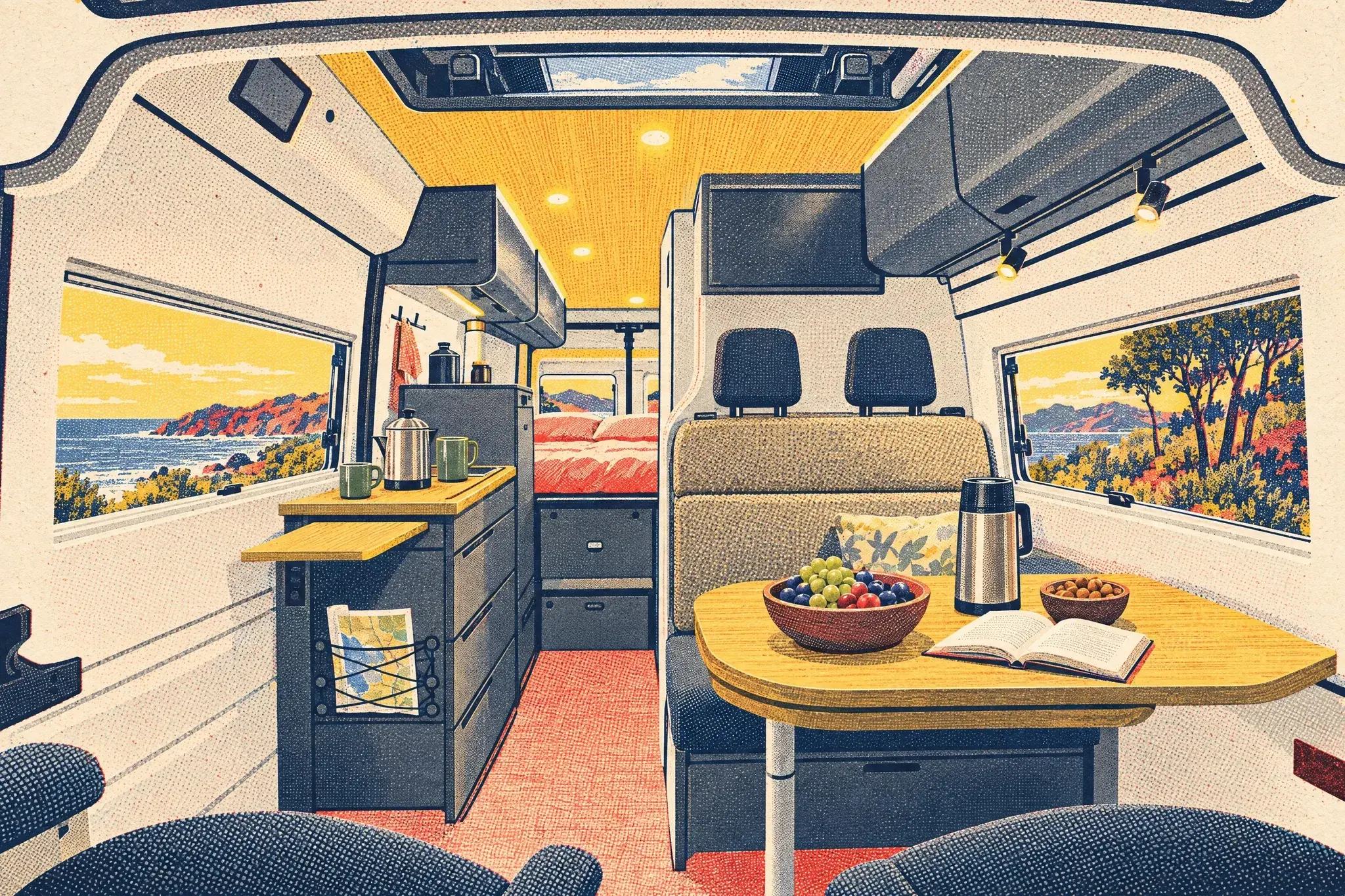
The standard equipment: better than you would expect
This is where the Redwood starts to justify its existence. The standard specification is not the stripped-out, add-everything-yourself affair you might expect at this price point. Hymer has been generous.
What you get without paying a penny extra
One important clarification first, because it is the thing buyers most often get wrong: the pop-top sleeping roof is not standard. The base Redwood is a two-berth with a fixed roof, and the pop-top, which adds the second double bed and makes the van a four-berth, is a cost option. Dealers have quoted it at around £4,200 on its own, though Hymer does not publish a clean standalone price, so confirm the exact figure when you configure one. It is a genuinely good roof, with a 209 by 143 centimetre bed, a skylight and an electric locking mechanism, but it belongs on the options list rather than the standard-kit list, and we fold it into the price maths below.
What you do get as standard, though, is generous. Swivelling cab seats with armrests, an attachable table with a slide-out extension, the Travel Lounge rear bench with adjustable inclination, a 90-litre compressor fridge with freezer compartment, a two-burner gas hob with sink combination, deep self-closing drawers, a pull-out spice rack, and LED ambient lighting throughout the living area and kitchen.
The insulation is proper, too. Fifteen millimetres of open-cell foam in the walls and 16 millimetres of XPS in the roof. The floor is insulated. The aluminium-framed windows are insulated. This is a campervan that has been built with the assumption that you will actually use it in weather that is not perfect. Not every manufacturer seems to share that assumption.
The bathroom, whichever layout you choose, gets a cassette toilet with level indicator, a proper shower tray with circular gutter, and a skylight. The fresh water tank holds 100 litres. The waste water tank holds 90 litres. These are not token capacities.
The technology package
Every Redwood comes with Hymer Connect as standard. This is the system that lets you control and monitor heating, lighting, fridge temperature, water levels and battery status through a 7-inch touch display mounted inside the van, or remotely through the Hymer Connect smartphone app.
It sounds like a gimmick until the first time you are lying in bed on a cold morning and can turn the heating up without getting out from under the duvet. Then it makes perfect sense.
On the safety side, the Redwood inherits a solid set of driver aids as standard from the Fiat Ducato base: lane-departure warning, traffic-sign recognition, emergency-brake warning, and rain and light sensors. Cruise control, tyre-pressure monitoring, parking sensors with rear obstacle detection, electric cab windows, an electric entrance step and remote central locking are included too. For a van at this price, that standard safety kit is genuinely good.
What is not all standard, and this is worth being clear about because it is easy to assume otherwise, is the fuller driver-assistance and cab-technology kit. Hymer offers a separate Driver Assistance Package and a Driving Comfort Package as paid options, and the more advanced aids, along with the upgraded cab tech such as the reversing camera, the digital cockpit and the large touchscreen, live in those packages rather than in the base price. So the essentials are covered without paying extra, but the complete suite is not, and we cover what those packages cost below.
The safety specification
The base Redwood comes with ESC, ABS, ASR, hill start assist, crosswind assist, trailer stability control, and post-collision braking. There are driver and passenger airbags. ISOFIX points for child seats on the rear bench. Embedded lashing eyes in the floor and rear bed for securing cargo.
For a vehicle at this price, the standard safety kit is difficult to fault. Hymer has clearly decided that the fundamentals should not be left to the options list, and they are right.
The three equipment lines
The Redwood is available in three equipment lines: Trail, Sport, and Explorer. Trail is the standard specification, included in the base price. Sport and Explorer are packages that bundle cosmetic and functional upgrades.
Trail
This is the default. Grigio Campovolo paintwork, which is a warm grey. The Rio fabric combination inside. Glossy black skid plate. Fog lights with cornering light function. It is handsome in an understated way. Not flashy. Not trying too hard.
Sport
The Sport line costs £2,650 on top and brings Storm Blue Metallic paint, a matching storm blue skid plate, black grill frame, the Peru fabric combination inside, and black matt 16-inch alloy wheels. It is the one that looks best in photographs, if you care about that sort of thing. And honestly, most people do.
Explorer
At £3,270 extra, the Explorer is the most interesting option because it is not just cosmetic. It brings the Autonomy Pack as standard, which means you get the 6 kilowatt diesel warm air heating system with a 10-litre warm water boiler, 1,800-watt electric bar heater, an atmospheric pressure sensor for altitude camping, a heated and insulated waste water tank, and pre-wiring for solar panels. The Lanzarote Grey paint and Caldera fabric combination round out a package that properly changes what the van can do.
If you plan to use the Redwood in autumn, winter, or spring, or anywhere above about 1,000 metres altitude, the Explorer is not really an option. It is a necessity.
Now for the uncomfortable bit: the options list
Here is where the Redwood's attractive base price starts to look a little less solid. Because the things you will almost certainly want are not cheap, and they add up with the quiet efficiency of a restaurant bill where you ordered one too many sides.
The automatic gearbox
The base Redwood comes with a six-speed manual gearbox. It is perfectly adequate. The Fiat Ducato manual is not unpleasant to drive, and 140 horsepower is enough for a van of this size and weight. But if you have ever driven a 3.5-tonne campervan in stop-start traffic, through narrow town centres, or up a multi-storey car park ramp, you will already know that an automatic makes life considerably easier.
The eight-speed automatic with the same 140 horsepower engine costs £3,420. Hymer has at times also offered a more powerful automatic-only engine at a higher price, so if you want extra pull, check the current engine options and cost with your dealer, as the line-up can change.
For most people, the 140 horsepower automatic at £3,420 is the sweet spot. A more powerful engine is nice to have on long Alpine climbs but harder to justify on a balance sheet.
Diesel heating
The standard Redwood comes with a 6-kilowatt diesel warm air heating system with a 10-litre warm water boiler. It works. It will keep you warm. But it relies on your gas bottles, which means carrying weight and finding places to refill or exchange them, and it does not work as efficiently at altitude or in very cold conditions.
The diesel heating upgrade brings a 6-kilowatt diesel-powered warm air heater that draws from the vehicle's fuel tank. No separate gas dependency for heating. An 1,800-watt electric bar heater for faster warm-up when you are on hook-up. An atmospheric pressure sensor that adjusts the heater's operation at altitude. This is the kind of heating system that lets you use the van in February in the Scottish Highlands without lying awake wondering if the gas will last until morning.
If you are buying the Explorer equipment line, diesel heating is included. If you are buying Trail or Sport, the Autonomy Pack costs £3,270 and bundles it with the heated waste water tank and solar pre-wiring. You can buy the diesel heater on its own for £1,360, but the pack makes more sense if you want the full winter capability.
The Driving Comfort Package
This is the one that most buyers will find difficult to resist. For £3,420, you get the Fiat 10-inch touchscreen infotainment system with integrated sat nav, DAB radio, Apple CarPlay, and Android Auto. A reversing camera. A fully digital cockpit with integrated 7-inch display. A wireless smartphone charging shelf. Automatic air conditioning with pollen filter. An electric parking brake. And a multifunctional steering wheel.
The standard van comes with manual air conditioning, a basic DAB radio pre-installation, and a conventional handbrake. Those things are fine. They work. But the Driving Comfort Package turns the cab from something you tolerate into somewhere you actually want to sit, and the reversing camera alone is worth a decent portion of that price when you are reversing a six-metre vehicle into a tight campsite pitch.
How quickly it adds up
Let us do the maths that Hymer would probably prefer you did not.
You start at £63,970 for a Redwood 600 in Trail specification, and that is a two-berth. If you want the four-berth version most families picture, you need the pop-top roof, an option dealers have quoted at around £4,200. You add the automatic gearbox at £3,420. The Driving Comfort Package at £3,420. And the Explorer equipment line at £3,270 for diesel heating and winter capability. With the pop-top, that is around £78,280 before you have even looked at LED headlights (£1,020), seat heating, a towbar (£810), all-terrain tyres (£1,920), or a heated windscreen (£240). Leave the pop-top off and stay a two-berth and you are nearer £74,000.
A realistically specified Redwood, with the things that most UK buyers would consider essential rather than luxury, comes in somewhere around £75,000 as a two-berth, or closer to £78,000 to £79,000 once you add the pop-top to make it a four-berth. That is still a lot less than a Grand Canyon S, which starts north of £80,000 before options. But it is a fair distance from the £63,970 headline figure.
To be fair to Hymer, this is not a trick unique to them. Almost every manufacturer in the campervan market prices their base models competitively and then recovers margin on the options list. It is how the industry works. But it is worth understanding before you fall in love with that starting figure.
What it is like inside
The Redwood's interior is, by any reasonable measure, lovely. The Native Bamboo furniture finish gives it a warmth and lightness that many campervans lack. Textured wood ceiling panels. Fabric-laminated walls in the bedroom for heat and sound insulation that also happens to look and feel far better than bare panels.
The ambient lighting is well thought through. There are LED reading lights with touch control, kitchen lighting that is bright enough to actually cook by, and a general lighting scheme that manages to be atmospheric without being impractical. You can adjust it all through the Hymer Connect display, which is the sort of feature that sounds excessive until you discover how often you want slightly different lighting at 10pm versus 7am.
The kitchen
A two-burner gas hob and sink combination with a glass cover. An expandable worktop that gives you a reasonable amount of preparation space. Deep drawers with premium self-closing pull-outs. A pull-out spice rack, which is a small touch that reveals someone at Hymer has actually cooked in a campervan and understood the frustration of hunting through a cupboard for cumin while the onions burn.
The 90-litre compressor fridge with freezer compartment runs on 12 volt or 230 volt, has a silent night mode, and offers enough capacity for a couple to eat well for several days without resupply. It is not a full-width domestic fridge, obviously. But for a sub-six-metre van, it is generous.
The bedroom
The rear transverse double bed is the Redwood's strongest interior feature. At 195 by 157 centimetres at its widest, it sleeps two adults comfortably without the contortions that some campervan beds demand. The disc spring mattress system beneath is a proper step up from basic foam, offering the kind of support that makes the difference between waking up refreshed and waking up wondering why your lower back has declared independence.
The optional pop-top roof bed adds a second sleeping space at 209 by 143 centimetres. It comes with a skylight for ventilation and stargazing, and the electric locking mechanism means you are not wrestling with manual catches at 11pm in the rain. If you are travelling with children, or friends who owe you a favour, the pop-top turns the Redwood from a couples van into something properly versatile.
The bathroom
Neither the 600 nor the 601 has a bathroom that will make you forget your one at home. That is the reality of any sub-six-metre campervan. But both are well considered within the space available.
The 600's compact bathroom with folding door keeps things tight but functional, and the integrated wardrobe is a welcome addition. The 601's Vario bathroom with sliding wall creates a more usable shower space at the cost of that wardrobe. Both have a cassette toilet, a shower tray with decent drainage, and a skylight for ventilation.
The bamboo insert in the shower tray, available on higher specifications, is a small detail that makes the shower feel marginally less like standing in a plastic box. It dries quickly and adds a touch of the spa to what is, in fairness, a small room in a van. But small touches matter when you are living in 5.99 metres.
On the road
The Fiat Ducato 2.2-litre diesel is the workhorse of the European campervan industry for good reason. It is reliable, well-supported by service networks across the continent, and it pulls the Redwood's 2,900-kilogram unladen weight without drama.
The 140 horsepower engine with six-speed manual is adequate. It will cruise at motorway speeds, handle hills without embarrassment, and return reasonable fuel economy. It is not exciting. It is not trying to be. It is a tool for getting you and your home to wherever you want to be, and it does that job competently.
The automatic gearbox, if you have added it, makes the driving experience noticeably more relaxed. The eight-speed transmission is smooth, nicely matched to the engine, and takes the effort out of driving in exactly the situations where a manual becomes tiresome. Slow traffic. Town centres. Ferry queues. Long motorway stretches where your left leg starts to feel redundant.
At 5.99 metres, the Redwood fits comfortably in a standard parking space and does not demand the kind of careful route planning that longer campervans require. You can use it as a daily driver if your lifestyle allows it. You can take it through towns, down B-roads, and into car parks without the constant background anxiety that comes with piloting something the size of a delivery vehicle.
The 3,500-kilogram gross vehicle weight means it sits within the standard driving licence limit for anyone who passed their test before 1997, or holds a Category B licence. You do not need additional driving qualifications, which removes a barrier that some heavier campervans impose.
The Hymer Connect system: genuine utility or digital fluff
Hymer Connect deserves its own section because it is actually useful in a way that many campervan technology features are not.
The 7-inch touch display inside the van gives you real-time information about your habitation battery charge level, fresh water and waste water tank levels, heating status, and fridge temperature. You can adjust the heating, set lighting scenes, and monitor your energy consumption without crawling around the van looking at gauges and switches.
The smartphone app extends this control to wherever you happen to be. Standing in a supermarket queue and wondering whether you remembered to turn the heating down? Check the app. Sitting in a pub and want the van warm when you get back? Adjust the heating remotely.
It is the kind of system that sounds like a solution looking for a problem until you have used it for a weekend. After that, going back to a van without it feels oddly primitive. The interface is clean, the app is reliable, and it all works the way it should. Hymer has done this well.
Who is the Redwood actually for
The Redwood is for people who want a Hymer but thought they could not afford one. It is Hymer's answer to the question that a lot of campervan buyers are asking: why should I spend more for a premium badge when I can get a perfectly good conversion from someone else for less?
The answer, if you have spent any time with a Hymer, is build quality. The doors close with a solidity that cheaper conversions cannot match. The furniture feels permanent rather than temporary. The insulation actually works. The electrical systems are engineered with a thoroughness that pays dividends over years of ownership. And the resale values reflect all of this.
The Redwood brings those qualities to a price point that competes directly with the likes of the Bürstner Copa and the Adria Twin, while offering a level of standard equipment that those rivals struggle to match. It is not cheap. A realistically optioned Redwood is a £75,000 vehicle. But compared to the Grand Canyon S at over £80,000, or a VW California at similar money with considerably less space, it makes a strong case for itself.
It is particularly well-suited to couples who want a compact, capable, four-season campervan that they can also use as an everyday vehicle without feeling like they are commuting in a bus. The six-metre length is the sweet spot for versatility. Short enough for supermarket car parks. Long enough for comfortable living.
The competition
In the premium six-metre campervan space, the Redwood competes most directly with a handful of established models.
The Bürstner Copa sits at a similar price point and offers comparable specifications, though its interior design tends toward the more conventional. The Adria Twin range provides strong value and proven layouts, but lacks the Hymer badge's resale advantage. The Volkswagen California, in its various guises, costs similar money for less interior space and a less capable living area, though it drives like a car rather than a van.
Further up the price scale, the Hymer Grand Canyon S on its Mercedes Sprinter chassis offers a more premium driving experience and a slightly more refined interior, but at a considerable price premium. The Redwood undercuts it while delivering much of the same living experience.
The Redwood's advantage is that it offers Hymer's build quality and engineering at a price that used to be the exclusive territory of less premium brands. Its disadvantage is that the options list means the as-delivered price may be rather higher than the number you first saw on the website.
Final thoughts
The Hymer Redwood is a very good campervan that costs more than you think it does but less than you might expect for what it is. It offers premium quality at a competitive entry price, with the caveat that the entry price is just the beginning of the conversation.
The standard specification is genuinely strong. The Hymer Connect system, the core driver aids, the insulation, the build quality, all included at £63,970, and all things that would cost extra or simply not be available from some competitors. The pop-top roof that makes it a four-berth is not part of that base price, though, so factor it in. Hymer has still loaded a lot of value into the base van, and it shows.
But the things that turn the Redwood from a good campervan into a great one sit on the options list. The pop-top roof, if you want a four-berth. Diesel heating. The automatic gearbox. The Driving Comfort Package. They add up to a vehicle that costs around £75,000, or closer to £79,000 with the pop-top, by the time it is realistically specified for year-round UK touring.
Is that good value? Compared to what else is available at that price, yes. Compared to the headline figure on the brochure, it requires a conversation with yourself about budgets and priorities.
If you are in the market for a premium compact campervan and the idea of owning a Hymer appeals to you but the Grand Canyon S pricing does not, the Redwood is the van that Hymer built specifically for you. Go and see one. Sit in it. Open the drawers. Feel the weight of the furniture. Look at the finish on the bamboo surfaces. Then open the configurator on your phone and start adding options.
Just maybe sit down first.
That is exactly the kind of van that Campervan.win exists to help you win. A premium campervan at a price that, with a bit of luck and good timing, does not have to remain a daydream.
Common questions
What is the Hymer Redwood?
It is a premium German compact campervan new for 2026, slotting into Hymer's range below the Mercedes Sprinter-based Grand Canyon S. It is built on the Fiat Ducato 2.2-litre 140hp platform, measures 5.99 metres long, and comes in two layouts (the 600 and 601), offering a proper Hymer at a more accessible price.
How much does the Hymer Redwood cost?
The UK starting price is 63,970 pounds, which is genuinely reasonable for a premium Hymer. The catch is the options list: an automatic gearbox, diesel heating, the Driving Comfort Package, the pop-top roof (dealers quote around 4,200 pounds) and the Sport (2,650 pounds) or Explorer (3,270 pounds) equipment lines add up quickly, so the configured price can climb well above the headline.
What is the difference between the Hymer Redwood 600 and 601?
Essentially the bathroom, since both share the same rear bed (195 by 157cm). The 600 has a space-optimised compact bathroom with an integrated wardrobe and a folding door; the 601 gets Hymer's Vario bathroom with a sliding partition that creates a more defined shower space. If you shower in the van regularly, the 601 is probably better; if you mostly use campsite facilities, the 600 gives you a wardrobe instead.
What standard equipment does the Hymer Redwood come with?
Better than you would expect: swivelling cab seats with armrests, an extending table, the Travel Lounge rear bench with adjustable recline, a 90-litre compressor fridge with freezer, a two-burner hob and sink, deep self-closing drawers, a pull-out spice rack and LED ambient lighting, plus a 100-litre fresh and 90-litre waste tank and decent insulation (15mm wall foam, 16mm XPS roof).
Does the Hymer Redwood have a pop-top?
It is available as an option rather than standard. The optional pop-top is a genuinely good roof, with a 209 by 143cm bed, a skylight and an electric locking mechanism, but it belongs on the options list (dealers quote around 4,200 pounds) rather than the standard-kit list, so factor it into the price if you want the extra berth and headroom.
Who is the Hymer Redwood for?
Buyers who want a premium, German-engineered compact campervan and like the idea of owning a Hymer, but for whom the Mercedes-based Grand Canyon S is too expensive. The Redwood is the van Hymer built specifically for that buyer. Just go in clear-eyed about the options list, since a sensibly specced one costs noticeably more than the 63,970-pound headline.
The reachable bit
The camper you fall for is rarely the one you can afford. That gap is the whole reason Campervan.win exists. Right now we’re giving away the Sunlight Vanlife, worth around £65,000, and closing that gap is the point: capped entries so the odds stay honest, £10 a ticket, a maximum of five per person, £500 to a UK charity from every full draw, the winner picked by a public randomness beacon anyone can re-check, and one person driving away in the van itself.
Enjoyed this post?
Get more honest campervan guides like this one in your inbox.
You’re in!
Check your inbox. We’ve just sent you a welcome email.

About the author
Leo
Leo covers campervan technology, maintenance, kit, and ownership advice, with a clear, practical focus on how things work in real life.
Keep Reading
Related Reading
Thoughtful articles that build on what you’ve just read.
Campervan Reviews
12 min read
Rolling Homes Darwin review: the long Crafter camper with a proper washroom
The Darwin is Rolling Homes' step up from the Transporter: a long-wheelbase VW Crafter two-berth with an enclosed washroom. We set out what is published, what the price does, and who it suits.
Campervan Reviews
13 min read
Jerba Cromarty review: the long-wheelbase five-seater with two double beds
The Jerba Cromarty is a 5.45 m Scottish-built camper on a VW T7 or Ford Transit Custom that seats five in belts and sleeps two as standard, or four with the optional roof bed. We look at how it lives, what the from-price buys, the published weights and who it suits.
Campervan Reviews
12 min read
Bilbo's Nexa+ T7 review: a rear kitchen, a cassette toilet and the new Low-Lie roof
The Nexa+ is the Bilbo's for people who want a fitted toilet in a Volkswagen Transporter. We go through the rear-kitchen layout, the beds, the power and heating as published, the T7 base, the £77,930 in-stock price and who it suits.
Campervan Reviews
13 min read
Hillside MVX review: the Multivan camper from £70,995, or £78,995 as an eHybrid 4MOTION
Hillside's MVX puts a four-berth pop-top conversion on the Volkswagen Multivan, with a plug-in hybrid and all-wheel drive at the top of the range. Here is what it offers, what it leaves to the Transporter-based Cromford, and where the 2026 Club judges placed it.