
Stop Paying for Mobile Data in Your Campervan. Starlink Mini Has Already Won.

Written by
Martha
Martha writes about interiors, ownership stories, and the everyday realities of campervan life, with a focus on comfort, cost, and how vans are used over time.

The short answer
For campervan internet in 2026, Starlink Mini has effectively made 4G and 5G routers obsolete, and the good news is how affordable that has become. The kit is £179 (often free bundled with a residential plan), the Roam plan £55 a month for 100GB that you can pause the moment you get home, and it delivers 50 to 200 Mbps anywhere with a clear view of the sky, not just near a phone mast. It is laptop-sized, draws just 20 to 40 watts (about a small fridge), wires straight into a 12V system, and runs sustainably off-grid on 200W of solar and a 100Ah battery. Latency is around 25ms, comparable to home broadband. Here is why custom builders have already switched, and why you should too.

A Starlink Mini Kit costs £179. The Roam plan is £50 a month for 100 gigabytes. You can pause it the moment you get home and restart it the day you leave again. The hardware is often available for free in the UK when bundled with a residential plan.
Read that again, because it changes everything about how you think about internet in a campervan.
For less than the price of a decent folding table and chairs set, you get a satellite internet terminal the size of a laptop that delivers 50 to 200 megabits per second, anywhere with a clear view of the sky. Not anywhere near a phone mast. Not anywhere with three bars of 4G. Anywhere. A headland in Pembrokeshire. A loch side in the Highlands. A cliff top in Northumberland. A mountain pass in the Alps. If the dish can see the sky, you have broadband.
The accessories tell the same story. A roof rack mount is £30. A car adapter for 12 volt power is £52. A mobility mount is £25. A Router Mini, if you want the smaller router option, is £38. The entire system, hardware and all accessories, costs less than a single optional extra on most new campervans. Less than a paint upgrade. Less than a set of alloy wheels. Less than the connectivity package that most manufacturers charge for a 4G router that will not work on half the campsites you plan to visit.
And here is the part that should make every campervan owner sit up: you only pay when you use it. Heading out for a fortnight in August? Activate the plan. Coming home in September and not touring again until Easter? Pause it. You are not locked into twelve months of payments for a service you use eight weeks a year. You pay for the months you tour, and you pay nothing for the months you do not.

That flexibility alone kills the mobile data argument. But it is only the beginning of why Starlink Mini has made 4G and 5G routers in campervans obsolete.
The mobile data problem nobody wants to talk about
Mobile data in a campervan has always been sold as simple. Buy a router, insert a SIM, get internet. The reality has never matched the pitch.
Coverage is the fundamental issue. The UK has roughly 98 percent population coverage for 4G, which sounds impressive until you remember that campervans spend a disproportionate amount of their time in exactly the places where the remaining two percent lives. Rural Wales. The Scottish Highlands. Coastal headlands. National parks. Moorland. The edges of everywhere. These are the places people buy campervans to visit, and they are precisely the places where mobile signal is thinnest, weakest, or simply absent.
Even where coverage exists, it is not equal. One network might have a mast within range. Another might not. You end up either carrying multiple SIM cards and swapping between them, or paying for an expensive multi network router that promises to find the best signal automatically but still cannot create signal where none exists.
Data caps add another layer of frustration. Unlimited mobile data plans in the UK typically come with fair use policies that throttle speeds after a certain threshold. If you are working remotely from a campervan, running video calls, uploading files, and streaming in the evening, you can burn through a generous allowance in days rather than weeks.
Then there is roaming. Since the UK left the EU, mobile roaming charges have crept back in for most providers. A week touring in France or Spain with a UK SIM can generate surprising bills or trigger a data cap that turns your connection into something that would have felt slow in 2005.
And through all of this, the fundamental architectural limitation remains. Mobile data needs a ground based mast within range. No mast, no signal. No amount of expensive antenna, booster, or clever routing can change that. You are always dependent on infrastructure that somebody else built, in locations that somebody else chose, for reasons that had nothing to do with whether you wanted to check your email from a campsite in Snowdonia.
Why Starlink Mini changes the equation entirely
Starlink Mini connects to a constellation of thousands of low earth orbit satellites at around 550 kilometres altitude. Traditional satellite internet used geostationary satellites at 36,000 kilometres, which meant latency of over 500 milliseconds. That made video calls impossible and web browsing painful. Starlink's low orbit cuts latency to around 25 milliseconds, which is comparable to decent home broadband. Video calls work. Streaming works. Remote working works. It does not feel like satellite internet. It feels like broadband that happens to arrive from space.
The Mini draws between 20 and 40 watts. With a 12 volt to 48 volt DC converter, or Starlink's own £52 car adapter, it wires directly into a campervan's electrical system alongside the fridge, the water pump, and the heater. No inverter needed. No 230 volt power brick taking up space. It becomes just another 12 volt load, drawing roughly the same power as a small compressor fridge.
For a campervan with 200 watts or more of solar and a lithium battery bank of 100 amp hours or above, running a Starlink Mini is entirely sustainable off grid. On a sunny day, the solar easily covers the draw. On a cloudy day or in winter, you manage it the same way you manage any other power consumer: with awareness and a bit of planning.
And it does not need a mast. It does not need ground infrastructure at your location. It needs sky. That single fact rewrites the connectivity story for every campervan on the road.
The cost comparison that ends the argument
This is where the conversation stops being theoretical and starts being embarrassing for anyone still selling mobile data solutions.
A Starlink Mini Kit is £179. In some UK promotions, the hardware is free when bundled with a Starlink residential subscription, meaning you can get the dish at no upfront cost and activate it on a Roam plan for your campervan.
The Roam plan for 100 gigabytes is £50 a month. If you need unlimited data, the Roam Unlimited plan is around £100 a month. You can pause the service whenever you like and pay a small standby fee of a few pounds per month instead of the full subscription.
Now add up what a proper mobile data setup actually costs in a campervan. A decent multi network 4G or 5G router runs between £200 and £500. An external MIMO antenna to improve signal costs another £50 to £150. Installation, cabling, and mounting adds more if you are not doing it yourself. Then you need a SIM card and a data plan at £20 to £50 per month. If you tour in Europe, add roaming costs or local SIM cards in every country.
By the time you have a properly installed mobile data system with a good antenna, a decent router, and a generous data plan, you have spent more on hardware than a Starlink Mini Kit costs, and you are paying a similar monthly fee for a service that only works some of the time, in some places, at speeds that depend entirely on how close the nearest mast happens to be.
The Starlink setup is cheaper to buy, similar or less to run, and it works almost everywhere. The mobile data setup is more expensive to buy, similar to run, and it works in maybe two thirds of the places you actually want to be.
For someone who tours eight weeks a year on the 100 gigabyte Roam plan, pausing for the other ten months, the annual service cost is £400 plus a few pounds in standby fees. Add the £179 hardware in year one, and you are at under £600 for a full year of broadband quality internet on every trip. That is less than many people spend on campsite hook up fees alone. It is less than a single optional extra on most new campervans. It is, frankly, absurd value for what it delivers.
Why custom builders have already made the switch
The custom campervan conversion industry moves faster than the big manufacturers because it can. A small builder with a workshop and a client list can change their standard specification in a week. If a new product works better, they fit it. If something becomes obsolete, they drop it.
And that is exactly what has happened with Starlink. Walk through the portfolio of any serious UK custom builder right now, companies like CJL Leisure, Vanworx, Rolling Homes, and dozens of others, and you will see Starlink Mini appearing as either a standard fit or a prominent option. CJL Leisure has engineered their own dedicated Starlink Mini roof mount, designed to sit permanently on the van roof with hidden cabling and a low profile bracket that bolts directly to the metalwork or to roof rails.
Arjan de Kock of Forged Vans, who builds custom vans for professional climbers including Alex Honnold, covered Honnold's latest van roof with 900 watts of solar partly because the van runs Starlink as its primary internet source. The entire electrical philosophy of the build is designed around solar powering everything, including satellite internet, without any gas or mains dependency.
These builders are not fitting Starlink because it is trendy. They are fitting it because their clients, who are typically experienced tourers with specific requirements, have been asking for it. And once they experience it, they do not go back. The pattern across the campervan community is consistent: people who switch to Starlink from mobile data do not switch back. The reliability difference is too large.
Why manufacturers need to catch up, and quickly
This is the part that should make the big brands uncomfortable.
Walk into a campervan show in the UK right now and look at the connectivity offerings from the major manufacturers. What you will typically find is a 4G or 5G router, sometimes integrated into the vehicle's own system, sometimes offered as an optional extra, marketed as the internet solution for modern touring. Some brands offer it as part of a technology or connectivity pack that adds several hundred pounds to the price.
That was a reasonable offering three years ago. It is not a reasonable offering now. Not when a Starlink Mini Kit costs £179 and a roof rack mount costs £30.
The problem is not that manufacturers are unaware of Starlink. The problem is structural. Model year cycles run 12 to 18 months ahead. Supply chain agreements with router and antenna suppliers are locked in. Marketing materials are already printed. Dealer training is already done. Changing the connectivity specification in a production campervan is not a small decision, even if the technical implementation is straightforward.
But none of that matters to the buyer standing on a dealer forecourt in 2026, comparing a factory fitted 4G router that costs £400 as part of a technology pack and will not work in Snowdonia, against a Starlink Mini that costs £179, works everywhere, and can be fitted in an afternoon.
The manufacturers who move first will have a genuine competitive advantage. Not a gimmick. A functional advantage that their customers will notice every single time they park somewhere beautiful and remote.
What manufacturers actually need to do: it is embarrassingly simple
Here is the thing that makes the current situation so frustrating. Manufacturers do not even need to supply the Starlink hardware. They do not need to negotiate a deal with SpaceX. They do not need to bundle a subscription or become a reseller or add another line to their already complicated options list. They just need to do what they already do with every other system in the vehicle: pre-install the infrastructure.
That means three things.
First, a weatherproof cable routed from the roof to the interior. The Starlink Mini uses a single cable that carries both data and power. The manufacturer runs that cable from a designated external mounting point on the roof, through a sealed grommet, down through the wall cavity or ceiling lining, and terminates it at a neat connection point inside the living space. This is exactly the same kind of cable routing that every manufacturer already does for roof mounted solar panels, television antennas, reversing cameras, and exterior lighting. It is not new engineering. It is existing engineering applied to a different cable.
Second, an external mount on the roof. Starlink's own roof rack mount costs £30. A manufacturer could either specify the official Starlink mount as a factory fit item or, more likely, design a simple universal mounting plate in the same way they already provide mounting points for satellite television dishes, solar panels, and roof racks. The mount needs to hold a device that weighs about a kilogram in a position with a clear view of the sky. That is less demanding than mounting a solar panel. It is less demanding than mounting an air conditioning unit. It is, structurally, one of the simplest things you could bolt to a campervan roof.
Third, an interior position for the router. The Starlink Mini has a built in Wi-Fi router, so in its simplest form this just means a neat shelf, bracket, or locker position where the Mini sits when the cable comes through from the roof. If the buyer opts for the separate Router Mini at £38, that router is tiny, barely bigger than a phone, and needs a small shelf and a USB-C power connection. Either way, the interior requirement is a mounting point and a tidy cable termination. Less space than a gas locker. Less complexity than a control panel.
That is the entire factory installation. One cable. One roof mount. One interior bracket. The manufacturer does not supply the Starlink hardware, does not manage the subscription, does not provide technical support for the satellite service. The buyer purchases their own Starlink Mini Kit for £179, plugs it into the pre-installed cable and mount, downloads the Starlink app, activates their £50 a month plan, and they have broadband. The manufacturer has simply made that process seamless instead of leaving the buyer to drill holes in their brand new campervan's roof.
Compare that to what manufacturers currently do for connectivity. A factory fitted 4G or 5G system requires a router, an internal antenna or external MIMO antenna, a SIM card slot, power wiring, sometimes a dedicated control interface, and often integration with the vehicle's own smart home system. It requires supplier agreements, firmware updates, and ongoing compatibility testing. It is more complex, more expensive to implement, and delivers a worse result in the places where campervan owners actually tour.
A Starlink pre-installation is simpler than a 4G installation. It costs less in materials. It requires less engineering time. And it delivers a categorically better internet experience for the end user. The only reason it is not already standard on every new campervan rolling off a production line is that nobody in the big manufacturers' product planning departments has yet signed off on the change.
The first brand to list Starlink Ready as a standard feature, meaning the cable, the mount, and the interior bracket come fitted to every vehicle, will own that conversation overnight. It will appear in every review. It will be mentioned in every forum comparison. It will become one of those features that, once one manufacturer offers it, every other manufacturer looks foolish for not having thought of it first.
And the cost to the manufacturer? A cable, a grommet, a mounting plate, and a bracket. Probably under £50 in parts. On a vehicle that sells for £65,000 or more, that is not even a rounding error. It is a statement of intent.
The objections, addressed honestly
Starlink is not perfect. Nothing is. But the common objections deserve honest answers.
It needs a clear view of the sky
True. If you park under dense tree cover, in a narrow valley, or against a tall building, the dish may struggle. In a heavily wooded campsite, you may get intermittent service or none at all.
But here is the context. A mobile data router also struggles in these locations, because dense tree cover and valleys tend to block or weaken mobile signal too. The difference is that Starlink needs sky, which is available in the vast majority of UK and European touring locations, while mobile data needs a nearby mast, which is available in far fewer of the remote locations where campervans actually go.
For the small percentage of situations where tree cover blocks Starlink, keep a SIM card in your phone as a backup. You do not need an expensive router system. Just a phone with a data plan for the rare occasions when Starlink cannot see enough sky. That is a backup, not a primary system.
It uses power
At 20 to 40 watts, Starlink Mini draws meaningful power. On a small electrical system with a single AGM leisure battery and no solar, running it for extended periods would drain your battery uncomfortably fast.
But campervan electrical systems have been moving towards larger lithium batteries and more solar capacity for years, driven by demand for compressor fridges, induction hobs, diesel heaters, and phone charging. A modern campervan with 200 watts of solar and a 100 amp hour lithium battery can run a Starlink Mini, a compressor fridge, LED lighting, and USB charging simultaneously without anxiety.
If your electrical system cannot support Starlink, the honest answer is that it probably needs upgrading anyway, because it is also struggling with everything else a modern tourer expects.
The monthly cost adds up
Only if you leave it running when you are not using it. At £50 a month, paused when you are home, the annual cost for a typical UK tourer doing six to eight weeks of trips is £300 to £400. That is broadly the same as a decent mobile data plan, except the Starlink actually works in the places you want to be.
And that is without the often free hardware. If you pick up a Mini through a residential bundle promotion, your upfront cost is zero. Your only expense is the months you choose to activate.
What this means for buyers right now
If you are buying a new campervan or motorhome in 2026, here is the practical advice.
Do not pay extra for a factory fitted 4G or 5G connectivity package unless it comes as part of a bundle you want for other reasons. The router itself may be fine as a secondary backup, but it should not be your primary internet solution if you tour anywhere outside major urban centres.
Instead, buy a Starlink Mini Kit for £179. Add the car adapter for £52 to power it from 12 volts. Add a roof rack mount for £30 if you want it permanently fitted, or a mobility mount for £25 if you prefer something more flexible. Total hardware cost: between £204 and £261, depending on which mount you choose. If you want the smaller Router Mini instead of the built in router, add £38.
That is your entire connectivity setup for less than £300. Activate the £50 a month Roam plan when you tour. Pause it when you get home. Total annual cost for eight weeks of touring: around £400 in service plus the one off hardware.
Compare that to a factory connectivity package at £300 to £500 that gives you a 4G router which cannot find signal on a Northumberland beach, and the decision makes itself.
If you are ordering a custom build, ask your builder about Starlink integration from the start. A dedicated roof mount position, a pre-wired 12 volt circuit, and a neat interior cable run. The best builders are already doing this as standard, because their clients have been asking for it since the Mini launched.
If you are buying from a manufacturer, ask the dealer whether the vehicle is Starlink Ready. If the answer is no, ask why not. Ask them how much it would cost to have the dealer pre-install a cable and mount before collection. Some dealers will do it. The ones who will not are telling you something about how quickly they are adapting to the world their customers already live in.
The bigger picture
Starlink is not standing still. The satellite constellation is growing. Speeds are improving. The Mini hardware has already dropped from its original launch price to £179 in the UK, and competition from Amazon's planned Kuiper constellation and other providers will likely push prices lower and performance higher over the coming years.
At the same time, the way people use campervans is changing. Remote working is not a pandemic novelty. It is a permanent feature of how a growing number of people organise their lives. The ability to work from a campervan, not as a romantic fantasy but as a practical reality, depends entirely on reliable internet. Starlink makes that possible in a way that mobile data never could, because mobile data could never guarantee coverage in the places where people actually want to be.
Manufacturers who integrate Starlink compatibility into their standard electrical designs, even if they do not include the hardware itself, will be positioning their vehicles for how people actually tour in 2026 and beyond. One cable, one mount, one interior bracket. That is the entire investment. And the first manufacturer to make it standard will not just be selling a feature. They will be selling the message that they understand their customers better than every competitor who is still fitting 4G routers and hoping nobody notices.
The ones who do not will find themselves in the same position as the television manufacturers who kept fitting analogue tuners after the digital switchover. Technically functional. Practically irrelevant.
The bottom line
A Starlink Mini Kit costs £179. The monthly plan is £50. You can pause it whenever you like. A roof rack mount is £30. A 12 volt car adapter is £52. The hardware is often free in the UK through promotional bundles.
For under £300 in hardware and £50 a month only when you are actually touring, you get broadband speed internet from a device the size of a laptop, powered from your campervan's 12 volt system, anywhere with a clear view of the sky. It works on a Welsh hillside. It works on a Scottish loch side. It works in the Alps. It works in places where your phone shows zero bars and your expensive 4G router shows a blinking red light and nothing else.
Custom builders have already adapted. The aftermarket has already adapted. The campervan community has already adapted. Manufacturers need to do the bare minimum: run a cable, fit a mount, provide a bracket. Under £50 in parts on a vehicle that costs tens of thousands of pounds. That is not a product development challenge. It is a decision that somebody needs to make.
If you are fitting out a campervan in 2026 and you are still planning a 4G router as your primary internet solution, stop. The Starlink Mini Kit costs less than the router you were about to install. The monthly plan costs less than the data SIM you were about to buy. And it actually works in the places you are going.
The technology has moved. It has moved decisively. And for £179, there is no reason not to move with it.
And if the cost of kitting out a campervan still feels like a stretch, well, that is exactly why we run Campervan.win. Someone has to make these things accessible.
Common questions
Is Starlink Mini good for a campervan?
Yes, it has effectively become the default. The kit is 179 pounds and the Roam plan 55 pounds a month for 100GB, which you can pause the moment you get home, and it delivers 50 to 200 Mbps anywhere with a clear view of the sky, not just near a phone mast. For internet on a headland, a loch side or a mountain pass, it does what no 4G router can.
Does Starlink Mini work better than a 4G or 5G router in a campervan?
In most cases, decisively. The UK has roughly 98 percent population 4G coverage, but campervans spend a disproportionate amount of time in the remaining two percent, exactly where a mast-based router struggles. Starlink connects to low-earth-orbit satellites instead, so as long as the dish can see the sky you have broadband, which is why custom builders have already switched.
How much does Starlink Mini cost to run in a campervan?
The Starlink Mini kit is 179 pounds (often free in the UK when bundled with a residential plan), and the Roam plan is 55 pounds a month for 100GB, which you can pause when you are home and restart when you travel. Accessories are modest, like a 52-pound 12V car adapter and a 30-pound roof mount. That typically undercuts the connectivity package and data SIM many manufacturers charge for.
How much power does Starlink Mini use, and can it run off-grid?
It draws between 20 and 40 watts, roughly the same as a small compressor fridge, and with a 12V-to-48V converter or Starlink's 52-pound car adapter it wires directly into the van's electrical system as just another 12V load, with no 230V power brick. For a van with 200W or more of solar and a 100Ah-plus lithium battery, running a Starlink Mini off-grid is entirely sustainable.
Does Starlink Mini need a clear view of the sky?
Yes, that is the main caveat. Starlink needs a clear view of the sky to connect, so dense tree cover or a deep gorge can block it, though it is far more forgiving than older satellite systems. In the open spots campervans actually head for, a headland, a loch side, an open pitch, that requirement is easily met.
What is the latency of Starlink in a campervan?
Around 25 milliseconds, comparable to decent home broadband. Starlink uses low-earth-orbit satellites at about 550km altitude, where traditional geostationary satellite internet sat at 36,000km with latency over 500 milliseconds. That low orbit is what makes Starlink usable for video calls and normal browsing rather than the laggy experience old satellite internet gave.
The reachable bit
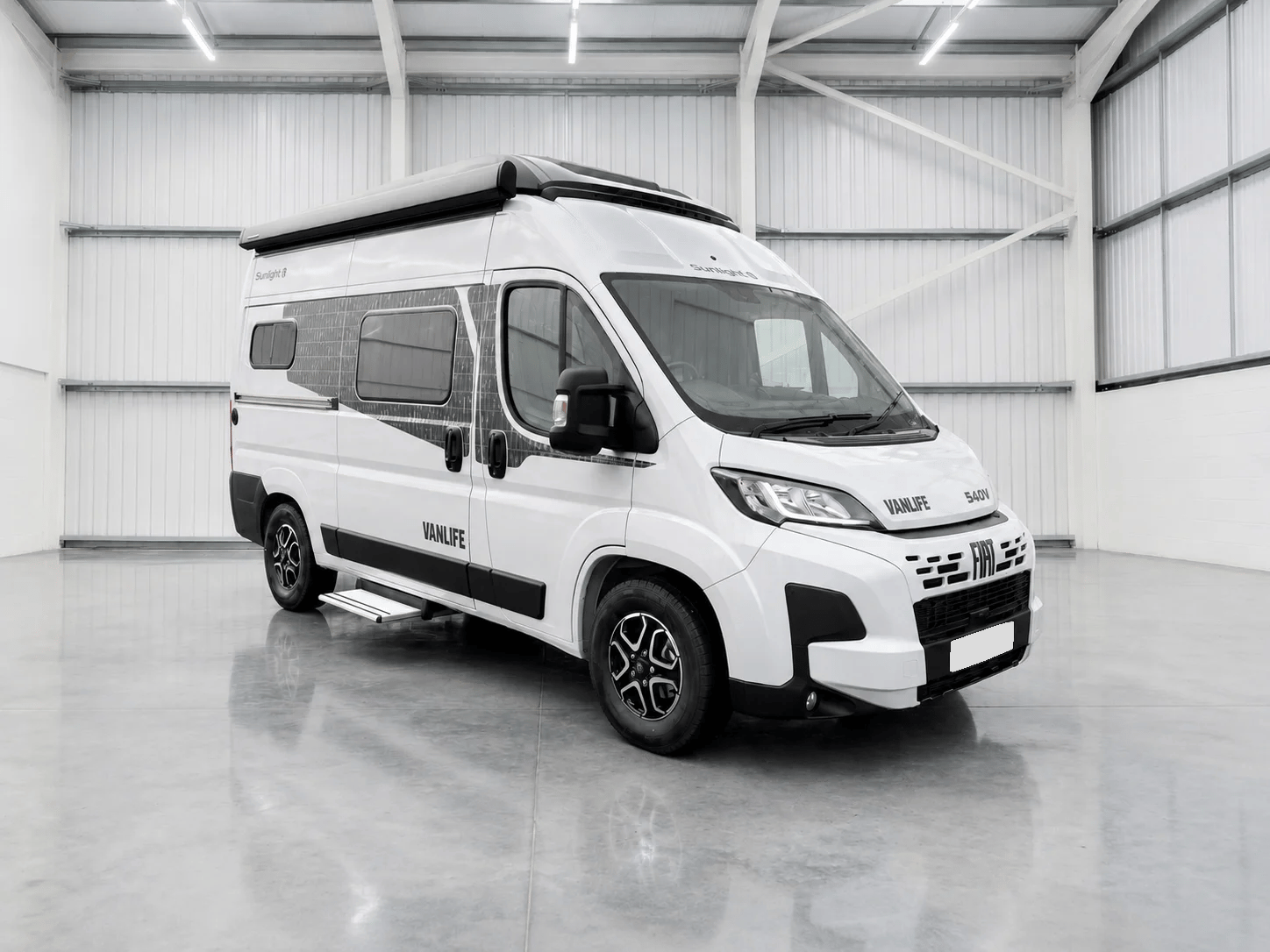
The camper you fall for is rarely the one you can afford. That gap is the whole reason Campervan.win exists. Right now we’re giving away the Sunlight Vanlife, worth around £65,000, and closing that gap is the point: capped entries so the odds stay honest, £10 a ticket, a maximum of five per person, £500 to a UK charity from every full draw, the winner picked by a public randomness beacon anyone can re-check, and one person driving away in the van itself.
Enjoyed this post?
Get more honest campervan guides like this one in your inbox.
You’re in!
Check your inbox. We’ve just sent you a welcome email.

About the author
Martha
Martha writes about interiors, ownership stories, and the everyday realities of campervan life, with a focus on comfort, cost, and how vans are used over time.
Keep Reading
Related Reading
Thoughtful articles that build on what you’ve just read.

Campervan Tech & Electrics
10 min read
Campervan electric systems: how to judge a good one
A plain-English guide to reading and reviewing a campervan's electrical setup, from leisure batteries and solar to DC-DC chargers and inverters, so you can tell a genuinely good system from a flashy spec sheet.
Campervan Tech & Electrics
10 min read
The best campervan electrical systems, explained honestly
A plain-English guide to what makes a campervan electrical system genuinely good, from leisure batteries and charging to inverters and safety, with honest setups for different ways of travelling.
Campervan Tech & Electrics
11 min read
Campervan air conditioning: the honest UK guide for motorhomes and vans
A practical look at whether air conditioning is worth fitting to your van, the real pros and cons, the main types, what it takes to run off-grid, and which system suits which budget.

Campervan Tech & Electrics
26 min read
Off-grid for real: what 100Ah lithium and Alde heating get you in a 4x4 van
An honest, detailed look at what a single 100Ah lithium battery and an Alde wet heating system actually deliver in a 4x4 campervan, with real UK figures, day counts, and the mistakes that catch people out.