
The Surfer Boy Pizza campervan in Stranger Things: the VW that stole season 4

Written by
Oliver
Oliver is the founder of Campervan.win and writes about campervans, travel, and the life-changing freedom that comes with getting out on the road.
The short answer
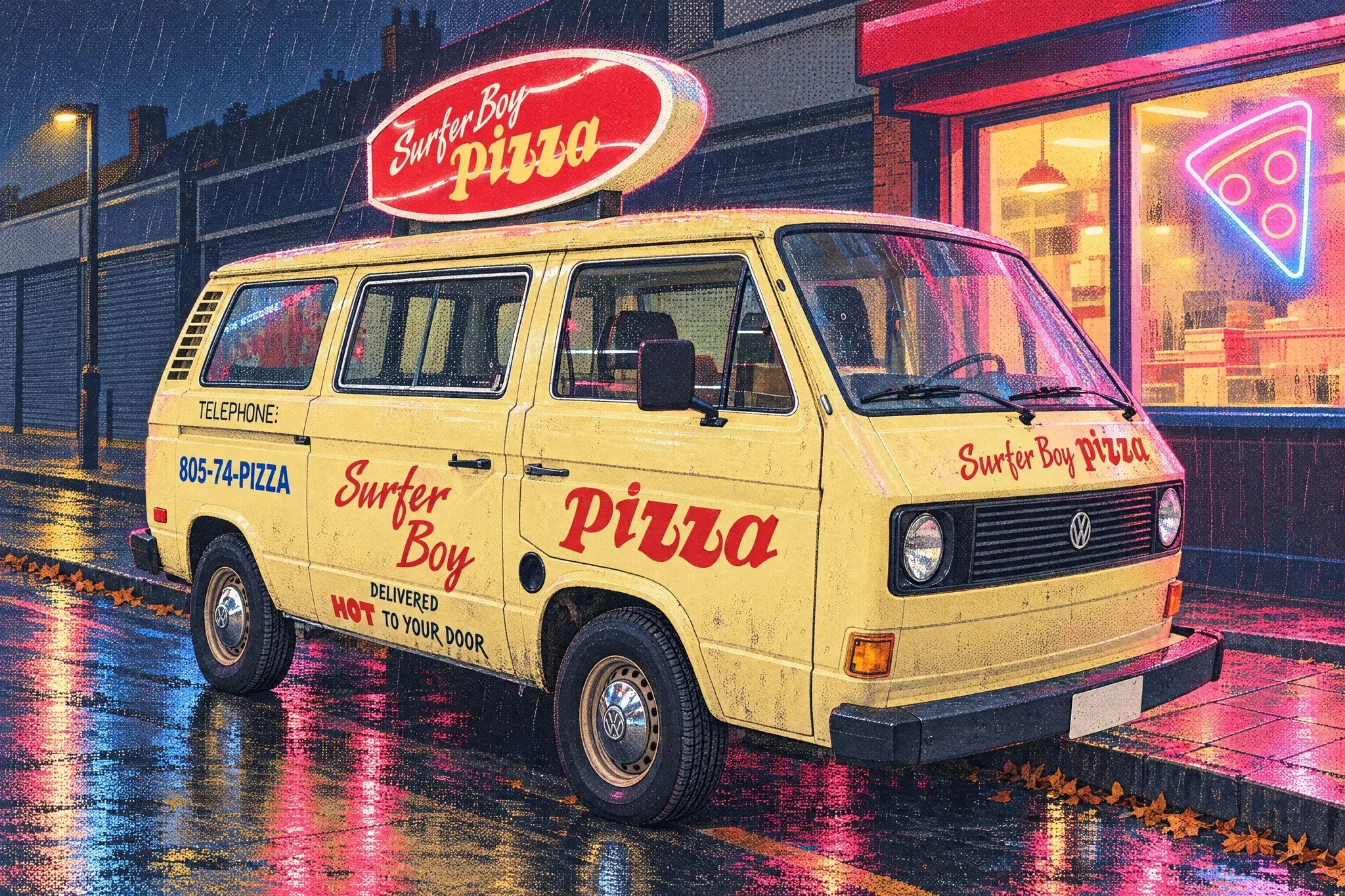
The Surfer Boy Pizza campervan that stole Stranger Things season 4 is a Volkswagen Type 2 (T3), the square-shouldered 1980s generation of the Transporter (known in the UK as the T25 and in North America as the Vanagon) that sits between the rounded T2 and the front-engined T4. Made in Germany from the late 1970s into the early 1990s, with four-wheel-drive Syncro versions built in Austria, it was the last of the rear-engined VW vans. Bright, boxy and full of character, it became a character in its own right on screen and has since spawned Revell model kits, a Funko Pop and remote-control versions. It is a wonderful reminder that campervans are never just transport. Here is the full story of the VW that stole the season.

There are vehicles that appear on television like furniture. They exist to fill space, get a character from A to B, and quietly disappear between scenes.
Then there is the Surfer Boy Pizza campervan in Stranger Things.
It turns up bright as a boiled sweet, wearing a roof sign the size of a surfboard, and instantly feels like a character in its own right. You do not have to be a campervan person to notice it. You do not even have to be a car person. It has that rare screen presence where you can almost hear it before it arrives, even if it is just rolling into shot at low speed.
For those of us who care about campervans and motorhomes, it does something else as well. It reminds you why these boxes on wheels get under people’s skin. Not because they are flawless, or fast, or sensible. Because they carry stories. Sometimes literally.
This is the story of the Stranger Things pizza van. What it is in real life, where it comes from, why the production chose it, what it might actually be like to drive, and how it became so popular that it ended up as everything from a model kit to a remote control toy and even a Transformers crossover.
What is the Surfer Boy Pizza van, exactly?
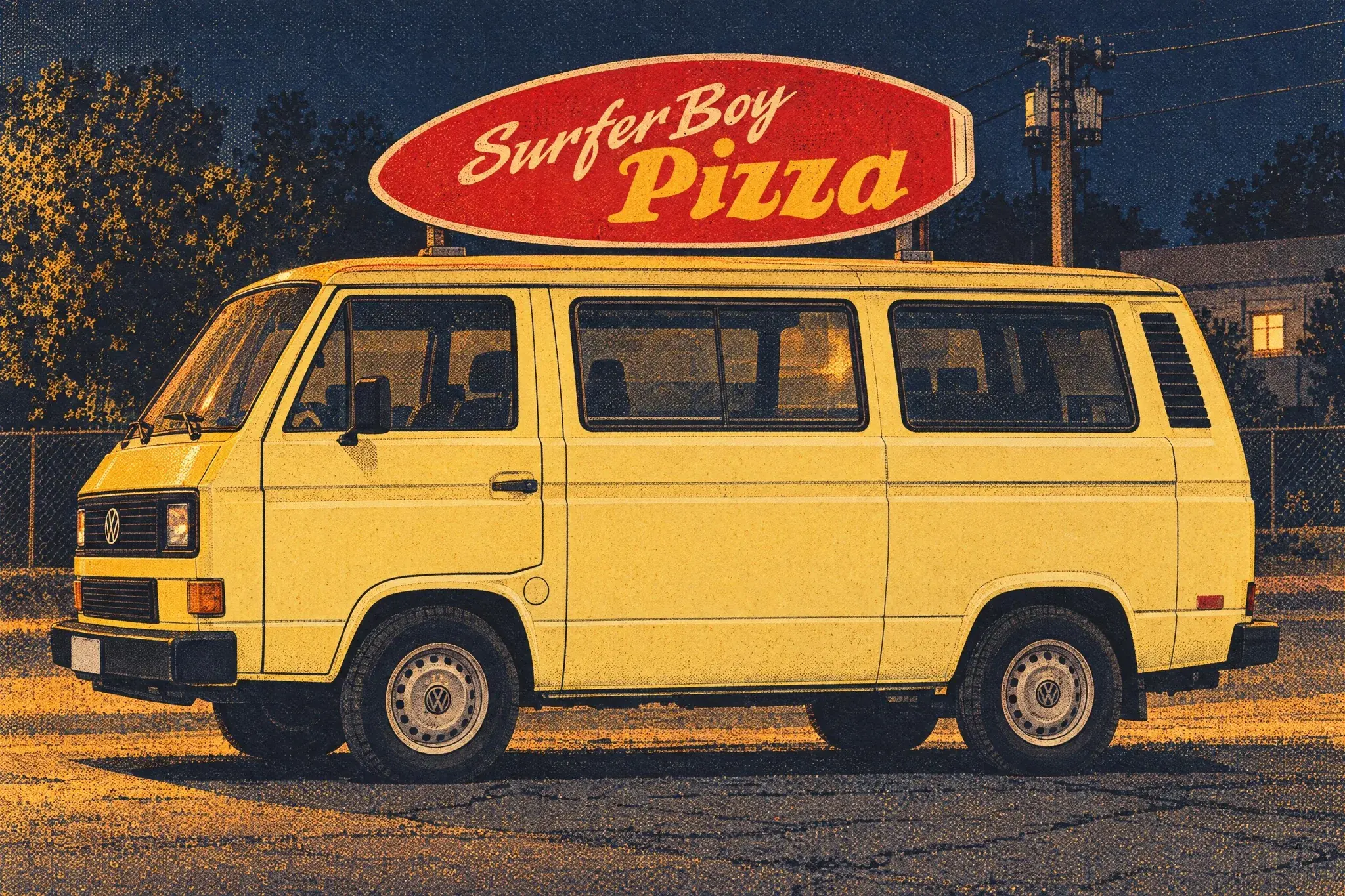
The vehicle used for the Surfer Boy Pizza van is a Volkswagen Type 2 (T3). In the UK you will often hear people call it a VW T25, while North Americans usually call it a Vanagon. It is the third generation of the Volkswagen Transporter, and it is the square shouldered Eighties one that sits between the classic rounded T2 and the later front engine T4.
That matters, because the T3 has a very particular look. It is boxy without being bland. Upright without being awkward. It feels like a practical tool that accidentally became stylish.
The T3 was made in Germany from the late Seventies into the early Nineties, with some four wheel drive Syncro production continuing in Austria a little longer. South African production carried on later for that market.
The van in Stranger Things is dressed as a pizza delivery vehicle, but it sits firmly in campervan culture. Even if it is not a classic pop top conversion on screen, it uses the same foundation, the same shape, and the same emotional shortcut. You see it and you think freedom, mischief, and a bit of chaos, in that order.
A quick, human history of the VW T3
If you grew up around British campsites, surf towns, festivals, or the kind of family friends who always seemed to be going somewhere, you probably remember the T3 era.
It was the moment when the Transporter got bigger and more angular, but still kept the rear engine layout that Volkswagen had been using for decades. The T3 is often described as the final generation of rear engined Volkswagens, and it was offered in rear wheel drive and a four wheel drive Syncro version.
For campervan people, the T3 hits a sweet spot.
It is old enough to feel classic, but new enough to feel usable. It has proper doors, decent glass area, and a driving position that makes you feel like you are sitting at the front edge of the world. If you have ever driven one, you will know the feeling of your toes being closer to the front bumper than your brain expects.
It is also a van with real variety. People turned them into everything.
Simple weekend campers with a bed platform and a coolbox.
Westfalia style conversions with kitchens and pop top roofs.
Syncro builds with chunky tyres and a surprising ability to get places you probably should not be.
And, as Stranger Things proves, perfect rolling billboards for fictional pizza shops.
Volkswagen made a lot of T3s, which helps explain why the van still feels present in the real world. It is not a rare unicorn. It is a workhorse that survived long enough to become loved.
Why the Surfer Boy van works so well on screen
Television cars do a job. They tell you something quickly, before anyone speaks.
The Surfer Boy Pizza van tells you loads, instantly.
It tells you California without showing a palm tree.
It tells you youth without showing a skateboard.
It tells you easygoing vibes, and it does it while still looking a bit battered and real.
The colour choice is doing a lot of heavy lifting too. Yellow is not subtle. Yellow says this is meant to be seen. It makes the van feel like part of the show’s visual language, not just a prop parked in the background.
Then there is the roof sign. It is oversized, simplified, and wonderfully daft in the way only Eighties advertising could be. According to the Stranger Things Wiki, the sign even had lights fitted inside so the directors could choose to have it internally lit.
Even if you never read a single behind the scenes detail, you can feel that sort of thinking in the finished result. It is a vehicle designed to be readable in motion, in darkness, through dust, and in the middle of a busy scene.
The van as part of the story, not just the scenery
Season 4 gives the Surfer Boy Pizza van proper moments. It is not a blink and miss it cameo.
It becomes transport, shelter, and occasional emotional confessional. One Entertainment Weekly piece about season 4 notes a scene where characters are in the Surfer Boy Pizza van during an important conversation, which tells you how the show treats it as an intimate space rather than just a vehicle.
That is a very campervan thing, even when the van is not being used as a camper.
The truth is that any boxy vehicle with a sliding door becomes a room when you stop. That is what campervans and motorhomes do better than cars. They turn a pause into a place.
Who built it for the show?
This is the point where it is worth being honest about what is publicly documented and what is not.
Film and television vehicle work is usually split between departments. A picture car team sources and maintains vehicles. The art department handles the look, including paint, graphics, signage, and dressing. The transportation department then handles the day to day logistics of getting vehicles to set, keeping them running, and making sure they are where they need to be when the camera is ready.
A lot of those individual craftspeople do not get singled out in splashy articles, even when they do brilliant work. But we can still put some solid names around the broader creative umbrella.
Production designer Chris Trujillo is credited as the production designer for Stranger Things, and Netflix has featured him in official behind the scenes content discussing the design work on season 4. His job is to oversee the visual world, which includes the look and feel of key props and environments. That does not mean he personally painted the van, but it does mean the Surfer Boy Pizza van’s design sits within the world his department shaped.
The Stranger Things Wiki also claims that the production originally prepared a different van, but switched to the VW Vanagon because the earlier choice was too tight for quality camera work. That rings true if you have ever tried to film inside a small vehicle. Camera rigs, lighting, sound, and just the physical space needed for performers all add up quickly. A van that feels roomy in real life can feel tiny once the crew arrives.
So, while we cannot point to one named individual and say they were the sole person who created the Surfer Boy van, we can say with confidence that it is the kind of hero vehicle that would have involved a careful collaboration between the picture car specialists and the art department, guided by the production design vision for the season.
What it might be like to drive a VW T3 like this
If you are used to modern campervans, the first shock in a T3 is how upright everything is. You sit high, close to the screen, with big flat glass in front of you. It is lovely for visibility, especially on scenic roads, but it can also make you feel like you are driving the front row of a cinema.
The second shock is the pace.
A standard T3 is not quick. Even when it is in good health, it is not built for hurry. You learn to plan overtakes like you are booking a dentist appointment. You build speed gradually. You accept that hills are a conversation.
The third shock is the sound and movement.
Because the engine is at the back, the character is different to a modern front engine van. There is often a particular rumble behind you, plus the sense that the vehicle has its own rhythm. It is not bad. It is just very analogue.
On British roads, you would also notice crosswinds. A tall, flat sided vehicle always feels a bit alive in a gust. That is not a flaw, it is simply part of the experience. You learn to hold it gently rather than fight it.
Now add the Surfer Boy dressing.
You have a big roof sign, which is brilliant for television and probably not brilliant for fuel economy. You also have a van that is clearly meant to be a delivery vehicle in story terms, so it would need to start reliably, idle happily, and survive repeated short journeys during filming. That is exactly the kind of work a well prepared classic VW can do, as long as it is maintained properly.
In other words, it is the opposite of modern campervan life where the vehicle disappears beneath you. With a T3, you are always aware you are driving a thing. You do not glide. You participate.
The details that make it feel real
One reason the Surfer Boy Pizza van landed so well is that it feels dressed rather than invented.
The graphics look like a fictional business that could exist. The roof sign feels like something a small chain would do if they wanted to be memorable. The whole thing has the happy clunkiness of Eighties branding.
Even the phone number became part of the fun. Fans noticed the Surfer Boy Pizza number on the van and discovered it actually worked in the real world, connecting callers to a pre recorded message. Polygon reported on the number working and delivering a playful message from Argyle. Teen Vogue also covered it, noting that the message was voiced by the actor who plays Argyle.
That is a perfect example of how a vehicle prop becomes more than a prop. It becomes a bridge between the show and the audience.
Why campervan people fell for it
If you spend time around campervans and motorhomes, you get used to the idea that vehicles have personalities. It sounds daft until you have lived with one. Then it becomes obvious.
The Surfer Boy van has a personality that feels familiar.
It is not a pristine show van. It looks used. It looks like it has done the rounds. It looks like it has been parked in the sun and scrubbed down quickly and sent out again. That is exactly the sort of lived in vibe that makes campervans and motorhomes feel honest.
It is also the right kind of size. Big enough to feel like a space, small enough to feel nimble. It is a vehicle that suggests you could throw a sleeping bag in the back and disappear for the night, even if you are technically meant to be delivering pizzas.
That fantasy is half the appeal of campervans. They are always quietly offering you an escape route, even when you are not using it.
The fan culture: from toy shelves to model benches
The moment a screen vehicle becomes popular, it starts appearing in miniature.
The Surfer Boy Pizza van has done that in a big way.
The Revell model kit
Revell released a Stranger Things VW T3 Surfer Boy model kit in 1:25 scale. Their own product listing describes it as a highly detailed Volkswagen Vanagon kit, with newly tooled parts specific to the Stranger Things version, including the roof mounted Surfer Boy Pizza sign and other detail pieces.
Hobbycraft’s listing for the kit also positions it directly as the iconic VW T3 Surfer Boy pizza van from season 4.
This is not just a sticker sheet slapped onto a generic van. It is a kit aimed at fans who want the exact look. That is how you know the vehicle has crossed into proper pop culture territory.
If you are the sort of person who likes a rainy Sunday project, building one of these is basically a tiny tribute to the art department’s work. It is also a reminder that vehicle design has fans in the same way costumes and sets do.
The Funko Pop Ride
Funko has an official Pop Ride figure of Argyle with the pizza van. Funko’s own product page describes it as an exclusive Pop Ride featuring Argyle with the Pizza Van.
This matters because Funko chooses cultural moments, not engineering details. If a vehicle ends up as a Pop Ride, it has become instantly recognisable, like the Batmobile or the Mystery Machine.
The remote control van
Yes, there is a remote control Surfer Boy Pizza van too.
Walmart has carried an Adventure Force 1:20 scale Stranger Things Pizza Van radio controlled vehicle, described as a detailed Volkswagen Vanagon styled like the one on the show, with a remote that looks like a small walkie talkie.
This is one of those products that makes you smile because it captures the childlike joy of it. A campervan that you can drive around the living room. A little roof sign wobbling along behind the sofa. It is silly, and it is charming, and it makes sense because the real van has that same playful energy.
The Transformers crossover, because of course there is
This might be my favourite sign that the van truly made it.
Hasbro released a Transformers Collaborative figure called Code Red, which is a Transformers and Stranger Things crossover. Hasbro Pulse describes it as a Stranger Things x Transformers Code Red product.
The whole idea is that the Surfer Boy Pizza van becomes a transforming robot. It is both absurd and completely perfect for Stranger Things, which lives in the sweet spot between childhood nostalgia and monster horror.
You do not get a Transformers crossover unless the vehicle has become iconic.
Was the Surfer Boy van a real campervan?
In story terms, it is a pizza delivery vehicle. In real world terms, it is built on one of the most culturally loaded campervan platforms ever made.
A lot of T3s in the UK are campers. Plenty are not. Some are simple Transporters, some are Caravelles, some are full conversions. The Surfer Boy van sits in the middle as a cultural campervan more than a literal one.
And that is fine, because the emotional role it plays is a campervan role.
It is the vehicle you pile into when you need to go.
It is the vehicle you talk inside when you cannot talk anywhere else.
It is the vehicle that makes a ridiculous plan feel possible.
That is what campervans and motorhomes do, in real life too.
The real world replicas and why brands keep building them
When a screen vehicle becomes a hit, Netflix and partners often build promotional replicas. There is a UK example worth mentioning, because it shows how much effort goes into recreating the look.
Promohire, a UK promotional vehicle company, wrote about being asked by Netflix to build the Surfer Boy Pizza van for a campaign, describing how they transformed a VW T3 into the iconic look.
This is separate from the filming vehicles, but it tells you something important. The van is recognisable enough that putting a replica on a London street is instantly legible. People know what it is at a glance. That is rare.
If you wanted one like it in the UK, what would it really mean?
A lot of people finish season 4 and have the same thought. They want a T3. They want a bright one. They want something with personality.
Here is the gentle reality check, delivered with love.
Owning a T3 in the UK is brilliant, but it is not modern campervan ownership. It is classic vehicle ownership with camping benefits.
You need to be comfortable with maintenance. You need to accept that parts are a hobby. You need to accept that your mates will call it charming right up until you ask them to help push it.
But if you get a good one, and you treat it well, it can be a glorious way to travel. Not because it is easy, but because it makes every trip feel like an event.
And that, again, is why the Surfer Boy van works so well. Stranger Things is a show obsessed with the texture of the Eighties. The T3 is that texture in metal and glass.
The little backstories fans love
Some of the backstory around the van lives in fan spaces rather than official press, but it is still fun, and it fits the realities of filming.
The Stranger Things Wiki claims the production originally prepared a different van and later switched to the VW Vanagon because the earlier choice felt too tight for filming. Whether every detail of that is perfect or not, the logic is sound. Crew and cameras take space. Sliding doors help. Big windows help. A boxy VW is basically a mobile set.
Then there is the sign lighting detail, also mentioned in the same source, which is exactly the sort of quiet practical tweak a production makes. It is not about realism, it is about giving directors options.
Finally, there is the phone number Easter egg, which is very much official in effect even if it is playful. Multiple outlets reported that the number on the van worked in real life and played a recorded message.
Put all that together and you get the sense of a vehicle prop that was treated with care, because the show knew it would be seen.
Why it belongs on a campervan site at all
Some people will say the Surfer Boy Pizza van is not really a campervan, it is just a van with a sign.
I get it. But I do not agree.
Campervans and motorhomes are not only defined by furniture. They are defined by what they represent. A box that carries people and possibility. A rolling room. A shelter that moves. A place where conversations happen because you cannot escape each other.
The Surfer Boy van is all of that. It is a campervan shaped story device, and it does the campervan job beautifully.
It also does something else that is worth saying out loud.
It makes people care about a van.
That matters, because caring is how people end up travelling. It is how a teenager watching Stranger Things ends up noticing a T3 on a driveway years later. It is how someone who has never set foot in a campervan starts wondering what it might be like to sleep near the sea, kettle on, rain tapping the roof.
Not every screen vehicle sparks that. This one does.
A last look at why it is so cool
Cool is a slippery word. It usually disappears the moment you try to explain it.
But the Surfer Boy Pizza van earns it.
It is cool because it is functional and ridiculous at the same time.
It is cool because it looks like it has lived a life.
It is cool because it is the sort of vehicle that makes friends out of strangers at petrol stations.
It is cool because it carries the show’s energy without being precious about it.
And it is cool because it reminds us, quietly, why campervans and motorhomes matter.
They are never just transport. They are the container for whatever happens next.
Common questions
What van is the Surfer Boy Pizza campervan in Stranger Things?
It is a Volkswagen Type 2 (T3), the square-shouldered 1980s generation of the VW Transporter that sits between the rounded T2 and the front-engined T4. In the UK people often call it the T25, and in North America the Vanagon. It was the last of the rear-engined VW vans, which gives it its distinctive upright, boxy look.
When was the VW T3 made?
The T3 was made in Germany from the late 1970s into the early 1990s, with some four-wheel-drive Syncro production continuing in Austria a little longer. It is the third generation of the Transporter, offered in rear-wheel drive and the four-wheel-drive Syncro version, and is often described as the final generation of rear-engined Volkswagens.
Was the Surfer Boy Pizza van a real campervan?
The vehicle used is a real Volkswagen T3, dressed for the show with its big roof sign and pizza livery rather than being a purpose-built prop. Production designer Chris Trujillo led the design work on Stranger Things season 4, and the show treats the van as an intimate space and a character in its own right rather than just scenery.
What is a VW T3 like to drive?
Different from a modern campervan. The first shock is how upright everything is, and a standard T3 is not quick, so you are always aware you are driving a thing rather than gliding along. That deliberate, slightly old-fashioned character is much of the charm for the people who love them.
Why do campervan fans love the Surfer Boy Pizza van?
Because the VW T3 hits a sweet spot: characterful and nostalgic, with that boxy 1980s presence, yet still common enough to feel present in the real world since VW made a lot of them. Its Stranger Things fame turned it into a cultural object too, spawning a Revell 1:25 model kit, a Funko Pop Ride and remote-control versions, a reminder that campervans are never just transport.
The reachable bit
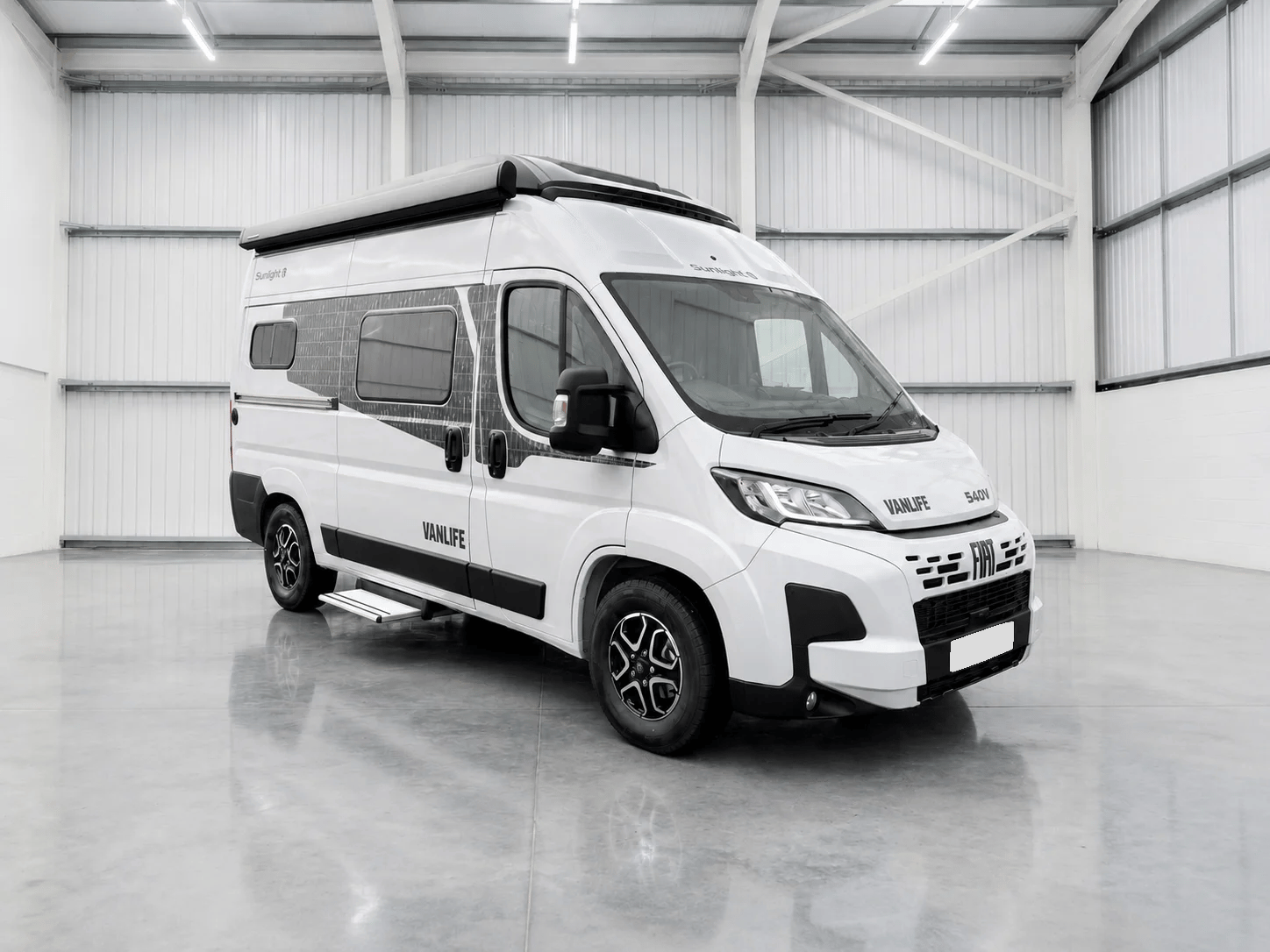
The camper you fall for is rarely the one you can afford. That gap is the whole reason Campervan.win exists. Right now we’re giving away the Sunlight Vanlife, worth around £65,000, and closing that gap is the point: capped entries so the odds stay honest, £10 a ticket, a maximum of five per person, £500 to a UK charity from every full draw, the winner picked by a public randomness beacon anyone can re-check, and one person driving away in the van itself.
Enjoyed this post?
Get more honest campervan guides like this one in your inbox.
You’re in!
Check your inbox. We’ve just sent you a welcome email.

About the author
Oliver
Oliver is the founder of Campervan.win and writes about campervans, travel, and the life-changing freedom that comes with getting out on the road.
Keep Reading
Related Reading
Thoughtful articles that build on what you’ve just read.
TV & Movie Campervans
20 min read
Alex Honnold's Campervans: A Decade in a Van, Three Rigs, and a Foundation That Started on the Road
Alex Honnold lived in a van for over a decade, long before van life was a hashtag. From a bare bones 2002 Ford Econoline to a custom solar powered Dodge ProMaster, and now a family ready rig built by Forged Vans, his campervans tell a story about simplicity, purpose, and what happens when you use a vehicle not as a home but as a way to get closer to the thing you love.
TV & Movie Campervans
10 min read
Paul and the rented motorhome that makes American touring look both ridiculous and irresistible
Paul is a modern classic road film for anyone who has ever daydreamed about hiring a huge American motorhome and disappearing into the desert. The motorhome is the punchline, the sanctuary, and the temptation all at once. Here is what the film’s RV actually was, why it works so well on screen, and what it gets right about the reality of touring on an American scale.
Campervan Reviews
12 min read
Rolling Homes Darwin review: the long Crafter camper with a proper washroom
The Darwin is Rolling Homes' step up from the Transporter: a long-wheelbase VW Crafter two-berth with an enclosed washroom. We set out what is published, what the price does, and who it suits.
Campervan Buying Guides
13 min read
Rolling Homes of Shrewsbury: VW-qualified campers from the Columbus to the Crafter Darwin
A plain-English profile of Rolling Homes, the Shrewsbury family converter with Volkswagen's Motorhome Qualified Converter status: what it builds on, what each model in the range is for, the 13 October 2026 prices, and what to ask before you put a deposit down.