
Westfalia Columbus Liner: the roof-terrace Ducato camper and its 4,250 kg UK catch

Written by
Felix
Felix covers campervan technology, layouts, and modern conversions, with a focus on design-led thinking and practical performance
The short answer
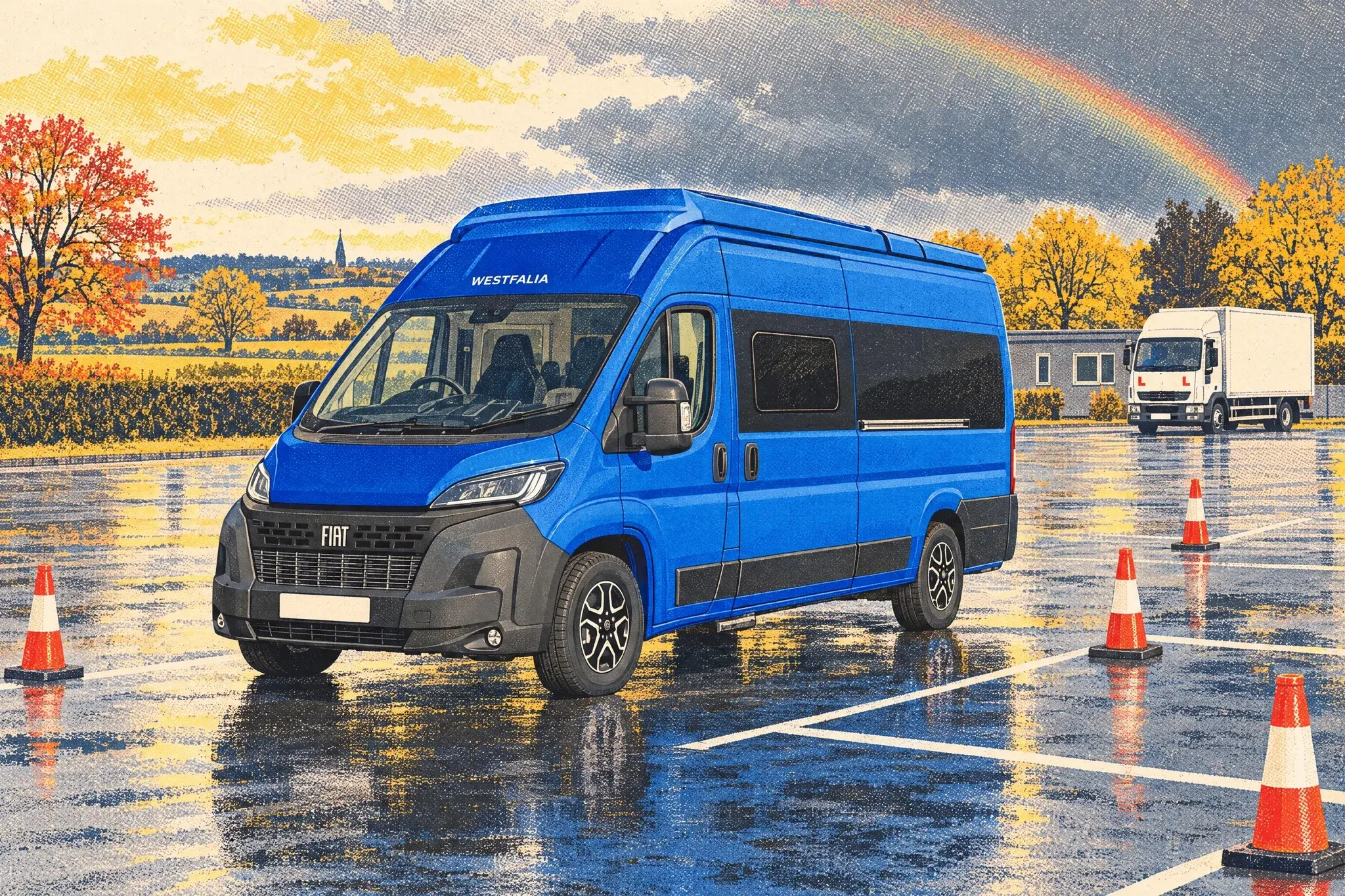
The Westfalia Columbus Liner is a 6.36 m high-roof Fiat Ducato campervan with a three-level layout: living area, raised king-size bed and an optional walk-on Sky Lounge roof terrace. It runs 3,400 kg in running order and is plated at 4,250 kg, so UK drivers who passed their car test on or after 1 January 1997 need a C1 licence. German prices start at €83,900, and UK partner Campersales is advertising a right-hand-drive First Edition at £109,135.

A campervan with a terrace on the roof sounds like a doodle on a napkin. The Westfalia Columbus Liner is a real one. It is a high-roof Fiat Ducato panel-van conversion that had its world premiere at Caravan Salon Düsseldorf in late summer 2026, and its party piece is a three-level layout: a living area at floor level, a king-size bed on its own raised level, and an optional Sky Lounge that puts you on top of the van with a view. Underneath the headline sits a 6.36 m van with a running-order mass of 3,400 kg and a plated weight of 4,250 kg, and that last number decides who in the UK can drive it on a car licence.
What the Columbus Liner is
Westfalia gave the Columbus Liner its world premiere at Caravan Salon Düsseldorf, which ran from 28 August to 6 September 2026, on its stand in Hall 4. Westfalia describes a three-level layout with a spacious living area, a King Size bed and the optional Sky Lounge, which it calls a private rooftop terrace. Westfalia also lists a generous XXL rear garage, a new bathroom design, a fully equipped kitchen and optional energy packages for self-sufficiency.
The base is a Fiat Ducato. Westfalia's catalogue gives the base as a Fiat Ducato L4 H3, the longest van body with the super-high roof. Westfalia's own spec sheet, checked on 6 October 2026, gives 6.36 m long, 2.05 m wide and 3.04 m tall, rising to 3.80 m with the roof open. That 2.05 m width is the giveaway that this is a panel-van conversion rather than a coachbuilt: it keeps the Ducato's own steel body, so it is narrower than a 2.2 m or wider coachbuilt.
Westfalia lists a 2.2 Multijet3 in two outputs: 117 kW (160 hp), marked as being only for the UK market, and 132 kW (180 hp), with a six-speed manual or an eight-speed automatic. Westfalia says the published data reflects the current stage of development and may change before series production, so treat every figure below as pre-production rather than a signed order form.
The three levels, one at a time
Most 6.4 m vans give you two levels at best: floor and bed. The Liner adds a third on the roof. That is the whole idea, and it changes how the van feels more than the length figure suggests.
The living area
The ground floor is the living area with the kitchen, bathroom and seating. Westfalia's spec lists four travel seats, a king-size bed and an optional bench bed of 1.80 by 0.90 m. So the Liner can carry four people with belts, and Westfalia's catalogue gives two to four berths, counting the optional fold-out bench bed as two. Be realistic about that second bed: at 1.80 m long and 0.90 m wide it is single-bed width, so two on it means two small children, and it is not a second double.
The king-size bed
Westfalia's catalogue gives the main bed as 1.89 m wide, 2.04 m long on the right-hand side and 1.86 m on the left. For context, a UK king-size mattress is 1.50 m wide and a super king is 1.80 m, so this is wider than a super king at home, in a van that is itself only 2.05 m wide outside. Because the bed sits on its own raised level and runs lengthways, two adults get a flat bed without the foot-well compromises of a transverse bed squeezed across a standard panel van, though the taller sleeper will want the 2.04 m right-hand side.
The Sky Lounge
The optional Sky Lounge is the reason the Liner made headlines. It is a terrace on the roof, reached through the pop-up roof, and with the roof open the van stands 3.80 m tall. A YouTube walkaround of a First Edition describes a walk-on forward roof terrace paired with a rear pop-up sleeping roof. Think of it as the van's balcony: a place to sit with a coffee above the hedge line on a pitch, or to watch the sea from a cliff-top aire. It is optional, so if you would never climb up there you can leave it off and save the weight and the money.
Gear Patrol's take is that the Liner shows you do not have to go to a full motorhome to get spacious mobile living. That is the fair summary. You keep the panel-van footprint and get volume where a van normally has none.
Garage, kitchen, bathroom and the gas question
Lifting the bed onto its own level is what makes a garage of this size possible in a 6.36 m van. Westfalia calls it an XXL rear garage, and in a van this length that means room for the bulky outdoor kit that normally ends up strapped to a rack: bikes, boards, a folding table and chairs, wetsuits. If you tour with gear rather than just luggage, this is the Liner's most useful feature after the bed.
The kitchen includes Westfalia's first optional induction hob, and the fridge is a 90 litre compressor unit. The spec sheet also lists a 2.8 kg gas supply, which is small by motorhome standards. The same YouTube video describes a First Edition with the 180 hp engine and automatic gearbox and calls it a gas-free setup, with flush induction cooking and the Eberspächer diesel heater. Put the two together and the picture is this: with the optional induction hob and the diesel heater, the van can run without gas, while a base version still carries a small gas supply. Ask the dealer which you are looking at before you order, because it changes what you need to carry and refill.
In the bathroom, Westfalia's catalogue lists a separating dry toilet as standard and a Clesana water-free toilet as an option. The Clesana does away with the cassette, the chemicals and the trip to the emptying point, and instead seals waste in a liner you bin like household rubbish. For a van built around staying off-grid, not needing to find a cassette point every couple of days is a real freedom. The trade-off is that you buy liners rather than toilet fluid, so build that into your running costs.
Power, heating and water
Westfalia lists an Eberspächer 5 kW diesel water heater with two zones, a 90 litre compressor fridge, 95 litres of fresh water, 100 litres of waste, a 2.8 kg gas supply, lithium batteries of 300 Ah in the Plus Pack or 540 Ah in the Premium Pack, a 3,000 W inverter and 165 W of solar.
Two things stand out. First, heating comes from an Eberspächer 5 kW diesel water heater with two zones, so there is no gas bottle to run out on a cold night. That suits winter touring and skiing trips, and Westfalia's catalogue offers an optional heated double floor with two zones, one for the living area and one for the shower tray. Second, the electrical system is sized for induction cooking off-grid. A 3,000 W inverter is enough to run a single induction ring, and the 540 Ah Premium Pack gives a meaningful buffer for cooking, charging and the compressor fridge without hook-up. The 165 W solar panel is modest; it will keep things ticking over on a bright day but it is not what refills a 540 Ah bank after a week of cooking on electricity, so plan on driving or plugging in.
Water is 95 litres fresh and 100 litres waste. For two people that is comfortable for a few days of washing up and showering lightly; four people will be looking for a tap more often.
Weight, payload and the licence
Westfalia quotes a mass in running order of 3,400 kg, a maximum technically permissible mass of 4,250 kg and a payload of approximately 800 to 850 kg depending on specification. The arithmetic is simple: 4,250 minus 3,400 is 850 kg, and Westfalia's catalogue gives 3,420 kg for a van with the two-seat rear bench. Westfalia's running-order figures are for the standard van without options, so extras such as the Sky Lounge and the bigger battery pack come off that payload.
Mass in running order under EU rules includes a 75 kg driver, fuel at 90 per cent and whatever water and gas the maker chooses to count, and the declared figure can differ from the actual van by up to plus or minus 5 per cent under the type-approval rules. Westfalia's weights page says its running-order figures include a 75 kg driver, a 90 per cent fuel tank, 10 litres of fresh water and a full gas bottle, so the rest of the 95 litre fresh tank comes off the payload. With three passengers at 75 kg each, a full fresh tank and a garage full of bikes, 800 kg goes quicker than it sounds, but it is still far more usable than most 3,500 kg vans of this length can offer.
Why 4,250 kg matters in Great Britain
A category B car licence covers a motor caravan of up to 3,500 kg maximum authorised mass. The Liner is plated at 4,250 kg. If you passed your car test before 1 January 1997 you hold C1 as an acquired right and can drive it, keeping C1 until your 70th birthday and then renewing by post every three years with a D4 medical each time. If you passed on or after 1 January 1997 you have category B only, so you need to gain C1: apply for provisional entitlement with forms D2 and D4 (the D4 medical done by a doctor), then pass a theory test and a practical test in a suitably heavy vehicle. Northern Ireland has its own licensing, so check with the DVA there.
The June 2025 rule that lets a category B holder drive up to 4,250 kg applies only to zero-emission vehicles. The Liner is a diesel, so it does not help here. Nor is downplating a sensible escape: plating the Liner at 3,500 kg would leave about 100 kg of payload on Westfalia's running-order figure, which is not enough for passengers, let alone a garage full of kit.
Tax and MOT
There is one upside to the weight. A motor caravan over 3,500 kg revenue weight is taxed as a Private HGV, tax class TC10, at £177 a year for 2026 to 2027, against £375 a year for a motor caravan at or under 3,500 kg with an engine over 1,549 cc. Going over 3.5 tonnes makes the tax cheaper, not dearer. Check the GOV.UK motorhome rates page for the live figure before you budget. The MOT is class 4 whatever the weight, from three years old.
Speed limits, height and zones
Speed limits for motor caravans are set by unladen weight, with the dividing line at 3.05 tonnes, never by the plated figure. GOV.UK's speed limits for motor caravans over 3.05 tonnes unladen are 50 mph on single carriageways and 60 mph on dual carriageways, with 70 mph on motorways. Unladen weight strips out the driver, fuel and water that running order includes, so a 3,400 kg running-order figure does not automatically mean the Liner is over 3.05 t unladen. To get under, it would need to shed about 350 kg, and the 75 kg driver, the diesel and the 10 litres of water that the running-order figure includes come to well under that, so the Liner is likely to land above the line. The figure that counts is the unladen weight on the V5C or the certificate of conformity, so check it before you assume car limits. Cameras enforce the posted limit for the road, but a 50 mph single-carriageway limit still applies to you if the van is over 3.05 t unladen.
Height is 3.04 m with the roof closed, or 2.98 m with Westfalia's optional super-flat roof window. Anything over 3 m must display its height in the cab, so expect a sticker on the dash. Most car-park height barriers will shut you out, and you will be booking ferries in the taller bands, so give operators 3.04 m rather than guessing. The 3.80 m figure is the roof open, which is for the pitch, not the road.
In London a motor caravan over 3,500 kg gross weight falls under the Low Emission Zone, which asks for Euro VI, rather than the ULEZ. England's charging Clean Air Zones are Bath, Birmingham, Bradford, Bristol, Portsmouth, Sheffield and Tyneside, and each sets its own vehicle classes, so put the registration into the official GOV.UK vehicle checker rather than assuming a new diesel sails through. Scotland's Low Emission Zones in Glasgow, Dundee, Aberdeen and Edinburgh work the same way; use the checker at lowemissionzones.scot before driving in.
Price and UK availability
Westfalia's German price starts from €83,900, including German VAT at 19 per cent, but the German motoring news agency SP-X reports that the Liner is being sold first as a nearly fully equipped First Edition from €105,000, with the base version to follow. Neither figure converts neatly into pounds, because a UK price reflects UK specification, the exchange rate and the dealer's own costs, not a straight currency swap.
Campersales of Burgess Hill, Westfalia's UK partner, lists the Liner at 3,400 kg running order and 4,250 kg maximum, and in October 2026 it was advertising a right-hand-drive Liner First Edition with the 160 hp engine and eight-speed automatic at £109,135, due in April 2027. Westfalia Mobil is listed as an exhibitor at the Motorhome and Caravan Show at the NEC from 13 to 18 October 2026. Being an exhibitor does not mean the Liner will be on the stand, so ask before you buy a ticket for that reason alone.
That listing settles right-hand drive, and it fits Westfalia's spec sheet, which lists the 160 hp engine as being only for the UK market. It is one dealer's price for one specification, so ask Campersales what the build you want would cost and when it could be delivered.
If you are tempted to buy in Germany and bring it over, the preferential duty rate on a new EU-origin motor caravan is 0 per cent under the UK-EU Trade and Cooperation Agreement, provided the maker supplies an origin declaration; the 10 per cent third-country rate applies only if the vehicle does not qualify as EU origin. Import VAT at 20 per cent is then charged on the vehicle price plus delivery plus any duty. A van bought in Germany would also be left-hand drive, whereas the Campersales van is right-hand drive.
Who the three-level layout really suits
The Liner is not a van for everyone, and the people it suits are quite specific.
Couples who tour for weeks, not weekends
A full-size bed that never needs making up, a diesel heater with two zones, a 90 litre fridge, up to 540 Ah of lithium and a toilet that never needs emptying at a cassette point: that is a specification for living in, not for the odd bank holiday. If your plan is a month in Scotland or a winter in the Alps, the Liner's extras stop being gimmicks and start paying their way.
Anyone who carries real outdoor kit
Panel vans and bikes are a famously awkward pair. An XXL garage under a raised bed means the bikes, boards or climbing gear live inside, locked and dry, without a rear rack adding length and weight behind the axle. If you have ever wrestled a wet bike into a van with a transverse bed, you already know the appeal.
People who want van width with motorhome space
At 2.05 m wide and 6.36 m long the Liner parks and threads lanes like any long-wheelbase Ducato conversion. What it adds is volume upwards: the H3 roof, the raised bed level and the roof terrace. If you have been torn between a panel van you can park and a coachbuilt you can stand up and spread out in, this is the layout that tries to give you both.
Who should think twice
- Drivers who passed on or after 1 January 1997 and have no C1. Gaining C1 is a theory test, a practical test in a heavy vehicle and a doctor's medical. It is doable, but it is a project, and it is renewed with a medical every five years from age 45 and every year from 65.
- Anyone who relies on height-barrier car parks. At 3.04 m you will be parking with the coaches, not the cars. Seaside towns and city centres get harder.
- Families of four who all need proper beds. The optional bench bed is 1.80 by 0.90 m, single-bed width, so the king bed and bench bed together comfortably sleep two adults and a child. Westfalia counts the bench bed as two berths to reach its total of four, but at 0.90 m wide that suits two small children at most; four adults will be short of sleeping space.
- Buyers who want a confirmed UK spec today. The right-hand-drive van Campersales lists is not due until April 2027, so the final production details are still to come. If you need certainty now, wait for the UK order book.
The bottom line
The Westfalia Columbus Liner is the most interesting answer yet to the question of how much living space a 6.4 m panel van can hold, and the roof terrace is the fun part of a serious package: a proper king-size bed, a garage that swallows bikes, diesel heating, lithium power sized for induction cooking and a toilet with no cassette. The price of all that is weight. At 4,250 kg it needs C1 for anyone who passed their car test on or after 1 January 1997, it will probably sit above the 3.05 t unladen line for speed limits, and at 3.04 m tall it lives with the coaches. For a couple who tour long and carry kit, those are fair trades. Before you fall for the terrace, check your licence, ask Campersales about UK pricing and delivery for the build you want, and ask whether it will be on the NEC stand in October.
Common questions
Can I drive the Westfalia Columbus Liner on a UK car licence?
Only if you passed your car test before 1 January 1997, because the Liner is plated at 4,250 kg and a category B licence covers motor caravans up to 3,500 kg. Drivers who passed on or after 1 January 1997 need to gain C1 through a medical, a theory test and a practical test in a suitably heavy vehicle.
How much does the Westfalia Columbus Liner cost in the UK?
Westfalia's German price starts from €83,900 including German VAT, and the motoring news agency SP-X reports that the first vans are a First Edition from €105,000. In October 2026 Campersales of Burgess Hill, Westfalia's UK partner, was advertising a right-hand-drive Liner First Edition with the 160 hp engine and automatic gearbox at £109,135, due in April 2027.
What are the Columbus Liner's dimensions and weights?
Westfalia quotes 6.36 m long, 2.05 m wide and 3.04 m tall, or 3.80 m with the roof open, with a mass in running order of 3,400 kg, a maximum of 4,250 kg and a payload of approximately 800 to 850 kg depending on specification.
What is the Sky Lounge on the Westfalia Columbus Liner?
It is an optional walk-on roof terrace reached through the van's pop-up roof, forming the third level above the living area and the raised king-size bed. With the roof open the van stands 3.80 m tall, so it is for the pitch, not the road.
What speed limits apply to the Columbus Liner in the UK?
Motor caravan speed limits depend on unladen weight, with the dividing line at 3.05 tonnes. A van with a 3,400 kg running-order mass is likely to be over that line, which means 50 mph on single carriageways and 60 mph on dual carriageways, but confirm the unladen figure on the V5C or certificate of conformity.
Does the Columbus Liner use gas?
Westfalia's spec lists a small 2.8 kg gas supply, while the induction hob is optional and heating is an Eberspächer 5 kW diesel water heater. A YouTube walkaround of a First Edition describes a gas-free setup with induction cooking, so ask which configuration you are ordering.
The reachable bit
The camper you fall for is rarely the one you can afford. That gap is the whole reason Campervan.win exists. Right now we’re giving away the Sunlight Vanlife, worth around £65,000, and closing that gap is the point: capped entries so the odds stay honest, £10 a ticket, a maximum of five per person, £500 to a UK charity from every full draw, the winner picked by a public randomness beacon anyone can re-check, and one person driving away in the van itself.

Enjoyed this post?
Get more honest campervan guides like this one in your inbox.
You’re in!
Check your inbox. We’ve just sent you a welcome email.

About the author
Felix
Felix covers campervan technology, layouts, and modern conversions, with a focus on design-led thinking and practical performance
Keep Reading
Related Reading
Thoughtful articles that build on what you’ve just read.
New & Noteworthy
12 min read
Knaus Boxtime 600 ME (2027): twin singles in 6 m, and the payload figure to question
Knaus's new Boxtime 600 ME squeezes two lengthways single beds into a 5.99 m van from £81,725. We lay out what that layout gives a couple, run the weight sums with Knaus's own figures, and explain why the 211 kg 'maximum payload' line needs a question before you sign.
New & Noteworthy
10 min read
Swift Carrera goes gas-free for 2027: 340Ah lithium, diesel heat and induction cooking
Swift has taken the gas out of its Carrera campervan for 2027, swapping bottles for a 340Ah lithium battery, diesel heating and an induction hob. Here is what that means across a real UK year, how it compares with the cheaper Merlin, and the one question to ask at the NEC.
New & Noteworthy
10 min read
British campervan converters at the NEC 2026: who builds on what, and for how much
A stand-by-stand map of the British campervan converters at the Motorhome and Caravan Show 2026: the vans they build on, their from-prices, seats, roofs and lead times, plus the four questions to put to every one of them.
New & Noteworthy
9 min read
Plug-in hybrid campervans at the NEC: what a PHEV gives you and why full EVs are rare
Four UK converters have hybrid campers at or around the Motorhome and Caravan Show this October, while fully electric campers remain scarce. Here is what a plug-in hybrid camper does well, what the sellers rarely tell you, and the questions to ask on the stand.