
Which Tyres Should You Choose for Your Campervans or Motorhomes? The Real World Guide to All Season, Camping and All Terrain Rubber

Written by
Rowan
Rowan writes editorial features, comparisons, and industry context pieces that help readers understand the campervan and motorhome landscape.

The short answer
For most UK campervans and motorhomes, where around 95 percent of miles are on tarmac, the best tyre is simply a quality all-season van or camping tyre with good wet grip and stability, ideally carrying the 3PMSF (three-peak mountain snowflake) winter marking, like the Continental VanContact 4Season, Goodyear Vector 4Seasons Cargo, or the CP-marked Michelin CrossClimate Camping for heavier coachbuilts. All-terrain tyres like the BFGoodrich KO2 or KO3 only really make sense on 4x4 and adventure builds that genuinely go off tarmac. Whatever you fit, the basics matter most: weigh the vehicle, read the sidewall markings, mind the tread (1.6mm minimum) and age limits, and carry a spare you can actually change. Get that right and your tyres look after your trip. Here is the real-world guide to choosing well.

A lot of campervans and motorhomes feel the same on a glossy brochure page. Tyres are where reality shows up.
You feel it the first time you hit standing water on the M6, or drop down a steep lane with gravel scattered across the surface, or pull onto wet grass and realise you have made a slightly optimistic choice. The tyres are the only part of your vehicle that actually touches the road, and on a heavy vehicle that carries your bed, your food, your water and often your family, that matters more than it does on a small car.
The tricky bit is that tyre choice is not one decision. It is a chain of decisions that overlap.
How heavy is your vehicle actually loaded, not what the brochure says. How often do you tour in winter. Whether you spend time on wet fields, forestry tracks, beach car parks and muddy showgrounds. Whether you are in a big coachbuilt motorhome with a long rear overhang, or a compact panel van conversion that is more nimble but still heavy for its footprint.
So this is a practical guide. Not a brand fan club, not a forum argument, and not a one size fits all answer. By the end you should know what type of tyre you need, which markings matter, what compromises you are accepting, and how to avoid the most common tyre mistakes that catch campervan and motorhome owners out.

Start with the tyres you actually need, not the tyres you fancy
It is tempting to look at a rugged tyre with chunky tread blocks and think: that looks like freedom.
Sometimes it is. Sometimes it is also extra road noise, slower steering response, a hit to fuel economy, and a tyre that is brilliant on a muddy track but only average in the wet where you spend most of your time.
Before we get into types, get two facts straight.
First, weight. If you have not weighed your vehicle properly when loaded for a trip, you are guessing. You do not need a laboratory, just a public weighbridge. Do it once with your normal touring kit onboard. Then you can choose a tyre with the right load rating, and set pressures properly. Tyre choice without real weights is like buying boots without knowing your shoe size.
Second, usage. Be honest. If 95 percent of your miles are on tarmac in the UK, you want wet grip, stability and predictable handling. If you spend weekends on grassy rallies, you want traction at low speeds. If you chase snow, you want proper winter performance or at least a tyre that is genuinely capable when temperatures drop.
Now we can talk types.
The tyre alphabet soup that actually matters
Load rating and why it is not optional
Every tyre has a load index and speed rating. On campervans and motorhomes, the load index matters more than most people realise, because you are often close to the limit.
When a vehicle is heavy, an under specified tyre is not just a bit underwhelming. It runs hotter, it flexes more, it wears oddly, and it is more vulnerable to damage. That is why you will often see commercial van tyres, and in motorhome specific cases, tyres marked CP.
C marking and CP marking
On many panel van based campervans you will see tyres designed for vans, often with a C marking. They are built to carry load and deal with kerbs, potholes and hard working use.
On many heavier motorhomes you will see CP marked tyres. The CP marking is used for camping tyres, designed for the unique life of a motorhome, including higher loads and long periods standing still. The Michelin CrossClimate Camping range is a clear example of a CP marked tyre aimed at motorhomes.
Not every motorhome must have CP tyres, but if your vehicle is heavy, or you find yourself near the top of its axle limits, a CP tyre is often a sensible move.
M plus S and 3PMSF
You will also see winter related markings. M plus S is often used loosely. The more meaningful marking is 3PMSF, the three peak mountain snowflake symbol, which indicates the tyre has met a defined snow performance standard. Michelin explain the difference clearly in their winter tyre markings guidance.
For UK touring, 3PMSF matters if you travel through cold upland areas, go abroad in winter, or simply want a tyre that stays confident when temperatures drop and roads get greasy.
Tyre types for campervans and motorhomes, with real world pros and cons
1) Standard road tyres and summer leaning tyres
These come on plenty of new vehicles, especially on lighter campervans. In warm, dry conditions they can be quiet and efficient.
But in the UK they are rarely the best choice for touring, because touring means wet roads, cool mornings, shaded lanes, and sudden weather changes. A summer tyre can feel fine right up until it does not.
Pros
Quiet, often good fuel economy, sharp steering feel
Cons
Less confidence in cold and wet conditions, not designed for long standing loads on heavy vehicles, can be more vulnerable on rough surfaces
If you live somewhere genuinely warm most of the year and you mainly drive on decent roads, you can make a case. For most UK use, it is not where I would start.
2) All season van tyres, the sweet spot for many campervans
For UK touring, an all season tyre designed for vans is one of the best compromises going. You get good wet performance, better cold weather behaviour, and usually decent tread life.
A strong example is something like the Continental VanContact 4Season, which is positioned as an all season tyre for vans with emphasis on wet and winter conditions.
Another example is the Goodyear Vector 4Seasons Cargo, which is also widely available in van sizes and carries 3PMSF in many fitments.
Pros
Works well across UK seasons, better cold weather grip, often 3PMSF, good everyday comfort
Cons
Not as sharp as a pure summer tyre in warm dry conditions, not as capable as a full winter tyre in deep snow, not as grippy as a true all terrain tyre on mud
Recommendation
If you have a typical panel van campervan and you tour year round, an all season van tyre is often the most sensible single set to live with.
3) All weather and all season tyres made specifically for motorhomes
Motorhomes can be a different story because weight and long periods parked up change the demands.
The Michelin CrossClimate Camping tyre is designed as an all weather motorhome tyre, with 3PMSF certification and CP marking in many sizes, and is pitched specifically at year round touring.
Pros
Designed around motorhome loads and usage, strong all year grip, less compromise than fitting a car oriented all season tyre
Cons
Cost, availability in some sizes, and you still need to set pressures correctly and manage weight
Recommendation
If you have a coachbuilt motorhome, especially one over 3.5 tonnes, a dedicated motorhome tyre range is worth serious consideration.
4) Summer plus winter tyre sets, the best performance but the most hassle
This is the approach that gives the best performance across extremes. You use summer tyres for warm months and winter tyres for cold months.
For most campervan and motorhome owners in the UK, the practical drawbacks are big.
You need storage for a second set of tyres, you need swaps booked, and you need to justify the cost. If you are regularly in snowy areas or you do a lot of winter touring across Europe, it can be worth it. Otherwise, a good all season or all weather tyre usually wins on simplicity.
Pros
Best grip in both summer and winter, strongest safety margin when conditions are difficult
Cons
Cost, storage, swapping, and it is easy to get lazy and run the wrong set at the wrong time
5) All terrain tyres, when your touring includes real rough surfaces
All terrain tyres are designed for a mix of road and off road. They typically have chunkier tread, stronger sidewalls, and better traction on loose surfaces.
They also come with compromises. Expect more noise, slightly heavier steering, and often a small hit to fuel economy.
This is where tyres like BFGoodrich All Terrain T A KO2 and KO3 get mentioned. KO2 has been a popular choice for vehicles that genuinely see rough surfaces, and KO3 is the newer generation with BFGoodrich positioning it around durability and all terrain performance.
In campervan terms, these tyres make the most sense on 4x4 capable conversions and adventure builds that actually use the capability. They can be brilliant on wet grass, gravel tracks, and muddy entrances.
Pros
Traction on mud, gravel and grass, tougher construction, confidence on rough surfaces
Cons
Road noise, can feel less precise on tarmac, fuel economy impact, and in some sizes and loads you need to be careful you are choosing the right rating for the vehicle
Recommendation
If your touring involves farm tracks, winter rallies, beaches, or you regularly end up on wet fields, an all terrain tyre can be a very practical choice. If your travel is almost entirely tarmac, you may be paying for capability you do not use.
6) Mud terrain tyres, usually the wrong answer
Mud terrain tyres look impressive and can be incredible in deep mud. They are also loud, harsh, and not ideal for wet road braking. For campervans and motorhomes used mainly on the road, they are rarely sensible.
If you are building something truly specialist, that is another conversation. For everyone else, all terrain is usually as far as you want to go.
Tyre choice by touring style, a simple way to decide
If you want a quick way to narrow it down, think like this.
If you tour mostly on the road in the UK, year round
Choose a quality all season van tyre or a motorhome specific all weather tyre depending on your vehicle weight and tyre size availability.
If you have a heavier motorhome and you sit parked for long periods
Look seriously at CP marked motorhome tyres, and pay attention to tyre age and condition.
If you often park on wet grass, muddy fields, or rough tracks
Consider an all terrain tyre, but be honest about the trade offs.
If you regularly chase winter conditions or travel in snowy regions
Choose a 3PMSF rated tyre at minimum. In some cases, a winter tyre set is worthwhile.
The overlooked stuff that matters just as much as the brand
Tyre pressures are not a guess, especially on motorhomes
Motorhomes in particular often run high tyre pressures, and those pressures should match axle loads. Michelin’s motorhome guidance makes the point that tyre choice and pressure management go together.
Over inflation can reduce grip and make the ride harsher. Under inflation is worse, it builds heat and can cause damage.
The boring answer is the correct one: weigh the vehicle, then set pressures based on the tyre maker and vehicle maker guidance.
Age matters, sometimes more than tread depth
It is common to see tyres on motorhomes that look fine on tread, but are old.
In Great Britain there are specific legal restrictions on using tyres aged more than 10 years on certain vehicles and axles, including goods vehicles over 3.5 tonnes on the steering axle. Many motorhomes fall into the weight bracket where tyre age becomes especially relevant.
Even where it is legal, age still matters. Tyres deteriorate over time. TyreSafe publish dedicated motorhome tyre safety guidance and stress the importance of proper maintenance and inspection.
Michelin’s technical bulletin for RV and motorhome tyres also recommends regular inspection, with tyres in service for five years or more inspected annually by a specialist.
Practical takeaway
If your tyres are older, or you cannot clearly read the date code, treat that as a priority. A tyre can look fine and still be past its best.
Replace earlier than the legal tread limit if you tour in the wet
The legal minimum tread depth for cars and light vans is 1.6 mm across the central three quarters.
You can be legal and still have noticeably worse wet performance. For touring in heavy rain with a heavy vehicle, replacing before you hit the absolute minimum is usually money well spent.
Specific tyre recommendations people ask about
This is not a definitive shopping list because sizes and ratings matter, but these are the kinds of tyres that come up often.
For UK touring on campervans that live on the road
Continental VanContact 4Season is a well known all season van option.
Goodyear Vector 4Seasons Cargo is another popular all season van tyre range, and many sizes carry 3PMSF.
Pirelli and Hankook also offer all season van tyres in many common sizes, and it is worth checking what is available for your exact fitment.
For heavier motorhomes that want proper all year touring ability
Michelin CrossClimate Camping is designed as an all weather motorhome tyre with 3PMSF certification.
Continental also market motorhome capable tyres like VanContact Camper with robust construction aimed at heavy loads.
For adventure builds and proper mixed surface touring
BFGoodrich All Terrain T A KO2 and KO3 are positioned around all terrain use, and KO3 is the newer generation in the range.
A note of realism
All terrain tyres are not magic. They help when surfaces are loose, wet, or soft. They do not turn a heavy motorhome into a mountain goat, and they do not make up for poor weight distribution or pushing a front wheel drive van into mud where it simply cannot pull itself through.
Carrying a spare tyre, the biggest stress saver you can buy
If you have ever had a puncture in a remote spot, you will understand why I am going to sound slightly intense about this.
A spare tyre turns a worst case day into a mild inconvenience. Without one, you are relying on mobile fitting availability, the right tyre being in stock, and your vehicle being somewhere a fitter can safely work.
Full size spare versus space saver
A full size spare is ideal, particularly if you have a heavy vehicle or you travel far from major towns.
A space saver spare can get you moving, but it is not always appropriate for heavier campervans and motorhomes, and often comes with speed and distance limits.
If you do carry a spare, remember it also ages. Michelin’s RV tyre service life guidance explicitly includes spare tyres in inspection recommendations.
Where to put it
This is where campervans and motorhomes differ.
Some vehicles have an under slung carrier. Some store a spare in a rear garage. Some carry a spare externally on a rear rack system.
If you carry it externally, protect it from sun exposure and check it regularly. If you carry it underneath, keep the mechanism clean and usable. It is surprisingly common to discover a spare carrier has seized when you actually need it.
What if you do not have space for a spare: is tyre foam sealant safe?
A sealant kit can be useful, but it is not the same as a spare. It is a way to get you out of a vulnerable situation and to a professional, not a proper repair.
The AA are very clear that repair kits are a temporary fix.
Michelin also stress that sealant is temporary and not suitable for long distance or high speed use, and that the tyre may have been damaged by being driven at low pressure before the sealant goes in.
TyreSafe explain that puncture repair kits are temporary measures only, and that proper repairs must be done by a specialist in line with British standards.
There is another practical issue. Sealant can make a tyre more difficult and messy to repair, and some fitters may prefer replacement depending on damage and contamination. Tyre repairs in the UK should follow the current British Standard BS AU 159, as referenced by the British Tyre Manufacturers Association.
Practical rule of thumb
Sealant is acceptable as an emergency tool if you understand the limits.
It is not suitable for sidewall damage, large tears, or tyres that have been driven flat. It will not rescue you from every puncture.
If you do use sealant, drive gently, keep speeds down, and get the tyre inspected properly as soon as possible.
The two tyre mistakes that catch people out most often
1) Buying the right tread pattern in the wrong load rating
This happens when someone chooses a tyre because it is popular, without checking load index and speed rating.
It is especially common when people retrofit a more rugged looking tyre. Make sure the tyre is suitable for your vehicle and your actual axle loads.
2) Treating tyres like they are car tyres
Campervans and motorhomes are heavy. Motorhomes can sit for long periods. Front axle loads can be higher than expected. Rear overhangs magnify movement.
That means tyres need more attention, not less. Regular pressure checks, proper inspections, and a realistic view of age and condition.
So what should you choose, really?
If you want my calm, slightly boring answer: most UK touring campervans are best served by a good all season van tyre.
Most heavier UK touring motorhomes are best served by a motorhome specific tyre with the right load capacity, often CP marked, and ideally with 3PMSF if you tour beyond summer.
If you genuinely go off the beaten track, park on wet grass often, or use a 4x4 conversion properly, then an all terrain tyre can be worth the compromises.
And whatever you choose, a spare tyre and the ability to change it safely is one of the best value upgrades you can make. It is not glamorous, but it is the difference between a ruined weekend and a quick reset.
If you are ever unsure, do the sensible thing: weigh the vehicle, read the sidewall markings, and speak to a specialist tyre fitter who understands campervans and motorhomes. Your tyres are carrying more than a vehicle. They are carrying your trip.
Common questions
What tyres are best for a UK campervan or motorhome?
For most, where around 95 percent of miles are on tarmac, a quality all-season van or camping tyre with strong wet grip and stability is the best choice, ideally one carrying the 3PMSF winter marking. Examples include the Continental VanContact 4Season and Goodyear Vector 4Seasons Cargo, or a dedicated motorhome tyre like the Michelin CrossClimate Camping for heavier coachbuilts.
What does the 3PMSF marking on a tyre mean?
3PMSF is the three-peak mountain snowflake symbol, which means the tyre has met a defined snow-performance standard, a more meaningful winter marking than the older M+S label. For UK touring it matters if you travel through cold upland areas, go abroad in winter, or simply want a tyre that stays confident when temperatures drop and roads get greasy.
Do I need all-terrain tyres on a campervan?
Usually not. All-terrain tyres like the BFGoodrich All-Terrain T/A KO2 and the newer KO3 only make real sense on 4x4-capable conversions and adventure builds that genuinely use the capability. On a normal tarmac-focused campervan they add noise and reduce comfort and economy for off-road grip you will rarely use, so a good all-season tyre is the better pick.
What is the best tyre for a heavy coachbuilt motorhome?
A dedicated motorhome tyre range is worth serious consideration, especially over 3.5 tonnes. The Michelin CrossClimate Camping, for example, is designed as an all-weather motorhome tyre with 3PMSF certification and a CP marking in many sizes, pitched at year-round touring. CP-marked camping tyres are built for the high loads and long standing periods a motorhome puts on its tyres.
What are the tyre rules for campervans and motorhomes in the UK?
The legal minimum tread depth for cars and light vans is 1.6mm across the central three-quarters of the tyre. There are also age restrictions: in Great Britain, tyres older than 10 years are banned on the steering axle of certain vehicles, including goods vehicles over 3.5 tonnes. Always check the sidewall markings and the date code, and replace ageing tyres even if the tread looks fine.
Should I carry a spare tyre in a campervan?
Yes, a spare tyre and the ability to change it safely is one of the best-value upgrades you can make, the difference between a ruined weekend and a quick reset. If there genuinely is no space for a spare, a tyre foam sealant can be a stopgap for minor punctures, but it is no substitute for a proper spare, so plan recovery accordingly.
The reachable bit
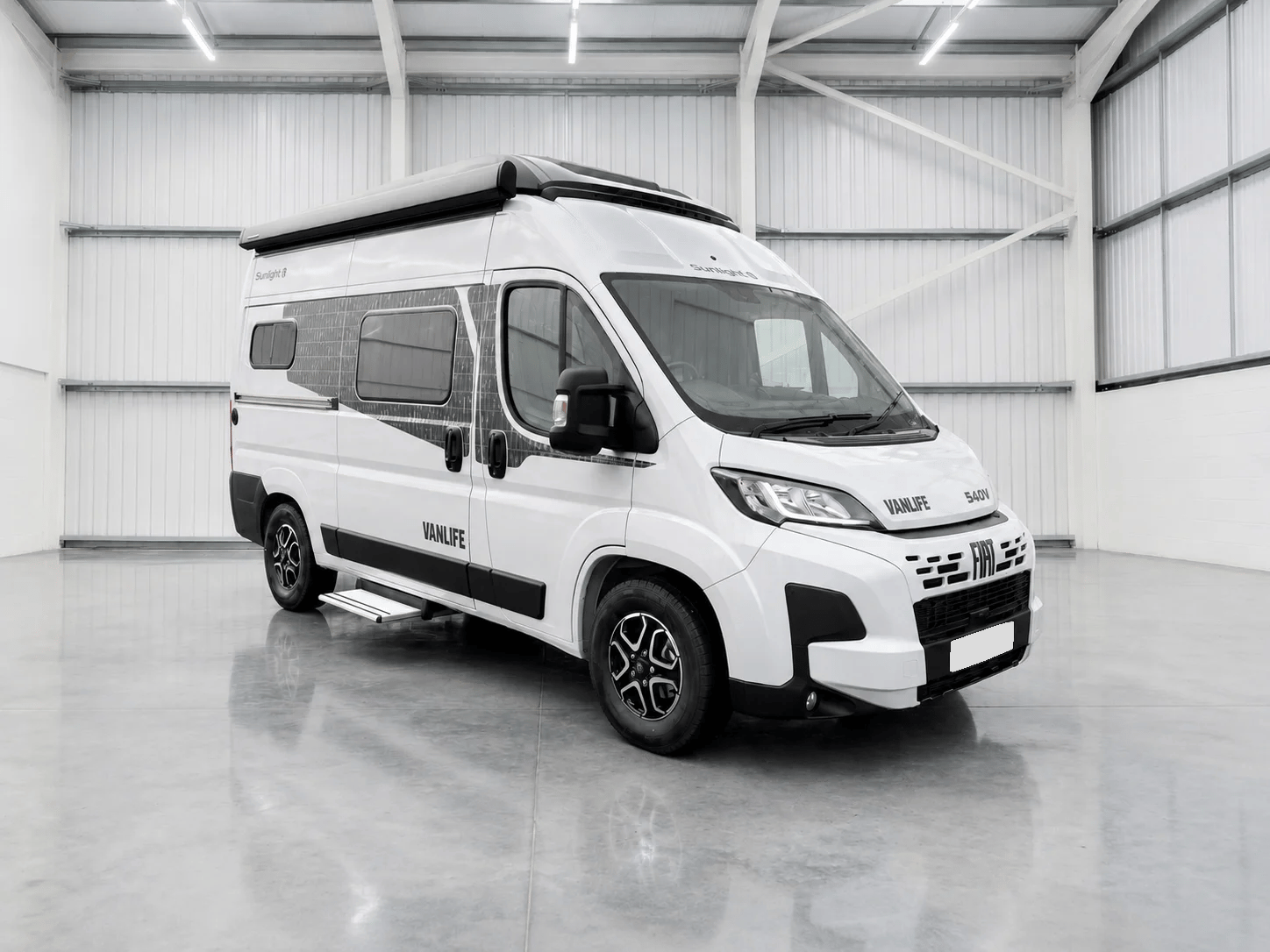
The camper you fall for is rarely the one you can afford. That gap is the whole reason Campervan.win exists. Right now we’re giving away the Sunlight Vanlife, worth around £65,000, and closing that gap is the point: capped entries so the odds stay honest, £10 a ticket, a maximum of five per person, £500 to a UK charity from every full draw, the winner picked by a public randomness beacon anyone can re-check, and one person driving away in the van itself.
Enjoyed this post?
Get more honest campervan guides like this one in your inbox.
You’re in!
Check your inbox. We’ve just sent you a welcome email.

About the author
Rowan
Rowan writes editorial features, comparisons, and industry context pieces that help readers understand the campervan and motorhome landscape.
Keep Reading
Related Reading
Thoughtful articles that build on what you’ve just read.

Campervan Buying Guides
13 min read
Rolling Homes of Shrewsbury: VW-qualified campers from the Columbus to the Crafter Darwin
A plain-English profile of Rolling Homes, the Shrewsbury family converter with Volkswagen's Motorhome Qualified Converter status: what it builds on, what each model in the range is for, the 13 October 2026 prices, and what to ask before you put a deposit down.

Campervan Buying Guides
11 min read
Bilbo's explained: the Surrey VW converter since 1977, now on the T7 and Transit Custom
A plain profile of Bilbo's, the Surrey converter that has been putting raising roofs on Volkswagen Transporters since 1977 and now builds its Celex layout on both the T7 and the Ford Transit Custom. The range, the in-stock prices on 13 October 2026, the warranty, the owner-voted awards, and what to ask before you order.

Campervan Buying Guides
12 min read
Hillside Leisure explained: Derby's type-approved VW converter with a hybrid Multivan
A plain profile of Hillside Leisure of Derby: what the company builds on, every model with its published from-price, the approvals most buyers never ask about, and who it suits.

Campervan Buying Guides
10 min read
Swift Merlin 2027: nine layouts from £64,190 and how to pick the right one
Swift's all-new Merlin campervan arrives for 2027 with nine layouts on the Fiat Ducato panel van. We sort them into four families, work the payload sum on a four-seat version, and explain what the roof, the automatic and the prices mean for your choice.