
Motorhome Safety, Weight & Licensing
3,500 kg motorhomes at the NEC: the payload you really get, model by model

Written by
Jasper
Jasper writes campervan reviews, travel guides, and practical advice, with a focus on everyday use and relaxed touring around the UK.
The short answer
On a car licence a motorhome is plated at 3,500 kg, so payload is 3,500 kg minus the maker's mass in running order. Makers' own figures for 3,500 kg vans from brands at the NEC run from about 274 kg to 710 kg, but each counts water and gas differently, a driver is already included, every extra passenger is rated at 75 kg, and options such as an automatic gearbox (45 to 50 kg) or a pop-top (143 kg) come off the same allowance.

A motorhome has a weight limit, and the van itself uses most of it. On a category B licence that limit is 3,500 kg, and what is left after the van, a driver and a tank of fuel are on the scales is your payload: people, water, food, chairs, bikes, the lot. At the Motorhome and Caravan Show at the NEC Birmingham, 13 to 18 October 2026, every stand will show you a kitchen and a bed. Far fewer will volunteer the one number that decides whether a family of four can take a weekend's kit without breaking the law.
Why 3,500 kg turns payload into the deciding figure
Category B, the ordinary car licence, covers a motor caravan with a maximum authorised mass (MAM, also written MTPLM or plated weight) of up to 3,500 kg. If you passed your car test on or after 1 January 1997 that is your ceiling unless you take the C1 test. So almost every motorhome aimed at the UK family market is plated at exactly 3,500 kg, and the only thing that varies is how much of that the van itself has already used.
The maker's figure for the van as built is its mass in running order (MRO, sometimes MIRO). Under Regulation (EU) 1230/2012, as retained in GB law, that figure already includes a 75 kg driver and fuel at 90 per cent, plus whatever water and gas the maker chooses to count. Each passenger is rated at 75 kg too. Payload is simply the plate minus the MRO.
Two things make that figure softer than it looks. First, the type-approval rules allow the real MRO of a motor caravan to differ from the declared figure by up to plus or minus 5 per cent. On a 3,000 kg van that is 150 kg either way, which is most of a family's luggage. Second, what sits inside the MRO differs from maker to maker, so two vans quoting the same payload are not carrying the same things.
What each maker counts in running order
Before comparing anything, read the small print under the weight table. From the makers' own pages and price lists, checked on 10 October 2026:
- Bailey: 75 kg driver, 90 per cent fuel, 10 kg of gas, fresh-water tank empty.
- Auto-Sleepers: 75 kg driver, 90 per cent fuel, fresh-water tank empty.
- Auto-Trail: 75 kg driver, 90 per cent fuel, a full 16 kg aluminium gas bottle, fresh water at 100 per cent of the reduced travel volume, with a plus or minus 5 per cent tolerance stated.
- Coachman: counts one full LPG cylinder and travels with the water tanks empty.
- Adria UK (not covered below, but a useful contrast from its FAQ): 75 kg driver, 90 per cent fuel, 16 kg of gas, 20 per cent fresh water, a full boiler and the mains cable.
- Elddis: describes MRO as a default value defined in the type-approval procedure.
- Knaus: the basic model without optional equipment.
- Swift: its 2027 quick guide gives payloads but no MRO, and says vehicle weights are estimated at time of print.
So an Auto-Trail payload figure already has gas and travel water inside it. A Bailey or Auto-Sleepers figure has an empty tank, so the water comes out of your payload. A Knaus figure is for a van with no options fitted. None of these approaches is wrong, but you cannot set them next to each other without adjusting.
The figures, maker by maker
Prices and weights below are the makers' own, taken from their pages and price lists on 10 October 2026. "Stated" is the maker's own payload figure; "difference" is the plated weight minus the quoted MRO, where the maker gives no payload line. We have not ranked them, because the running-order definitions differ too much for a league table to mean anything.
Bailey
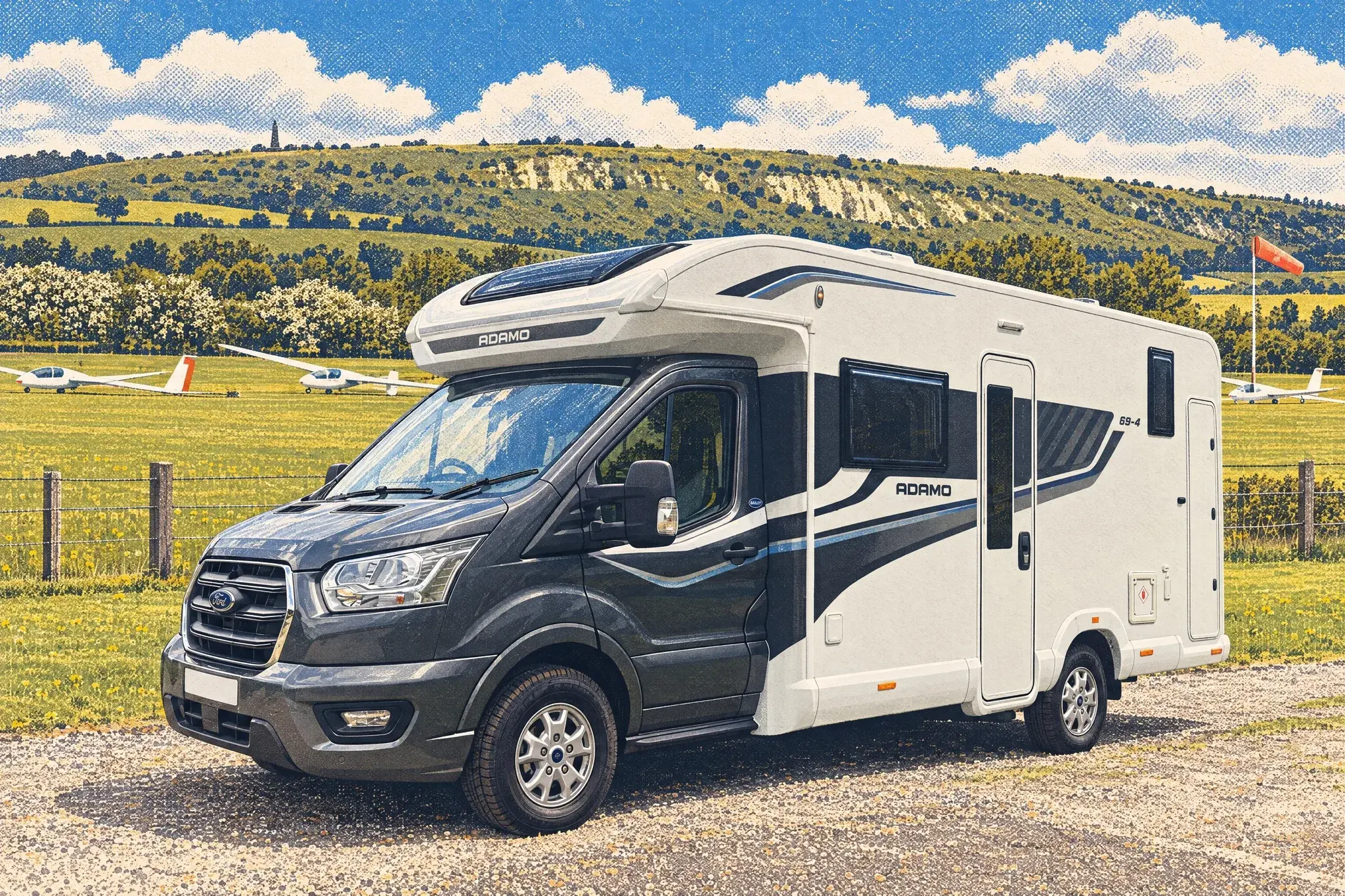
The Ascent 64-2 (£79,799 OTR) has an MRO of 2,882 kg and a stated payload of 618 kg, with two seats. The Ascent 69-4 (£81,899) is 3,071 kg and 429 kg with four seats, and the Ascent 75-4DL (£83,999) is 3,160 kg and 340 kg, also four seats. The Autograph 72-2 (£94,499) is 3,226 kg and 274 kg, two seats. The Endeavour B68 (£75,999) is 2,989 kg and 511 kg, or 368 kg with the pop-top. Remember the Bailey tank is empty in all of these.
Coachman
The Veloce VL65 and VR65 (both £86,500) have MROs of 3,077 kg and 3,099 kg, giving personal payloads of 423 kg and 401 kg, each with four travelling seats. Gas is in the figure; water is not.
Swift
The Voyager 505 (£75,995 OTR) is listed with a payload of 663 kg and the Trekker 505 (£81,135 OTR) with 615 kg. Both come from Swift's 2027 quick guide, which says vehicle weights are estimated at time of print and gives no MRO, so ask the dealer for the running-order figure and check the subtraction yourself. That makes Swift the clearest case for asking the stand what the figure includes and when it will be confirmed.
Auto-Trail
The F60 (£68,369 ex-works plus £455) has an MRO of 2,790 kg, a difference of 710 kg. The F70 (£72,378 plus £455) is 2,980 kg, a difference of 520 kg. The F60's is the most generous-looking figure here, and both are also the most conservative in what they count, with a full 16 kg bottle and travel water already inside.
Auto-Sleepers
The Broadway EK TB LP (£84,245 OTR) is 3,039 kg and 461 kg, both marked as estimates. The Nuevo EK Plus (£86,645 OTR) is 2,919 kg, marked as estimated, and 581 kg. Water is not in either figure.
Elddis
The Autoquest GT 70DS (£74,027) has an MRO of 2,980 kg, with a stated range of 2,831 to 3,129 kg, and a difference of 519 kg from its 3,499 kg plate. The Whirlwind GT 70DS (£65,827) is 2,880 kg (2,736 to 3,024 kg), difference 619 kg, also on a 3,499 kg plate. The price pages also carry a note that prices are based on German retail prices, so confirm the UK on-the-road figure on the stand.
Hymer
The Exsis-t 474 (£96,290 OTR) is 2,824 kg (2,683 to 2,965 kg), a difference of 676 kg. The Exsis-t 580 is 2,984 kg, a difference of 516 kg. Those published ranges are the 5 per cent tolerance written out, which is more helpful than a single number.
McLouis
The Fusion 330 and 360 share an MRO of 2,910 kg and a payload of 590 kg. The 373 is 550 kg and the 379 is 560 kg. McLouis states that the automatic gearbox takes 48 kg.
Knaus
The Van TI Plus 650 MEG (from £88,072) has a basic-model MRO of 3,070 kg (2,916 to 3,223 kg), a difference of 430 kg. But Knaus's own page shows "Maximum payload (kg): -15 kg" for the specification as priced, which shows how options can use up the whole allowance. Ask the stand exactly what that figure is measured against.
The family-of-four sum
The driver is already in the MRO. Three passengers at 75 kg each add 225 kg. Take that off the stated payload of the four-seat Bailey and Coachman vans:
- Bailey Ascent 69-4: 429 kg minus 225 kg leaves 204 kg, with the water tank still empty.
- Bailey Ascent 75-4DL: 340 kg minus 225 kg leaves 115 kg, tank empty.
- Coachman Veloce VL65: 423 kg minus 225 kg leaves 198 kg, gas included, tank empty.
- Coachman Veloce VR65: 401 kg minus 225 kg leaves 176 kg, gas included, tank empty.
Now add water. A litre weighs a kilogram, so even half a tank of 50 litres is 50 kg. For the Ascent 75-4DL that leaves around 65 kg for four people's clothes, bedding, food, a table and chairs, a hose, a cable and a toolkit, which is tight. For the others you are looking at roughly 125 to 155 kg after that half tank, before anything heavy goes on the back. Bikes, a rack and a full awning can take a large slice of what is left.
Where a maker's figure already includes water and gas, the sum is kinder. The F70 has two belted seats as standard; Auto-Trail's half dinette with two forward-facing seatbelts is a 20 kg option, so with it 520 kg minus 20 kg minus 225 kg leaves 275 kg, with travel water and a full bottle already counted. The point is that the same 225 kg for passengers lands very differently depending on what the maker put inside its running-order figure. Whatever the van, check the maker's pictogram: the number of belted travel seats, the number of berths and the number of dining places are three different icons.
Two-seat vans are simpler: one passenger, 75 kg. The Bailey Autograph 72-2 at 274 kg leaves 199 kg for water and kit, which is the number to weigh your own gear against.
How options and automatics eat the allowance
Every kilogram of factory option comes off the same figure. The makers themselves give the clearest examples:
- Automatic gearbox: McLouis states that the automatic gearbox takes 48 kg (a Fusion 330 goes from 590 kg to 542 kg). Auto-Sleepers' Broadway EK TB LP page lists its Fiat 140bhp automatic upgrade as 45 kg less payload, though a footnote on the same page says the automatic adds 50 kg, so ask which figure applies.
- Pop-top: the Bailey Endeavour B68 drops from 511 kg to 368 kg, a difference of 143 kg.
- A full options list: the Knaus Van TI Plus 650 MEG has a 430 kg basic-model difference, and its page separately shows a "Maximum payload" of minus 15 kg for the specification as priced. These are different measures, so ask the stand how one leads to the other.
Awnings, solar panels, bike racks, towbars, upgraded leisure batteries, a second gas locker fitting and a larger fridge all follow the same arithmetic. Makers' option tables carry a weight column; use it, and keep a running total on your phone as you spec the van.
In the figures above, only the Auto-Trail F60 passes 700 kg, and only on Auto-Trail's water-and-gas-included definition.
What to ask on the stand
- What is the mass in running order, and what does it include? Driver, fuel, gas, water, boiler, cable. Get the list, not just the number.
- Is the figure confirmed or estimated? Swift and Auto-Sleepers both mark some figures as estimates. Ask when the type-approval figure will be available and whether the price list will be updated.
- What does every option on my order weigh? Gearbox, awning, rack, solar, extra battery, pop-top. Ask for the total, in writing, on the order.
- What is the plate on this exact van? Look at the plate in the cab or door shut, not the brochure. Ask for the gross figure and the individual axle limits, because a rear-garage van can run out of rear-axle allowance before it runs out of total payload.
- How many belted travel seats? Count them yourself and match them to the pictogram.
- What are my options if I go over? Uprating the plate above 3,500 kg raises the MAM without changing the unladen weight, but a driver who passed on or after 1 January 1997 then needs C1 to drive it. Downplating a heavier van to 3,500 kg gets round the licence rule but usually leaves very little payload.
The best answer you can get on a stand is a running-order figure, a list of what it includes, and a weight for every option on your order. If a salesperson can give you all three, you are talking to the right stand.
After delivery: the weighbridge check
Because the declared MRO can sit 5 per cent either side of reality, the only number you can trust is the one from a public weighbridge. Load the van exactly as you would for a trip, with everyone aboard, the tank at your usual travel level and a full gas bottle, then weigh the whole vehicle and each axle separately. Compare the results with the plate. Hymer, Elddis and Knaus printing that range is a useful habit, because it shows how far your van could sit from the headline figure.
While you are there, note the unladen weight too. For speed limits the dividing line is 3.05 tonnes unladen, which excludes fuel and water and is never the plated weight. A running-order figure over 3,050 kg does not by itself put a van over the line, so check the unladen weight on the V5C or the certificate of conformity. You do not need to drain the tanks to find it.
The bottom line
At the NEC the layout will sell itself. The payload will not, so you have to go and find it. Take the maker's running-order figure, read what it includes, subtract 75 kg for every passenger, add the water the maker left out, then take off the weight of every option you want. If the number that is left would not cover a wet weekend's kit for everyone on board, the van is wrong for you however good the kitchen looks. The figures above show that the right answer at 3,500 kg can be anywhere from a comfortable 500 kg to nothing at all, and the difference is in the small print, not the showroom.
Common questions
How do I work out a motorhome's payload at 3,500 kg?
Take the plated weight (3,500 kg on a category B motorhome) and subtract the maker's mass in running order. Then check what that figure includes, because a 75 kg driver and 90 per cent fuel are always inside it but water and gas vary by maker.
Does the maker's payload figure include passengers?
No. The driver is inside the mass in running order, but every other passenger is rated at 75 kg and comes off the payload. A family of four therefore loses 225 kg before any luggage or water goes in.
Why do payload figures from different makers not compare directly?
Each maker counts different things in running order. Auto-Trail includes a full 16 kg gas bottle and travel water, Bailey counts 10 kg of gas with the tank empty, Auto-Sleepers counts the driver and 90 per cent fuel with the water tank empty, and Knaus quotes the basic model with no options.
How much payload does an automatic gearbox use?
McLouis states 48 kg on its 3,500 kg chassis. Auto-Sleepers' options table says 45 kg, though a footnote on the same page says 50 kg. Either way it comes straight off the stated payload, so a Broadway EK TB LP goes from 461 kg to 416 kg, or 411 kg on the 50 kg figure.
Can the real weight of a new motorhome differ from the published figure?
Yes. Type-approval rules allow a motor caravan's actual running-order mass to differ from the declared figure by up to plus or minus 5 per cent, which is around 150 kg on a 3,000 kg van, so a weighbridge check after delivery is worthwhile.
What should I ask on a stand at the NEC about weight?
Ask for the mass in running order and what it includes, whether the figure is estimated or confirmed, the weight of every option on your order, the plated gross and axle figures on the van itself, and how many belted travel seats it has.
The reachable bit
The camper you fall for is rarely the one you can afford. That gap is the whole reason Campervan.win exists. Right now we’re giving away the Sunlight Vanlife, worth around £65,000, and closing that gap is the point: capped entries so the odds stay honest, £10 a ticket, a maximum of five per person, £500 to a UK charity from every full draw, the winner picked by a public randomness beacon anyone can re-check, and one person driving away in the van itself.

Enjoyed this post?
Get more honest campervan guides like this one in your inbox.
You’re in!
Check your inbox. We’ve just sent you a welcome email.

About the author
Jasper
Jasper writes campervan reviews, travel guides, and practical advice, with a focus on everyday use and relaxed touring around the UK.
Keep Reading
Related Reading
Thoughtful articles that build on what you’ve just read.
Motorhome Safety, Weight & Licensing
11 min read
Bailey Ascent 2027: a Ford Transit automatic on a car licence, but mind the payload
Bailey's new five-model Ascent range puts an eight-speed automatic Ford Transit motorhome on a category B licence, but payload runs from 618 kg down to 340 kg. We work the sums from Bailey's own figures to show which layouts carry four people and which are really for two.
Motorhome Safety, Weight & Licensing
12 min read
Pössl Roadstar XL EVO: a 7 m Sprinter 4x4 campervan at 4.1 tonnes. Will it reach the UK, and who can drive it?
Pössl's new X-Line flagship is a near-7 m Mercedes Sprinter 4x4 campervan plated at 4.1 tonnes. We look at what Pössl has actually built, whether it is coming to the UK, who is legally allowed to drive it, and what the weight and height mean on British roads.
Motorhome Safety, Weight & Licensing
11 min read
Electric motorhomes up to 4.25 tonnes on a car licence: what the UK rules mean after Caravan Salon 2026
A standard car licence in Great Britain now covers zero-emission vehicles up to 4.25 tonnes, and an electric motorhome concept called EVOLVE at Caravan Salon 2026 was built around exactly that. Here is what the rule actually says, what it leaves out, and whether it changes anything for you yet.
Motorhome Safety, Weight & Licensing
12 min read
Eura Mobil Xtura 656 HB: a 4x4 Sprinter motorhome with an electric roof tent, and what 4,100 kg means in the UK
Eura Mobil's new short Xtura pairs a four-wheel-drive Mercedes base with an electrically raised roof tent and insulated inner tent. We go through the beds, the weights, the C1 licence question, speed limits, the 3.21 m height and what is still unconfirmed for the UK.