
Motorhome Safety, Weight & Licensing
Pössl Roadstar XL EVO: a 7 m Sprinter 4x4 campervan at 4.1 tonnes. Will it reach the UK, and who can drive it?

Written by
Iris
Iris writes travel guides, road trips, and park-up features, with a focus on slower UK touring, living space, and how campervans are used day to day.
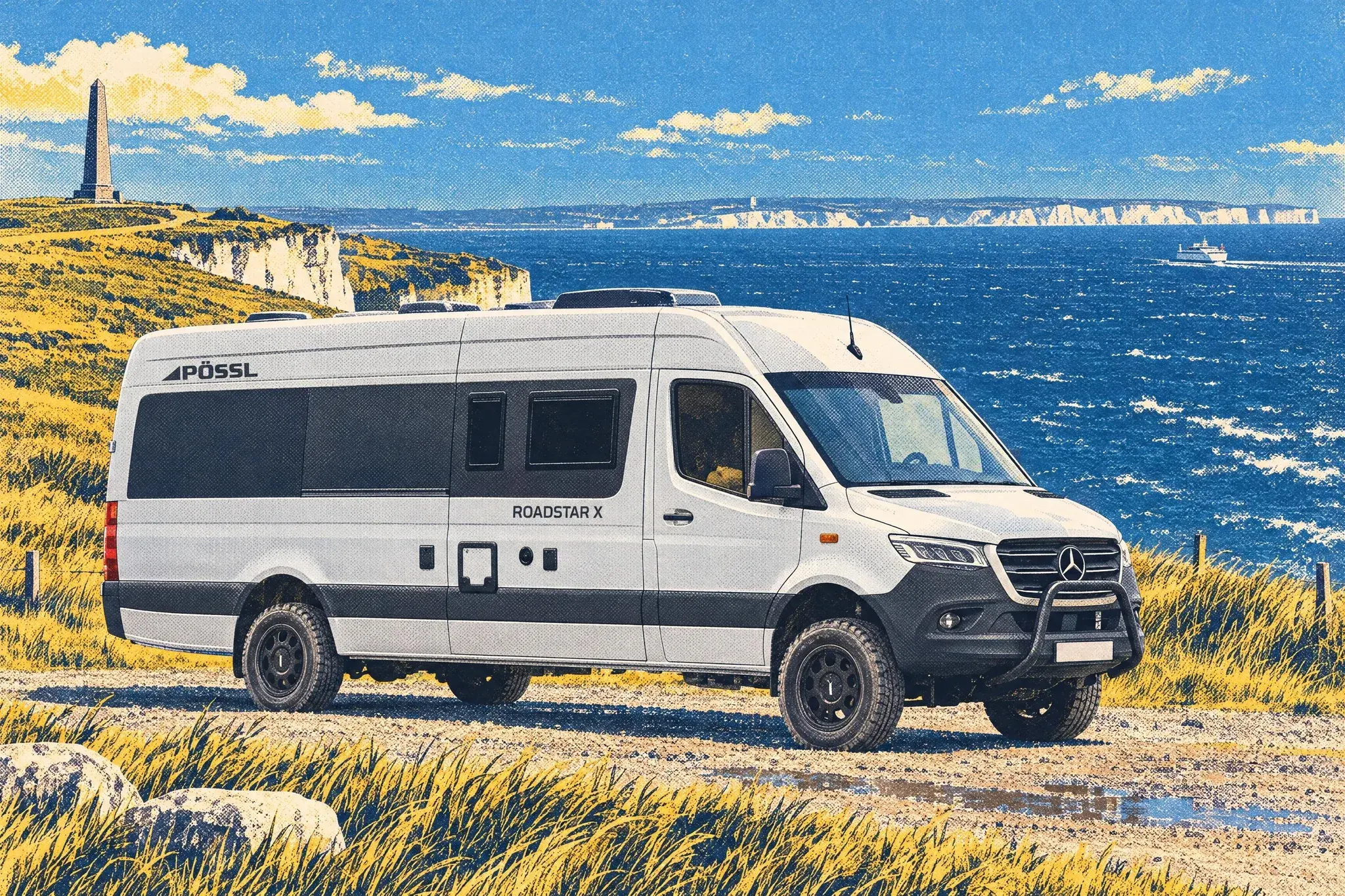
The short answer
The Pössl Roadstar XL EVO is a 6.97 m Mercedes-Benz Sprinter 4x4 campervan plated at 4,100 kg, with a 3,560 kg running weight, shown at Caravan Salon Düsseldorf 2026 at a launch price of €104,999 and now listed from €107,499 after base prices rose from 1 October 2026. It is not confirmed for the UK. Anyone who passed their car test on or after 1 January 1997 would need C1 entitlement to drive it, and heavier motor caravans face 50 mph single-carriageway limits.

Pössl has built a big one. The Roadstar XL EVO is just under 7 m long, sits on a Mercedes-Benz Sprinter with four-wheel drive, and is plated at 4.1 tonnes. It was unveiled at Caravan Salon Düsseldorf 2026 (28 August to 6 September) and it has been all over the show coverage since. For a UK reader, though, two questions matter more than the glossy photos. Can you actually buy one here? And if you could, are you allowed to drive it on the licence in your wallet? The short answers are "not confirmed" and "it depends on when you passed your test". Here is the longer version.
What Pössl has actually built
The Roadstar XL EVO sits in Pössl's X-Line, its Sprinter-based panel van range. The idea is straightforward: take the long, all-wheel-drive Sprinter, keep the extra ground clearance that the 4x4 version brings, and fit a layout for two people who want to go further off the tarmac than a typical van owner would.
The headline feature inside is an electrically operated lift bed that runs lengthways over a rear garage. Raise it and you have a tall storage space for bikes, boards or boxes; lower it and you have your bedroom. Pössl's own listing gives the bed as 195 x 204.5 / 154.4 cm. Those are two lengths and a width: 194 to 195 cm on the driver's side, 204.5 cm on the passenger side, and 154.4 cm wide. That makes it over two metres at its longest, but check the exact shape in person before you assume it suits two tall sleepers.
The bathroom is the other talking point. The shower and toilet can be separated, so you are not showering over the loo in the way many compact van bathrooms force you to. Pössl's X-Line description calls it off-road capable, agile and luxurious, which is marketing language, but the spec sheet does back up a serious long-distance tourer.
The numbers, from Pössl's own page
These figures come from the Pössl Group website, checked in early October 2026. Where a magazine, dealer or video disagrees with them, we have gone with Pössl.
- Length, width, height: 6,970 x 2,020 x 2,850 mm
- Interior standing height: 1,900 mm
- Maximum technically permissible mass: 4,100 kg
- Mass in running order: 3,560 kg
- Seats: 3, with a fourth optional
- Berths: 2 as standard, 4 with the optional rear bed
- Engine and drive: 190 PS diesel with 4x4, which Pössl's X-Line description states and Motor1 and dealer configurators confirm for the XL EVO, and a nine-speed automatic, which fan4van reports
- Ground clearance: 15 cm more than a standard Sprinter, according to Pössl's X-Line description
- Heating and hot water: Truma Combi 4 in Pössl's table, though fan4van, vanvergleich and the CamperVans show-van report describe diesel heating, so the heater fitted depends on the specification
- Water: 155 L fresh, 122 L waste
- Leisure battery: one 185 Ah
- Fridge: 100 L compressor
Two of these figures deserve a second look. First, the weight. One German site, fan4van, quotes 4.2 tonnes; Pössl's own page says 4,100 kg, and we have used Pössl's number throughout. Second, the sleeping. Pössl's table lists two berths, but a rear extra bed is an official factory option, so it is two as standard, four with the optional rear bed.
What it costs in Germany (and why we will not convert that)
CamperVans Magazin gave a launch price of €104,999. CSL Reisemobile reports that base prices rose from 1 October 2026 and now lists the Roadstar XL EVO from €107,499. Motor1 reports a figure over €132,000 for the heavily optioned van shown at Düsseldorf. That spread tells you the options list is long and the headline price is a starting point rather than a realistic drive-away figure.
We are not going to turn those euros into a pound figure, because a UK price would depend on things nobody can know yet: whether a right-hand-drive version exists, which importer handles it, UK-specific equipment, VAT and registration, and the exchange rate on the day. Any sterling number we wrote would be a guess dressed up as fact.
Is it coming to the UK?
As of early October 2026, we could find no UK listing for the Roadstar XL EVO, and no announcement that a right-hand-drive version is planned.
There is a plausible route, though. Pössl's sister brand, Globecar, sells right-hand-drive vans in the UK through SMC Motorhomes of Newark, and SMC is exhibiting at the NEC from 13 to 18 October 2026. If a UK version of the XL EVO is ever going to appear, that is the kind of channel it would come through. But plausible is not confirmed, and nothing published by Pössl, Globecar or SMC says the XL EVO is on the way.
Could you import a left-hand-drive one privately? In principle, yes. In practice you are taking on registration paperwork, tax on import, a left-hand-drive van on UK roads, and a dealer network that may not be set up to support a model it does not sell here. Some people do exactly that and are happy. Most would be better waiting to see what happens after the NEC.
Who can drive a 4.1 tonne van in the UK?
This is the bit that catches people out, and it is the single most important thing to understand before falling for any van plated above 3,500 kg.
A standard car licence (category B) covers vehicles up to 3,500 kg maximum authorised mass. The Roadstar XL EVO is plated at 4,100 kg. That means:
- If you passed your car test before 1 January 1997, your licence almost certainly carries C1 entitlement, which covers vehicles between 3,500 kg and 7,500 kg. Check the categories on the back of your photocard to be sure. You can drive this van.
- If you passed on or after 1 January 1997, you have category B only. You cannot legally drive a 4.1 tonne motorhome until you add C1.
Adding C1 is not a formality. You apply for provisional C1 entitlement, which involves a medical examination (the D4 form, completed by a doctor), then pass a theory test and a practical test in a suitable vehicle. Most people book a short training course first. Allow a few days of your time and expect the total, with training, to usually run to four figures. It is very doable, and plenty of motorhome owners have done it precisely because the van they wanted was over 3.5 tonnes, but it needs to be in your budget and your diary before you order.
One more thing for older drivers: C1 entitlement, whether earned or inherited, is not kept automatically past 70. Renewing it involves a medical, so if you are near that age and planning to keep a heavy van for years, factor that in.
The official categories are on GOV.UK's driving licence categories page, and it is worth five minutes with your own licence in hand.
Running weight, unladen weight, and the speed limit trap
Two different weights matter here, and they are often muddled.
Mass in running order (Pössl's 3,560 kg) is the van as the factory supplies it, with a standard allowance for the driver and typically fuel and fluids included. It is the number manufacturers use to tell you roughly what you can carry.
Unladen weight is a UK legal term: the vehicle without passengers, driver, goods or other items. It is lower than the running-order figure, because it strips out the driver allowance, the fuel and what the driver brings along. It is this unladen figure, not the plated maximum, that sets your speed limits as a motor caravan.
GOV.UK's speed limit table is clear. A motor caravan with a maximum unladen weight over 3.05 tonnes is limited to 50 mph on single carriageways, 60 mph on dual carriageways and 70 mph on motorways. At 3.05 tonnes unladen or below, car limits apply: 60, 70 and 70.
Pössl does not publish an unladen weight for the XL EVO, and we are not going to invent one. What we can say is that the gap between the 3,560 kg running weight and the 3.05 tonne threshold is 510 kg. Whether a driver allowance, fuel and fluids account for that much is something only the type-approval paperwork or the V5C can answer. If you were buying, ask for the unladen weight in writing. Until you have it, plan as if this is a 50 mph single-carriageway vehicle, and remember that changes how far you comfortably cover in a day on Welsh and Scottish A-roads.
What 540 kg of payload really buys you
Take 3,560 kg from 4,100 kg and you get 540 kg of payload. That sounds generous next to a 3.5 tonne van with 400 kg to play with, but a 7 m 4x4 with a big garage invites you to fill it.
- Fill the 155 L fresh tank and that alone is around 155 kg, if the running-order figure does not already include it (Pössl's page does not say, so ask).
- Two e-bikes in the garage can easily be 50 kg between them.
- A third or fourth passenger and their kit, plus food, clothes, chairs, a barbecue, tools and the hundred small things a van collects, add up faster than anyone expects.
The 4.1 tonne plating is not an indulgence on this van; it is what makes the spec work. A 7 m all-wheel-drive Sprinter with this much water and equipment would struggle to have usable payload at 3.5 tonnes. The weight is the cost of the capability, and the licence question is the cost of the weight.
Other things that change above 3.5 tonnes
- Vehicle tax: motorhomes over 3,500 kg are taxed in the private HGV class rather than as a light goods vehicle. Check the current rate on GOV.UK rather than relying on a figure from an older article.
- MOT: motor caravans are tested as class 4 regardless of weight, so the annual test itself is the same as for a smaller van.
- Insurance: some insurers treat anything over 3.5 tonnes differently, and the 4x4 and the price will matter too. Get a quote before you commit, not after.
- London: heavier motorhomes are assessed under the Low Emission Zone rather than the ULEZ. A brand-new diesel meeting current standards should be fine, but run the registration through TfL's vehicle checker rather than assuming.
- Tolls and ferries: some charge by height and length bands, and 2.85 m tall and 6.97 m long will not always sit in the cheapest one. Declare the real dimensions when you book.
Where 4x4 genuinely helps in the UK
It is easy to roll your eyes at an off-road camper in a country where almost everywhere worth going has a tarmac road to it. But all-wheel drive earns its keep in a few very British situations.
Where it helps
- Wet grass. Leaving a soft pitch after a week of rain is the number one time a heavy van gets stuck. A 4.1 tonne van on a grass field is exactly the scenario where driven front and rear axles make the difference between driving out and asking for a tow.
- Farm and forestry tracks. Certificated sites, small-farm stopovers and estate tracks in Wales, Northumberland and the Highlands often involve a rutted lane with a steep bit. Here the 15 cm of extra ground clearance matters as much as the drive.
- Winter in the hills. Snow on a Highland or Pennine road, or an icy campsite slope in the Lakes, is where all-wheel drive stops a trip ending early. Pair it with proper winter or all-season tyres; four driven wheels do not help you stop.
- Steep, wet slipways and beach car parks where driving on the sand is allowed. Not many, but they exist.
Where it does not
- Most touring. Motorway, A-road, campsite, repeat. On that loop, 4x4 is weight and cost you carry for nothing.
- Green lanes. A 7 m, 2.85 m tall van is not a trail vehicle, whatever the drivetrain. Byways with overhanging trees, tight turns and rock steps are not where this belongs.
- Braking and cornering. Four-wheel drive gets you going; it does nothing for stopping distance or grip in bends, and the extra weight works against you there.
Our view: if your touring includes Scottish winters, farm stopovers or regular soft-ground pitches, the 4x4 is a genuine advantage. If it is mainly serviced campsites from April to October, a two-wheel-drive long van would do the same job with less to carry.
Living with 7 m long and 2.85 m tall
The width is the easy part. At 2,020 mm the XL EVO is standard panel-van width, narrower than most coachbuilt motorhomes at 2.2 m and over, and it will fit through gaps and down lanes that a coachbuilt would not. Length and height are where you need to think.
Length
At 6.97 m you will overhang a standard parking bay, which is usually around 4.8 m long, by more than two metres. Expect to use the far end of car parks, coach bays where allowed, and to check pitch lengths at smaller sites. Many campsites are fine with 7 m; some older, tighter ones are not, and they will usually say so in the booking notes.
Height
Pössl quotes 2,850 mm, and the extra ground clearance will do nothing to bring that down. Nearly every multi-storey is out. So are the 2.0 to 2.1 m height barriers at a great many supermarket, seafront and country-park car parks, which is where the 4x4 irony kicks in: the van that can handle the track may be kept out of the car park at the end of it. Learn your exact height, stick it on the dashboard, and plan parking before you set off rather than discovering a barrier on arrival. On the plus side, 1,900 mm of standing room inside is proper, walk-about headroom for most adults.
The bottom line
The Roadstar XL EVO is a well-specified, genuinely capable long-distance van, with a proper garage, a lift bed, big tanks and 540 kg of payload on Pössl's own figures.
For UK readers, it is not confirmed here, though the Globecar connection through SMC Motorhomes in Newark means the door is not closed. Drivers who passed their car test on or after 1 January 1997 will need C1, and whoever drives it should plan on 50 mph single-carriageway limits until the unladen weight proves otherwise. The 4x4 is a real advantage on soft ground and winter hills and dead weight on a motorway run, and at 2.85 m tall it will go places a normal van cannot, then be turned away from the car park.
None of that makes it a bad van. It makes it a specific one, for specific people. Answer the licence question before the price question.
Common questions
Is the Pössl Roadstar XL EVO available in the UK?
Not as of early October 2026. There is no UK listing and no announced right-hand-drive version. Pössl's sister brand Globecar is sold in the UK by SMC Motorhomes of Newark, who are at the NEC from 13 to 18 October 2026, but the XL EVO is not confirmed.
What licence do I need to drive a 4.1 tonne campervan in the UK?
If you passed your car test on or after 1 January 1997 you need category C1, which means a medical, a theory test and a practical test. Drivers who passed before that date usually already have C1 on their licence; check the categories on your photocard.
What is the difference between mass in running order and unladen weight?
Mass in running order is the manufacturer's figure for the van as supplied, including a driver allowance and typically fuel and fluids. Unladen weight is the UK legal figure without driver, passengers or goods, so it is lower, and it is the one that sets motor caravan speed limits.
What speed limits apply to a heavy motorhome in the UK?
A motor caravan with a maximum unladen weight over 3.05 tonnes is limited to 50 mph on single carriageways, 60 mph on dual carriageways and 70 mph on motorways. Pössl does not publish an unladen weight for the XL EVO, so ask for it before assuming car limits apply.
How much payload does the Pössl Roadstar XL EVO have?
Pössl's figures give a maximum of 4,100 kg and a running weight of 3,560 kg, which leaves 540 kg of payload. A full 155 L fresh water tank alone is around 155 kg if it is not already included in the running weight.
How much does the Pössl Roadstar XL EVO cost?
CamperVans Magazin reported a German launch price of €104,999. CSL Reisemobile reports that base prices rose from 1 October 2026 and now lists the Roadstar XL EVO from €107,499. Motor1 reports over €132,000 for the heavily optioned Düsseldorf show van. There is no UK price because the van is not confirmed for the UK.
The reachable bit
The camper you fall for is rarely the one you can afford. That gap is the whole reason Campervan.win exists. Right now we’re giving away the Sunlight Vanlife, worth around £65,000, and closing that gap is the point: capped entries so the odds stay honest, £10 a ticket, a maximum of five per person, £500 to a UK charity from every full draw, the winner picked by a public randomness beacon anyone can re-check, and one person driving away in the van itself.

Enjoyed this post?
Get more honest campervan guides like this one in your inbox.
You’re in!
Check your inbox. We’ve just sent you a welcome email.

About the author
Iris
Iris writes travel guides, road trips, and park-up features, with a focus on slower UK touring, living space, and how campervans are used day to day.
Keep Reading
Related Reading
Thoughtful articles that build on what you’ve just read.
Motorhome Safety, Weight & Licensing
11 min read
3,500 kg motorhomes at the NEC: the payload you really get, model by model
The plate on a category B motorhome is 3,500 kg, so what you can carry is whatever the van leaves over. We put the makers' own running-order and payload figures side by side, run the family-of-four sum, and list the questions to ask on any stand at the NEC.
Motorhome Safety, Weight & Licensing
11 min read
Bailey Ascent 2027: a Ford Transit automatic on a car licence, but mind the payload
Bailey's new five-model Ascent range puts an eight-speed automatic Ford Transit motorhome on a category B licence, but payload runs from 618 kg down to 340 kg. We work the sums from Bailey's own figures to show which layouts carry four people and which are really for two.
Motorhome Safety, Weight & Licensing
11 min read
Electric motorhomes up to 4.25 tonnes on a car licence: what the UK rules mean after Caravan Salon 2026
A standard car licence in Great Britain now covers zero-emission vehicles up to 4.25 tonnes, and an electric motorhome concept called EVOLVE at Caravan Salon 2026 was built around exactly that. Here is what the rule actually says, what it leaves out, and whether it changes anything for you yet.
Motorhome Safety, Weight & Licensing
12 min read
Eura Mobil Xtura 656 HB: a 4x4 Sprinter motorhome with an electric roof tent, and what 4,100 kg means in the UK
Eura Mobil's new short Xtura pairs a four-wheel-drive Mercedes base with an electrically raised roof tent and insulated inner tent. We go through the beds, the weights, the C1 licence question, speed limits, the 3.21 m height and what is still unconfirmed for the UK.