
Motorhome Safety, Weight & Licensing
Eura Mobil Xtura 656 HB: a 4x4 Sprinter motorhome with an electric roof tent, and what 4,100 kg means in the UK

Written by
Martha
Martha writes about interiors, ownership stories, and the everyday realities of campervan life, with a focus on comfort, cost, and how vans are used over time.
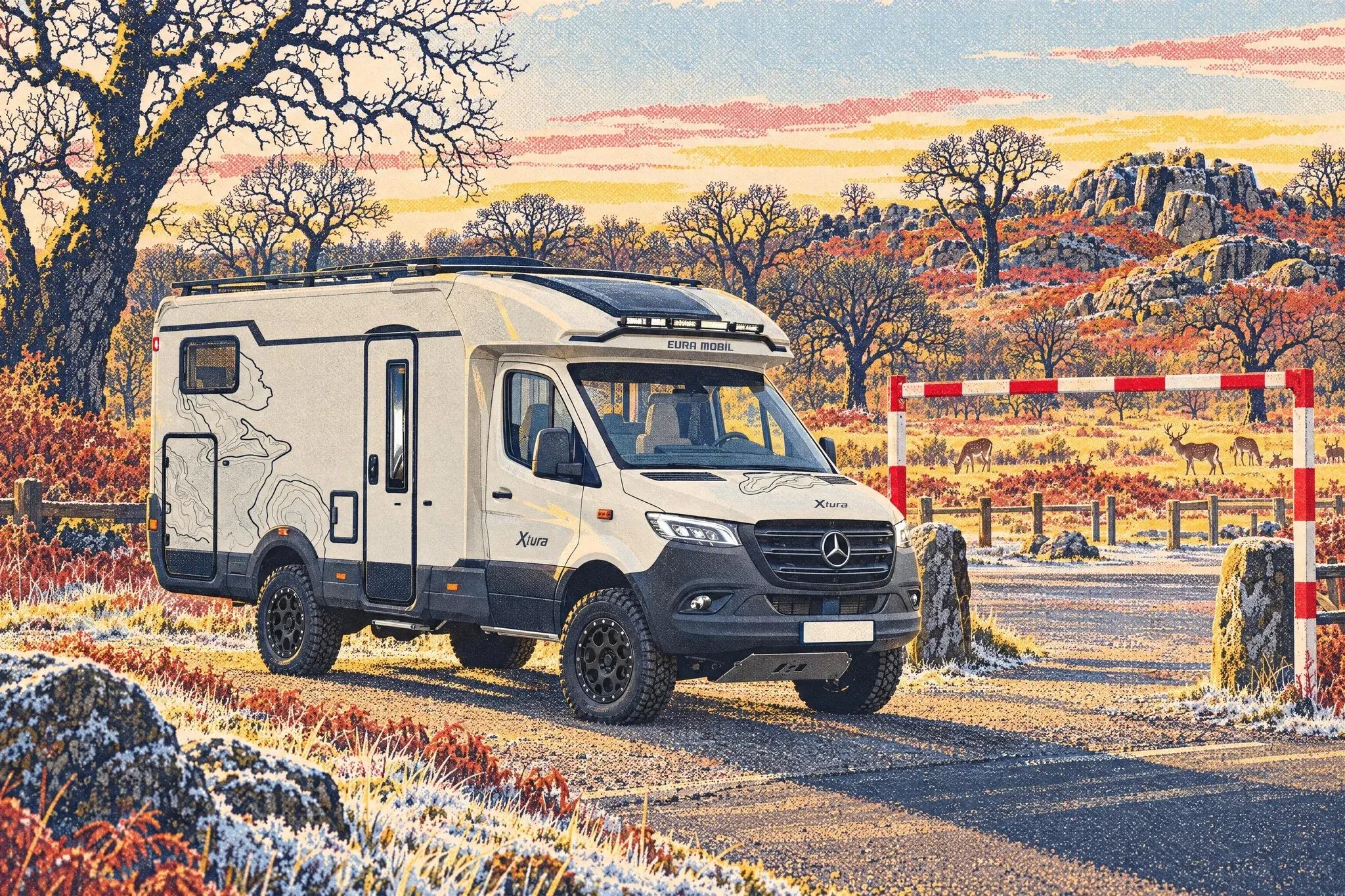
The short answer
The Eura Mobil Xtura XT 656 HB is a 6.68 m coachbuilt motorhome on a four-wheel-drive Mercedes-Benz base with a 190 PS diesel, 9G-Tronic automatic and an electrically raised roof tent. Its 4,100 kg maximum means a C1 licence if you passed your test on or after 1 January 1997, lower speed limits (50 mph single, 60 mph dual carriageway) and a nominal payload of around 741 kg. UK price and right-hand drive are not yet confirmed.

The Eura Mobil Xtura 656 HB is a four-wheel-drive motorhome with a tent on its roof that lifts itself up at the press of a button. It can weigh up to 4,100 kg fully loaded, and that one number changes which licence you need, how fast you may drive and how much you can carry. This piece explains the van as Eura Mobil describes it, then works through what 4,100 kg, 3.21 m and 2.2 m actually mean on British roads, ferries and campsites.
What the Xtura 656 HB actually is
Eura Mobil builds the Xtura range at Sprendlingen in Germany, and the XT 656 HB is its new, shorter model. It had its world premiere at Caravan Salon Düsseldorf 2026, which ran from 28 August to 6 September, at a show that also added new roof-tent and off-road display areas. That tells you where the market thinks this sort of vehicle sits: not a seaside tourer, but a go-anywhere base for people who like the idea of a tent and the reality of a heated motorhome.
Underneath is a Mercedes-Benz base with four-wheel drive, a 140 kW (190 PS) diesel and the nine-speed 9G-Tronic automatic, according to Eura Mobil. Expedition Portal describes the Xtura as a Class C motorhome on the Sprinter 4x4, which in UK terms is a coachbuilt: Eura Mobil's own habitation body sits on a Mercedes chassis cab rather than inside a standard panel van shell. That is why the dimensions are what they are. The 656 HB measures 6,680 mm long, 2,198 mm wide and 3,210 mm tall. A 2.2 m body is wider than any family car, and 3.21 m is taller than almost everything with a height barrier in front of it.
There are two Xtura floor plans: the longer XT 686 EF with twin beds, and this 656 HB with a rear transverse bed and the roof tent.
The roof tent, and how many people really sleep in it
The headline feature is a roof tent that raises electrically. Eura Mobil's premiere video makes much of the view from the top, and the tent has an insulated inner tent. Eura Mobil's equipment list marks the roof tent as optional, while promobil calls it standard, so whether the €183,400 base price includes it is unresolved. The roof-tent bed measures 1,980 x 1,300 mm. Downstairs, the rear transverse bed measures 1,940 x 1,380 mm.
Now the careful bit. Eura Mobil's specification page for the 656 HB lists two sleeping places, with an extension to four sleeping places, and marks the roof-tent bed as optional. So the 656 HB sleeps two as standard, in the rear bed, and four with the roof tent. There are four belted travel seats. If you plan to tour with four, make sure the vehicle you order has the roof tent, and check that the berth count on the paperwork matches your plans.
On the sizes themselves, 1,300 mm across is a snug double or a generous single, which is typical of roof tents. The 1,380 mm transverse bed below is a proper double by motorhome standards. Transverse means you lie across the vehicle, so both sleepers get the same 1,940 mm length, which suits most adults but is worth measuring against yourself if you are over six feet.
Living on board: water, power and heat
The off-grid kit is where the money goes. Eura Mobil quotes 140 litres of fresh water, of which only 10 litres is carried while driving, and 105 litres of waste. Keeping the tank at 10 litres on the move is a weight decision, and we come back to it in the payload sums. Power comes from two 200 Ah lithium batteries, 400 Ah in total, which is a serious bank for a factory-built motorhome and is the main reason an electric roof tent, diesel heating and a fridge can all run away from hook-up for days rather than hours.
Heating is diesel-fired hot-water heating as standard on the 656 HB. Eura Mobil lists Alde hot-water heating and underfloor heating as standard on the Xtura range, with diesel hot-water heating standard on the 656 HB, which reduces the gas locker to one 5 kg cylinder. Running heat from the same tank you fill at the pumps is a sensible choice for a vehicle designed to be used in winter and far from a gas supplier.
Licence: why 4,100 kg usually means C1
A standard category B car licence covers vehicles up to 3,500 kg maximum authorised mass. The Xtura 656 HB is plated at 4,100 kg. So:
- If you passed your car test on or after 1 January 1997, you need category C1, which covers vehicles between 3,500 kg and 7,500 kg. That means a medical, a provisional C1 entitlement, a theory test and a practical test. Most people do it through a training school, and the cost depends mostly on how many days of tuition you need, so get a quote before you fall for the van.
- If you passed before 1 January 1997, you were granted C1 automatically. It stays on your licence until you are 70, after which you renew it with a medical to keep driving anything over 3,500 kg.
- C1 on its own lets you tow a trailer of up to 750 kg. Anything heavier behind a 4,100 kg motorhome needs C1E.
Could you have it downplated to 3,500 kg to stay on a car licence? The arithmetic says no. With a mass in running order of 3,359 kg, a 3,500 kg plate would leave 141 kg for passengers, water, food and kit, which is less than two adults. The 4,100 kg maximum is not a quirk, it is what makes the vehicle usable. The full category rules are on GOV.UK's driving licence categories page.
Payload: the sums at 4,100 kg
Eura Mobil gives a mass in running order of 3,359 kg, with a stated range of 3,191 kg to 3,527 kg to cover manufacturing tolerance. Running order includes the driver, fuel tanks at least 90 per cent full and the 10 litres of driving water. The allowance for options and packages is 359.6 kg. Here is what that gives you:
- Nominal payload: 4,100 kg minus 3,359 kg is 741 kg.
- Best case, lightest build: 4,100 kg minus 3,191 kg is 909 kg.
- Worst case, heaviest build: 4,100 kg minus 3,527 kg is 573 kg.
- Tick every option and package: 741 kg minus 359.6 kg leaves around 381 kg on the nominal figure.
- Three passengers at the usual 75 kg convention: 225 kg, leaving about 156 kg for bedding, food, clothes, bikes, recovery gear and the dog.
- Fill the fresh tank from 10 litres to 140 litres: another 130 kg.
The lesson is not that the Xtura is short of payload. It is that a four-wheel-drive coachbuilt with 400 Ah of lithium and a roof tent with an insulated inner tent is heavy before anyone gets in, and the 4,100 kg plate is doing real work. Two practical habits follow. First, decide which options you genuinely want, because every one of them comes off the number you can carry. Second, take the finished, loaded vehicle to a weighbridge once, with the family and the kit you actually use, and check both the total and each axle against the plate. Eura Mobil has not published the individual axle limits in the figures we have, so read them off the vehicle's own plate.
Speed limits and the other over-3.5-tonne realities
GOV.UK sets separate limits for motor caravans over 3.05 tonnes maximum unladen weight: 30 mph in built-up areas in England, Scotland and Northern Ireland and 20 mph in Wales unless signed otherwise, 50 mph on single carriageways, 60 mph on dual carriageways and 70 mph on motorways. Unladen weight is a different measure from running order, because it leaves out the driver and fuel, but strip those from 3,359 kg and the nominal build still comes out above 3,050 kg, so expect the lower limits to apply, and confirm the unladen weight on your own vehicle's paperwork. On a long single-carriageway run through Wales or the Highlands that is a real difference from the 60 mph allowed for a motor caravan at or under 3.05 tonnes unladen. The full table is on GOV.UK's speed limits page.
Three other things change above 3,500 kg:
- Tax. Motorhomes over 3,500 kg are taxed in the private HGV class, a flat rate rather than a CO2-based one. Check the current figure on GOV.UK when you budget.
- MOT. As a rule, motor caravans are tested in class 4 whatever their weight, so you are not looking for an HGV test station every year. Confirm with your local testing station when the first test is due.
- Clean-air zones. In London, vehicles over 3,500 kg fall under the Low Emission Zone rather than the ULEZ, and the standard there is Euro VI. Run the registration through the Transport for London checker before you drive in, and do the same for any other city zone on your route.
3.21 m tall and 2.2 m wide: barriers, ferries and lanes
Height catches more motorhome owners out than weight, because it bites every day. At 3,210 mm, which is roughly 10 ft 6 in, the Xtura 656 HB will not go under the roughly 2 m barriers at most supermarket, beach and beauty-spot car parks, and it is tall enough that low railway bridges are a genuine planning point rather than a theoretical one. A simple rule: treat any bridge signed under 11 ft as a stop and rethink, and keep a sat-nav profile set to the true height, not the base van's.
Ferries ask for length and height when you book and price in bands. Quote 6.68 m and 3.21 m, check which band the operator puts you in, and compare fares across operators on the same route, because the bands do not all step at the same point. Remember the tent only adds height when it is raised on the pitch; you drive with it down.
Width is the other side of the same coin. The 2.2 m body, plus mirrors, is wider than any car. It is comfortable on A-roads and fine on campsite pitches, but it is worth knowing before you plan a route through single-track Cornish lanes or a tight ferry marshalling yard. It just means the Xtura rewards owners who plan routes rather than follow the car sat-nav.
The roof tent in British weather
The tent raises electrically, so there is no pitching or wrestling with poles in the rain. It has an insulated inner tent, which addresses the obvious shortfall of sleeping under fabric in a British October. And the bed is 1,980 x 1,300 mm.
What the sources do not tell us is the tent's fabric, its wind rating, how it handles condensation, how noisy it is in rain, or whether Eura Mobil advises lowering it in strong wind. Those are exactly the questions to put to Eura Mobil's people at the NEC in October; ask them whether the 656 HB is on the stand, so you can see the tent raised in front of you. Until then, treat the roof tent as a genuine second room for calm nights and as an open question for the rough ones.
Who the Xtura 656 HB suits
Families who want a 4x4 under seven metres
Four belted seats, an upstairs with an insulated inner tent for the children and a proper double below is an appealing recipe, and 6.68 m is shorter than a lot of four-berth coachbuilts. The caveats are that four berths depend on the optional roof tent, discussed above, and the need for a C1 licence for any driver who passed after 1996.
Adventurous couples
For two people the sums get easier. Sleep in the transverse bed, use the roof tent as a lookout on a clear night or a guest room when friends join, and enjoy a payload that is rarely stretched. If the tent does not appeal at all, the longer XT 686 EF with twin beds is the other Xtura floor plan.
Who it does not suit
Anyone unwilling to take a C1 test, anyone whose touring involves a lot of height-barriered car parks, and anyone who wants a motorhome to be cheap to buy. This is a premium, specialist vehicle and it is priced like one.
UK availability and price: what is and is not confirmed
Eura Mobil lists the 656 HB in Germany from €183,400. That base price may exclude the roof tent: Eura Mobil's equipment list marks the tent as optional, while promobil calls it standard, and this is unresolved. A UK price for the 656 HB has not been announced, so there is no pound figure for this model. Right-hand drive for this model is also unconfirmed.
A sterling price does exist for the sister model. A right-hand-drive Xtura XT 686 EF was launched for the UK on 13 March 2024 at £169,995 on the road, according to Practical Motorhome, and Motorhomes & Caravans Ltd of Hull, the UK Eura Mobil dealer, currently lists a 2027 XT 686 EF. River Motorhomes mentions the Xtura range, and Eura Mobil is exhibiting at the NEC from 13 to 18 October 2026; ask Eura Mobil at the NEC whether the 656 HB is on the stand. As a secondary pointer, one UK video review of the longer, roughly 7 m Xtura described it as a £160,000 motorhome; that is a different floor plan, not the 656 HB, so treat it as context only. Eura Mobil gives a ten-year watertightness guarantee on motorhomes from the 2017 season, up to 150,000 km, on condition of an annual paid leak check at an authorised partner. There is no general three-year warranty; the three-year term applies to furniture construction. Confirm how both apply in the UK with whichever dealer you buy from.
The bottom line
The Xtura 656 HB is an honest answer to a specific brief: four-wheel drive, serious lithium capacity, diesel heating and a roof tent with an insulated inner tent in a motorhome short enough to park in a normal UK pitch. The price of all that capability is weight and height. At 4,100 kg it needs a C1 licence for anyone who passed their test on or after 1 January 1997, it should expect 50 and 60 mph limits on single and dual carriageways, and its nominal 741 kg payload shrinks quickly once you add options, passengers and a full water tank. At 3.21 m it needs route planning. If those are trade-offs you are happy to make, go to the NEC, ask Eura Mobil whether the 656 HB is on the stand, ask about the berth count, the roof tent in wind and the UK price, and take the answers home before you decide.
Common questions
Do I need a special licence to drive the Eura Mobil Xtura 656 HB in the UK?
Yes if you passed your car test on or after 1 January 1997. The 656 HB is plated at 4,100 kg, above the 3,500 kg car-licence limit, so you need category C1, which involves a medical, a theory test and a practical test. Drivers who passed before 1997 have C1 automatically until they turn 70.
How many people can sleep in the Xtura 656 HB?
Eura Mobil's specification page lists two sleeping places as standard, in the 1,940 x 1,380 mm rear transverse bed, with an extension to four sleeping places using the 1,980 x 1,300 mm roof-tent bed, which Eura Mobil marks as optional. So it sleeps two as standard and four with the roof tent.
What is the payload of the Xtura 656 HB?
On Eura Mobil's figures, the nominal payload is 4,100 kg minus a 3,359 kg mass in running order, which is 741 kg. The running-order figure can range from 3,191 kg to 3,527 kg, and the options allowance is 359.6 kg, so a fully optioned vehicle has around 381 kg left for passengers, water and kit.
What speed limits apply to a 4,100 kg motorhome in the UK?
GOV.UK sets lower limits for motor caravans over 3.05 tonnes maximum unladen weight: 50 mph on single carriageways, 60 mph on dual carriageways and 70 mph on motorways, with 30 mph in built-up areas in England, Scotland and Northern Ireland and 20 mph in Wales, unless signed otherwise.
Is the Eura Mobil Xtura 656 HB available in the UK, and how much does it cost?
UK price and right-hand drive for the 656 HB are not yet confirmed. In Germany it starts from €183,400, but that base price may exclude the roof tent, which Eura Mobil's equipment list marks as optional while promobil calls it standard, and this is unresolved. A right-hand-drive Xtura XT 686 EF, the longer sister model, was launched for the UK on 13 March 2024 at £169,995 on the road. Motorhomes & Caravans Ltd of Hull, the UK dealer, currently lists a 2027 XT 686 EF, River Motorhomes mentions the Xtura range, and Eura Mobil is at the NEC from 13 to 18 October 2026.
Will the Xtura 656 HB fit under car park height barriers?
No. It is 3,210 mm tall, roughly 10 ft 6 in, so it will not pass the roughly 2 m barriers common at supermarket and beach car parks, and low railway bridges need planning. Treat any bridge signed under 11 ft as a stop and rethink.
The reachable bit
The camper you fall for is rarely the one you can afford. That gap is the whole reason Campervan.win exists. Right now we’re giving away the Sunlight Vanlife, worth around £65,000, and closing that gap is the point: capped entries so the odds stay honest, £10 a ticket, a maximum of five per person, £500 to a UK charity from every full draw, the winner picked by a public randomness beacon anyone can re-check, and one person driving away in the van itself.

Enjoyed this post?
Get more honest campervan guides like this one in your inbox.
You’re in!
Check your inbox. We’ve just sent you a welcome email.

About the author
Martha
Martha writes about interiors, ownership stories, and the everyday realities of campervan life, with a focus on comfort, cost, and how vans are used over time.
Keep Reading
Related Reading
Thoughtful articles that build on what you’ve just read.
Motorhome Safety, Weight & Licensing
11 min read
3,500 kg motorhomes at the NEC: the payload you really get, model by model
The plate on a category B motorhome is 3,500 kg, so what you can carry is whatever the van leaves over. We put the makers' own running-order and payload figures side by side, run the family-of-four sum, and list the questions to ask on any stand at the NEC.
Motorhome Safety, Weight & Licensing
11 min read
Bailey Ascent 2027: a Ford Transit automatic on a car licence, but mind the payload
Bailey's new five-model Ascent range puts an eight-speed automatic Ford Transit motorhome on a category B licence, but payload runs from 618 kg down to 340 kg. We work the sums from Bailey's own figures to show which layouts carry four people and which are really for two.
Motorhome Safety, Weight & Licensing
12 min read
Pössl Roadstar XL EVO: a 7 m Sprinter 4x4 campervan at 4.1 tonnes. Will it reach the UK, and who can drive it?
Pössl's new X-Line flagship is a near-7 m Mercedes Sprinter 4x4 campervan plated at 4.1 tonnes. We look at what Pössl has actually built, whether it is coming to the UK, who is legally allowed to drive it, and what the weight and height mean on British roads.
Motorhome Safety, Weight & Licensing
11 min read
Electric motorhomes up to 4.25 tonnes on a car licence: what the UK rules mean after Caravan Salon 2026
A standard car licence in Great Britain now covers zero-emission vehicles up to 4.25 tonnes, and an electric motorhome concept called EVOLVE at Caravan Salon 2026 was built around exactly that. Here is what the rule actually says, what it leaves out, and whether it changes anything for you yet.