
Motorhome Safety, Weight & Licensing
Bailey Ascent 2027: a Ford Transit automatic on a car licence, but mind the payload

Written by
Felix
Felix covers campervan technology, layouts, and modern conversions, with a focus on design-led thinking and practical performance
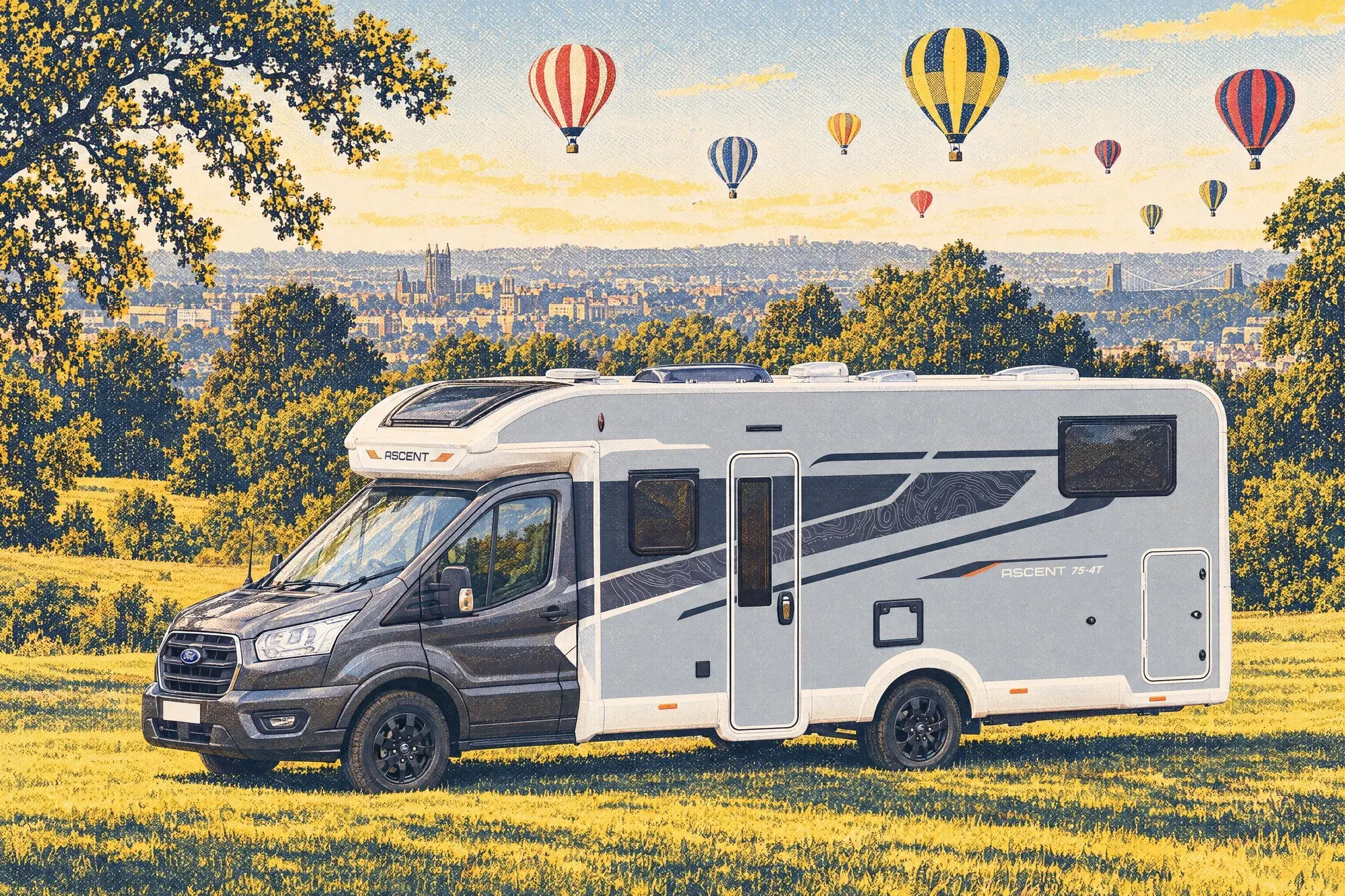
The short answer
The Bailey Ascent is a new five-model coachbuilt range on a Ford Transit chassis with a 165 bhp engine and eight-speed automatic as standard, all plated at 3,500 kg for a car licence and priced from £79,799 to £83,999. Payload runs from 618 kg (64-2) to 340 kg (75-4DL). With three passengers and a full fresh tank, the two 7.468 m layouts have only 15 to 19 kg left, so they suit two people; the 69-4 and 69-4TS suit four.

Bailey's new Ascent is a motorhome you can drive on an ordinary car licence, and it comes with an automatic gearbox as standard. That is the headline. The part worth reading the small print for is what it weighs once four people and a tank of water are on board. Bailey launched the five-model range on 8 October 2026, every one built on a Ford Transit chassis and every one plated at 3,500 kg, and the payload left for you runs from a generous 618 kg in the two-berth down to 340 kg in the longest four-berth. Worked through with Bailey's own figures, that gap decides which Ascents suit four people and which are really for two.
What the Ascent is
The Ascent is a new five-model motorhome range from Bailey of Bristol, launched on 8 October 2026 and due to make its first public appearance at the Motorhome and Caravan Show at the NEC Birmingham, which runs from 13 to 18 October 2026. Bailey is in Hall 19 on stand 25, and its show page lists all five Ascents as 'Coming Soon' and says some will be seen by the public for the first time there. If one layout matters to you, ask which are on the stand before you travel.
Each Ascent has a coachbuilt body on a Ford Transit skeletal chassis. According to Bailey's launch article, the 2.0-litre engine (1,995 cc on the model pages) produces 165 bhp and drives through an eight-speed automatic gearbox, standard on every model. One wrinkle: Bailey's range page quotes 160 bhp in one place and 165 bhp in another, while the individual model pages say 165 bhp, so take 165 bhp as the working figure and confirm it on the order form. For context, Bailey's Adamo 69-4, also a Transit coachbuilt at £81,899, lists the same 165 bhp, 1,995 cc engine and eight-speed automatic, while its Endeavour campervans list a 130 bhp Ford 2.0-litre with a six-speed manual.
Standard specification is strong for the money. Bailey's model pages list cab air conditioning, cruise control, electric windows, automatic headlights and a 12-inch touchscreen, and Ropers Leisure's listing for the 64-2 adds automatic wipers. Grantham Caravans' listing for the 75-4T mentions black 16-inch alloy wheels with tyre pressure sensors. In the living area every model gets Truma Combi Neo 6E heating, a 150 Ah lithium leisure battery, 200 W of Truma flexible solar, a Thetford 150-litre compressor tower fridge with a 17-litre freezer, 100-litre fresh and waste tanks and a dual-access rear garage. Bailey says its motorhomes are cold-chamber tested to Grade III for thermal insulation and heating, which is the grade you want for year-round touring.
Every Ascent is 2.393 m wide with the mirrors folded (2.720 m with them out) and 2.859 m tall, with 2.136 m of headroom inside, which clears someone of 6 ft 6 in (about 1.98 m) with room to spare. That width is well beyond any family car, so allow for it on narrow lanes and in car parks. Prices run from £79,799 to £83,999, recommended on-the-road as at 8 October 2026 including VAT. The on-the-road figure includes £1,400 for road fund licence, first registration, number plates and delivery.
The five layouts
Ascent 64-2, £79,799
The shortest Ascent at 6.447 m, with two berths and two designated (belted) travelling seats. The bed is a rear drop-down double measuring 1.29 m by 1.82 m. Mass in running order is 2,882 kg, leaving a payload of 618 kg.
Ascent 69-4, £81,899
6.976 m long, four berths, four travelling seats. There is a front double of 1.66 m by 2.221 m and a front drop-down double of 1.54 m by 1.82 m. Bailey's page says the front bunks convert into twin Aguti travel seats with ISOFIX for two additional passengers, and Bailey lists the same Aguti ISOFIX travel seats on its other four-berth Ascents. Running order 3,071 kg, payload 429 kg.
Ascent 69-4TS, £82,999
The same 6.976 m length, but with twin electrically operated, multi-position drop-down single beds (0.9 m by 1.8 m and 0.9 m by 1.886 m) above a parallel front lounge that also converts into a 1.565 m by 2.221 m double. Running order 3,083 kg, payload 417 kg.
Ascent 75-4T, £82,949
Stretched to 7.468 m, with rear single beds of 0.8 m by 1.85 m and 0.8 m by 1.88 m plus a front double of 1.221 m by 2.221 m. Running order 3,156 kg, payload 344 kg. The 75-4T is £50 cheaper than the shorter 69-4TS, and its singles are 10 cm narrower than the TS's drop-down pair.
Ascent 75-4DL, £83,999
Also 7.468 m, with front and rear drop-down doubles, each 1.29 m by 1.82 m. Running order 3,160 kg, payload 340 kg. It is the dearest Ascent and the one with the least payload.
How Bailey counts the weight
Payload is the plated maximum (3,500 kg on every Ascent) minus the mass in running order, and all five figures above check out. The useful detail is what Bailey includes in that running-order figure. Bailey states that it is taken with the fresh-water tank empty and includes a 75 kg driver, fuel at 90 per cent and 10 kg of gas. Three things follow.
- The driver is already counted, so you only add the passengers.
- Water is not counted. Fill the 100-litre fresh tank and you add about 100 kg, because a litre of water weighs a kilogram.
- Only 10 kg of gas is counted. Carry more than that and the extra comes out of your payload.
There is also a tolerance to know about. EU type-approval rules allow the actual running-order mass of a motor caravan to differ from the declared figure by up to plus or minus 5 per cent. On a 3,160 kg van that is about 158 kg either way, which is nearly half the 75-4DL's entire payload. Options add weight too, and Bailey lists the Ascent's optional upgrades, such as mobile wi-fi, as retailer-fit items, so ask the dealer what each one weighs before you tick any boxes.
The payload sums, layout by layout
Take Bailey's payload, subtract 75 kg per passenger (the figure the type-approval rules assume, and lighter than many adults with a coat on), then subtract 100 kg for a full fresh tank. What is left has to cover clothes, food, bedding, chairs, bikes, a hose, levelling ramps, a spare gas cylinder and everything else that lives in a motorhome.
- 64-2 with two aboard: 618 kg minus one passenger (75 kg) is 543 kg; minus a full tank is 443 kg. Plenty.
- 69-4 with four aboard: 429 kg minus three passengers (225 kg) is 204 kg; minus a full tank is 104 kg.
- 69-4TS with four aboard: 417 kg minus 225 kg is 192 kg; minus a full tank is 92 kg.
- 75-4T with four aboard: 344 kg minus 225 kg is 119 kg; minus a full tank is 19 kg.
- 75-4DL with four aboard: 340 kg minus 225 kg is 115 kg; minus a full tank is 15 kg.
Fifteen to nineteen kilograms for four people's belongings is a couple of weekend bags and nothing in the garage. Travel with the tank a quarter full and the 75s gain about 75 kg back, but you are still packing like a hiker. Run the same two 7.468 m vans as couples and the picture changes: the 75-4T has 344 kg minus one passenger, 269 kg, and 169 kg after a full tank; the 75-4DL has 265 kg and 165 kg. That is workable for two, with care.
The 6.976 m pair with two aboard are roomier still: the 69-4 has 354 kg after a passenger and 254 kg after water; the 69-4TS has 342 kg and 242 kg.
Which Ascent suits whom
Two people
The 64-2 is the obvious couple's van, with the best payload in the range by a distance and the shortest body. If you want four belted seats for occasional guests and a bigger lounge, either 69 works comfortably for two, and the 69-4TS's two electric singles mean neither of you climbs over the other at night. The 75s suit two who want the extra half a metre of living space and are disciplined about weight.
Four people
The 69-4 and 69-4TS are the Ascents that can carry four people, water and a sensible amount of kit without a weighbridge argument. The ISOFIX travel seats Bailey lists on the four-berth Ascents point the 69s at families with young children, who weigh less than the 75 kg the sums assume, so a family with two small children will do better than the figures above suggest. Four adults in a 75-4T or 75-4DL is a plan for a dry-tank, light-luggage weekend, not a fortnight in Scotland. Treat the two long layouts as two-berths that can seat and sleep four occasionally.
What 3,500 kg does and does not mean
Licence
Bailey says every Ascent can be driven on a standard UK category B licence, and at 3,500 kg MTPLM that holds for anyone with a car licence, whenever they passed. Drivers who passed on or after 1 January 1997 cannot go over 3,500 kg without gaining C1, so the 3,500 kg plate is what opens the Ascent to them. It also means there is no uprating headroom on a car licence: 3,500 kg is both the plate and the ceiling.
Speed limits
The speed limit for a motor caravan depends on unladen weight, not the plate. At or under 3.05 tonnes unladen you drive to car limits: 60 mph on single carriageways, 70 mph on dual carriageways and motorways. Over 3.05 tonnes unladen the limits drop to 50 mph on single carriageways and 60 mph on dual carriageways, with 70 mph on motorways. Unladen weight excludes the driver, fuel and water, so it is lower than Bailey's running-order figure. The 75s run at 3,156 kg and 3,160 kg in running order; take off the 75 kg driver and 10 kg of gas and you are at 3,071 kg and 3,075 kg before the fuel comes off, which puts them close to the line. Bailey's model pages give the running-order mass, not the unladen weight, so check the V5C or the certificate of conformity rather than assuming either way. Speed cameras enforce the posted limit for the road, not your vehicle class.
Tax and zones
At 3,500 kg with a 1,995 cc engine, an Ascent falls into tax class TC11 at £375 a year (2026 to 2027 rate), and the road fund licence at registration is part of Bailey's £1,400 on-the-road figure. In London the ULEZ, rather than the Low Emission Zone, applies to a motor caravan of 3,500 kg or under. For England's charging Clean Air Zones and Scotland's Low Emission Zones, put the registration into the official checkers rather than relying on the vehicle's age.
Where the published figures differ
New ranges produce a few loose ends, and the Ascent has three. Bailey's launch article lists the 69-4 as a two-berth with two seats at 6.4 m, but its model page says four berths, four seats and 6.976 m, and Practical Motorhome's report agrees with the model page. Practical Motorhome prices the 69-4 at £81,999 against Bailey's £81,899, a £100 difference that is small but worth clearing up at order time. The 7.468 m Bailey gives for the 75-4T and 75-4DL appears as 7.49 m in Practical Motorhome and 7.5 m in Bailey's launch article, and Grantham Caravans lists the 75-4T at 7.47 m. None of that changes the sums, which rest on the model pages, but it is a reminder to get the figures for your van written into your order.
Before you order
- Ask the dealer for the weight of every option you add, and subtract it from the payload.
- Weigh your passengers and kit for real. The 75 kg figure is a type-approval convention, not a description of your family.
- Decide how you will travel with water. A quarter tank is about 25 kg; a full one is about 100 kg.
- Take the van to a public weighbridge loaded as you mean to tour, and check each axle against the figures on the plate as well as the total.
- Read the unladen weight off the V5C before assuming car speed limits.
- Confirm the engine output (165 bhp on the model pages) and the length on your order form.
The bottom line
The Ascent gives Bailey a Transit-based coachbuilt with an automatic as standard, Grade III insulation, lithium and solar in the box, and a price spread of just £4,200 across five layouts. The two-berth 64-2 has the payload to carry a couple and whatever they like. The 69-4 and 69-4TS are the four-up choices. The 75-4T and 75-4DL are long, well-equipped vans for two that can seat four, and Bailey's own numbers say so. Pick by the sums, not the berth count, then prove it on a weighbridge.
Common questions
Can I drive a Bailey Ascent on a car licence?
Yes. Every Ascent is plated at 3,500 kg MTPLM, and Bailey says each can be driven on a standard UK category B licence, so that includes drivers who passed their test on or after 1 January 1997.
Which Bailey Ascent is best for four people?
The 69-4 (429 kg payload) and 69-4TS (417 kg). With three passengers at 75 kg and a full 100-litre tank they still have 104 kg and 92 kg left for kit. The 75-4T and 75-4DL have only 19 kg and 15 kg left on the same sums.
Why is the payload so low on the 75-4T and 75-4DL?
Their longer 7.468 m bodies push mass in running order up to 3,156 kg and 3,160 kg, and the 3,500 kg plate cannot move on a car licence, so only 344 kg and 340 kg remain.
Does Bailey's payload figure include water?
No. Bailey takes mass in running order with the fresh tank empty, including a 75 kg driver, fuel at 90 per cent and 10 kg of gas. Filling the 100-litre fresh tank takes about 100 kg off your payload.
What speed limits apply to a Bailey Ascent?
It depends on unladen weight, not the 3,500 kg plate. At or under 3.05 tonnes unladen you drive to car limits; over it you drop to 50 mph on single and 60 mph on dual carriageways. Check the unladen weight on the V5C.
What engine and gearbox does the Ascent have?
Bailey's launch article and model pages give a 2.0-litre (1,995 cc) Ford engine with 165 bhp and an eight-speed automatic as standard on all five models, though Bailey's range page quotes 160 bhp in one place, so confirm it on your order form.
The reachable bit
The camper you fall for is rarely the one you can afford. That gap is the whole reason Campervan.win exists. Right now we’re giving away the Sunlight Vanlife, worth around £65,000, and closing that gap is the point: capped entries so the odds stay honest, £10 a ticket, a maximum of five per person, £500 to a UK charity from every full draw, the winner picked by a public randomness beacon anyone can re-check, and one person driving away in the van itself.

Enjoyed this post?
Get more honest campervan guides like this one in your inbox.
You’re in!
Check your inbox. We’ve just sent you a welcome email.

About the author
Felix
Felix covers campervan technology, layouts, and modern conversions, with a focus on design-led thinking and practical performance
Keep Reading
Related Reading
Thoughtful articles that build on what you’ve just read.
Motorhome Safety, Weight & Licensing
11 min read
3,500 kg motorhomes at the NEC: the payload you really get, model by model
The plate on a category B motorhome is 3,500 kg, so what you can carry is whatever the van leaves over. We put the makers' own running-order and payload figures side by side, run the family-of-four sum, and list the questions to ask on any stand at the NEC.
Motorhome Safety, Weight & Licensing
12 min read
Pössl Roadstar XL EVO: a 7 m Sprinter 4x4 campervan at 4.1 tonnes. Will it reach the UK, and who can drive it?
Pössl's new X-Line flagship is a near-7 m Mercedes Sprinter 4x4 campervan plated at 4.1 tonnes. We look at what Pössl has actually built, whether it is coming to the UK, who is legally allowed to drive it, and what the weight and height mean on British roads.
Motorhome Safety, Weight & Licensing
11 min read
Electric motorhomes up to 4.25 tonnes on a car licence: what the UK rules mean after Caravan Salon 2026
A standard car licence in Great Britain now covers zero-emission vehicles up to 4.25 tonnes, and an electric motorhome concept called EVOLVE at Caravan Salon 2026 was built around exactly that. Here is what the rule actually says, what it leaves out, and whether it changes anything for you yet.
Motorhome Safety, Weight & Licensing
12 min read
Eura Mobil Xtura 656 HB: a 4x4 Sprinter motorhome with an electric roof tent, and what 4,100 kg means in the UK
Eura Mobil's new short Xtura pairs a four-wheel-drive Mercedes base with an electrically raised roof tent and insulated inner tent. We go through the beds, the weights, the C1 licence question, speed limits, the 3.21 m height and what is still unconfirmed for the UK.