
Motorhome Safety, Weight & Licensing
Electric motorhomes up to 4.25 tonnes on a car licence: what the UK rules mean after Caravan Salon 2026

Written by
Rowan
Rowan writes editorial features, comparisons, and industry context pieces that help readers understand the campervan and motorhome landscape.
The short answer
Yes. Since 10 June 2025, Category B licence holders in Great Britain can drive zero-emission vehicles up to 4.25 tonnes, with no extra training, and the regulation is not limited to goods vans, so an electric motorhome qualifies. Petrol and diesel motorhomes over 3.5 tonnes still need C1 if you passed your test on or after 1 January 1997. Treatment abroad is not yet confirmed, and Northern Ireland's 4,250 kg allowance covers zero-emission goods vehicles only, so an electric motorhome does not appear to be covered there; check with the DVA.

Since 10 June 2025, an ordinary car licence in Great Britain has let you drive an electric vehicle weighing up to 4.25 tonnes. That includes motorhomes. At Caravan Salon Düsseldorf 2026, a purpose-built electric motorhome concept called EVOLVE was shown with that exact figure in mind. So the obvious question is whether the rule, and the van, add up to anything you can use. The rule is real and already in force, the van is a concept with no price or factory, and there are a few loose ends in the law that nobody has tied off yet. Let's go through all three.
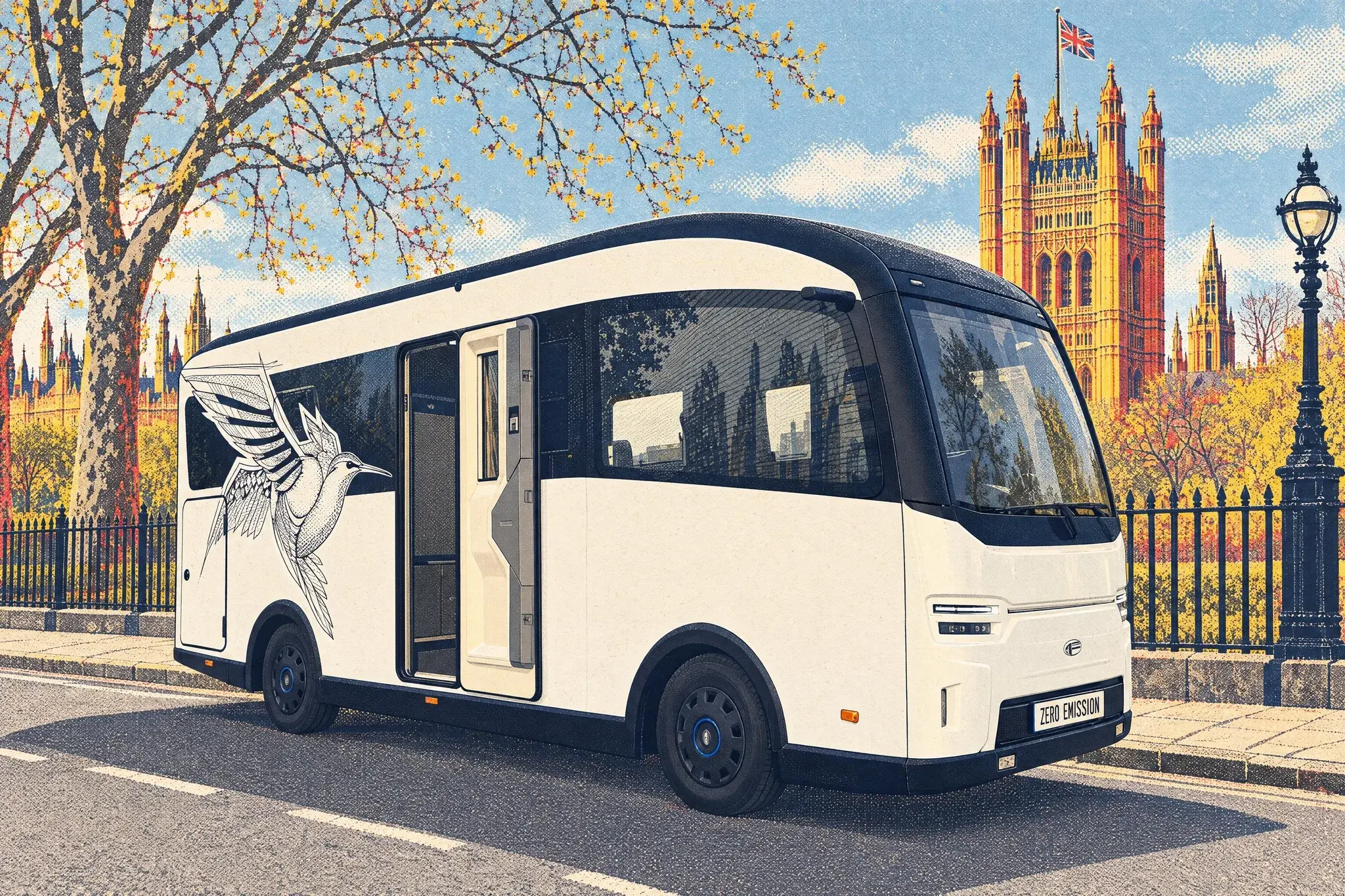
EVOLVE in brief: a concept, not a van you can order
EVOLVE is a joint project from three companies: CityFreighter, which supplies a skateboard chassis with the battery packaged in the floor; Vöhringer, which built the interior using its AIRPLY lightweight panel system; and Motive Development. It is not a conversion of an existing diesel van. It was drawn from scratch as an electric motorhome, which is why the floor is flat from front to back and why the whole thing could be shaped around a weight target rather than squeezed into a donor van's limits.
The headline figures, taken from the project's own site at evolve.cityfreighter.com, are these:
- A 128 kWh battery.
- DC charging at 200 kW, with 10 to 80 per cent quoted at around 20 minutes.
- A claimed real-world range of more than 400 km, which electrive reports as around 400 km. In UK terms that is roughly 250 miles.
- Dimensions of 6.95 m long, 2.35 m wide and 2.72 m tall. That width is coachbuilt territory, noticeably wider than a panel van conversion at about 2.05 m, and wider than any family car.
- Under 3.5 tonnes as a complete demonstrator, with about 750 kg of payload if plated at 4.25 tonnes.
- A heat pump for cabin heating, and vehicle-to-load so the drive battery can power things outside the van.
- The project describes it as built for the new 4.25-tonne Category B licence.
Now the important caveat. The project itself says EVOLVE is not a production vehicle, and promobil reports there is no timetable, no price and no factory. Treat it as a well-argued demonstration of what a ground-up electric motorhome could be, not as something to put a deposit on. The reason it still matters is that it shows how the maths changes once the legal ceiling for a car licence rises from 3.5 to 4.25 tonnes.
The GB rule in plain English
The change came in through The Motor Vehicles (Driving Licences) (Amendment) (No. 2) Regulations 2025, known as SI 2025/608, which took effect on 10 June 2025. It allows Category B licence holders in Great Britain to drive zero-emission vehicles with a maximum authorised mass of up to 4.25 tonnes.
The Department for Transport summed it up in its response to a public petition on 23 March 2026. In its words, the change allowed all zero-emission vehicles to be driven on a Category B licence, removed the training requirement, and permitted these vehicles to tow a trailer.
Three things in that sentence matter for motorhomes:
- All zero-emission vehicles. The regulation has no goods-only wording. Earlier allowances for heavier alternatively fuelled vehicles were aimed at delivery vans. This one is not, so an electric motorhome with a MAM of 4,250 kg sits inside it.
- No training requirement. You do not need to complete a course or take any extra test. Your existing Category B entitlement covers it.
- Towing is permitted. The DfT states these vehicles can tow a trailer. According to the GOV.UK guidance "Driving an electric or hydrogen powered vehicle", the combination may be up to 7,000 kg MAM with a trailer up to 3,500 kg.
What zero-emission rules out
The wording is zero-emission, not low-emission. A diesel motorhome with a large leisure battery is still a diesel. A hybrid still has a tailpipe. Neither qualifies. In practice this means a fully electric motorhome, or a hydrogen fuel-cell one if any ever reach the market, and nothing else.
Diesel over 3.5 tonnes still means C1
Nothing has changed for petrol and diesel motorhomes. If you passed your car test on or after 1 January 1997, your licence covers vehicles up to 3,500 kg MAM. Anything heavier, up to 7.5 tonnes, needs a C1 entitlement, which means a medical, a theory test and a practical test in a suitable vehicle. If you passed before 1 January 1997, you were given C1 automatically and keep it, though from age 70 you have to renew with a medical to hold on to it.
Caravan Salon 2026 had plenty of vans that illustrate the point. The Westfalia Columbus Liner is plated at up to 4,250 kg. The Pössl Roadstar XL EVO is plated at 4,100 kg. Robeta's own page for the Hercules states plainly that it needs a C1 licence. All three are diesel, so for a post-1997 driver in Great Britain, all three need C1 regardless of how good the EVOLVE concept looked a few halls away.
The slightly odd result is that, today, a British car licence holder can legally drive a 4.25-tonne electric motorhome but not a 3.6-tonne diesel one. That is the rule as written, and it is worth being clear-eyed about it before you fall for a heavy diesel at a show.
Europe is heading somewhere different
The EU published its Fourth Driving Licence Directive on 5 November 2025. It will allow Category B holders to drive motorhomes up to 4,250 kg on any fuel, but only after at least seven hours of training, a test, or both. Directive (EU) 2025/2205 says member states must adopt and publish the rules by 26 November 2028 and apply them from 26 November 2029.
So the two systems are diverging. Great Britain has gone further on electric vehicles, with no training needed, while saying nothing about diesel. The EU is going to cover every fuel, but with a training hurdle and a longer wait. When asked whether it would follow the EU for all motorhomes, the DfT said it has not yet assessed doing the same. That is not a no, but it is not a plan either. If you are hoping to drive a 4-tonne diesel on a car licence in the UK, there is nothing to wait for yet.
What is not settled, and who to ask
Two gaps are big enough that you should not assume anything.
Taking a 4.25-tonne electric motorhome abroad
The GB regulation is a domestic rule about what your licence allows here. How France, Spain or Germany would treat a UK Category B driver in a 4.25-tonne electric motorhome has not been confirmed. The EU's own framework for heavier alternatively fuelled vehicles on a B licence, set by Directive 2006/126/EC Article 6(4)(c) as inserted by Directive 2018/645, was limited to goods vehicles without a trailer, for drivers who had held a licence for at least two years, with the extra mass due solely to the propulsion system. It had no training requirement (the five-hour training was a GB addition), and the new directive for motorhomes does not have to be applied until late 2029. Until there is a clear statement, a ferry ticket and a 4.25-tonne plate are a risk. Ask the DVLA, and ask the embassy or motoring organisation of each country you plan to drive in.
Northern Ireland
SI 2025/608 applies to Great Britain. Northern Ireland has its own driver licensing arrangements. The Department for Infrastructure announced that new regulations came into operation on 1 August 2026 raising the category B limit to 4,250 kg for zero-emission goods vehicles, with a two-year licence-holding condition. That material covers goods vehicles only, so an electric motorhome does not appear to be covered in Northern Ireland. If you live or drive there, check with the DVA before relying on the 4.25-tonne allowance.
Your insurer
Being legal to drive is not the same as being insured. A motorhome plated above 3.5 tonnes may sit in a different underwriting bracket, and an electric one over 3.5 tonnes is still unusual. Tell your insurer the exact MAM, the fuel type and the date you passed your test, and get the answer in writing.
Why 750 kg of extra MAM matters so much for an electric motorhome
Payload is where this rule earns its keep. A motorhome's payload is its plated MAM minus its mass in running order, and it has to cover people, water, gas or its electric equivalent, food, bikes, awnings and everything else you bring. In a diesel coachbuilt, payloads of a few hundred kilograms at 3.5 tonnes are normal, and owners already run close to the line.
Now add an electric drivetrain. A 128 kWh battery is heavy, and so are the motors, inverters and the structure to carry them. EVOLVE's own claimed figures make the point: as a complete demonstrator it comes in under 3.5 tonnes, and at a 4.25-tonne plate it has about 750 kg of payload. Plate that same van at 3.5 tonnes and the usable payload would shrink to a few tens of kilograms at best, which is not a motorhome anyone could tour in. The 4.25-tonne allowance is the difference between an electric motorhome that is legal on paper and one that can carry a family and a week's kit.
That is also why the project leaned so hard on lightweight construction. Vöhringer's AIRPLY panels and the skateboard layout exist to claw back mass so that payload survives. Expect any production electric motorhome of this size to make the same trade-offs, and to put payload front and centre in its marketing.
Living with a 4.25-tonne electric motorhome: the small print
Crossing the 3.5-tonne line changes a few everyday things, whether the van is electric or not. None are deal-breakers, but all are worth knowing before you buy.
- Speed limits. In the UK, motorhomes with an unladen weight over 3.05 tonnes face lower limits than cars: 50 mph on single carriageways, 60 mph on dual carriageways and 70 mph on motorways. A 4.25-tonne electric motorhome will almost certainly fall into that group.
- Weight-limit signs. Any road or bridge signed at 3.5 tonnes, except for access, is now a road you have to think about. Plan routes with that in mind, especially in older towns and on rural lanes.
- Ferries and tolls. Many operators price by length and height, and some by weight class. Check how a 6.95 m, 2.72 m tall, 4.25-tonne vehicle is categorised before you book.
- Weighing. With 750 kg of payload you have room, but you still need to know where you stand. A trip to a public weighbridge, fully loaded with water and passengers, is cheap and settles it.
- Charging on a campsite. A standard 16 A hook-up delivers roughly 3.5 kW. Filling a 128 kWh battery from empty at that rate would take well over a day, and many sites do not allow EV charging from pitch bollards at all. Ask before you plug in, and plan around public rapid chargers on the road.
- Charging cost. This depends entirely on where you charge. At a public rapid charger priced at around 80p per kWh, a full 128 kWh would cost roughly £100. On a standard home tariff at about 25p it would be closer to £30, and an off-peak EV tariff could bring it below £10. You would rarely charge from empty to full in one go, but it shows why home or destination charging matters.
- Winter range. Heating a large box in January takes energy. A heat pump, which EVOLVE has, is far more efficient than resistive heating, but you should still expect the quoted 400 km to shrink in cold weather, as it does for every electric vehicle.
A bigger plate solves the payload problem. It does not solve charging, speed limits or weight signs. Go in with eyes open on all four.
Does this change what you should buy now?
It depends on your licence and your timeline.
If you passed your test before 1997
Nothing changes. You already have C1 and can drive any motorhome up to 7.5 tonnes on any fuel. The only thing to watch is the medical at 70 if you want to keep that entitlement.
If you passed on or after 1 January 1997 and want a big van now
Your realistic choices are a diesel at or under 3.5 tonnes, or taking the C1 test. The electric allowance does not help yet because there is barely anything to buy. Most electric camper conversions on sale in the UK today are built on electric panel vans and sit comfortably under 3.5 tonnes anyway, so the 4.25-tonne headroom is not the thing holding them back. Purpose-built electric motorhomes at EVOLVE's scale are still concepts.
If you can wait
Two things could move. The first is a production electric motorhome that actually uses the 4.25-tonne allowance, and EVOLVE is the clearest signal so far that manufacturers are designing for it. The second is whether the UK follows the EU in extending the 4.25-tonne limit to all fuels with training. The DfT has only said it has not yet assessed that, so do not build plans around it, but keep an eye on it.
The bottom line
The rule is simple and already in force: in Great Britain, a Category B licence covers zero-emission vehicles up to 4.25 tonnes, with no training, and that includes motorhomes. The catch is that the vehicles do not exist yet in any number. EVOLVE shows what one could look like, with a 128 kWh battery, around 250 miles of claimed real-world range, rapid charging and a sensible 750 kg payload, but it has no price, no factory and no date. Diesel motorhomes over 3.5 tonnes still need C1 for post-1997 drivers, and the EU's broader change does not have to apply until 2029. Before you rely on the 4.25-tonne allowance for anything, confirm it with the DVLA and your insurer, and do not assume it travels with you across the Channel. In Northern Ireland the equivalent allowance covers zero-emission goods vehicles only, so an electric motorhome does not appear to be covered there; check with the DVA.
Common questions
Can I drive an electric motorhome over 3.5 tonnes on a normal car licence in the UK?
In Great Britain, yes. Since 10 June 2025, Category B licence holders can drive zero-emission vehicles up to 4.25 tonnes MAM with no extra training, and the regulation is not limited to goods vans, so an electric motorhome qualifies. Northern Ireland differs: its 4,250 kg allowance, in operation since 1 August 2026, covers zero-emission goods vehicles only, with a two-year licence-holding condition, so an electric motorhome does not appear to be covered there. Check with the DVA.
Does the 4.25-tonne allowance apply to diesel motorhomes?
No. Petrol and diesel motorhomes over 3.5 tonnes still need a C1 licence if you passed your car test on or after 1 January 1997. The Department for Transport says it has not yet assessed extending the 4.25-tonne limit to all motorhomes.
Can I buy the EVOLVE electric motorhome shown at Caravan Salon 2026?
Not at the moment. The project describes EVOLVE as not a production vehicle, and promobil reports there is no timetable, price or factory. It is a demonstrator built by CityFreighter, Vöhringer and Motive Development.
Will the EU let car licence holders drive 4.25-tonne motorhomes too?
Yes, under the Fourth Driving Licence Directive published on 5 November 2025, Category B holders will be able to drive motorhomes of any fuel up to 4,250 kg after at least seven hours of training, a test, or both. Directive (EU) 2025/2205 says member states must adopt and publish it by 26 November 2028 and apply it from 26 November 2029.
Can I take a 4.25-tonne electric motorhome abroad on a UK car licence?
That has not been confirmed. The GB rule is a domestic change, and how other countries treat a UK Category B driver in a 4.25-tonne electric vehicle is unclear, so check with the DVLA and the authorities in each country before you travel.
Why does an electric motorhome need the extra 750 kg so badly?
Batteries, motors and the structure to carry them are heavy, so an electric motorhome plated at 3.5 tonnes can be left with almost no payload. EVOLVE's own figures show the point: under 3.5 tonnes as a demonstrator, with about 750 kg of payload at a 4.25-tonne plate.
The reachable bit
The camper you fall for is rarely the one you can afford. That gap is the whole reason Campervan.win exists. Right now we’re giving away the Sunlight Vanlife, worth around £65,000, and closing that gap is the point: capped entries so the odds stay honest, £10 a ticket, a maximum of five per person, £500 to a UK charity from every full draw, the winner picked by a public randomness beacon anyone can re-check, and one person driving away in the van itself.

Enjoyed this post?
Get more honest campervan guides like this one in your inbox.
You’re in!
Check your inbox. We’ve just sent you a welcome email.

About the author
Rowan
Rowan writes editorial features, comparisons, and industry context pieces that help readers understand the campervan and motorhome landscape.
Keep Reading
Related Reading
Thoughtful articles that build on what you’ve just read.
Motorhome Safety, Weight & Licensing
11 min read
3,500 kg motorhomes at the NEC: the payload you really get, model by model
The plate on a category B motorhome is 3,500 kg, so what you can carry is whatever the van leaves over. We put the makers' own running-order and payload figures side by side, run the family-of-four sum, and list the questions to ask on any stand at the NEC.
Motorhome Safety, Weight & Licensing
11 min read
Bailey Ascent 2027: a Ford Transit automatic on a car licence, but mind the payload
Bailey's new five-model Ascent range puts an eight-speed automatic Ford Transit motorhome on a category B licence, but payload runs from 618 kg down to 340 kg. We work the sums from Bailey's own figures to show which layouts carry four people and which are really for two.
Motorhome Safety, Weight & Licensing
12 min read
Pössl Roadstar XL EVO: a 7 m Sprinter 4x4 campervan at 4.1 tonnes. Will it reach the UK, and who can drive it?
Pössl's new X-Line flagship is a near-7 m Mercedes Sprinter 4x4 campervan plated at 4.1 tonnes. We look at what Pössl has actually built, whether it is coming to the UK, who is legally allowed to drive it, and what the weight and height mean on British roads.
Motorhome Safety, Weight & Licensing
12 min read
Eura Mobil Xtura 656 HB: a 4x4 Sprinter motorhome with an electric roof tent, and what 4,100 kg means in the UK
Eura Mobil's new short Xtura pairs a four-wheel-drive Mercedes base with an electrically raised roof tent and insulated inner tent. We go through the beds, the weights, the C1 licence question, speed limits, the 3.21 m height and what is still unconfirmed for the UK.