
Carado CV595 X-Edition explained: the £87,890 4x4 VW Crafter campervan, for UK buyers

Written by
Leo
Leo covers campervan technology, maintenance, kit, and ownership advice, with a clear, practical focus on how things work in real life.
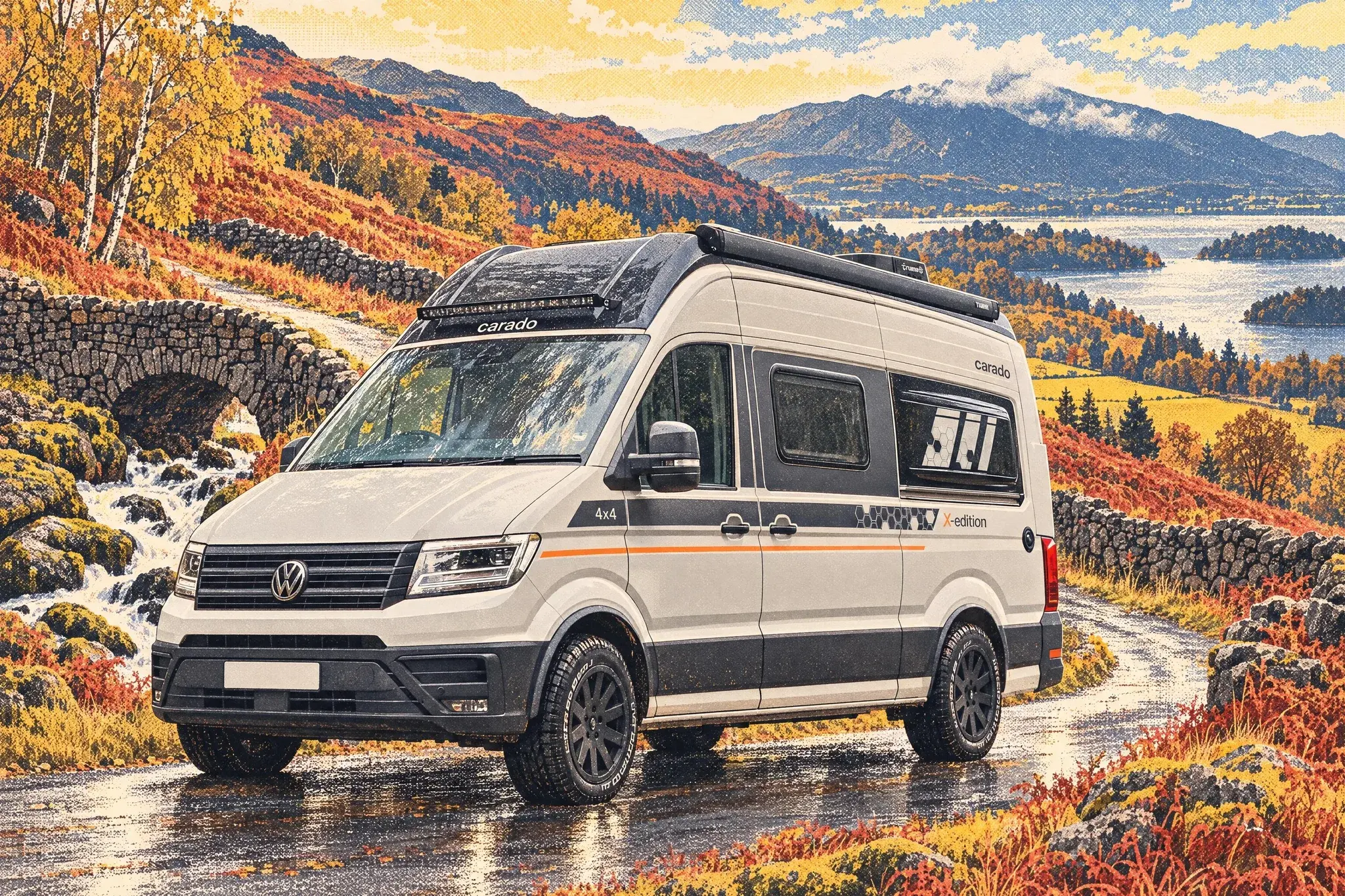
The short answer
The Carado CV595 X-Edition is a 5.99 m panel van conversion on a VW Crafter with permanent 4MOTION all-wheel drive, a 163 PS 2.0 TDI and an eight-speed automatic, priced at £87,890 in the UK for model year 2027. It sleeps two to three with a 200 x 136 cm transverse bed and 434 kg of payload including the driver. It suits buyers who regularly meet wet grass, tracks or snow; right-hand drive is not yet confirmed.

The Carado CV595 X-Edition is a campervan that sends power to all four wheels, so it keeps going on wet grass and rough tracks where an ordinary van starts to spin. It is built on a Volkswagen Crafter, it costs £87,890 in the UK, and it arrived for the 2027 model year with plenty of attention and a fair amount of muddle about what it actually offers. This is the long version. We cover what the van is, what the hardware does and does not do, how the weights and prices work out for a British buyer, what reviewers of it and its twin have said, and exactly what to confirm before you put down a deposit.
What the CV595 X-Edition actually is
Start with the simple facts, because the press coverage has blurred some of them. According to Carado's own press release of 20 July 2026, the CV595 X-Edition is the brand's first campervan built on a Volkswagen base. It uses the Crafter with permanent 4MOTION all-wheel drive, it is a model year 2027 vehicle, and it had its public debut at the Caravan Salon in Düsseldorf in 2026. Carado's UK and Ireland price list, valid from 1 August 2026, confirms it is being offered on this side of the Channel.
What it is not is Carado's first four-wheel-drive campervan. That was the CV 590 4x4, built on the Ford Transit, which arrived in 2023 according to promobil. So the CV595 is better understood as Carado's second go at the idea, on a different donor van, with a different drivetrain. That history matters because it tells you the company has already lived with a 4x4 camper for a few seasons before building this one.
Carado is one of two brands built by Capron at its plant in Neustadt in Saxony. The other is Sunlight. According to promobil, the CV595 X-Edition is the sister model of the Sunlight IBEX 604D, and the two share the same hardware: the same Crafter 4MOTION base, the same engine and gearbox, and the same fundamental layout. The differences are in trim, graphics and the way each brand bundles its equipment. We have a separate article that puts the two side by side in detail, so here we mention the IBEX only where a reviewer's experience of it tells you something useful about the Carado.
In body terms, this is a panel van conversion. It keeps the Crafter's own steel body, which is why it measures 204 cm wide. It is not a coachbuilt with a wider habitation box, and it is not an A-class. The one change to the standard body is at the rear, where Carado has fitted widening panels on both sides to make room for the 200 cm transverse bed. We will come back to that, because it is the single cleverest thing about the layout.
The X-Edition name covers a fixed set of standard equipment. Every CV595 X-Edition comes with folding cab blackout blinds, an electric entry step, rear shelving, X-Edition decals, Forest Shadow upholstery, Visby oak furniture and Ascot Grau paint. The CV595 is sold as the X-Edition, so that is the van we are describing throughout.
The base vehicle: a VW Crafter with 4MOTION and an automatic
Carado's price lists for Germany and for the UK and Ireland give the mechanical spec plainly, and Carado's website repeats the key figures. The van sits on a 3,500 kg Crafter with the 2.0 TDI diesel producing 120 kW, which is 163 PS, meeting Euro 6. It drives through an eight-speed automatic gearbox, and the diesel tank holds 75 litres. All-wheel drive is standard, not optional.
You will see torque figures of 400 or 410 Nm quoted in press coverage and video walkarounds. Those figures are not in Carado's own lists, so treat them as approximate. In practical terms, a 3.5 tonne van with around that much torque and eight ratios should pull cleanly out of junctions and hold motorway speeds without drama, which is what most owners actually care about.
The 4MOTION system is worth understanding properly. CamperVans Magazin, which tested the IBEX twin, describes it as an electronically controlled multi-plate clutch. In plain English, the van does not have a heavy, old-fashioned transfer box with a lever you pull. Instead a clutch pack shifts drive between the front and rear axles as the electronics detect a difference in grip. Carado describes the system as permanent, meaning it is always active rather than something you switch on, but the actual split of power varies moment to moment. You do not have to do anything. You drive it like any other automatic van and the system quietly sorts out which wheels get the effort.
Because four-wheel-drive hardware adds weight at the front and the van is being sold as something you might take onto uneven ground, Carado has specified a reinforced front axle rated to 2,100 kg, with reinforced springs, dampers and anti-roll bars. That is a sensible thing to see on a spec sheet. A heavy nose on soft springs is what makes a van wallow on a rutted track and dive under braking, and stiffer components help keep the body level.
The standard tyres are 235/65 R16 C summer tyres on 16-inch black steel wheels. Note the word summer. We return to it in the winter section, because for a British buyer it is one of the most important lines on the whole spec sheet.
One more point for UK readers: a Euro 6 diesel meets the emissions standard for the London ULEZ and for the clean air zones in English cities, so you should not face a daily charge in them. That is not special to this van, but it is worth knowing if you are comparing it against an older used 4x4 conversion.
We are not going to quote a fuel consumption figure, because neither Carado list we have seen gives one and we would rather not invent a number. What we can say is that all-wheel drive, a 3.5 tonne weight and a high roof all push consumption the wrong way, and that CamperVans Magazin found the all-terrain tyres on the IBEX twin raised fuel use further. Budget on the pessimistic side.
What 4MOTION really does, and when you do not need it
Four-wheel drive is the headline of this van, so let us be precise about what it buys you, because the marketing language around 4x4 campers tends to run ahead of the hardware.
What it genuinely helps with
- Wet grass pitches. This is the most common place a UK camper gets stuck. A September pitch at a Lake District or Pembrokeshire site after two days of rain, a slight slope towards the hedge, and a front-wheel-drive van simply spins. Having both axles driven, plus the electronic traction systems, can be the difference between driving off on Sunday morning and waiting for the warden with a tractor.
- Gravel and forestry tracks. Loose surfaces where one wheel keeps losing grip. 4MOTION keeps the van moving without the stop-start scrabbling that chews up a track and your nerves.
- Snow and slush on hills. A Scottish glen road in February, or a steep lane to a Yorkshire Dales campsite that the gritter has not reached. All-wheel drive helps you get going and keep momentum on a climb.
- Slipways, beach access roads and muddy farm gateways. The short, slippery stretches that separate a lovely spot from the public road.
What it does not do
- It does not help you stop. Four driven wheels do nothing for braking. On ice or compacted snow, your tyres decide how quickly you stop, and summer tyres stop badly in the cold.
- It does not help you corner. Lateral grip comes from tyres and weight, not the drivetrain. A 3.5 tonne, high-roof van is still a tall, heavy van in a crosswind on a wet bend.
- It does not make the van an expedition truck. Carado does not publish a ground clearance figure and does not offer a suspension lift. The wheelbase is 364 cm and the body is nearly 6 metres long, so there is a substantial rear overhang that can ground out on a sharp crest or a deep rut long before the drivetrain runs out of ideas. motor1's view, which we come to below, is that this is a practical van rather than one built for demanding terrain, and nothing on the spec sheet argues with that.
When you do not need it
Here is the honest test. Think back over your last year of touring, or the touring you realistically plan to do. How many times would a two-wheel-drive van with a decent set of all-season tyres and a pair of grip mats under the front wheels have left you stuck? For a lot of UK owners the honest answer is once, or never. Campsites with hardstanding pitches, aires, pub stopovers, club sites and National Trust car parks: none of them need four-wheel drive.
All-wheel drive costs you money up front, adds weight you cannot use for kit, uses more fuel every mile, and adds mechanical complexity to a vehicle you may hope to keep for a decade. Those are not reasons to avoid it. They are reasons to want it for a real purpose rather than for the idea of it. If your touring includes regular grass pitching in the shoulder seasons, winter trips to the Highlands, or a habit of following gravel tracks to see where they go, the CV595 earns its drivetrain. If you tour from April to September on hardstanding, it is an expensive comfort blanket.
The off-road pack: what £5,140 actually buys
On top of the standard 4MOTION, Carado offers an off-road pack at €5,999 in Germany and £5,140 in the UK. It adds 33.5 kg to the van. Here is what is in it and what each part does.
- Rear differential lock. Normally a differential lets the two wheels on an axle turn at different speeds, which you need for cornering. The downside is that when one wheel loses grip completely, it spins and the other does little. A locking rear diff ties the two rear wheels together so the wheel with grip gets the drive. On a muddy pitch where one rear wheel is in a hole, this is what gets you out.
- Hill start assist. Holds the brakes for a moment when you move your foot from brake to accelerator on a slope, so a 3.5 tonne van does not roll back on a steep track.
- Hill descent assist. Holds a slow, steady speed down a steep, loose slope so you can concentrate on steering rather than fighting the pedals. Genuinely useful on a rutted descent; you will not use it on the M5.
- 18-inch off-road tyres on Delta 4x4 wheels. The tyres are from Loder, and the chunkier tread is what gives bite in mud and gravel. The wheels are a dedicated off-road design.
There are some rules around the pack. It cannot be combined with the optional 17-inch alloy wheels, which cost €2,089 or £1,790, so you choose one or the other. An LED light bar is a further €1,299 or £1,110. A bull bar appears on the accessory list without a price. If you want the light bar, ask the dealer exactly how it is wired and when it can legally be switched on in the UK, because auxiliary lamps on public roads come with rules, and a bar that is fine on a private track may not be usable on a dual carriageway.
Two things the pack does not do. It does not raise the van: no lift is offered, and Carado does not publish ground clearance with or without the pack, so do not assume the bigger wheels buy you meaningful extra height under the sills. And it does not change the body, so the rear overhang stays as it is.
The pack also carries a cost you will notice every day. Testing the IBEX twin on all-terrain tyres, CamperVans Magazin found them loud and found they raised fuel consumption. That is the known trade-off with aggressive tread: excellent in mud, noisy and thirsty on tarmac, and most of your miles will be on tarmac.
Our view, labelled as such: for a UK buyer whose hardest terrain is a wet grass pitch and the occasional snowy B-road, a set of good all-season tyres on the standard 16-inch steel wheels will do more for year-round safety than the off-road pack, at a fraction of the price and weight, and without the motorway drone. The pack makes sense if you will actually use the rear diff lock and hill descent on tracks, which means you know the tracks you have in mind. If you are buying it because the van looks better on the big wheels, be honest with yourself about that, and about the 33.5 kg.
Size, height and driving it on British roads
Carado lists the CV595 at 599 cm long, 204 cm wide and 272 cm tall, on a 364 cm wheelbase, with 198 cm of standing height inside.
The length is well judged for the UK. At just under six metres it is manageable in town. More usefully, many ferry operators set their vehicle price bands by length, and six metres is a common break point. If you are thinking about Ireland, Orkney, Shetland, the Hebrides or France, check the operator's bands, because a van at 5.99 m can be noticeably cheaper to carry than a longer one.
Width is where a panel van conversion wins. At 204 cm the body is close to the width of a large SUV before mirrors, so narrow lanes, village streets and supermarket car parks are far less stressful than in a wide coachbuilt. It will still not fit through the tightest width restrictions, which are often set at around two metres, so you will learn to read those signs quickly.
The height question
Here is a conflict you need to know about. Carado's own list says 272 cm. Some press coverage quotes 2.90 to 2.94 m. That is a gap of roughly 20 cm, and nobody has explained it publicly. It could reflect different measuring points, roof fittings, or a van on the larger off-road tyres, but we do not know, so we will not guess. What we can tell you is what to do about it: before you trust any height barrier, measure your own van with everything fitted, write the figure on a label on the dashboard, and treat the Carado figure as a minimum rather than a promise. Either way, this is a high-roof van. Standard car park barriers at around 2.0 to 2.1 m are out, as are most multi-storeys. You will be parking in the outer sections of retail car parks and in coach bays, like every other high-top owner.
Speed limits and the 3,050 kg line
UK speed limits for motor caravans depend on unladen weight. Motor caravans with an unladen weight of 3,050 kg or less follow car limits; above that, the limit drops to 50 mph on single carriageways and 60 mph on dual carriageways, with 70 mph still permitted on motorways. The CV595's mass in running order of 3,066 kg includes a 75 kg driver and 20 litres of water, so the unladen figure that ends up on your V5C is likely to sit very close to the 3,050 kg line. Which side of it your van falls on depends on the options fitted. Check the V5C once registered rather than assuming.
Towing
Carado quotes a towing capacity of 3,000 kg braked and 750 kg unbraked. That is a generous figure for a campervan and brings a small car on a trailer or a boat within reach, subject to the usual checks on your licence entitlement and the combined weight you are allowed to run. Few owners will use it, but it is there.
The layout, and why the 200 cm transverse bed matters
The CV595 is a classic rear-bed, mid-washroom, front-dinette campervan with four belted travel seats, one of which has Isofix, and two to three berths. Standing height is 198 cm, which is enough for most adults to stand straight while cooking. The interesting bit is at the back.
How Carado got a 200 cm bed across a 204 cm van
A transverse bed, one that runs across the van rather than along it, is the most space-efficient way to sleep two people in a six-metre van. The catch is that a panel van's inside width is noticeably less than its outside width once you subtract the steel, the insulation and the wall panels, so in many conversions a transverse bed ends up well short of two metres. Fine for many people, tight for anyone tall.
Carado's answer is to fit widening panels on both sides of the rear body, which create the room for a 200 x 136 cm bed. The effect is a van that drives like a 2.04 m wide vehicle but sleeps two tall people across it. It is the single feature that makes this layout work for taller couples, and the main reason to prefer it over a longitudinal-bed van of the same length.
Two caveats. CamperVans Magazin quotes the bed at 200 x 140 cm, slightly wider than Carado's official figure, so take the width as roughly 136 to 140 cm. More importantly, the same magazine found that the mattress on the IBEX was shorter than the stated bed size. The bed platform may be 200 cm; the mattress you actually lie on may not be. If you are six foot or more, lie on the mattress in the showroom, not the brochure.
Getting up there, and the storage underneath
The bed is set high, which is what creates the storage below, and Carado has done something neat with the step. A sliding bulkhead between the living area and the rear storage doubles as the step up to the bed, so one part does two jobs.
Under the bed there is a storage space that Carado lists as 77 x 75 x 124 cm, with four lashing eyes, and the standard X-Edition kit includes rear shelving. Carado's list does not say which figure is height, so take a tape measure to the showroom: the height of the opening is what limits how tall a single object can be. Folding bikes, camping chairs, a table, wetsuits and boards should go in comfortably. A full-size bike may not stand upright, so check whether yours fits, wheels on or off, before you assume. The lashing eyes matter on a van designed to go off tarmac, because kit that shifts on a track is both annoying and a weight-distribution problem.
The third berth
For €349 or £300 you can add a dinette bed of 170 x 100 cm. That is a bed for a child or a shorter adult rather than a comfortable spot for a six-footer, so the realistic picture is two adults in the back and a child up front, or two adults and a lot of space. The four travel seats with Isofix mean a family of four can travel; sleeping four is not what this van is for.
Kitchen and washroom: what you get and what reviewers noticed
The kitchen
The kitchen has a two-burner gas hob, a locker for a single 5 kg gas bottle, and the standout item: an 84 litre compressor fridge with freezer that pulls out so you can reach it from inside the van or from outside. CamperVans Magazin picked this out as a highlight on the IBEX twin, and it is easy to see why. If you cook under the awning or eat outside, you are not forever climbing in and out for the milk.
The same reviewers were less kind about the hob. They measured 19 cm between the two burners, which in practice means two large pans will not sit comfortably side by side. One big pan plus a small one is fine; two big saucepans at once is a squeeze. If you cook properly on tour rather than reheating, look at the hob and imagine your own pans on it.
The 5 kg bottle locker needs a word for UK buyers. UK and continental gas bottles come in different sizes, shapes and fittings, so ask the dealer which UK cylinder physically fits the locker and its strap before you assume you can swap at a garage forecourt. A refillable cylinder of the right dimensions is one way to solve the problem on a van you plan to take across Europe, because it removes the question of finding the right exchange bottle in each country. Remember too that the heating is diesel, so the gas only runs the hob, which makes a single small bottle last a long time.
The washroom
The washroom has a folding door, a folding basin and a Thetford C 223 cassette toilet. The Basic pack, which is standard, adds a shower kit, a bathroom window, a clothes rail and a 70 x 50 cm Midi Heki rooflight. Folding doors and basins are how you get a usable washroom into a van this width: the basin flips away so you can stand to shower, and the door folds rather than needing a swing arc that would eat the corridor. It is a wet room, and a compact one. If you want a separate shower cubicle, you are looking at the wrong size of van.
Finish
The interior is Visby oak furniture with Forest Shadow upholstery, and the windows are double-glazed framed units. There are two 40 x 40 cm rooflights as well as the Midi Heki, which gives you three roof openings for airing a damp van, a real help with condensation in winter. Carado also lists an awning built into the roof. Reviewers of the IBEX twin criticised the plastic wall panels as a point where the budget shows. Look at them in person and decide whether that bothers you; some owners prefer wipe-clean surfaces in a van that will see wet dogs and muddy boots, and the oak-effect furniture carries the warmth.
Heating, power and water: how it will cope with a British winter
This is the section that matters most if the four-wheel drive has made you think about winter trips, because a van that can reach a snowy glen is no use if it cannot keep you warm and powered once you are there.
Heating
The standard heater is a Truma Combi 4 diesel, which heats both the living space and the water, drawing fuel from the van's 75 litre diesel tank. Diesel heating suits a 4x4 van well: you are not rationing a small gas bottle, you refuel the heater at any filling station, and the single 5 kg gas locker only has to feed the hob. The optional Combi 6 DE, at €1,299 or £1,110, gives more heating output and adds an electric element, so on a campsite hook-up you can heat on mains electricity and save your diesel. If you plan real winter use, or expect to spend most nights on hook-up, the Combi 6 DE is one of the better-value options on the list.
The Winter pack, at €799 or £680, heats the steering wheel, the cab seats and the windscreen. A heated windscreen on a big van screen that frosts overnight is a genuine quality-of-life item in January, and it saves a lot of scraping.
Water in the cold
The fresh tank holds 90 litres, with a 20 litre travel fill, and the waste tank holds 70 litres with an electric drain. Carado offers a heated waste tank for €599 or £510. If you are serious about sub-zero trips, add it. A frozen waste tank means you cannot drain your sink or shower until it thaws, which in a Highland February might be some time.
Electrics: the honest gap
The standard leisure battery is a 95 Ah AGM with an 18 A charger. A 104 Ah lithium battery is €999 or £860. There is a battery-to-battery charger, so the leisure battery charges properly from the engine while you drive, which is the right approach on a modern Euro 6 van. Inside there are three 230 V sockets and a double USB.
Now the gap, which Carado's lists make plain and which you need to plan around: neither the German nor the UK price list offers a solar panel or an inverter. That has two consequences. First, the three 230 V sockets only work when you are plugged into a campsite hook-up. Off grid, they are decorative. Second, your off-grid capacity is whatever is in the leisure battery when you stop driving.
Put that in context. As a rule of thumb, you only want to use around half of an AGM battery's rated capacity before you start shortening its life, so call it roughly 45 to 50 Ah usable. A compressor fridge of this size will typically use a good share of that over a day, more in warm weather or with frequent door opening. A diesel heater's fan and pump add a steady draw while it runs. Add lights, phone charging and the water pump, and a cold night or two off grid can take an AGM battery close to empty. Lithium batteries can be used much more deeply, so the 104 Ah option gives you substantially more usable energy for £860, and in our view it is the first option a buyer who intends to use the 4x4 for remote stops should tick. Solar will have to be a dealer or specialist fit, which adds weight, cost, and a conversation about how roof work affects the water-ingress warranty. Ask that question before you sign, not after.
Tyres, again
Finally, the point we flagged earlier. The standard tyres are summer tyres. In the UK that is fine for much of the year. In a cold snap, summer rubber hardens and loses grip for braking and cornering, which no amount of all-wheel drive compensates for. If you buy this van to use in winter, budget for a set of all-season or winter tyres before the first frost. It is the single most effective winter upgrade you can make, and it is not on the price list.
Weight, payload and living with the 84 kg options allowance
This is where a lot of 3.5 tonne campervans quietly let their owners down, so let us do the arithmetic properly using Carado's own figures.
The maximum technically permissible laden mass is 3,500 kg. The mass in running order is 3,066 kg, within a stated range of 2,913 to 3,219 kg. Carado's figure includes a 75 kg driver and 20 litres of fresh water. It also quotes an allowance for options of 84 kg.
The sums
- 3,500 kg minus 3,066 kg leaves 434 kg, and the driver is already counted.
- Add three more adults at 75 kg each, which is 225 kg, and you are left with 209 kg for everything else: extra water, gas, food, clothes, bedding, chairs, the dog, the bikes.
- Tick the off-road pack and 33.5 kg of that goes immediately, leaving around 175 kg.
- Fill the fresh tank to its 90 litre capacity rather than the 20 litre travel fill and you add roughly another 70 kg of water.
Now look at the range Carado gives for mass in running order: up to 3,219 kg. A van at the top of that range leaves just 281 kg before you add a single passenger. The 84 kg options allowance is a stated allowance, not a cap on what you can order, and a buyer who adds the off-road pack, the Combi 6 DE, the heated waste tank, the Winter pack and the lithium battery could easily go beyond it. Carado does not publish individual weights for most options, so we will not guess them. The answer is a weighbridge, loaded as you actually tour, before your first long trip.
Remember the axles, too. Carado specifies a reinforced front axle rated at 2,100 kg. Overall weight is one limit; the weight on each axle is another, and a heavy load in the rear storage shifts the balance. A weighbridge ticket that shows each axle separately costs little and tells you both numbers.
The 3.88 tonne upgrade
Carado offers an uprating to 3.88 tonnes for €2,178 or £1,870. For a two-person van it is the most straightforward way to make the payload comfortable, adding 380 kg on paper. But in the UK it changes the van's legal position in ways you must understand first:
- Licence. A standard category B car licence covers vehicles up to 3,500 kg. If you passed your car test on or after 1 January 1997 you will need to pass a C1 test to drive a 3,880 kg motor caravan. If you passed before that date you usually have C1 already, with medical requirements to keep it from age 70.
- Speed limits. Uprating changes the maximum laden mass, not the unladen weight, so it does not by itself move you onto the lower motor caravan limits; check the unladen weight on your V5C as described above.
- Tax and tolls. Over 3,500 kg the van can move into a different vehicle tax class in the UK, and on the Continent some toll roads and ferries put vehicles over 3.5 tonnes into a higher category.
- Insurance. Tell your insurer. Some policies are written around 3,500 kg.
If you have C1 entitlement and the van is for two of you, the uprating is well worth considering. If you need a C1 test first, factor in the time and cost.
What it costs: Germany, the UK, and how the options add up
Carado's German price is €88,599, which its website confirms, plus a mandatory €189 for registration documents. The UK and Ireland list prices the CV595 X-Edition at £87,890 including VAT and on-the-road costs, which Carado UK says covers delivery from Germany, registration and the pre-delivery inspection. Possible import duties are excluded, so the first question for any UK dealer is whether duty applies to the van you are ordering and what the written out-the-door figure is.
You may have seen a price of €92,650 reported by motor1. That matches French pricing rather than German, so do not use it as your baseline.
The packs and options, in UK money
- Off-road pack: £5,140 (adds 33.5 kg)
- 17-inch alloy wheels: £1,790 (cannot be combined with the off-road pack)
- LED light bar: £1,110
- Truma Combi 6 DE heater: £1,110
- 104 Ah lithium battery: £860
- Heated waste tank: £510
- Winter pack: £680
- Dinette bed: £300
- Assistance Professional £470, Extended £1,110, Advanced £1,200
- Schiefergrau or Violettblau paint: £1,110
- Uprating to 3.88 t: £1,870
A realistic winter-and-tracks spec might look like this: base van £87,890, off-road pack £5,140, Combi 6 DE £1,110, lithium battery £860, heated waste tank £510, Winter pack £680, dinette bed £300 and the Extended assistance pack £1,110. That comes to £97,600 before any import duty, before a set of winter tyres, and before any solar or inverter fitted afterwards. Leave off the off-road pack and the same spec comes to £92,460, leaving room in a similar budget for all-season tyres and a solar fit, which arguably makes a van better suited to British use. Neither is a small number, so be sure the four-wheel drive earns its place in your touring before you commit.
Warranty
Carado gives a seven-year water-ingress warranty. That is a long cover period for the thing that most often goes wrong with a camper body, and it is the warranty you most want on a van you intend to take onto wet, muddy ground. Ask the dealer what warranty applies to the Volkswagen base vehicle, and get both warranties in writing with their conditions, including whether a dealer-fitted solar panel or other roof work affects the water-ingress cover.
Insurance and the value question
A new campervan at close to £90,000 needs a specialist motorhome policy rather than a van policy, ideally with agreed value or new-for-old cover in the early years. Insurers may ask about four-wheel drive and about any off-road use, so be straightforward with them. Think about security, too: a high-value Crafter conversion benefits from a tracker and a mechanical steering lock, and some insurers will ask for one or both.
What the reviewers say
This section is opinion from people who have seen or driven the van or its twin, and we have labelled it as such because it is the kind of thing a brochure will not tell you.
motor1's overall verdict is that the CV595 X-Edition is practical but not built for demanding terrain. That matches the spec sheet: no lift, no published ground clearance, a long rear overhang, and an all-wheel-drive system designed to keep you moving rather than to climb boulders.
CamperVans Magazin tested the Sunlight IBEX 604D, which shares its hardware with the Carado, so its findings should largely transfer. On the positive side, it liked the pull-out fridge, the roomy high-roof interior, and the way the Crafter handled. On the negative side, it criticised the 19 cm gap between the hob burners, the plastic wall panels, a mattress that was shorter than the stated bed size, and the loud all-terrain tyres, which also raised fuel consumption.
Read those together and a clear picture forms. The driving experience and the big design choices, the bed concept and the fridge, are strong. The weak points are detail items, the hob spacing and the panel finish, plus one honesty issue, the mattress versus the stated bed size, and one trade-off that comes with the territory, noisy tyres. None of them is a deal-breaker for most buyers. All of them are things you can check for yourself in a showroom in ten minutes.
A 4x4 campervan is only as good as its tyres, its battery and its payload. The CV595 gets the first two right only if you spend a little more, and the third right only if you pack with discipline.
Who it suits in the UK, and who should keep the money
It suits you if
- You tour outside the summer months and pitch on grass regularly: spring and autumn in the Lakes, Wales, the West Country or the Highlands, where the tractor tow is a known risk.
- You want to go to Scotland or the Alps in winter and you are prepared to add proper winter tyres, the heated waste tank and the bigger heater.
- You are a tall couple, or a tall couple with one child. The 200 cm transverse bed in a 2.04 m wide van is a real selling point.
- You want a van that fits a normal driveway, goes through villages without stress, and comes in just under 6 m for ferries.
- You like the idea of one van for daily use and holidays. A 6 m automatic Crafter is about as everyday as a campervan with a proper washroom gets.
- You will actually follow gravel tracks to find quiet spots, and you understand the limits of a long, unlifted van when you do.
Save the money if
- Your touring is campsites with hardstanding, aires and pub stopovers. A two-wheel-drive van with all-season tyres and grip mats will do the job for considerably less, and it will likely carry more kit.
- You need to sleep four adults. Two to three berths is the honest capacity.
- You want long off-grid stays. With no solar or inverter on the list and a 95 Ah AGM battery as standard, you will be adding kit before the van does what the 4x4 badge implies.
- You expect true off-road ability. No lift, no published ground clearance and a 6 m body are the wrong starting point for that.
- You carry a lot. Four adults plus the off-road pack leaves around 175 kg for everything else at 3,500 kg, and the uprating needs a C1 licence if you passed your car test from 1997 onwards.
Buying one in the UK: dealers, drive side and the checklist
Carado has a UK website and a UK and Ireland price list, and it names two UK dealers: Camper UK in Lincoln and Southdowns in Portsmouth. What we have not been able to confirm is the single most important thing for a British buyer: whether the CV595 X-Edition is available in right-hand drive. Carado's materials do not state it, and we have not found a UK dealer listing for the CV595. That does not mean it is not coming. It means you must ask, and get the answer in writing, before you order. A left-hand-drive van is perfectly usable in the UK and many owners run them happily, but you should know which you are buying, and your insurer and your resale value will care too.
Before you order
- Confirm the drive side and the delivery timescale for a right-hand-drive van if that is what you want.
- Get the out-the-door price in writing, including whether any import duty applies and exactly what on-the-road costs the £87,890 covers.
- Lie on the mattress, not the bed platform, if you are tall. Ask for the mattress dimensions separately.
- Measure the height of the actual van with its roof fittings, and settle the 272 cm versus 2.90 m question for yourself.
- Ask which UK gas cylinder fits the 5 kg locker, and whether a refillable cylinder is an option.
- Ask about solar and an inverter. Neither is on the list. Find out what the dealer can fit, what it weighs, what it costs, and what it does to the seven-year water-ingress warranty.
- Decide on tyres. Standard summer tyres, the off-road pack's all-terrains, or a set of all-seasons you source yourself. For most UK buyers the last is the sensible winter answer.
- Do the payload sums with your own options list and plan a weighbridge visit. Ask for individual option weights where the dealer has them.
- Check the licence implications if you are considering the 3.88 t uprating, and talk to your insurer before you choose it.
- Get both warranties in writing: Carado's seven-year water-ingress cover and whatever warranty applies to the Volkswagen base vehicle, with their conditions.
On the test drive
Drive it on a dual carriageway at 60 or 70 mph and listen. If the demonstrator is on all-terrain tyres, that noise is what you will live with. Find a steep hill and feel how the eight-speed automatic behaves pulling away from a standstill. If the dealer has a grass area, ask to drive onto it; a short crawl up a wet slope will tell you more about 4MOTION than any paragraph. Inside, open and close the folding washroom door and basin a dozen times, pull the fridge out and reach it from both sides, and put two of your own saucepans on the hob.
The bottom line
The Carado CV595 X-Edition brings together permanent all-wheel drive, an eight-speed automatic and a 200 cm transverse bed in a 6 m, 2.04 m wide van that you could use every day. Reviewers of its twin liked the way the Crafter drives, the layout is clever, the pull-out fridge is a genuinely good idea, and the seven-year water-ingress warranty is reassuring on a van built to get muddy.
It also asks you to be clear-eyed. The four-wheel drive solves wet grass and snowy hills, not expedition terrain. The off-road pack adds real capability on tracks but brings noise, fuel use and weight that many UK owners will not want. There is no solar or inverter on the price list, so off-grid life needs further spending. The payload is adequate for two and tight for four. And right-hand drive is not yet confirmed, which for a British buyer is the first question to settle.
If you tour in the shoulder seasons on grass, fancy a winter in the glens, are tall and want to sleep across the van, and want one vehicle for the school run and the summer holiday, it is a compelling package at £87,890, especially once you add the lithium battery, the Combi 6 DE and a set of all-season tyres. If your touring is tarmac and hardstanding, buy the two-wheel-drive van you were looking at before and spend the difference on diesel and ferry crossings. Either way, you now know exactly what you are deciding between.
Common questions
How much does the Carado CV595 X-Edition cost in the UK?
Carado's UK and Ireland price list, valid from 1 August 2026, puts the CV595 X-Edition at £87,890 including VAT and on-the-road costs (delivery from Germany, registration and PDI). Possible import duties are excluded, so ask your dealer for a written out-the-door figure. The German price is €88,599 plus €189 for registration documents.
What van is the Carado CV595 X-Edition based on?
It is a panel van conversion on a 3,500 kg Volkswagen Crafter with permanent 4MOTION all-wheel drive, a 2.0 TDI diesel producing 120 kW (163 PS) to Euro 6, and an eight-speed automatic gearbox. According to Carado it is the brand's first campervan on a VW base; its earlier CV 590 4x4 of 2023 used a Ford Transit.
Is the Carado CV595 a proper off-roader?
No. The 4MOTION system and optional off-road pack (rear diff lock, hill start and descent assist, 18-inch off-road tyres) help on wet grass, gravel tracks and snow, but Carado publishes no ground clearance, offers no lift, and the 6 m body has a long rear overhang. motor1 describes it as practical rather than built for demanding terrain.
How much payload does the Carado CV595 X-Edition have?
The MTPLM is 3,500 kg and the mass in running order is 3,066 kg including a 75 kg driver and 20 litres of water, leaving 434 kg. Three more adults at 75 kg each reduce that to 209 kg, and the off-road pack takes a further 33.5 kg. An uprating to 3.88 tonnes costs £1,870 but needs a C1 licence if you passed your test after 1996.
Does the Carado CV595 come with solar panels or an inverter?
No. Neither the German nor the UK price list offers solar or an inverter, so the three 230 V sockets only work on campsite hook-up. The standard leisure battery is a 95 Ah AGM; a 104 Ah lithium battery is £860. Solar would need to be a dealer or specialist fit.
Is the Carado CV595 X-Edition available in right-hand drive in the UK?
Right-hand drive has not been confirmed in Carado's materials and we have not seen a UK dealer listing confirming a right-hand-drive van. Carado names Camper UK in Lincoln and Southdowns in Portsmouth as UK dealers, so ask the dealer to confirm the drive side in writing before ordering.
The reachable bit
The camper you fall for is rarely the one you can afford. That gap is the whole reason Campervan.win exists. Right now we’re giving away the Sunlight Vanlife, worth around £65,000, and closing that gap is the point: capped entries so the odds stay honest, £10 a ticket, a maximum of five per person, £500 to a UK charity from every full draw, the winner picked by a public randomness beacon anyone can re-check, and one person driving away in the van itself.

Enjoyed this post?
Get more honest campervan guides like this one in your inbox.
You’re in!
Check your inbox. We’ve just sent you a welcome email.

About the author
Leo
Leo covers campervan technology, maintenance, kit, and ownership advice, with a clear, practical focus on how things work in real life.
Keep Reading
Related Reading
Thoughtful articles that build on what you’ve just read.
Campervan Reviews
10 min read
Coachman Veloce (2027): a UK-built Fiat Ducato campervan at £86,500, and who it is for
Coachman has built its first Fiat Ducato campervans in the UK, the Veloce VL65 and VR65, at £86,500 each. We go through what that price includes, the payload sums for four seats, the heating and power kit, and who a premium British panel van like this suits.
Campervan Reviews
27 min read
VW Grand California 680 Dune deep dive: the long two-berth tourer, the C1 licence, and FWD or 4MOTION
A full look at the Volkswagen Grand California 680 Dune as a two-person long-distance tourer: dated UK prices, why the 3,880 kg weight means a C1 licence for many drivers, the real payload sums for front-wheel drive against 4MOTION, the lengthways bed, four-season kit and a viewing checklist.
Campervan Reviews
13 min read
Coachman Affinity One explained: who the Polish-built 6.36 m Fiat Ducato campervan really suits
The Coachman Affinity One is a long, tall Fiat Ducato campervan built in Poland and sold in the UK under the Coachman name. Here is what the fixed French bed, front bunk, washroom, 3,500 kg weight and 6.36 m length really mean for the people who might buy one.
Campervan Reviews
8 min read
Citroen Holidays review: the honest take on Citroen's compact camper
A clear, honest look at the Citroen Holidays, the compact pop-top campervan built on the SpaceTourer. What it does well, where it compromises, and who it really suits.