
Coachman Affinity One explained: who the Polish-built 6.36 m Fiat Ducato campervan really suits

Written by
Felix
Felix covers campervan technology, layouts, and modern conversions, with a focus on design-led thinking and practical performance
The short answer
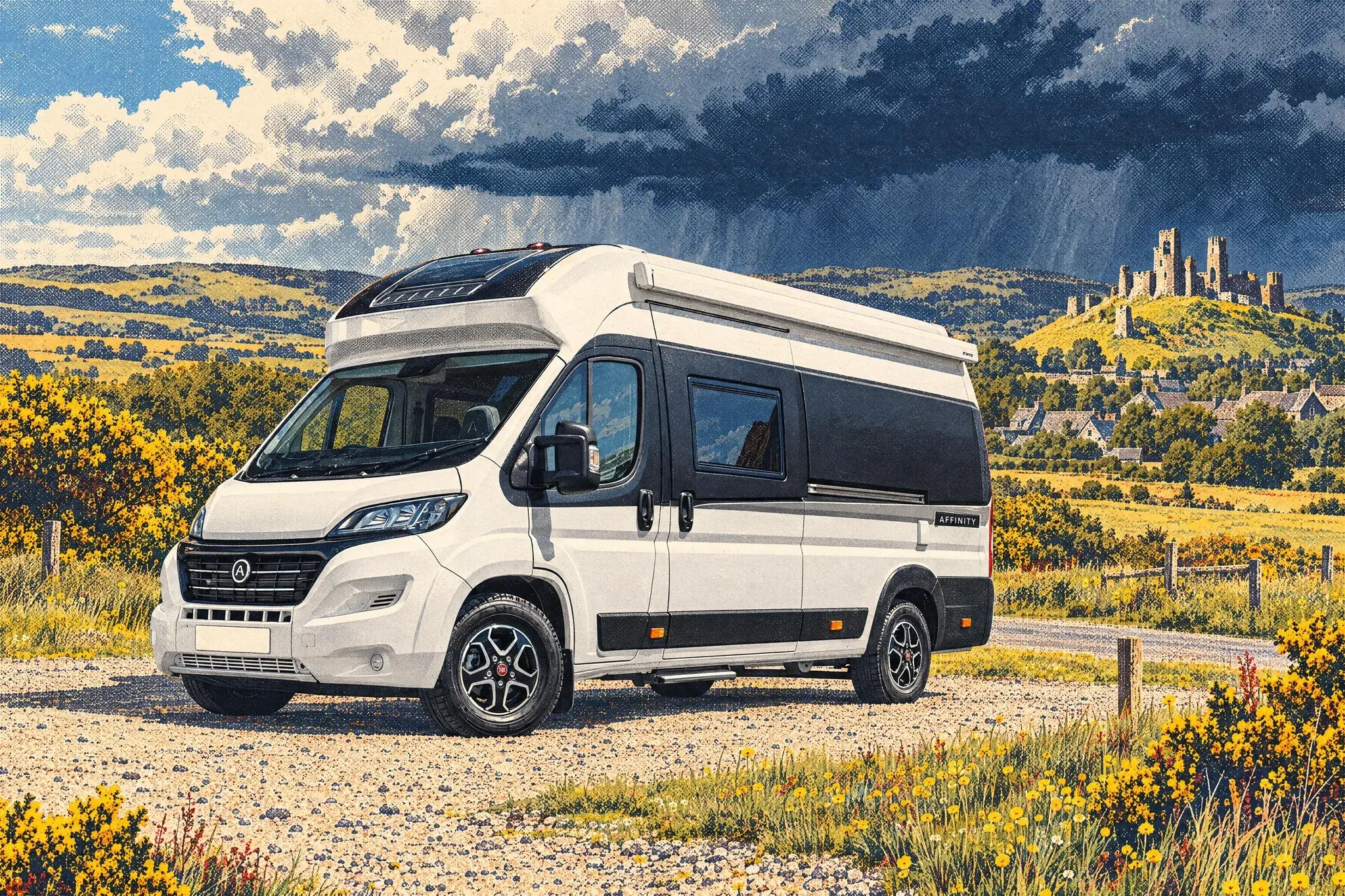
The Coachman Affinity One is the same van as the Affinity One sold in Europe, built by Affinity RV in Ozorkow, Poland, on a Fiat Ducato Maxi L4H3 with a 2.2-litre 180 hp engine and automatic gearbox. It is 6.36 m long, 2.2 m wide and 2.9 m tall, plated at 3,500 kg, with a rear French bed, a front fold-down bunk, a shower cabin and an L-shaped kitchen. UK launch price was £86,455 in February 2024.

The Coachman Affinity One is a big Fiat Ducato van with a fixed French bed at the back, an onboard washroom, a 90-litre fridge and a fold-down bunk, so up to four people can sleep in it. It is built in Poland and sold in the UK with a Coachman badge. A long, tall van body with a bed you never have to make up puts it in an interesting spot. This guide sets out what you get, what the numbers mean on a real UK trip, and which details you still need to pin down before you buy.
One van, two names
Let us clear this up first, because it confuses people. In the UK this van is sold as the Coachman Affinity One. In Europe its maker, Affinity RV of Ozorkow in Poland, sells it as the Affinity One. It is the same van. Out and About Live's review makes the point that the Affinity campervan comes from Ozorkow, unlike Coachman's Swedish-built motorhomes, so do not go looking for a British or Swedish factory behind it. Coachman is the UK route to market. Affinity RV is the builder.
According to Practical Motorhome, Coachman showed the Affinity One at the NEC in February 2024, alongside a sibling called the Affinity Duo. The Duo is MAN TGE-based, while the One is a Fiat. Affinity RV is also growing: Motor1 reports it presented a new sub-brand, Freedo RV, at the CMT show in Stuttgart in 2025. None of that changes what the One is, but it tells you the maker is an active, expanding converter rather than a one-off.
The base vehicle: Ducato Maxi, 180 hp, automatic
Affinity RV's own site lists the base as a Fiat Ducato Maxi L4H3 with the 2.2-litre 180 hp engine and an automatic gearbox. L4H3 is the longest, tallest Ducato panel van, and Maxi is the heavier-duty version of it. Caravan Guard's UK write-up adds that the 180 bhp engine and automatic are standard on the UK van, and that the engine is Euro 6d, which matters for clean-air zones.
One small wrinkle on the gearbox. Caravan Guard and the UK dealer Kimberley Caravans both describe a nine-speed automatic, while Affinity RV's own page lists a nine-speed automatic in one place and an eight-speed automatic in another. We cannot settle that from here, so ask the dealer what is fitted to the exact van in front of you. Either way, it is an automatic paired with the most powerful engine Fiat offers in this van, which is a sensible match for 3,500 kg.
Because it is plated at 3,500 kg, anyone with a standard category B car licence can drive it, including people who passed their test after 1997. That is one of the quiet advantages of staying at 3.5 tonnes, and we will come back to the cost of it when we talk about payload.
What 6.36 m long and 2.9 m tall mean day to day
The maker's figures are 636 cm long, 220 cm wide and 290 cm tall, with 196 cm of standing height inside. Those first three numbers shape where you can take it more than anything else about the van.
Parking
A typical UK parking bay is around 4.8 m long. At 6.36 m you will hang about a metre and a half out of it, so you learn to head for end bays, the far corners of car parks, or spots where you can take two bays nose to tail without blocking anyone. Width is less of a problem: 2.2 m is wider than a family car, but it is still a van body rather than a coachbuilt motorhome, and it fits a normal bay side to side. Whether the maker's 2.2 m includes mirrors is not stated, so allow extra in tight spots.
Height barriers
This is the one that catches people. Most supermarket, multi-storey and seaside car-park barriers sit somewhere around 2.0 to 2.1 m. At 2.9 m you will not get under any of them, and once you add an aerial or a solar panel it is safest to think of the van as 3 m. In practice that means no multi-storeys, a quick look at the map before you commit to a beach car park, and a note on the dashboard with the real height so you never have to guess at a barrier.
Ferries and the Eurotunnel
Most ferry operators price by length and height, and at 6.36 m and 2.9 m you are well outside the standard car tariff. Quote the exact dimensions when you book. Underestimating is a false economy, because operators can measure and re-charge at the port, and on a full sailing you risk not getting on at all.
Roads and campsites
A 6.36 m van is normal on a campsite pitch and easy on A-roads and motorways. Where it demands concentration is single-track lanes with high banks, village centres with cars parked on both sides, and the sort of farm track that leads to a lovely quiet spot. None of that is a reason not to buy it. It is a reason to be honest with yourself about where you actually tour.
The layout: French bed, fold-down bunk, washroom and kitchen
The rear French bed
The fixed bed at the back measures 192 x 129 cm according to the maker. For context, a standard UK double is 135 cm wide and a small double is 120 cm, so this sits between the two. How easy it is to get in and out depends on how the bed sits in the van, and that is something to judge in person. Lie on it at the viewing, from both sides, and try getting out as you would in the middle of the night.
An electric lift for this bed is an option. Raising the bed frees up storage underneath for bikes, chairs and the heavy stuff you would rather not carry inside. If you cycle or surf, ask whether the lift is fitted to the van you are looking at, because it changes what the back of the van can do.
The fold-down bunk
Affinity RV describes a foldable bunk bed and quotes two sizes for it: 192 x 67 cm and 182 x 67 cm. Length is fine for most adults. Width is the thing: a UK single bed is 90 cm, and 67 cm is a lot narrower than that. For a child or a slim teenager it works. For most adults it is a short-stay bed rather than a two-week one. That is why this van makes most sense as a couple's van that can carry children, rather than a four-adult tourer.
There is also a discrepancy to resolve with the dealer. The maker's site talks about up to four sleeping places, but its equipment list shows two as standard, with three or four as options. Caravan Guard describes the UK version as three berths with four travel seats. Whether that means fewer bunk places on UK-spec vans, or just a different way of counting, we cannot confirm. Ask, and get the answer in writing on the order.
The washroom
There is an onboard washroom with a 19-litre cassette toilet. That is the sourced detail, and it is a useful one: having your own loo makes quieter sites, aires and overnight stops far more comfortable. The 19-litre cassette is on the modest side, so for two people on a long weekend expect to empty it every couple of days, and favour campsites and aires with a chemical disposal point when you plan a route. Look at the washroom layout properly when you view, so you know exactly how it works for your height and habits.
The kitchen
Affinity RV lists a two-burner gas hob and a 90-litre fridge as standard. Ninety litres is a sensible amount of cold storage for a few days away between shops. The maker also lists three skylights as standard, and Kimberley Caravans adds a Skyview window to the roof pod, which helps a tall van feel like a room rather than a corridor. Check how the light falls and where the worktop space is when you view it.
Weight: 3,500 kg with four people aboard
This is where the honest sums have to happen. Affinity RV lists a weight in running order of 3,090 kg, and by its own definition that already includes a 75 kg driver, a fuel tank 90% full, a full 11-litre gas bottle and 20 litres of water. Against the 3,500 kg maximum that leaves 410 kg, the same payload Find My Leisure Vehicle lists for the UK van. The maker quotes a margin of error of plus or minus 5% on that running weight, which is about 155 kg either way, so check the plate on the actual van.
Working with 410 kg: the running weight already counts the driver, so three more adults at around 75 kg each is 225 kg, which leaves roughly 185 kg. The insulated fresh tank holds 110 litres according to Affinity RV, and water weighs a kilogram a litre, so filling it from the 20 litres already counted adds about 90 kg and takes you down to roughly 95 kg. Food, clothes, bikes, chairs and options such as the electric bed lift all have to fit in that, so four adults with a full tank is tight at best.
Run the same sum with two adults and two children and the picture changes completely. That is the realistic version of this van. If you do plan to run it near the limit, take it to a public weighbridge loaded as you would travel, because an overloaded van is an offence, can land you with a fine, and gives your insurer an easy reason to question a claim.
A 3,500 kg plate is what lets you drive this van on a normal car licence. The price of that convenience is a payload you have to respect, not ignore.
What to confirm before you buy
The maker's spec and the UK coverage do not always agree, and options change the numbers. Before you sign anything, get a dated answer on each of these:
- Payload and running weight for the exact van and spec, from the plate rather than a brochure.
- Water tanks: Affinity RV lists an insulated 110-litre fresh tank and a 100-litre grey tank, both inside the heated space, and Caravan Guard gives the same sizes. Confirm the van you are buying matches.
- Battery and solar: Caravan Guard's 2024 UK write-up describes a 120 Ah lithium battery and a 240 W solar panel, while Affinity RV now lists a 135 Ah lithium battery as standard, with 200 and 300 Ah batteries and 240 to 360 W solar packs as options. Ask exactly what is fitted.
- Heating: Caravan Guard and Affinity RV both list Truma's Combi 4E, which heats the van and the water, and Affinity RV offers a larger 6E and a diesel D6E as options. Confirm which is fitted.
- Gearbox: eight or nine speed, and the Ducato model year.
- Berths on the UK van: how many, and whether both bunk sizes are fitted.
- The current UK price, which brings us to the next section.
Price: what we know and what we do not
Practical Motorhome reported a launch price of £86,455 when the van appeared at the NEC in February 2024. That is the only firm UK number we can point to, and it is a 2024 figure. Dealer prices vary, specs change, and options like the electric bed lift move the total. So treat £86,455 as a dated reference point, ask a Coachman dealer for a current written quote, and note the date on it.
Two practical notes at this price level. Get an insurance quote before you fall in love, because a new, high-value campervan from a less familiar maker can prompt questions from some insurers, and knowing the premium up front avoids a surprise. And ask the dealer exactly who handles warranty and servicing in the UK, and what the warranty covers, since the van is built in Poland and sold through Coachman's network. Do not assume; ask.
Who it suits, and who it does not
The Affinity One is at its best for a couple who want a fixed bed they never have to make up, an onboard washroom, a good-sized fridge, and the freedom to use a normal pitch without a coachbuilt's extra width. It also suits a family with one or two children, who get the fold-down bunk and a van that still drives like a van.
It is a harder sell as a daily driver in a city, because 6.36 m and 2.9 m rule out most urban car parks. It is not the right van for four adults touring for a fortnight with full tanks, both because of the 67 cm bunk and because of the payload sums above. And if you want two full-width single beds rather than a shared French bed, look for a different layout.
What to check at a viewing
- Lie on the French bed, both sides. Get in and out from each side and check the access suits both of you.
- Drop the bunk and lie in it. Check the 67 cm width against the person who will actually sleep there, see how you get up to it, and ask about a safety net for children.
- Confirm the berth count on the UK spec and get it on the order form.
- Read the weight plate. Ask for the running weight and payload in writing, then do your own sum for the people and kit you carry.
- Check the washroom layout and how the 19-litre cassette comes out.
- Ask for the heating, battery and tank spec. If the dealer cannot tell you, that tells you something about how well supported the van is.
- Ask which gearbox is fitted and which Ducato model year the van is built on.
- Check whether the electric bed lift is fitted and look at what the space under the bed can actually hold with the bed up and down.
- Get a dated price with every option listed, and ask who handles warranty and servicing in the UK.
- Test drive it into a car park with marked bays. You will learn more about living with 6.36 m in ten minutes of parking than in an hour on the motorway.
- Get an insurance quote first so the premium is part of the decision, not an afterthought.
The bottom line
The Coachman Affinity One is a well-equipped, Polish-built Ducato L4H3 conversion with a fixed French bed, a washroom, a 90-litre fridge and a strong 180 hp automatic drivetrain, all kept at 3,500 kg so it works on a car licence. Its length and height decide where you can take it, its 67 cm bunk decides who sleeps in it, and its payload decides how many people and how much water you can realistically carry. If you are a couple, or a couple with young children, who tours campsites and open country rather than city centres, it deserves a serious look. Just go to the viewing with the list above, and get the spec of the exact van confirmed in writing, with a date, before you commit.
Common questions
Is the Coachman Affinity One the same van as the Affinity One sold in Europe?
Yes. It is built by Affinity RV in Ozorkow, Poland, and sold in the UK under the Coachman name. Out and About Live notes it comes from Ozorkow, unlike Coachman's Swedish-built motorhomes.
What base vehicle and engine does the Coachman Affinity One use?
The maker lists a Fiat Ducato Maxi L4H3 panel van with the 2.2-litre 180 hp engine and an automatic gearbox. Sources describe the automatic as either eight or nine speed, so confirm with the dealer which is fitted.
Can I drive the Coachman Affinity One on a normal car licence?
Yes. It is plated at 3,500 kg, so a standard category B car licence covers it, including for drivers who passed their test after 1997.
How big are the beds in the Coachman Affinity One?
The rear French bed is 192 x 129 cm, narrower than a standard UK double. The front fold-down bunk is 192 x 67 cm upper and 182 x 67 cm lower, which is fine for children but narrow for most adults.
How much does the Coachman Affinity One cost in the UK?
Practical Motorhome reported a launch price of £86,455 at the NEC in February 2024. Dealer prices vary and that figure is dated, so ask a Coachman dealer for a current written quote.
Will the Coachman Affinity One fit under car park height barriers?
No. At 2.9 m tall it will not pass any typical 2.0 to 2.1 m barrier, so multi-storeys and most supermarket and seaside car parks with barriers are out. Plan for 3 m once roof fittings are added.
The reachable bit
The camper you fall for is rarely the one you can afford. That gap is the whole reason Campervan.win exists. Right now we’re giving away the Sunlight Vanlife, worth around £65,000, and closing that gap is the point: capped entries so the odds stay honest, £10 a ticket, a maximum of five per person, £500 to a UK charity from every full draw, the winner picked by a public randomness beacon anyone can re-check, and one person driving away in the van itself.

Enjoyed this post?
Get more honest campervan guides like this one in your inbox.
You’re in!
Check your inbox. We’ve just sent you a welcome email.

About the author
Felix
Felix covers campervan technology, layouts, and modern conversions, with a focus on design-led thinking and practical performance
Keep Reading
Related Reading
Thoughtful articles that build on what you’ve just read.
Campervan Reviews
10 min read
Coachman Veloce (2027): a UK-built Fiat Ducato campervan at £86,500, and who it is for
Coachman has built its first Fiat Ducato campervans in the UK, the Veloce VL65 and VR65, at £86,500 each. We go through what that price includes, the payload sums for four seats, the heating and power kit, and who a premium British panel van like this suits.
Campervan Reviews
27 min read
VW Grand California 680 Dune deep dive: the long two-berth tourer, the C1 licence, and FWD or 4MOTION
A full look at the Volkswagen Grand California 680 Dune as a two-person long-distance tourer: dated UK prices, why the 3,880 kg weight means a C1 licence for many drivers, the real payload sums for front-wheel drive against 4MOTION, the lengthways bed, four-season kit and a viewing checklist.
Campervan Reviews
35 min read
Carado CV595 X-Edition explained: the £87,890 4x4 VW Crafter campervan, for UK buyers
A long, honest look at Carado's first VW Crafter campervan: what 4MOTION and the off-road pack really do, how the 3,500 kg payload works out, what the 200 cm transverse bed and no-solar spec mean for British touring, and what to confirm before you order one at £87,890.
Campervan Reviews
8 min read
Citroen Holidays review: the honest take on Citroen's compact camper
A clear, honest look at the Citroen Holidays, the compact pop-top campervan built on the SpaceTourer. What it does well, where it compromises, and who it really suits.