
VW Grand California 680 Dune deep dive: the long two-berth tourer, the C1 licence, and FWD or 4MOTION

Written by
Jasper
Jasper writes campervan reviews, travel guides, and practical advice, with a focus on everyday use and relaxed touring around the UK.
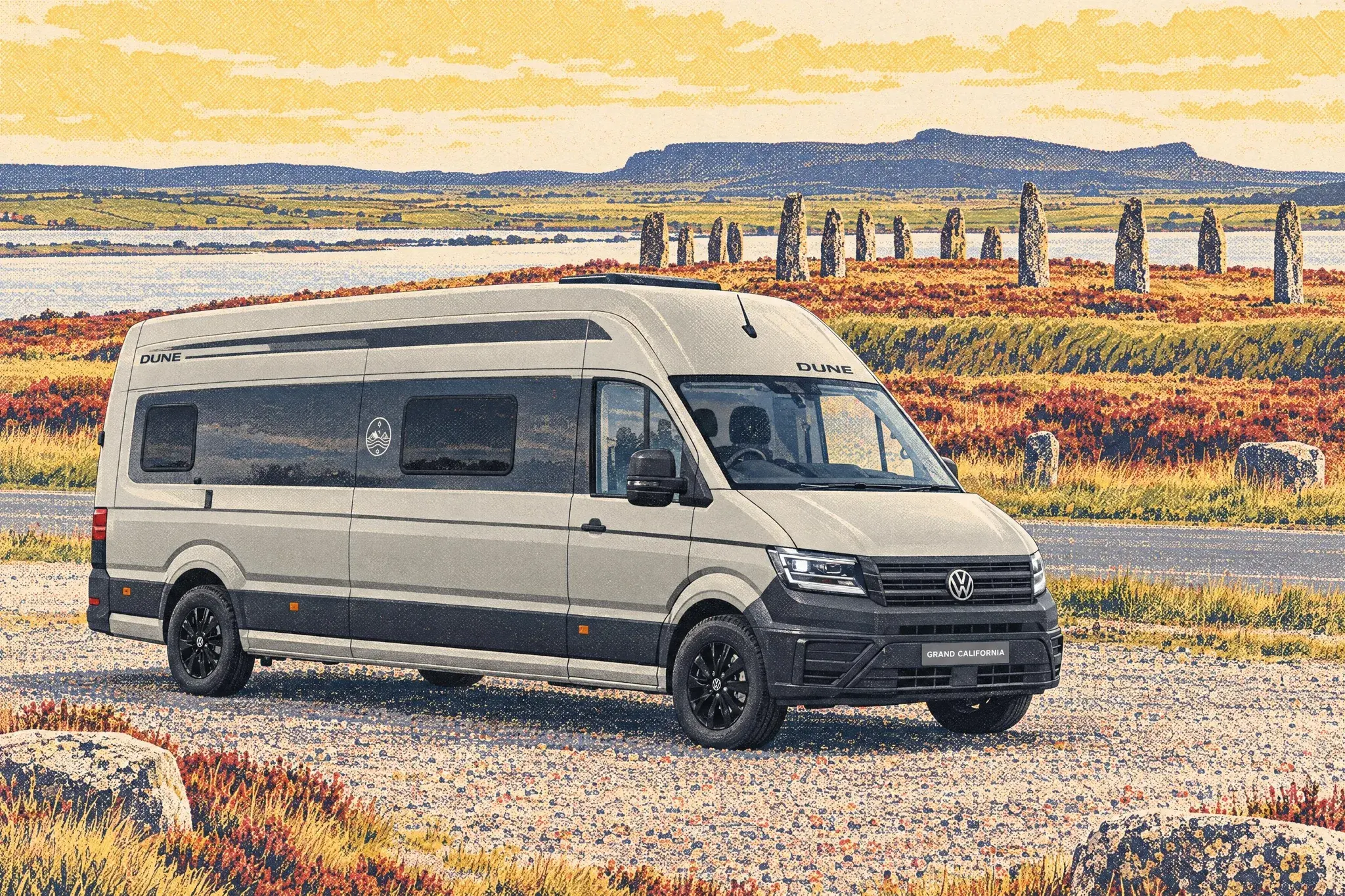
The short answer
The VW Grand California 680 Dune is a 6.84 m, two-berth Crafter-based campervan costing £88,186 with front-wheel drive or £96,250 with 4MOTION on VW UK's 30 September 2026 price list. Every 680 is plated at 3,880 kg, so drivers who passed their car test on or after 1 January 1997 need a C1 licence. 4MOTION adds £8,064 and costs 117 kg of payload, leaving 486 kg against 603 kg.

The Volkswagen Grand California 680 Dune is a big van built for two people who want to go a long way in comfort. It is 6.84 m long and it has a gross vehicle weight of 3,880 kg, and that single number changes who is allowed to drive it and how fast it can legally go on a British A-road. This is the deep dive: what you actually get, what it costs with the date attached, why the licence question matters more than any option, and whether the all-wheel-drive version is worth £8,064 and a slice of your payload. We have kept the options to the ones that genuinely matter on the 680, because the van itself deserves the attention.
What the 680 Dune actually is
Strip away the decals and the Grand California 680 is a factory-built panel van conversion on Volkswagen's Crafter. That matters in two ways. First, it keeps the Crafter's steel body, so it is 2,040 mm wide without mirrors, the same as the shorter Grand California 600 and far narrower than a typical coachbuilt motorhome. Second, the 680 uses the Crafter's own high roof rather than the 600's raised camping roof, which is why it sleeps two rather than four and why it sits lower at 2,840 mm tall.
Volkswagen builds the Grand California at its Września plant in Poland, according to information published by VW Austria's importer. A few UK reviews say Hannover, and the confusion is understandable because Hannover is the home of Volkswagen Commercial Vehicles, but the Polish plant is where the Crafter and its camper derivative are assembled.
Dune is a trim and styling package laid over the standard Grand California. In the UK it means one colour, Ascot Grey, with Dune decals, black bumpers, 17-inch gloss black Lismore alloy wheels, LED headlights with LED daytime running lights, automatic lights, Climatronic air conditioning in the cab, a rear-view camera and ambient interior lighting. There is no metallic or two-tone paint on the Dune. If you want a different colour, you buy the standard van.
Every UK Grand California, Dune or not, comes with adaptive cruise control, Front Assist, Lane Keeping, blind-spot monitoring, front and rear parking sensors, keyless entry, an alarm and a digital cockpit. On a van this long, the blind-spot monitoring and the sensors are not luxuries.
What it costs, with the date attached
Prices move, so every figure here is pinned to a source and a date. From Volkswagen UK's price list issued 30 September 2026, on the road:
- Grand California Dune 680 FWD: £88,186
- Grand California Dune 680 4MOTION: £96,250
The gap between the two drivetrains is £8,064. The standard, non-Dune 680 is £1,200 less in each case, so £86,986 with front-wheel drive and £95,050 with 4MOTION. Bought one at a time on the standard van, the Dune's LED headlights (£1,248), rear-view camera (£306), ambient lighting (£522) and black wheels (£180) come to £2,256 on the same price list, so for £1,200 the Dune saves you £1,056 if you wanted those anyway, and it adds Climatronic, the black bumpers and the decals on top. If you would rather have a different colour, or you can live without most of that list, the standard van is the cheaper route.
The configurator on 6 October 2026 listed the handful of options we think matter most for a 680 used as a long-distance tourer:
- Two extra side windows with nets and darkening (680 only): £744
- Awning, 2.5 m by 3.5 m: £1,008
- Off Grid Package (lithium batteries and a solar panel): £1,740
- Option 6J1, which switches the heater to diesel and mains: £720
- Differential lock (4MOTION only): £756
Add the first four to a front-wheel-drive Dune and you are at £92,398. Add all five to the 4MOTION Dune and you are at £101,218. Those are the two realistic configurations for someone planning months on the road, and the second one crosses a psychological line that the first does not.
The C1 licence question comes before everything else
Every Grand California 680 has a gross vehicle weight of 3,880 kg. That is not an optional uprating; Volkswagen UK lists 3,880 kg for every version, so plan on it. A standard car licence, category B, covers vehicles up to 3,500 kg. The 680 is over that limit, so it needs category C1, which covers vehicles between 3,500 kg and 7,500 kg.
Who already has C1? Broadly, anyone who passed their car test before 1 January 1997 was given C1 automatically. Check the back of your photocard: if C1 is listed, you are fine today. There is one caveat. That entitlement has to be renewed when you reach 70, and the renewal involves a medical rather than the simple self-declaration a car licence needs. So a 680 bought at 68 comes with some paperwork at 70.
Anyone who passed on or after 1 January 1997 has to add C1 to their licence. In outline, that means:
- A medical examination with a doctor, recorded on form D4, and an application for provisional C1 entitlement.
- A theory test for the category, made up of multiple-choice questions and a hazard perception test.
- Training in a suitable vehicle, usually a few days with a specialist school.
- A practical driving test in a C1-class vehicle.
Costs vary by school and by how much training you need, but once lessons, medical and tests are added together most people should budget a four-figure sum, and allow several weeks for the provisional licence and the test bookings. It is not a huge barrier, but it is a real one, and it has to be cleared before you take delivery, not after. Think of it as part of the purchase price.
One more detail catches people out. If you are the only C1 holder in the household, you are the only driver. On a long European tour that means every mile is yours. Some couples take the test together for exactly that reason.
There is also no way around it by choosing the smaller van and adding 4MOTION. In the UK, 4MOTION is offered on the 680 only. If you want all-wheel drive, you are buying the 3,880 kg van and you need the C1.
The speed limits most buyers miss
Weight affects your legal speed as well as your licence. GOV.UK sets lower national limits for motor caravans with a maximum unladen weight above 3.05 tonnes: 50 mph on single carriageways and 60 mph on dual carriageways, with the motorway limit staying at 70 mph. You can read the rules on the GOV.UK speed limits page.
The 680's kerb weight is 3,202 kg with front-wheel drive, measured with 90 per cent fuel, and 3,319 kg with 4MOTION. The Caravan and Motorhome Club's review states plainly that the 680 falls under the lower limits because of its unladen weight. Volkswagen's kerb figure includes fuel, and the legal definition of unladen weight does not, so the two numbers are not identical. Confirm the figure on your own registration document rather than taking our word for it, because that is the number an enforcement officer would use.
In practice this means that on a 60 mph Highland A-road you are a 50 mph vehicle, and on the A303 or the A1 dual carriageway stretches you are a 60 mph vehicle. It changes the rhythm of a journey more than people expect. The standard adaptive cruise control is genuinely helpful here, because holding 50 mph on an empty road takes discipline that a cruise system does not need.
Engine, gearbox and what it drinks
There is one engine. Volkswagen's current UK data gives a 2.0-litre TDI producing 163 PS (120 kW) at 3,600 rpm and 410 Nm of torque between 1,500 and 2,000 rpm, meeting Euro 6e emissions. Earlier Grand Californias had 177 PS, and Volkswagen's own UK press material from launch and several older reviews still quote that figure, so do not be surprised if a dealer's old brochure disagrees with the new one. The gearbox is an eight-speed automatic, with no manual offered on the Grand California in the UK.
Fuel capacity is 75 litres, with an 18-litre AdBlue tank. Volkswagen has not yet published official fuel consumption for the current engine; the UK brochure lists it as 'yet to be confirmed'. Real-world figures from reviewers are more useful anyway. Parkers recorded 26 to 27 mpg around town and more than 32 mpg holding 65 mph; What Car? saw 26 mpg. Treat 26 to 32 mpg as the honest band for a van with a loaded weight approaching four tonnes.
Range on paper: 75 litres is about 16.5 gallons, so 26 mpg gives roughly 430 miles and 32 mpg roughly 530 miles. Nobody runs a tank to empty, so 350 to 450 miles between fills is a sensible planning figure. Another way to think about cost that survives fuel-price changes: at 28 mpg you use about 16 litres per 100 miles. Multiply by whatever diesel costs when you read this.
Reviewers broadly agree about how the drivetrain feels, and this is their opinion rather than a measured fact: Parkers and carwow both praise the eight-speed automatic as excellent and the ride as good. With 163 PS moving this much metal, it is unhurried rather than slow. It is also tall and slab-sided, and What Car? found it was pushed about by crosswinds, which is worth remembering on exposed bridges and the tops of the Pennines.
Living with 6.84 m in the UK
Volkswagen's detailed data gives a length of 6,836 mm. The width is 2,040 mm across the body and 2,410 mm with the mirrors out. Height is listed at 2,840 mm, though Volkswagen's press data shows a span of 2,839 to 2,967 mm depending on specification, and VW Austria notes that a roof-mounted air conditioner takes it to about 2.96 m. The wheelbase is 4,490 mm, which means a substantial rear overhang behind the back axle.
What that means day to day:
- Parking. A standard UK bay is roughly 4.8 m long, so you are into two bays nose to tail or a long-vehicle area. Height barriers at most multi-storeys and many supermarket car parks sit around 2.0 to 2.1 m, so they are out. Park-and-ride sites, retail parks without barriers and street parking become your friends.
- Width. At 2.04 m the body is about the width of a large SUV, which is why people who have come from a coachbuilt motorhome often find the Grand California relaxing on narrow lanes.
- Overhang. With 4,490 mm between the axles and 6,836 mm overall, the tail swings wide on tight turns and can ground on steep ferry ramps and campsite dips. Watch the rear camera on the way out of pitches, not just on the way in.
- Turning circle. Here the sources disagree. Volkswagen UK's brochure gives 13.6 m for both the 600 and the 680; ADAC, the German motoring organisation, gives 16.9 m for the 680. A longer wheelbase normally means a wider circle, so the ADAC figure feels more plausible, but we cannot settle it from the paperwork. Try a U-turn in a car park before you sign.
Inside, the standing height is 1.97 to 2.03 m depending on where you measure. Most adults will stand straight; only the very tallest, around six foot six and up, will need to stoop. The 600's raised camping roof gives more headroom inside, which is one of the few areas where the shorter van beats the longer one.
Campsites rarely turn away a 6.84 m van, and many club sites simply ask for the length when you book so they can allocate a suitable pitch. Smaller certificated sites with narrow approach lanes deserve a phone call first. Ferry operators generally price by length band, so check where 6.84 m sits on the route you have in mind.
Weights and the payload sums that actually matter
Volkswagen's figures for the 680, with 90 per cent fuel on board:
- Front-wheel drive: kerb weight 3,202 kg, payload 603 kg
- 4MOTION: kerb weight 3,319 kg, payload 486 kg
4MOTION adds 117 kg of hardware and takes exactly that from what you can carry. Volkswagen's payload already allows for a 75 kg driver, so you do not need to deduct yourself.
Now the realistic sums for two people touring:
- Add a passenger at 75 kg. Front-wheel drive leaves 528 kg; 4MOTION leaves 411 kg.
- Fill the 110-litre fresh water tank, which weighs 110 kg. That leaves 418 kg or 301 kg.
- Add gas, a full fridge, clothes for a long trip, bedding, chairs, a table, tools, a hose, cables and the inevitable kitchen overspill. For two people on a multi-week tour this is routinely 100 to 150 kg before anything fun goes in.
- Add the fun. Two e-bikes and a rack are often 60 to 80 kg together. A tow bar, an awning and a roof air conditioner all add weight that comes off the same total.
Work through that for the 4MOTION van and you can be at or near 3,880 kg with the bikes on and the tank full. The front-wheel-drive van has an extra 117 kg of breathing room, which is roughly the difference between carrying the e-bikes and leaving them at home. Travelling with the fresh tank half full is the easiest way to claw back 55 kg, and it is what many experienced owners do between sites that have water.
The honest advice: once you have the van loaded for a real trip, drive it to a public weighbridge. It costs little, takes ten minutes, and tells you whether your tour is legal.
Front-wheel drive or 4MOTION?
This is the big decision on the 680, and in the UK it is a decision only the 680 gives you. 4MOTION on the Grand California is permanent all-wheel drive. Two further items come only with it: the differential lock, a £756 option on the 6 October 2026 configurator, and Hill Descent Assist, which holds a steady crawl on steep, loose slopes.
What reviewers say, as opinion: Parkers calls 4MOTION 'a worthwhile investment' for anyone who regularly uses grassy sites. Carwow notes that the front-wheel-drive van can get stuck on wet fields, which anyone who has watched a two-wheel-drive campervan spin its way off a sodden pitch in October will recognise.
What it costs you: £8,064 at purchase and 117 kg of payload for the life of the van, plus some unmeasured fuel penalty from the extra mass and driveline.
4MOTION makes sense if
- You tour in autumn, winter and early spring, when British grass pitches are soft.
- You favour small certificated sites and farm stays over hardstanding.
- Scotland, Scandinavia, the Alps or the Pyrenees in the shoulder seasons are on the list.
- You are the sort of traveller who turns down the unmarked track to see what is at the end of it.
- Your payload sums above still work after losing 117 kg.
Front-wheel drive makes sense if
- Most of your nights are on hardstanding or well-drained pitches.
- You carry heavy kit such as e-bikes and need every kilogram of the 603 kg.
- You would rather spend the £8,064 on the Off Grid Package, diesel heating, the awning and the windows and still have change.
- You are happy to carry a pair of grip mats, choose pitches carefully and ask the warden for the firmest corner when the forecast is wet.
A fair summary is that 4MOTION buys confidence rather than capability you will use every day. For a two-person long-distance tourer that genuinely wanders in all seasons, the confidence is worth a lot. For a couple who tour from Easter to September on club sites, it is an expensive way to never find out whether you needed it.
The bed: wider, not longer
The 680's reason for existing is the bed. It runs lengthways across the back of the van, a fixed double you never have to make up. Volkswagen's figures are 2.00 m by 1.67 m on the right-hand side and 1.90 m by 1.67 m on the left, which is a slightly odd way of saying that the mattress is 1.67 m wide overall and the two sides differ in length by about 10 cm. Practical Motorhome describes it as two singles of slightly different length that come together as a comfortable double. The Caravan and Motorhome Club gives a maximum of 6 ft 6 in by 5 ft 6 in from three mattress sections, which lines up. Parkers notes a small cut-out at the foot end, so the tallest person should take the longer right-hand side.
Compare that with the 600's cross-wise lower bed at 1.93 m by 1.36 m. The 680 is not really longer, but it is a full 31 cm wider. That is the difference between a bed two adults share and a bed two adults share without negotiation. For a van you might live in for weeks, width is what you notice on the twentieth night.
Two berths is the whole story. The 680 has no roof bed and no over-cab bed option. It does have four belted seats, with a rear bench carrying two three-point belts and Isofix mounts, so you can take friends or grandchildren out for the day. You just cannot sleep them unless they bring a tent. If you need to sleep four, the 600 with its roof bed is the Grand California for you, and a separate article covers it.
Kitchen, wardrobe and storage
The extra length goes into the living area as well as the bed. The kitchen worktop measures 1.40 m against 0.98 m in the 600, and Parkers calls it 'a useful slab of extra worktop', which is exactly what it is. There is a two-burner gas hob, a sink and a 70-litre pull-out compressor fridge-freezer. There is no oven. If baking matters, a stove-top oven such as an Omnia, or a small mains-powered countertop oven for hook-up nights, are the usual answers.
Storage is where the 680 pulls clear of the 600 for long trips. There are two lower cabinets and a tall, proper wardrobe, which Parkers singles out along with an extra drawer. Hanging space sounds trivial until you have spent a month folding everything into cubes. Reviewers do criticise the locker catches as flimsy, which is the kind of thing to test at a viewing by opening and closing every door a few times.
Because the fridge is a compressor unit running from 12 V, its appetite for battery power is tied directly to the electrical choices below. On hook-up it is a non-issue. Off grid in summer, it is the biggest draw you have.
Wet room, water and waste
The wet room measures 0.82 m by 0.82 m. The basin tap pulls out to become the shower head, and the toilet is a Thetford cassette. It is a compact space, as any panel van bathroom is, but it is a proper enclosed room with a door rather than a curtain, which matters when you are showering on a cold morning.
Fresh water capacity is 110 litres and the tank is frost-protected, which is a genuine four-season feature rather than a brochure word. Waste capacity is 90 litres. Hot water comes from a 10-litre store heated by the main heater, so showers are short and staggered rather than long and simultaneous. Two quick showers in a row is realistic; a leisurely one after a long walk is better taken in the campsite block.
Heating and power for four seasons
The standard heater is a 6 kW combined water and air unit that runs on gas or mains electricity, with the 10-litre hot water store mentioned above. Option 6J1, £720 on the 6 October 2026 configurator, changes it to a diesel and mains unit while the hob stays on gas.
For a long-distance tourer, 6J1 is one of the few options we would call close to essential. Diesel heating draws from the 75-litre fuel tank, so you are never rationing gas on a cold night and never hunting for a compatible bottle or refill point in a country with different fittings. Gas then only has to feed the hob, which stretches a bottle a very long way. If your touring is British summer and club sites with hook-up, the gas and mains heater will serve you well and the £720 can go elsewhere.
Electrical power is the Grand California's quieter weakness. The standard leisure battery is a 92 Ah AGM unit, which New Atlas puts at about 46 Ah usable, because lead-acid batteries should not be run below half. That will keep lights, the water pump and the fridge going overnight, but not for several nights without driving or hook-up.
The Off Grid Package, £1,740 on the same configurator, replaces it with two 40 Ah lithium iron phosphate batteries, around 64 Ah usable, and adds a roof solar panel. Volkswagen's brochure says 174 W; the configurator says 185 W. Either way it is a single panel's worth of output, which in a British summer will often run the fridge and top the batteries up, and in a British winter will mostly keep them from going flat while parked. Lithium also charges faster from the alternator and tolerates deep discharge far better, so the practical gain is larger than the jump from 46 Ah to 64 Ah suggests.
Honest expectation setting for off-grid use: with the Off Grid Package, two or three nights without hook-up in summer is realistic if you drive a little between them. In winter, with the heater fan running and short days, plan on hook-up every other night or so. The frost-protected tank, Climatronic in the cab and the enclosed wet room make the 680 a genuine four-season van; the battery is the part that keeps it honest.
The sliding door, the windows and the awning
Volkswagen UK's specification lists a 'manual side sliding door on driver's side'. In a right-hand-drive van that puts the habitation door on the offside, so when you are parked on a British street you step out into the road rather than onto the pavement. Practical Motorhome says the layout is not handed for the UK; carwow disagrees. We cannot reconcile the two from the published material, so look at the demonstrator and decide how much it matters for the way you use a van. On a campsite you simply reverse onto the pitch the other way round. In a seafront parking bay it is more of a nuisance.
The 680-only option of two extra side windows, £744 on the 6 October 2026 configurator, comes with darkening blinds and insect nets. Owners on the VW California Club forum speak warmly of them on the 680 Dune, and the logic is sound: the long rear section is otherwise a fairly closed box, and light over a fixed bed makes a van feel larger than any extra centimetres do. If you are buying new, see a van with them before you decide.
The awning is £1,008 and measures 2.5 m by 3.5 m. Remember that it comes off your payload like everything else.
What it is like to drive and live in, according to reviewers
Everything in this section is reviewer opinion, labelled as such, because we are working from their reports rather than our own hands on the wheel.
- Ride and gearbox. Parkers and carwow both rate the ride as good and the eight-speed automatic as excellent.
- Crosswinds. What Car? found the van pushed about by side winds, which is the price of a tall, flat-sided body. Exposed motorway bridges and the M62 over the Pennines are the places you are likely to feel it.
- The bulkhead. Reviewers report heads hitting the structure above the cab when moving forward into the living area. Walk through several times at a viewing.
- Climate controls. Cab heating and cooling are adjusted only through the touchscreen rather than physical controls, which reviewers find fiddly on the move.
- Locker catches. Described as flimsy. Test them.
- The upside. Parkers highlights the 680's proper wardrobe, the extra drawer and that slab of worktop as the things that make it a van for longer trips rather than weekends.
The standard driver assistance earns its keep on a 6.84 m van. Blind-spot monitoring covers the long flanks, the Dune's rear camera makes reversing far less of a guessing game, and the sensors at both ends help in car parks that are free of height barriers but still tight.
Towing with the 680
Volkswagen rates the 680 to tow 2,000 kg braked and 750 kg unbraked, with a nose weight of 80 kg on the 4MOTION version. Two things to keep in mind. A category C1 licence covers a trailer up to 750 kg; anything heavier behind a 3,880 kg van needs C1+E, which pre-1997 licences usually include and anyone else needs a further test for. And a tow bar is payload like anything else, so it comes off the same 603 kg or 486 kg before you load a thing. A small trailer for bikes or a boat is realistic; a large caravan behind a campervan is not what this van is for.
Recalls, warranty and finance
Recalls
Parkers counts two UK safety recalls on the Grand California, both relating to early window installations. One of them, R/2022/178, covered 115 vans whose roof window cover could come loose, according to Van Life Matters. Both concerned early vans, so if you are looking at an early used example, ask for proof that the work was done.
Warranty and servicing
Volkswagen's 5 Plus Promise bundles five services, three MOTs, five years' AA cover and a warranty of five years or 124,000 miles. For a van bought to cover big mileages, a five-year warranty with a six-figure mileage ceiling is a meaningful part of the price, and the included services take some of the guesswork out of running costs in the early years.
Finance
Volkswagen's representative PCP on the configurator dated 6 October 2026 runs over 48 months at 10,000 miles a year, with a £5,000 Volkswagen contribution, 5.9 per cent APR and an order deadline of 5 January 2027. For the Dune 680 4MOTION the example shows a £22,137.50 deposit, 47 monthly payments of £712.43 and an optional final payment of £49,280.74. Add those three figures together and you arrive at about £104,900 across the agreement; check how the £5,000 contribution is applied on your own quote, because the representative example and a personal quote are not always laid out the same way. There is no 0 per cent offer. The 10,000-mile allowance also deserves a hard look if you are buying this van to go a long way, because excess mileage charges on a PCP are easy to underestimate when the odometer is adding up European tours.
Who the 680 Dune suits, and who it does not
Picture the ideal owner and it is clear. Two people, no need to sleep children or guests, who want to leave for a month rather than a weekend. They have, or are prepared to get, a C1 licence. They like the fact that the van is no wider than a large SUV and that it has a proper wardrobe and a bed they can both stretch out in. They tour outside the summer holidays and probably abroad, which makes diesel heating and the extra windows obvious ticks. If they favour grass and shoulder seasons, they buy 4MOTION and accept the lighter payload. If they favour hardstanding and heavy kit, they keep front-wheel drive and spend the difference on the Off Grid Package and the rest.
It suits less well if you passed your test on or after 1 January 1997 and would rather not sit another one, if you need four berths, if you regularly park in city multi-storeys, or if the lower speed limits on A-roads would spoil the way you like to travel. In those cases the 600 is the more sensible Grand California: a 3,500 kg version you can drive on a car licence, with up to four berths and more headroom, and the trade-offs of a narrower cross-wise bed and a kitchen worktop 42 cm shorter.
The honest comparison with the wider market is simple too. A 2.04 m-wide panel van will never have the interior volume of a 2.2 m-plus coachbuilt, and it costs more than many of them. What it offers is the factory-built integration of a Volkswagen product, a drivetrain and cab that feel like a car, a five-year warranty with servicing, and a body that fits down lanes a coachbuilt would not attempt. Whether that is worth the money is a personal call, and it is a fair one either way.
A viewing checklist for the 680 Dune
Take this with you, ideally to a dealer with both a front-wheel-drive and a 4MOTION demonstrator.
- Licence first. Check your photocard for C1 before you fall for the van. If it is not there, price the training and tests into your budget.
- Lie on the bed. Both of you, both sides, and feel for the foot cut-out. Decide who takes the longer right-hand side.
- Walk through the cab into the living area several times. If your head meets the bulkhead, you will meet it every day.
- Open and close every locker and judge the catches for yourself.
- Stand up in every part of the van. Headroom is 1.97 to 2.03 m; tall partners should test it.
- Look at the sliding door side and think about how you park at home and on the street.
- Ask about the windows. If the demonstrator has the £744 extra windows, note the light; if it does not, imagine the rear without them.
- Try a U-turn in the dealer's car park, because the published turning circles disagree.
- Ask for a weighbridge ticket or the exact kerb weight for the specification you are ordering, then do the payload sums above with your real kit list.
- Confirm the unladen weight you will see on the registration document, so you know your speed limits from day one.
- Check the engine spec on the order. Current vans are 163 PS; older literature says 177 PS. Make sure what you are quoted matches what is being built.
- On a used van, ask for evidence that the early window recalls were carried out.
- Read the PCP mileage allowance against your honest annual plans.
The bottom line
The Grand California 680 Dune is the Grand California for people who go a long way, two at a time. The extra length over the 600 buys a bed wide enough to share properly, a real wardrobe and a kitchen you can actually cook in, inside a body no wider than the shorter van. The price for that is 3,880 kg: a C1 licence for anyone who passed their test on or after 1 January 1997, and 50 and 60 mph limits on single and dual carriageways.
On the drivetrain, the honest view is that front-wheel drive with the Off Grid Package, diesel heating, the extra windows and an awning, at £92,398 on 6 October 2026 configurator pricing, is the better-balanced long-distance van for most British couples who use hardstanding. 4MOTION at £96,250 before options earns its £8,064 and its 117 kg when the pitches are grass, the seasons are the cold ones and the roads are the sort that do not appear on a satnav. Decide which traveller you are, do the payload sums with your real kit, and let the van follow from that.
Common questions
Do I need a C1 licence to drive the VW Grand California 680 Dune?
Yes, if you passed your car test on or after 1 January 1997. Every 680 has a gross vehicle weight of 3,880 kg, which is above the 3,500 kg limit of a standard category B licence. Drivers who passed before 1997 usually have C1 already, but it must be renewed with a medical at 70.
How much does the Grand California 680 Dune cost in the UK?
Volkswagen UK's price list issued 30 September 2026 shows £88,186 on the road for the front-wheel-drive Dune 680 and £96,250 for the 4MOTION version, a difference of £8,064. The standard, non-Dune 680 is £1,200 less in each case.
Is 4MOTION worth it on the Grand California 680?
It depends on where you camp. Reviewers such as Parkers call it worthwhile for grassy sites, and carwow notes front-wheel drive can get stuck on wet fields, but it costs £8,064 more and reduces payload from 603 kg to 486 kg. It is best suited to shoulder-season touring on grass pitches.
What is the real fuel economy of the Grand California 680?
Volkswagen has not yet published official figures for the current 163 PS engine. Parkers recorded 26 to 27 mpg in town and over 32 mpg at 65 mph, and What Car? saw 26 mpg, so 26 to 32 mpg is a realistic band. With a 75-litre tank that gives roughly 430 to 530 miles on paper.
What speed limits apply to the Grand California 680 in the UK?
Because its unladen weight is above 3.05 tonnes, GOV.UK rules limit it to 50 mph on single carriageways and 60 mph on dual carriageways, with 70 mph on motorways. The Caravan and Motorhome Club confirms the 680 falls under these limits, but check the weight on your own registration document.
How big is the bed in the Grand California 680 compared with the 600?
The 680 has a fixed lengthways double measuring about 2.00 m on one side and 1.90 m on the other, with a width of 1.67 m. The 600's cross-wise lower bed is 1.93 m by 1.36 m, so the 680's bed is around 31 cm wider but not really longer.
The reachable bit
The camper you fall for is rarely the one you can afford. That gap is the whole reason Campervan.win exists. Right now we’re giving away the Sunlight Vanlife, worth around £65,000, and closing that gap is the point: capped entries so the odds stay honest, £10 a ticket, a maximum of five per person, £500 to a UK charity from every full draw, the winner picked by a public randomness beacon anyone can re-check, and one person driving away in the van itself.

Enjoyed this post?
Get more honest campervan guides like this one in your inbox.
You’re in!
Check your inbox. We’ve just sent you a welcome email.

About the author
Jasper
Jasper writes campervan reviews, travel guides, and practical advice, with a focus on everyday use and relaxed touring around the UK.
Keep Reading
Related Reading
Thoughtful articles that build on what you’ve just read.
Campervan Reviews
10 min read
Coachman Veloce (2027): a UK-built Fiat Ducato campervan at £86,500, and who it is for
Coachman has built its first Fiat Ducato campervans in the UK, the Veloce VL65 and VR65, at £86,500 each. We go through what that price includes, the payload sums for four seats, the heating and power kit, and who a premium British panel van like this suits.
Campervan Reviews
35 min read
Carado CV595 X-Edition explained: the £87,890 4x4 VW Crafter campervan, for UK buyers
A long, honest look at Carado's first VW Crafter campervan: what 4MOTION and the off-road pack really do, how the 3,500 kg payload works out, what the 200 cm transverse bed and no-solar spec mean for British touring, and what to confirm before you order one at £87,890.
Campervan Reviews
13 min read
Coachman Affinity One explained: who the Polish-built 6.36 m Fiat Ducato campervan really suits
The Coachman Affinity One is a long, tall Fiat Ducato campervan built in Poland and sold in the UK under the Coachman name. Here is what the fixed French bed, front bunk, washroom, 3,500 kg weight and 6.36 m length really mean for the people who might buy one.
Campervan Reviews
8 min read
Citroen Holidays review: the honest take on Citroen's compact camper
A clear, honest look at the Citroen Holidays, the compact pop-top campervan built on the SpaceTourer. What it does well, where it compromises, and who it really suits.