
Jerba Cromarty review: the long-wheelbase five-seater with two double beds

Written by
Arthur
Arthur writes buying guides, comparisons, and in-depth explainers to help readers choose the right campervan or motorhome with confidence.
The short answer
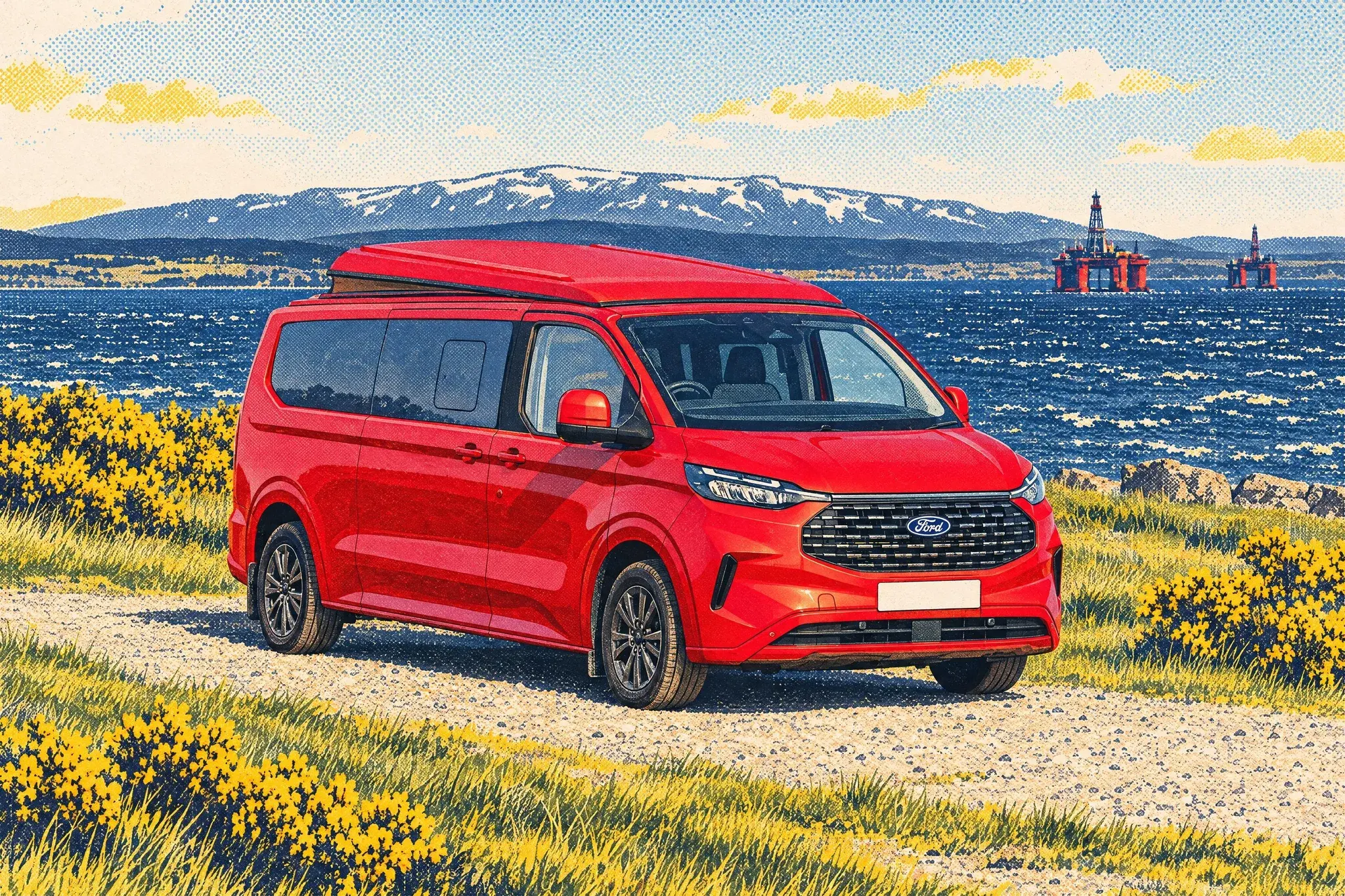
The Jerba Cromarty is a long-wheelbase campervan on the VW T7 or Ford Transit Custom, 5.45 m long, with five belted seats, a standard 126 cm by 186 cm lower double and an optional roof double. Caravan Guard listed it from £72,000 on the road on a Ford Tourneo Custom base on 13 October 2026, with a 3,245 kg maximum weight and payload from 675 kg, so it stays on a car licence.

The Jerba Cromarty is a long van for people who need to carry five in seat belts by day and sleep four at night with the optional roof bed. It is the family model from a small Scottish converter, built on either a VW T7 or a Ford Transit Custom. Jerba says it won Best Pop Top Campervan at the 2026 Out & About Live awards, where the judges cited the quality of the conversion, the practicality of the layout and the standard of the pop-top roof design. The question for a family is whether 5.45 m of van earns its place on the drive over the shorter Jerba Tiree, and whether a from-price in the low seventies buys the van you will use rather than the one you will keep adding to.
What it is
Jerba builds it in North Berwick, East Lothian, has been converting vans since 2006, and has been 100 per cent employee owned since January 2018 through the Jerba Campervans Trust, with around fifteen staff. Jerba's own Cromarty page lists it as a VW T7 or Ford Transit Custom conversion, 5.45 m long, on the long-wheelbase platform, with five seat belts and options for lower and roof beds, in diesel or plug-in hybrid form. Caravan Guard's 2026 review listed the Cromarty on a Ford Tourneo Custom base at an RRP from £72,000 on the road, as published on 13 October 2026. Out and About Live's buyer's guide listed the 2026 VW T7 four-berth Cromarty at £74,000 on the same date. Jerba says build slots for 2026 and 2027 are typically booking six to twelve months ahead and are reserved with a £1,000 deposit.
Layout and how it lives
This is a classic side-kitchen panel van layout, stretched. Jerba says the Cromarty is approximately 50 cm longer than the Tiree, which buys a wider rear bed (126 cm against 120 cm), a longer kitchen run and more storage.
Daytime
Up front, both cab seats swivel to face the living space. Behind them sits a three-seat belted rear bench, the side kitchen run with its hob, sink and side counter (storage beneath and overhead), a full-height rear cupboard and overhead rear storage. With five belted seats and ISOFIX options, this is a van you can put a car seat in and use for the school run during the week. Jerba says the furniture is scribed, cut and edge-banded in-house rather than kit furniture, and that side units are sized to the owner's kit. In practice that means you should turn up to the build discussion with a list of what you carry, from bikes to a pushchair, and let them size the lockers to it.
Beds
Jerba's standard specification describes the rear seating converting into a 126 cm by 186 cm bed with contoured cushioning on one side for sitting and a built-in mattress topper on the other for sleeping. A 186 cm bed is around 6 ft 1 in, which is fine for most adults but tight for anyone tall who sleeps stretched out. Jerba offers a wide extension that takes the lower bed to 6 ft 5 in long. The roof double bed is listed by Jerba as an optional feature: 1,150 mm by 1,960 mm, a 90 mm deep foam mattress, 1,100 mm of internal head height, reached by a folding ladder and with no weight restriction.
Note the word optional. The elevating roof itself is standard, but the double bed inside it is an extra, so the headline "two double beds" describes the van with the optional roof bed fitted, not the base build. In an earlier test of a T6-era Cromarty, Cameron McNeish wrote that the downstairs bed folded down easily and that he found it extremely comfortable.
The roof
Jerba describes the roof as its own forward-opening design, made with breathable Ventile cotton canvas, midge-proof netting and stainless steel components, closing to under the height restriction for multi-storey car parks. Caravan Guard gives the closed height as 2.05 m and the width as 2.15 m. Multi-storey limits vary, so check the posted height at the car parks you use rather than assuming. If pop-tops are new to you, our explainer on pop-top roof conversions covers what the canvas, hinges and bed frames mean for warmth and weather.
Kitchen, power and heating as published
One thing to pin down before you order: Jerba's layout copy describes a three-burner hob, while the standard specification list on the same page describes a combined glass-lid two-burner Dometic gas hob. Ask which is fitted to the build you are quoted. The standard list also includes a sink alongside the hob with a mixer tap, a 51-litre Vitrifrigo compressor fridge with a freezer box, and an internal 38-litre water tank that is frost-protected for year-round use. The 38-litre tank is a small tank for four, so plan on campsite taps or a spare container for longer stays.
Jerba fits a full lithium leisure battery system as standard, with 12 V and 230 V hook-up systems, a sealed steel gas box, and the installations certified by qualified gas and electrical engineers. A 200 W roof-mounted solar panel is an option. Ask for the battery capacity in amp hours and whether there is an inverter, because "lithium system" on its own does not tell you how many days the fridge will run without driving or hook-up.
Heating is the gap to ask about. The only heating on Jerba's published option list is a Wallas diesel hob and heater, which replaces gas with a single diesel fuel source and frees boot storage. Ask what heater, if any, is fitted in the standard build and what it is rated at, because a winter weekend in Scotland with two children in a canvas roof needs proper heating, not an afterthought.
Driving and the base vehicle
Jerba says any of its mid-size layouts can be built on the VW T7 or the Ford Transit Custom, and it is approved under the Ford National Converter Programme as well as being a long-standing VW converter. That gives you a choice of two very different vans under the same furniture, and our comparison of the VW T7 and Ford Transit Custom as campervan bases goes into cabs, engines and how each drives. Caravan Guard's test van was on a Ford Tourneo Custom base. Jerba's page lists diesel or plug-in hybrid power. Ask for the exact engine output, gearbox and which wheels are driven on your quote. Cameron McNeish's T6-era test van had a 2.0-litre Euro 6 diesel with 102 bhp, but that was an earlier generation of Transporter.
At 5.45 m long, check it fits your drive and the bays you use. On type approval, Jerba's own FAQ says the Cromarty holds full type approval on the VW T6.1 and that the company is in the final stages of achieving it on the VW T7 and Ford Transit Custom platforms. Ask for the current approval status for the base you are ordering, in writing.
Weights, payload and licence
Caravan Guard lists a maximum weight of 3,245 kg and a payload from 675 kg for the Ford Tourneo Custom Cromarty. Those two figures imply a mass of 2,570 kg (3,245 minus 675). A payload worked out this way may already include a 75 kg driver, so on that basis four passengers at the 75 kg convention used in type approval come to 300 kg, which leaves 375 kg for luggage, bikes, water and any options you add. That is workable for a family, but roof bed, awning, solar panel and leather all take from it, so ask Jerba for the payload of your exact build on your chosen base. The type-approval rules also allow a motor caravan's actual running-order mass to differ from the declared figure by up to 5 per cent either way, so keep a margin.
- Licence: at 3,245 kg MAM the Cromarty is under 3,500 kg, so a standard category B car licence covers it whenever you passed your test.
- Speed limits: the dividing line is 3.05 tonnes unladen, which excludes fuel and water. With a running-order figure around 2,570 kg the Cromarty is likely to be under it, so car limits should apply: 30 mph in built-up areas (20 mph on restricted roads in Wales), 60 mph on single carriageways, 70 mph on dual carriageways and motorways. Check the unladen weight on the V5C.
- Vehicle tax: at or under 3,500 kg a motor caravan is in tax class TC11, £375 a year with an engine over 1,549 cc or £230 at or under, at the 2026 to 2027 rates. Check GOV.UK for the live figure.
- MOT: class 4 from three years old, whatever the weight.
- London and clean air zones: at or under 3,500 kg the ULEZ applies, so put the registration into TfL's vehicle checker. For England's charging Clean Air Zones and Scotland's Low Emission Zones, put the registration into the official checkers.
For the VW T7 build, ask Jerba for the width, weights and payload, and treat the Ford numbers above as a guide.
Price, what the from-price includes and the options that move it
Two 2026 from-prices stand as published on 13 October 2026: Caravan Guard's £72,000 on the road for the Ford Tourneo Custom base, and Out and About Live's £74,000 for the VW T7 four-berth. Jerba's used stock page listed a 2026 Cromarty Ford demo at £69,000 and a 2026 Ford Transit Custom Tiree demo at £64,500 on 13 October 2026. A demo with a build slot already used is the quickest way into one of these, given the six to twelve month wait for a new build.
What the standard build includes, from Jerba's own specification: the elevating roof, five belted seats, the 126 cm by 186 cm lower bed, the hob and sink, the 51-litre fridge, the 38-litre frost-protected tank, the lithium battery system with 12 V and 230 V hook-up, high-spec wall and floor insulation and commercial-grade vinyl flooring. Jerba says the base vehicle keeps its full VW or Ford manufacturer warranty and the conversion is covered by a Jerba warranty.
The options that will move the figure, as listed by Jerba:
- The roof double bed, which turns a two-berth into a four-berth.
- The wide and 6 ft 5 in extension to the lower bed.
- The 200 W solar panel.
- The Wallas diesel hob and heater, which removes the gas system altogether.
Jerba's options list includes leather upholstery, a Fiamma cassette awning with side and front panels, an option headed "grill or warming oven" whose description reads like a lockable steel safe (ask Jerba which it is), and a soft Thermoflex lining for the beds. Ask Jerba for a priced option sheet and add the ones you need before you compare the Cromarty with anything else.
How it compares with Jerba's own alternatives
The Tiree is the short-wheelbase van, with up to five belted seats, sleeping two, or four with the pop-top bed. It gives you the same seat count in a van about 50 cm shorter, with a 120 cm bed rather than 126 cm, and it is the one to pick if your drive, your parking or your second-car duties make length the enemy. We cover it in "Jerba Tiree 4Motion review: the short-wheelbase T7 camper built for Scottish weather". The Sanna is Jerba's other long-wheelbase layout, aimed at couples, with a fixed onboard toilet, twin singles or a double, and belted travel for four. If the choice is between a fifth seat and a toilet, that is the Cromarty against the Sanna in one line. Jerba's Crafter range runs to three layouts on the VW Crafter and MAN, named Harris, Mull and Barra, in medium, long and extra-long lengths, for anyone who has outgrown a mid-size van altogether. Our NEC 2026 round-up of British campervan converters and who builds what puts the Jerba range beside its rivals, and the profile "Jerba Campervans explained: the employee-owned Scottish converter approved by VW and Ford" covers the company itself. For the broader picture of what a side-kitchen pop-top is and is not, see our guide to types of campervan conversion.
Verdict
The Cromarty does one thing well: it keeps the mid-size van's everyday usability and spends its extra length on a wider bed, a longer kitchen and more cupboards, which is where a family feels the difference. The lithium system as standard, the frost-protected tank and the no-limit roof bed are the details that suggest it was designed for use rather than for the brochure. The open questions are the hob (two or three burners), standard heating, and payload on the T7 build, all of which are a phone call away.
It suits
- The family of four or five with one car space. Five belts, ISOFIX options and a 2.05 m closed height mean it does the school run on Tuesday and the Cairngorms on Friday.
- The couple who tour with grandchildren or friends. Two sleep below on a 126 cm bed, two above, and the lower bed's 6 ft 5 in option keeps a tall adult comfortable.
- The owner who wants a long-term relationship with the builder. A small employee-owned workshop with life-of-vehicle support, a used demo route in, and furniture sized to your kit rewards the buyer who plans to keep the van for a decade.
It does not suit
The buyer who needs a toilet or a shower on board. Jerba's standard specification list for the Cromarty covers a side kitchen, five seats and beds, though the comparison table on the same page ticks a full enclosed shower and toilet, so ask Jerba whether any toilet or shower is offered on the Cromarty. If a fixed loo is non-negotiable, Jerba's own Sanna gives up the fifth seat to fit one. Choose the Cromarty for the seats and the beds, and bring the toilet in a cassette.
Common questions
What is the Jerba Cromarty built on?
Jerba lists the Cromarty as a long-wheelbase conversion on either the VW T7 or the Ford Transit Custom, in diesel or plug-in hybrid form. Caravan Guard's 2026 review tested one on a Ford Tourneo Custom base.
How many does the Jerba Cromarty seat and sleep?
It has five belted travel seats with ISOFIX options. The standard lower bed is 126 cm by 186 cm, and the optional roof double (1,150 mm by 1,960 mm) takes it to four berths, so two sleep below and two in the roof.
How much does a Jerba Cromarty cost?
As published on 13 October 2026, Caravan Guard listed it from £72,000 on the road on a Ford Tourneo Custom base and Out and About Live listed the 2026 VW T7 four-berth at £74,000. Jerba's used stock page listed a 2026 Ford demo at £69,000 on the same date.
Can I drive a Jerba Cromarty on a car licence?
Yes. Caravan Guard lists a maximum weight of 3,245 kg, which is under 3,500 kg, so a category B car licence covers it. Its unladen weight is likely to be under 3.05 tonnes, so car speed limits should apply, but check the unladen weight on the V5C.
Is the roof bed standard on the Cromarty?
No. Jerba's elevating roof is standard, but the double bed inside it is listed as an optional feature, so budget for it if you need four berths.
The reachable bit
The camper you fall for is rarely the one you can afford. That gap is the whole reason Campervan.win exists. Right now we’re giving away the Sunlight Vanlife, worth around £65,000, and closing that gap is the point: capped entries so the odds stay honest, £10 a ticket, a maximum of five per person, £500 to a UK charity from every full draw, the winner picked by a public randomness beacon anyone can re-check, and one person driving away in the van itself.

Enjoyed this post?
Get more honest campervan guides like this one in your inbox.
You’re in!
Check your inbox. We’ve just sent you a welcome email.

About the author
Arthur
Arthur writes buying guides, comparisons, and in-depth explainers to help readers choose the right campervan or motorhome with confidence.
Keep Reading
Related Reading
Thoughtful articles that build on what you’ve just read.
Campervan Reviews
12 min read
Rolling Homes Darwin review: the long Crafter camper with a proper washroom
The Darwin is Rolling Homes' step up from the Transporter: a long-wheelbase VW Crafter two-berth with an enclosed washroom. We set out what is published, what the price does, and who it suits.
Campervan Reviews
12 min read
Bilbo's Nexa+ T7 review: a rear kitchen, a cassette toilet and the new Low-Lie roof
The Nexa+ is the Bilbo's for people who want a fitted toilet in a Volkswagen Transporter. We go through the rear-kitchen layout, the beds, the power and heating as published, the T7 base, the £77,930 in-stock price and who it suits.
Campervan Reviews
13 min read
Hillside MVX review: the Multivan camper from £70,995, or £78,995 as an eHybrid 4MOTION
Hillside's MVX puts a four-berth pop-top conversion on the Volkswagen Multivan, with a plug-in hybrid and all-wheel drive at the top of the range. Here is what it offers, what it leaves to the Transporter-based Cromford, and where the 2026 Club judges placed it.
Campervan Reviews
11 min read
Hillside Cromford T7 review: the LWB VW camper that won the Club's 2026 design award
The Hillside Cromford T7 puts a rear galley and a fixed toilet behind a privacy door into a long-wheelbase VW Transporter T7, and it won the Caravan and Motorhome Club's 2026 long-wheelbase campervan award. Here is what the extra length buys, what the £73,550 from-price covers, and who should look elsewhere.