
VW Transporter T7 vs Ford Transit Custom: the best campervan base?

Written by
Leo
Leo covers campervan technology, maintenance, kit, and ownership advice, with a clear, practical focus on how things work in real life.
The short answer
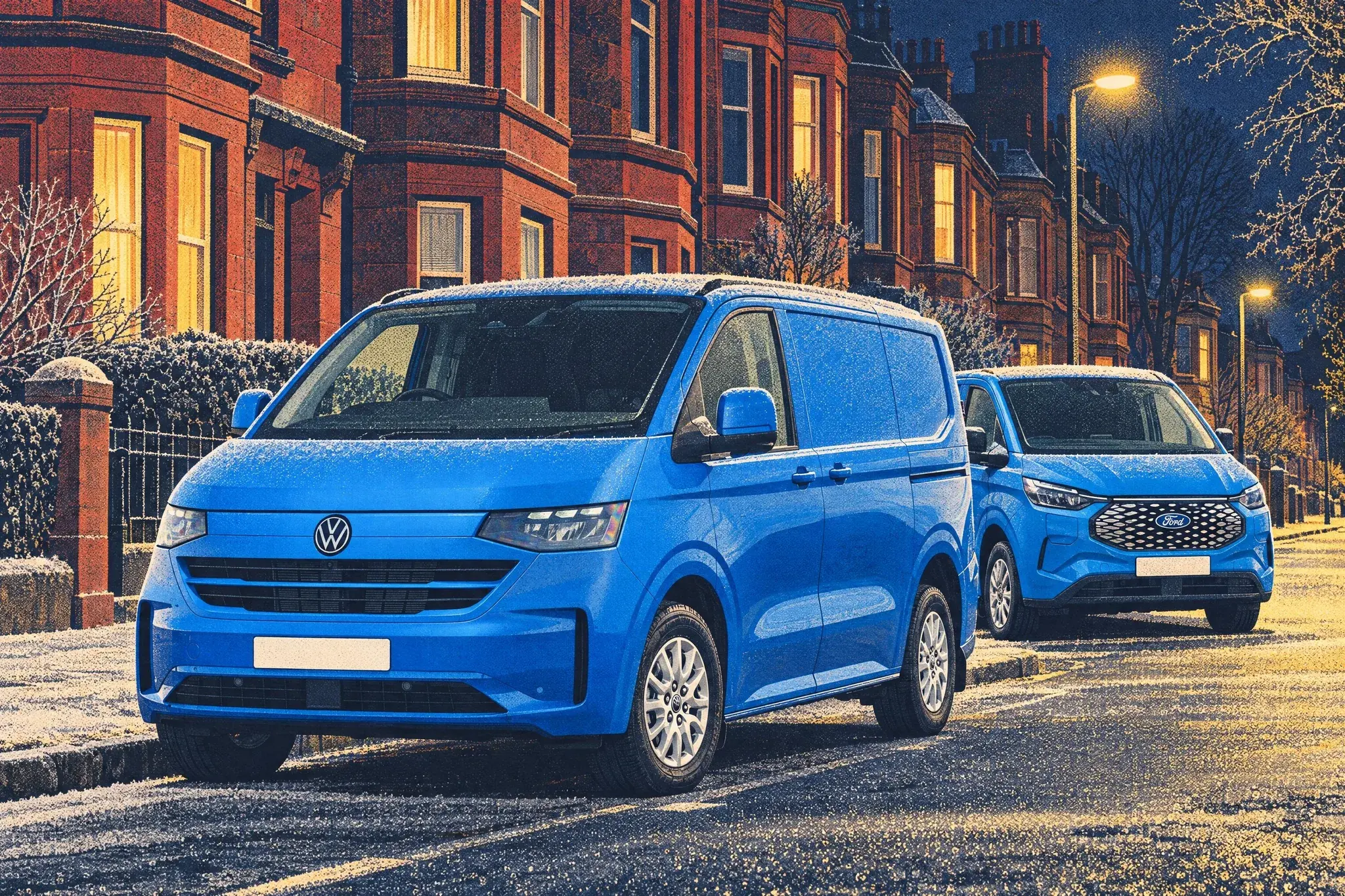
Here is a fact that reshapes the whole question: the new VW Transporter, the one you would convert today, is built by Ford, on the same line as the Ford Transit Custom in the same Turkish factory, with the same engines, while VW restyles the nose and softens the ride. So choosing a campervan base between them is largely choosing between two versions of the same van, which usefully shifts the decision to roof, payload, warranty, resale and badge. For most builds, order a long-wheelbase L2 with a mid-range diesel (VW 150 or Ford 136/170) and the eight-speed automatic, plus a higher gross-weight variant for payload headroom. A finished camper on either is a £60,000 to £90,000 proposition. Here is the full comparison, and which badge actually makes sense to build on.

Here's a fact that should change how you shop for a campervan base. The brand-new Volkswagen Transporter, the one you'd convert today, is built by Ford. Not "inspired by," not "co-developed in spirit." It rolls down the same production line as the Ford Transit Custom, in the same factory in Turkey, with the same engines under the bonnet. VW styles the nose, reskins the screen and tunes the ride a touch softer, then sends it out wearing the most respected badge in van life.
So when people ask whether to base a build on a "VW T7" or a Ford Transit Custom, the honest first answer is uncomfortable: to a large degree, you're choosing between two versions of the same van. That doesn't make the decision meaningless. It makes it more interesting, because once the mechanicals are off the table, what's left, the roof, the payload, the drivetrain, the warranty, the resale, the badge, is exactly the stuff that actually shapes how you'll live with a camper for a decade.
This is the long version. We'll untangle the Ford-VW alliance, clear up the genuinely confusing "T7" naming, go through engines, size, the all-important payload, four-wheel drive, the electric question, the factory campers, cost and resale, and finish with an honest verdict on which one deserves your conversion. Grab a brew. There's a vote at the bottom when you've made your mind up.
The same van? The Ford-VW alliance, explained
In June 2018 Ford and Volkswagen signed a memorandum of understanding. On 15 January 2019 they formally launched a global commercial-vehicle alliance, and they were careful to say what it wasn't: there's no cross-ownership, no merger, no equity swap. It's a deal to share the eye-watering cost of developing vans and pickups, by each company building certain vehicles for both badges. Ford's own announcement framed it as playing to each maker's strengths.
The division of labour, once you lay it out, is tidy:
- Ford engineers and builds the medium vans and medium pickups. That means the Transit Custom, the Ford-built VW Transporter that replaces it, the Ranger, and the Ranger-based VW Amarok.
- Volkswagen builds the small city van. The Ford Tourneo Connect and Transit Connect are now derived from the VW Caddy, built by VW in Poznan, Poland.
So the alliance runs both ways. Ford leans on VW for a small van; VW leans on Ford for the one-tonne workhorse and the pickup. The medium vans were the last big piece to land, arriving from around 2023, with the new Transporter going into production at the end of 2024.
Where this matters for you: the new VW Transporter is built at Ford Otosan in Golcuk, Kocaeli province, Turkey, on the same line as the Transit Custom. Ford led the engineering. The two vans share platform and powertrains. That's a genuine break with history. The outgoing T6.1 Transporter was a wholly Volkswagen product, designed and built in Hannover, Germany, with VW's own engines. The new one is, underneath, a Ford. If you've spent years assuming a Transporter is a fundamentally different, more "German" thing than a Transit, that assumption quietly expired in 2024.
None of this is a scandal, by the way. Badge-engineering and shared platforms are how the whole industry survives. Half the cars on your street are cousins under the skin. It's just rarely this stark, or this relevant to a buying decision, as when the two vans you're agonising over are the same van.
A vital aside: which "T7" do you actually mean?
Before we go further, we have to defuse the single most confusing thing in this whole conversation, because if you get it wrong you'll buy the wrong van.
Volkswagen currently sells two completely different vehicles that people call "T7."
- The Ford-based VW Transporter (2024 on). This is the commercial panel van and Kombi, built in Turkey on the Transit Custom platform. It's the natural conversion base, the direct rival to the Transit Custom, and the van this article is about. Strictly speaking VW hasn't even badged it "T7"; the name has stuck by succession because it replaces the T6.1. Press and forums use "T7" as shorthand. We'll do the same, but now you know it's not really a T-platform vehicle at all.
- The VW Multivan, and the California camper built on it. This is an entirely separate passenger MPV on VW's own MQB Evo platform, built in Hannover, Germany, launched in 2021. This is the official, capital-letters T7. And crucially, the new VW California factory camper is built on this Multivan, not on the Ford-based Transporter.
Read that last point twice. The famous VW California is no longer a Transporter underneath. It's a Multivan. So if you're cross-shopping a factory California against a Transit Custom conversion, you're comparing a German-built MQB people-carrier with a Turkish-built Ford-platform van. We dug into the California itself in our piece on the Taylored Offtrail versus the VW California, which is worth a read if a factory pop-top is on your list.
For the rest of this article, "VW Transporter" means the Ford-built cargo van you'd convert. That's the like-for-like fight with the Transit Custom, because they're the same van.
What VW actually changed
If they share a factory and a platform, is the Transporter just a Transit with a roundel? Not quite, and the differences are more interesting than badge-snobs or badge-cynics will tell you.
Parkers, who have driven both back to back, describe the split neatly. Everything above the horizontal line running across the middle of the Transporter's dashboard is Volkswagen's own design, with relocated cupholders and storage. The infotainment runs Ford's underlying operating system, but VW has reskinned it so the fonts, colours and graphics are all Volkswagen. The nose, the lights and the doors are bespoke VW items that nod to old Transporters. And VW has tuned the ride for comfort and composure, where the Transit Custom keeps a slightly sharper, more engaging edge from behind the wheel.
So it's not a pure badge-swap above the waist. VW has done real work on the touchpoints, the bits your hands and eyes meet every day, and on the way it rides. What it hasn't changed is the stuff that decides whether a van is a good camper base: the body shell, the floor, the engines, the running gear. Those are shared.
That's the frame for everything below. Mechanically, treat them as the same van. Differentiate them on the things VW and Ford chose to keep different: trim and tuning, roof options, drivetrain choices, warranty, dealer experience, price and resale. Those differences are real, and a couple of them are big enough to decide your build on their own.
At a glance
Before the detail, the shape of the thing, the differences that survive once you accept the two vans are mechanically the same:
| Spec | VW Transporter (T7) | Ford Transit Custom |
|---|---|---|
| Built by | Ford, in Turkey | Ford, in Turkey |
| Diesel | 2.0 TDI, 110 / 150 / 170 PS | 2.0 EcoBlue, 110 / 136 / 150 / 170 PS |
| Automatic | 8-speed | 8-speed |
| Four-wheel drive | 4Motion (150 PS only) | Not offered |
| Factory high roof | No, pop-top only | Yes (~1,778mm standing) |
| Electric | e-Transporter, 65kWh, ~190 to 200 mi | E-Transit Custom, 82.5kWh, ~236 mi |
| Max payload | up to ~1.3t | up to ~1.4t |
| Factory campervan | None on this van | Yes, the Nugget |
| Warranty | 3yr + 5+ Promise (to 5yr / 124k) | 3yr / 100k |
| Resale | Strongest in the class | Depreciates faster |
| Price from | ~£33k ex VAT | ~£32k to £35k ex VAT |
The engines, and which to pick for a camper
Because the powertrains are shared, the engine menu reads almost identically on both. The workhorse is a 2.0-litre turbodiesel in a familiar ladder of outputs, paired with either a six-speed manual or a Ford-developed eight-speed automatic. There's a plug-in hybrid, and there's a full-electric version. Let's take them in turn, through a camper-builder's eyes, because the right engine for a courier flogging up the M6 isn't always the right engine for a two-tonne home on wheels.
The diesels
- Ford Transit Custom: 2.0 EcoBlue diesel in 110, 136, 150 and 170 PS. Six-speed manual as standard, the eight-speed auto on the 136 and 150, and auto-only on the 170. (Auto Express quotes these as 109, 134, 148 and 168 bhp, which is the same engines in old money.)
- VW Transporter: the same 2.0 TDI, offered as 110 (manual), 150 (manual or auto) and 170 (auto only). VW skips the 136.
For a conversion, ignore the temptation to chase the headline power figure. A loaded camper spends its life cruising, not sprinting, and what you want is an engine that pulls a heavy van up a Welsh hill without strain and sits relaxed at 60 all day. The converter consensus, and ours, lands on the middle of the range: the Ford 136 or 170, or the VW 150, which VW's own marketing reasonably calls the sweet spot between power and economy. The 110 is fine for a light, occasional-use build but starts to feel weedy once you've added 600kg of furniture, water and people. The 170 is lovely and effortless, especially with the auto, but it's auto-only and pricier.
On gearbox: for a heavy camper that'll tow or climb, the eight-speed automatic is genuinely worth it. It's smoother, it keeps the engine in its torque band on a gradient, and it makes the van far more relaxing on a long tour. The manual saves money and a touch of weight, and purists will prefer it, but most full-timers who try the auto don't go back.
Real-world economy is, predictably, near-identical across the two badges because it's the same engine: think low 40s mpg for the manual diesels on a gentle run, dropping into the low-to-mid 30s once you're heavy, towing, or running the all-wheel-drive VW. Don't believe the brochure's best-case figure once your van weighs as much as a small car more than the factory tested.
The plug-in hybrid
Here the two diverge on timing. Ford already sells a Transit Custom PHEV: a 2.5-litre petrol engine paired with an 11.8kWh usable battery for a combined output around 232 PS and roughly 34 miles of electric range, with a gaudy 176.6 mpg on the official cycle that you will never see in real life. VW's equivalent, the eHybrid, was announced at the same 232 PS but only arrives during 2026, so at the time of writing it isn't a van you can go and buy.
We'll come back to whether a PHEV makes sense as a camper base. Short version: for a factory camper like Ford's Nugget it's a clever, low-emissions-zone-friendly option, but for a heavy self-build it's a harder sell, because the battery and petrol drivetrain eat into the two things a camper needs most: floor space and payload.
The electric versions
Both badges sell a full battery-electric van, and this is where the specs actually differ, because the two makers fitted different batteries.
- VW e-Transporter: a 65kWh battery, 136 or 218 PS, rear-wheel drive, with a WLTP range of roughly 197 to 201 miles for the 136 and around 190 to 192 for the 218.
- Ford E-Transit Custom: a much larger 82.5kWh usable battery, 136 or 218 PS, rear-wheel drive, up to about 236 miles WLTP, and faster DC charging at up to 125kW.
So the Ford has the meaningfully bigger battery and the longer legs. We'll weigh up the electric-camper question properly below, but flag now the figure that gets lost: those WLTP ranges are for an empty van on a gentle cycle. Add a tonne of conversion, a headwind and a roof box of drag, and a real-world touring range can fall well below the brochure. (Sources for the figures in this section: Honest John Vans and Parkers for the Transporter, Auto Express and Parkers for the Transit Custom. Powertrain line-ups and prices move, so check the live configurator before you commit.)
Living with it: the driving and the daily reality
Specs only tell you so much. Both of these are, by van standards, genuinely pleasant to drive and to live around, which matters more than it sounds when the van is also your bedroom.
The cab is the bit you touch most, and it's a high point on both. The shared dashboard is car-like, the driving position commanding, and the visibility good once you're used to the length. The Ford keeps a slightly sharper, more connected feel through the wheel; the VW is tuned a touch softer and more settled, which on a long motorway haul is arguably the nicer place to be. Neither feels like the agricultural vans of a decade ago.
The eight-speed automatic, if you choose it, is the single biggest upgrade to the daily experience. It shuffles ratios smoothly, holds a gear sensibly on a climb, and turns stop-start traffic and tight campsite manoeuvres from a chore into a non-event. On a heavy camper it earns its money for your left leg alone.
Size-wise, the long-wheelbase is still easy to place. At 5.45 metres it's longer than a big estate but a world away from a 6-metre motorhome, so it fits most car parks (mind the height once you've a pop-top up), threads a single-track lane and parks on a normal driveway. That everyday usability is the whole point of building on a medium van rather than a Crafter or Ducato: you get a camper at the weekend and a vehicle you can actually use on a wet Tuesday.
Refinement on the move is good, the diesel settling to a distant hum at a cruise and wind noise well suppressed for a boxy shape. Unladen, the ride can fidget over poor surfaces as all vans do, but a conversion's weight settles it down nicely. Park up, and the low-roof VW and the high-roof Ford have very different characters inside, which brings us neatly to the roof.
Size, roof, and the standing-room problem
The two vans are the same size, because they're the same van: a short-wheelbase L1 at 5,050mm and a long-wheelbase L2 at 5,450mm, with load volumes from 5.8 cubic metres up to around 9 for the biggest body.
For a camper you'll almost always want the long-wheelbase L2. That extra 400mm of body translates to roughly 2.9 to 3.0 metres of usable floor, and it's the difference between a fixed bed that fits across the back with a proper kitchen and seating ahead of it, and a compromised layout where everything fights for space. The short-wheelbase makes a brilliant weekender or day van, but for full-time or long touring, the LWB earns its keep every single day.
Then comes the difference that, for a lot of buyers, settles the whole argument: the roof.
The Ford Transit Custom offers a factory high roof (H2), around 2,471mm tall externally, which gives roughly 1,778mm of internal standing height. That means you can convert a Transit Custom and stand up inside it, cook at a worktop, pull on trousers without choreography, all without cutting a hole in the roof.
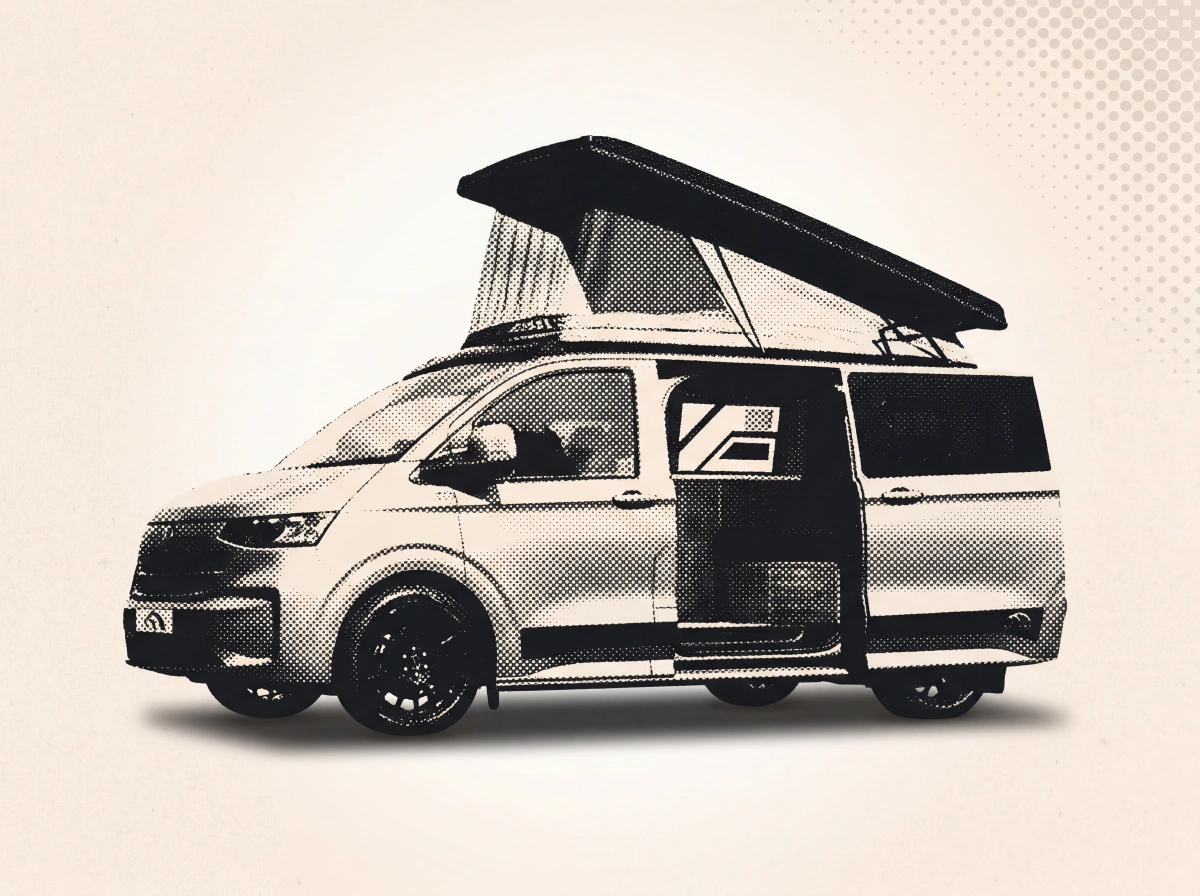
The VW Transporter has no factory high roof. It's low-roof only, under two metres tall. To get standing room in a Transporter conversion you have to fit an elevating roof, a pop-top, which is an extra few thousand pounds, another supplier, another thing to maintain, and a roof that's down (so no standing) whenever you're driving or it's blowing a gale.
This is arguably the single biggest practical difference between the two as conversion bases, and it cuts cleanly. If you want hard-sided standing height and you'd rather not faff with a pop-top, the Ford high roof is a genuinely compelling, and cheaper, route to it. If you're going to fit a pop-top anyway (and many people do, because a pop-top adds a second double bed up top and keeps the van low enough for height barriers and a normal garage), then the Transporter's lack of a high roof simply doesn't matter to you.
One small point back in the VW's favour on packaging: the Transporter is reported to have around 4cm more floor width between the wheel arches. That sounds trivial until you're trying to sleep sideways across the van or drop in a pre-made unit, where a few centimetres decides whether it fits. It's a minor edge, but a real one.
Layouts: how the roof choice shapes the build
The roof decision isn't just about standing up. It quietly dictates your whole interior, so it's worth thinking through before you fall for a layout your chosen van can't actually accommodate.
On a high-roof Ford, the extra vertical space changes what's possible. You can have a full-height kitchen you stand at to cook, tall cupboards and a hanging wardrobe, and in the longer body a small fixed washroom becomes realistic. A fixed transverse bed across the back sits at a sensible height with garage storage beneath, and you're not stooping anywhere. It feels like a small flat. The trade-off is height: at nearly 2.5 metres you'll meet height barriers, some ferries and the odd low branch, and it won't slide into a standard garage.
On a low-roof VW with a pop-top, the maths is different and, for many, better balanced. Roof down, the van is under two metres and goes anywhere a car goes. Roof up, you gain a second double bed in the canvas and standing room in the middle. The catch is that the standing room and the upstairs bed only exist when you're parked with the roof raised, so the downstairs layout has to work with the roof down too, and your tallest fixed furniture is capped by the lower roofline. It's the more flexible everyday van; the Ford is the more capable static home.
A few layout truths apply to both, because they're the same body. The rock-and-roll bed that doubles as travel seating is the family-friendly classic, letting you carry passengers and sleep two without a fixed bed eating the floor. The fixed bed across the back is the comfort choice for couples and full-timers, with no nightly making-up and a big garage underneath for bikes and gear. And the kitchen almost always runs down one side, with the sliding door as your veranda onto the view. The platform handles all of these happily; what changes between Ford and VW is simply how much air you have above them. That single fixed-bed-versus-rock-and-roll choice will shape your daily happiness more than the badge ever does.
Payload: the number that decides your whole build
If you take one thing from this article, take this: on a campervan, payload is the most important number on the spec sheet, and almost nobody checks it until it's too late.
Payload is the weight you're legally allowed to add to the van: everything that isn't the bare vehicle. And a conversion is heavy. The ply lining and insulation, the furniture, the bed, the worktop, a fridge, a leisure battery (lithium is lighter, but it's not nothing), a water tank where every single litre is another kilogram, a full toilet, gas if you use it, all your gear, bikes, and then the people. It adds up frighteningly fast. A modest conversion can swallow 700 to 900kg before you and your partner climb in.
Both vans offer healthy payloads on paper. Quoted figures run up to roughly 1,384 to 1,407kg for the heaviest-duty Ford diesels, and the VW spans something like 767 to 1,280kg depending on variant, with VW Commercial Vehicles headlining "up to 1.33 tonnes." But two warnings sit underneath those numbers:
- Manufacturer "maximum payload" is measured on a stripped, base-spec van. Add a higher trim, the auto gearbox, four-wheel drive, bigger wheels and creature comforts, and your real starting payload is lower, sometimes a lot lower, before you've fitted a single cupboard.
- Payload is entirely variant-specific. The same model name can have wildly different plated weights depending on the gross-vehicle-weight rating you ordered. For a serious build, choose a higher-GVW variant, the heavier-duty designations (think VW's T32 or Ford's 320 to 340 ratings), so you start with more headroom.
The practical advice is simple and unglamorous: decide your build's weight honestly, in writing, before you buy, and weigh the actual van (most weighbridges cost a few pounds) so you know your true starting payload rather than a brochure best-case. Overloading isn't a technicality. It voids insurance in a crash, it's an offence, and it ruins the way a van stops and steers. Plenty of beautiful conversions are quietly, dangerously overweight. Don't build one of them.
On this measure the two vans are close enough that payload won't usually decide VW-versus-Ford by itself. But it absolutely should decide which variant of either you buy, and it matters far more than the badge on the nose. The same logic applies right up the size ladder, which is why we bang on about it in our Fiat Ducato versus Mercedes Sprinter guide for the bigger vans too.
Two-wheel drive or four: the VW's one mechanical trump card
Here is the rare place where the two vans genuinely differ under the skin, and it's a point firmly in Volkswagen's favour.
The Ford Transit Custom is front-wheel drive only. There is no all-wheel-drive Transit Custom. The VW Transporter offers 4Motion all-wheel drive, although only on the 150 PS diesel.
For a lot of camper use this is irrelevant: front-wheel drive is perfectly capable on tarmac, it's lighter, cheaper and more economical, and it puts the weight over the driven wheels, which actually helps on a slippery slope. But if your version of van life involves snowy mountain passes, muddy festival fields, forestry tracks or a wet grass pitch in March, the 4Motion Transporter offers traction the Transit Custom simply cannot match at any price. It's the kind of capability you don't need often, but when you do, you really do.
If all-wheel drive matters to you and you want it on a medium van of this exact size, the VW Transporter is the only one of these two that can give it to you. That's a clean, decisive win, and for some buyers it ends the discussion.
What about electric or hybrid as a camper base?
The honest answer today, for most self-builders, is: not yet, with caveats.
Take the plug-in hybrid first. Around 34 miles of electric range is genuinely useful for low-emission-zone hops and quiet arrivals at a campsite, and Ford have built a PHEV Nugget around exactly that appeal. But for a heavy self-build the maths is harder. The petrol engine plus the 11.8kWh battery occupy space and weight that a diesel doesn't, so you give up some floor and some payload, the two things a camper can least afford to lose, in exchange for a short electric range you'll mostly use up before you've left town.
The full-electric vans are the more exciting long-term story and the trickier present-day reality. The Ford E-Transit Custom's 82.5kWh battery and circa 236-mile WLTP range are the more usable of the two, with the VW e-Transporter's 65kWh good for around 190 to 200. But three things bite a camper specifically. First, the traction battery lives under the floor, which raises the floor height and eats into your precious internal standing room. Second, electric payloads are lower, around 990 to 1,088kg, well short of the heaviest diesels, so you've less to play with for a heavy build. Third, real-world range collapses faster than you'd think once you're hauling a tonne of habitation, often into a headwind, so the touring radius between charges shrinks to something that demands real planning.
For an urban camper, a surf-day van, or someone whose trips are short and whose home charging is sorted, an electric base can already make sense, and it's a wonderful thing to wake up in: silent, fumeless, and able to run the habitation off the big battery. For the off-grid full-timer who wants to disappear into the Highlands for a fortnight with a fixed bed, a wet room and a fortnight's water, the diesel is still the rational base today. That will change. It hasn't quite changed yet.
Factory campers: the Ford Nugget, and the van VW won't sell you
Here's an asymmetry that surprises people. If you want a factory-built campervan on this exact platform, Ford will sell you one and Volkswagen won't.
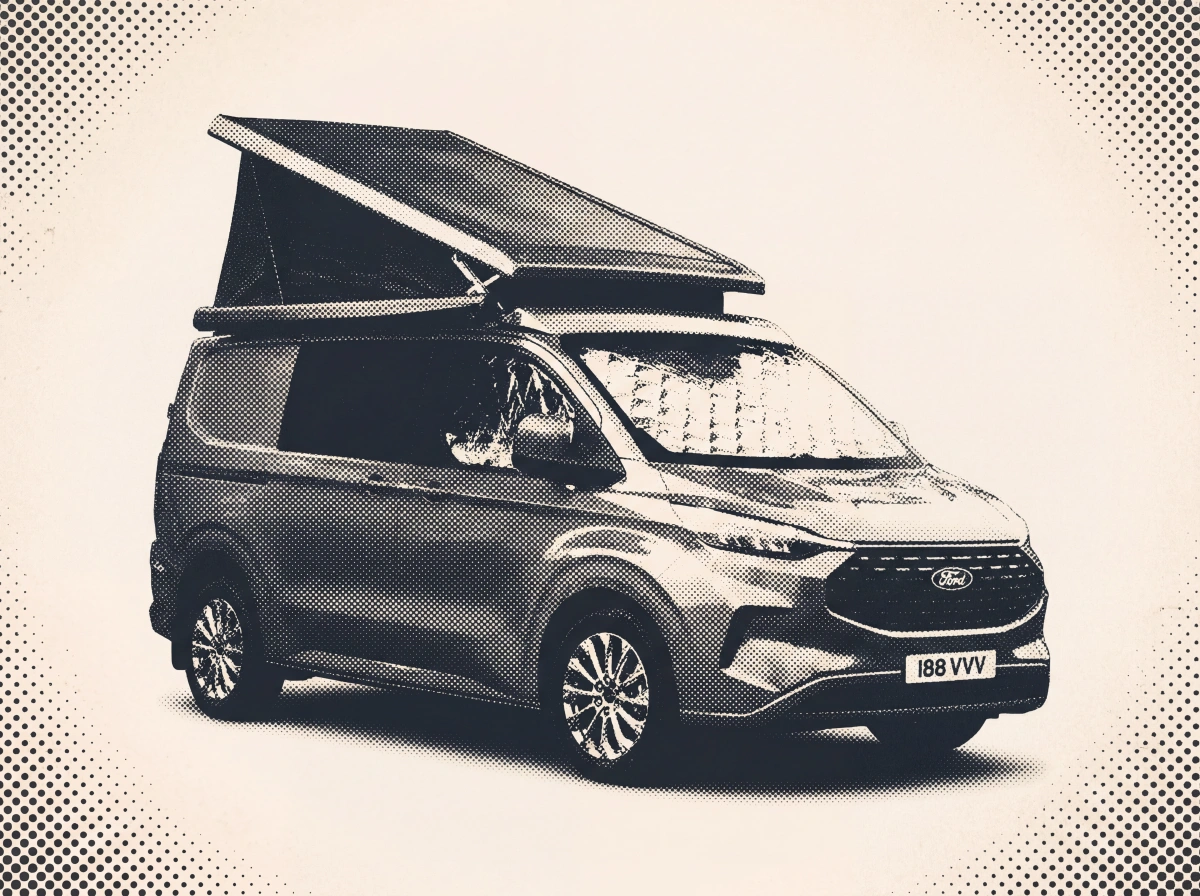
Ford offers the Transit Custom Nugget, built in partnership with the German conversion royalty Westfalia. The new-generation Nugget runs the 170 PS diesel with the eight-speed auto, and, in a first for the Nugget, a plug-in hybrid version too. It has an elevating pop-up roof, two double beds, a flat floor between cab and living area, and a 13-inch touchscreen, and it lands at around €76,500 in Germany, with a UK figure quoted in the region of £65,000 (treat that as indicative, not gospel). Diesel deliveries began in spring 2024.
Volkswagen, as we covered above, does not make a factory camper on the Ford-based Transporter. The VW California you can buy is built on the separate Multivan. So the curious upshot of the alliance is this: the factory campervan on this platform wears a Ford badge, not a VW one.
For our purposes, the takeaway is about routes to ownership. If you want a turnkey, dealer-backed, factory-warrantied camper on this platform, the Nugget is the option, and a genuinely good one. If you go the Volkswagen route, you're committing to a conversion, either by a specialist converter or yourself. Both are valid. They're just different journeys, and it's worth knowing which one each badge actually offers before you fall in love with an idea that doesn't exist.
The converter's-eye view: which is nicer to build on?
Because the body shell is shared, a self-builder or a converter is working with broadly the same canvas either way. But people who do this for a living do note a few differences, and they're worth repeating.
On the Ford side, converters praise a body that feels designed with conversion in mind: ready-made grommets for routing cabling, panels that are straightforward to cut, and notably straight, square walls that make cabinetry sit cleanly without a fight. Build enough vans and that adds up to hours saved and neater results.
On the VW side, the practical wins are that slightly wider floor between the arches, and, more importantly, the size and maturity of the aftermarket. The Transporter inherits the vast ecosystem built up around decades of VW camper culture: off-the-shelf pop-top roofs, flat-pack furniture kits cut to fit, fitted units, and a thousand forum threads on exactly your problem. The Transit Custom's aftermarket is growing fast, helped by the shared platform, but the VW world is still deeper if you want to lean on existing kit rather than fabricate everything.
If you're paying a professional converter, none of this changes your day much, they'll make either van beautiful. If you're building it yourself in a barn over eighteen months, the Ford's converter-friendly body and the VW's richer parts ecosystem pull gently in opposite directions, and which matters more depends on how much you want to buy off the shelf versus make from scratch. While you're planning the electrics, our campervan power systems guide covers the kit that goes in either van.
Cost: badge premium, running costs, insurance and resale
Money is where the alliance has quietly rewritten the old rules, so this needs care.
For years the received wisdom was simple: the VW costs a good deal more than the Ford for what is, increasingly, the same van. There's truth in that history. One 2026 trade source still puts the VW at typically 8 to 10% more expensive than an equivalent Ford, spec for spec. But another 2026 review found the opposite at the entry point, quoting the Transporter from £32,965 against the cheapest Transit Custom at £35,614, with the VW also bundling air-conditioning and LED headlights as standard, so on those specific trims the VW actually undercut the Ford by around £2,650.
Both can be true at once. Ford's range starts lower historically and offers more sparsely-equipped entry variants, so matched trim-for-trim the VW has tended to carry a premium, while at particular early-2026 entry trims the VW's headline "from" price sat below Ford's. The blunt takeaway: now they share a factory and powertrains, the old "the VW always costs thousands more" rule is weakening fast. Price the exact trims you want, on the day, both ways including and excluding VAT (van prices are quoted both ways, which trips people up constantly), rather than trusting a rule of thumb.
Running costs are, again, near-identical, because it's the same diesel: expect best-case economy around 40 to 41 mpg on the lighter manuals, falling with weight and with the all-wheel-drive VW.
Insurance tends to favour the Ford. It's typically cheaper to insure thanks to a lower purchase value and cheaper, more widely-stocked parts, while the VW often starts a group or two higher on account of its value and VW-specific part prices. Over a decade that gap is real money.
And then resale, which is the VW's genuine trump card and the single biggest line in your true cost of ownership. The VW Transporter holds its value about as well as any panel van on sale, propped up by the badge and by a fervent camper-conversion resale market where a tidy VW camper sells itself. The Ford depreciates faster. A converter we rate put it well: if someone wants something they can full-time in for years and then sell on with confidence, it's hard not to lean towards the VW. Depreciation is invisible until you sell, and then it's the biggest number of all, so weigh it properly rather than fixating on the sticker price.
Reliability, warranty and dealers
Three more ownership factors, and they don't all fall the same way.
On reliability, Volkswagen Commercial Vehicles came out strongly in 2025's industry surveys, topping the charts as the most reliable van brand, with the Transporter named the most reliable model for a second year running. The Transit Custom, as a fresh design, climbed to third. Both are strong; the VW currently has the edge on reputation, though the new shared platform is young enough that long-term data is still being written.
On warranty, the picture flips. Ford covers the Transit Custom for 3 years or 100,000 miles. VW's headline is also 3 years, but it's commonly bundled with the "5+ Promise": five years or 124,000 miles of cover, five services, the first three MOTs and five years of roadside assistance. For a van you intend to keep and rack up miles in, that extended package is a meaningful, money-saving advantage to the VW.
On dealers, it's close to a wash. Ford's commercial network of Transit Centres is enormous and used to vans-as-tools, while VW Commercial Vehicles has a solid, slightly more premium-feeling network. Wherever you break down in Britain, you're rarely far from help with either.
The used route: do you even need a new one?
Here's a question the new-van brochures would rather you didn't ask: do you need the brand-new, Ford-built van at all? Because the used market on this platform is deep, and for a lot of camper builders it's the smarter spend.
Two things make it compelling. Vans depreciate hardest in their early years, so letting someone else absorb that first chunk of loss frees up thousands you could pour into the conversion instead. And the previous-generation vans are genuinely excellent, and, tellingly, are wholly each maker's own design rather than the shared platform, which some buyers actively prefer.
A used VW Transporter T6.1 (the outgoing, fully-VW van built in Hannover) is the camper world's darling, and priced accordingly. Demand from converters keeps used values stubbornly high, which is brilliant if you're selling and sobering if you're buying: you'll pay a real premium over an equivalent Transit, and a tidy low-mileage example can cost not far off a new entry van. The flip side is that the premium largely holds, so your money is parked, not burned.
A used previous-generation Ford Transit Custom is, by contrast, one of the best-value camper bases in Britain. Same story as new: a cracking medium van that depreciates faster than the VW, which is your gain as a buyer. You'll get more van, or newer, or fewer miles, for the same money than the VW equivalent, and there's vast supply because Ford sold them by the hundred thousand to fleets. A well-kept ex-fleet Custom with full history is a superb, affordable canvas.
The watch-outs are the usual used-van ones, and they bite harder on something you'll convert. Check the service history obsessively, because a neglected diesel with a clogged DPF or a tired auto box is an expensive mistake under a finished conversion. Look for rust around the sills, arches and door bottoms, and for signs of a hard fleet life. Get any high-miler's cambelt and clutch history. And weigh the van, because an ex-fleet example with a ply-lined load bay and a tow bar may have less payload left than you'd hope. If resale is your priority, a used T6.1 is the safest money in the camper world; if value-for-conversion is, a used Transit Custom is hard to beat.
So which should you base your camper on?
Time to call it, honestly, because that's the whole point of us.
Start from the truth we opened with: underneath, these are the same van, from the same factory, with the same engines. Anyone who tells you the Transporter is a fundamentally better machine than the Transit Custom is, in 2026, mostly describing a badge and a memory. That's not nothing, but it's not engineering.
Base your camper on the Ford Transit Custom if: you want hard-sided standing height without a pop-top (the factory high roof is the headline reason to choose Ford, and it's cheaper than adding an elevating roof to a VW); you want the lowest price to buy and to insure; you like the slightly sharper drive and the much-praised cabin; you fancy building on a body that's genuinely converter-friendly; or you want a turnkey factory camper, in which case the Nugget is the only one of the two that exists. For a lot of rational self-builders chasing standing room and value, the Ford is quietly the smart pick.
Base your camper on the VW Transporter if: you want four-wheel drive, which Ford can't offer at all on this van; you're keeping it long-term and care about resale, where the VW is in a class of its own; you want the longer "5+ Promise" warranty; you plan to lean on the deep VW camper aftermarket of pop-tops and flat-pack kits; or, yes, the badge and what it does for you and for resale genuinely matters, which is a legitimate reason, just be honest that that's what you're paying for. Devon's Taylored, for instance, build their excellent Offtrail conversion on exactly this Transporter base, pop-top and all.
If we had to reduce it to a single sentence: choose the Ford if you want the most van and the most standing room for your money today, and the VW if you want all-wheel-drive ability, the best resale in the class, and you'll happily fit a pop-top anyway. The pop-top question is the quiet decider for most people. If you're popping the roof regardless, the VW's lack of a factory high roof costs you nothing and its resale earns you plenty. If you want to stand up the moment you park, without a pop-top, the Ford hands it to you for less.
What you shouldn't do is pay a big premium believing you're buying a fundamentally superior vehicle. The alliance ended that. You're choosing trim, tuning, a roof option, a drivetrain option, a warranty and a resale curve, on top of a van that's the same underneath. Choose the wrapper that fits your life, and put the money you save into the conversion, because that's the bit you actually live in.
Frequently asked questions
Is the new VW Transporter really just a rebadged Ford Transit Custom? Largely, yes. It's built by Ford on the Transit Custom platform, in Ford's Turkish factory, with the same engines. VW restyles the nose, designs the upper dashboard, reskins the infotainment and softens the ride, so it isn't identical to sit in or drive, but mechanically, treat it as the same van. The badge, trim, warranty and resale are where the real differences now live.
Can I get a factory high-roof VW Transporter? No. The Transporter is low-roof only, under two metres. To stand up inside one you fit an elevating pop-top. The Ford Transit Custom offers a factory high roof with around 1,778mm of internal standing height, so if hard-sided standing room without a pop-top is your priority, that's a strong reason to choose the Ford.
Which holds its value better? The VW, clearly, and it's not close. The Transporter has among the strongest residuals of any panel van, propped up by the badge and a hungry camper-conversion resale market. The Ford depreciates faster, which hurts if you're selling and helps if you're buying used. Over a long ownership, residual value is usually the single biggest cost, so weigh it as heavily as the purchase price.
Is the electric version any good as a campervan base yet? For short-range and urban campers, increasingly yes; for long-tour, off-grid, fixed-bed full-timers, not quite. The Ford E-Transit Custom's 82.5kWh battery and circa-236-mile WLTP range are the more usable, but real-world range falls sharply with a heavy conversion aboard, the under-floor battery raises the floor and trims standing room, and electric payloads are lower than the diesels. A fine choice for the right use, still a compromise for serious touring today.
VW Transporter or Transit Custom for full-time living? Go long-wheelbase whichever you pick, then it's down to roof and resale: the high-roof Ford gives you a proper standing home for less outlay, while the VW gives you four-wheel-drive availability, the best resale and the deepest aftermarket if you're popping the roof anyway. Most full-timers chasing standing room and value lean Ford; those prioritising AWD and resale lean VW.
Is the Ford Nugget worth it over a self-build or a specialist conversion? If you want turnkey, dealer-backed and factory-warrantied, the Nugget is a genuinely good thing, and the only factory camper on this platform. A specialist conversion or self-build will usually give you a more bespoke layout, more off-grid capability and often better value for the spec, at the cost of more hassle and a longer wait. It's the classic factory-versus-bespoke trade-off.
Does sharing a platform with Ford make the VW cheaper to run or fix? Potentially, over time: shared platforms tend to mean better parts availability and a wider pool of technicians who know the mechanicals, which helps keep an older camper on the road cheaply. In practice, though, VW-branded parts and VW servicing can still cost more than the Ford equivalent even when the part underneath is identical, so the VW's running and insurance costs stay a little higher despite the common origins. The badge follows you to the parts counter.
What's the ideal spec to order if I'm converting one? For most builds: a long-wheelbase (L2) body for the floor space, a mid-range diesel (the VW 150, or the Ford 136 or 170) with the eight-speed automatic for relaxed, loaded cruising, and a higher gross-weight variant (think T32, or the 320 to 340 ratings) so you start with real payload headroom. Add 4Motion only if you'll genuinely use it, because it costs payload, economy and money. Keep the cab trim sensible rather than piling on heavy options that quietly eat your payload. And unless your trips are short and your charging is sorted, stick with diesel for a heavy off-grid build today. On the Ford, the factory high roof is the single box that most changes the conversion; on the VW, budget for the pop-top from the very start, because you'll need it to stand up.
Common questions
Is the new VW Transporter really the same as a Ford Transit Custom?
To a large degree, yes. The new VW Transporter, in production from late 2024, is built by Ford on the same line as the Transit Custom in the same factory in Turkey, with the same engines, under the Ford-VW alliance launched in 2019. VW restyles the nose, reskins the screen and tunes the ride a touch softer; mechanically they are two versions of the same van.
Which T7 do people mean, the Transporter or the California?
This is the key source of confusion. VW uses T7 loosely for two different vehicles: the new Ford-based Transporter panel van, and the car-based Multivan that VW markets as the T7 California camper. They are different platforms in different factories. For a conversion base, the Transporter is the one compared with the Ford Transit Custom.
Which engine should I choose for a camper on a Transporter or Transit Custom?
The converter consensus is the middle of the range: the Ford 136 or 170, or the VW 150, the sweet spot between power and economy. The entry 110 feels weedy once you have added 600kg of furniture, water and people; the 170 is lovely and effortless but auto-only and pricier. The eight-speed automatic suits a heavy, cruising camper. Expect low 40s mpg gently, dropping into the 30s when heavy.
Does the VW Transporter have an advantage over the Ford Transit Custom?
Its main mechanical trump card is four-wheel drive (4Motion), which the VW offers and is useful for slippery pitches, though it costs payload, economy and money, so only add it if you will genuinely use it. Otherwise the differences are the badge, the styling, a slightly softer ride, and warranty, resale and dealer network, since the vans are mechanically the same.
What is the ideal spec to convert into a camper?
For most builds: a long-wheelbase L2 body for floor space, a mid-range diesel (VW 150, or Ford 136 or 170) with the eight-speed automatic for relaxed loaded cruising, and a higher gross-weight variant (think T32 or 320 to 340 ratings) so you start with real payload headroom. Add 4Motion only if you will use it, keep the cab trim sensible, and budget for the pop-top from the start on the VW to stand up.
Should I base my camper on the VW Transporter or the Ford Transit Custom?
Since they are mechanically the same van, decide on the things that differ: badge and resale (the VW commands a premium), the Ford's factory high-roof option, warranty and dealer network, and whether you want 4Motion (VW only). If the badge and residuals matter and you will use four-wheel drive, the VW; if you want the best value on identical engineering, the Ford.
The reachable bit
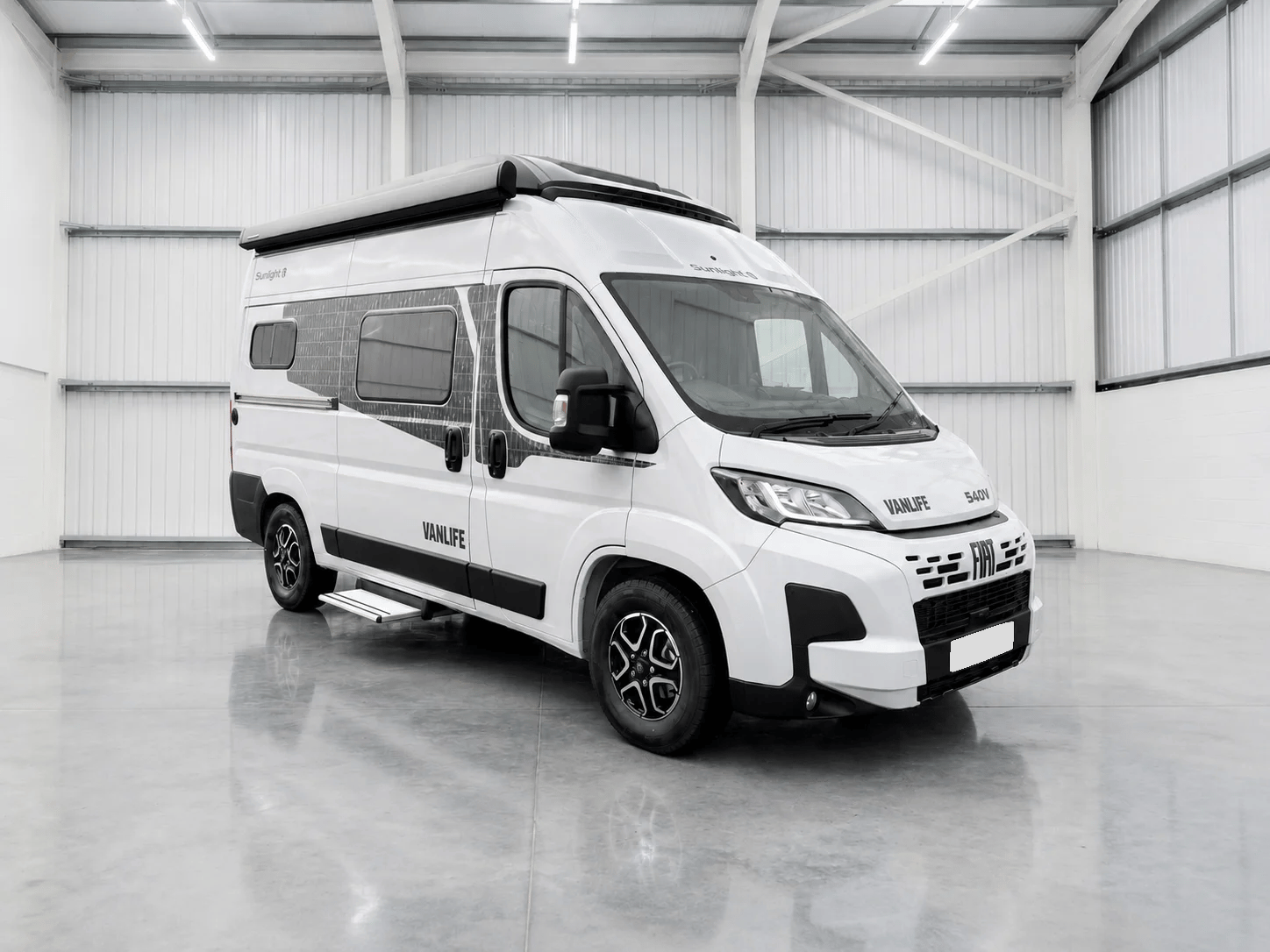
The camper you fall for is rarely the one you can afford. That gap is the whole reason Campervan.win exists. Right now we’re giving away the Sunlight Vanlife, worth around £65,000, and closing that gap is the point: capped entries so the odds stay honest, £10 a ticket, a maximum of five per person, £500 to a UK charity from every full draw, the winner picked by a public randomness beacon anyone can re-check, and one person driving away in the van itself.
VW Transporter or Ford Transit Custom: which would you build on?
Same factory, same engines. Which badge gets your conversion?
VW Transporter (T7)
Ford Transit Custom
Tap a side to vote. It’s anonymous.

About the author
Leo
Leo covers campervan technology, maintenance, kit, and ownership advice, with a clear, practical focus on how things work in real life.
Keep Reading
Related Reading
Thoughtful articles that build on what you’ve just read.
Campervan Buying Guides
10 min read
Swift Merlin 2027: nine layouts from £64,190 and how to pick the right one
Swift's all-new Merlin campervan arrives for 2027 with nine layouts on the Fiat Ducato panel van. We sort them into four families, work the payload sum on a four-seat version, and explain what the roof, the automatic and the prices mean for your choice.
Campervan Buying Guides
11 min read
Bailey Endeavour B68: the end-lounge Transit campervan where the pop-top costs 143 kg
Bailey's new Endeavour B68 puts a rear lounge in a 5.98 m Ford Transit campervan. We compare it with the B65 and B62, check the 1.86 m bed, and do the payload sums if you add the £7,500 pop-top.
Campervan Buying Guides
12 min read
New campervans under £60,000 for 2027: what the NEC shows and what the price leaves out
A fair look at the new 2027 campervans listed under £60,000 ahead of the Motorhome and Caravan Show at the NEC, with each price given as its maker words it, and the differences between ex-works, delivered and German-retail-based figures explained so you can compare real on-the-road totals.
Campervan Buying Guides
14 min read
Eura Mobil Vancona 2027: a €57,400 campervan with just 84 to 118 kg left for options
Eura Mobil's new Vancona is a well-equipped Fiat Ducato campervan from €57,400, but its 84 to 118 kg options allowance means you need to order it with the weight sheet open. We explain what the figure means, what the 4.25 t uprate costs you in licence terms, and which options to prioritise.