Motorhome Reviews
Swift Trekker 594: is the compact coachbuilt the sweet spot for UK touring?

Written by
Jasper
Jasper writes campervan reviews, travel guides, and practical advice, with a focus on everyday use and relaxed touring around the UK.
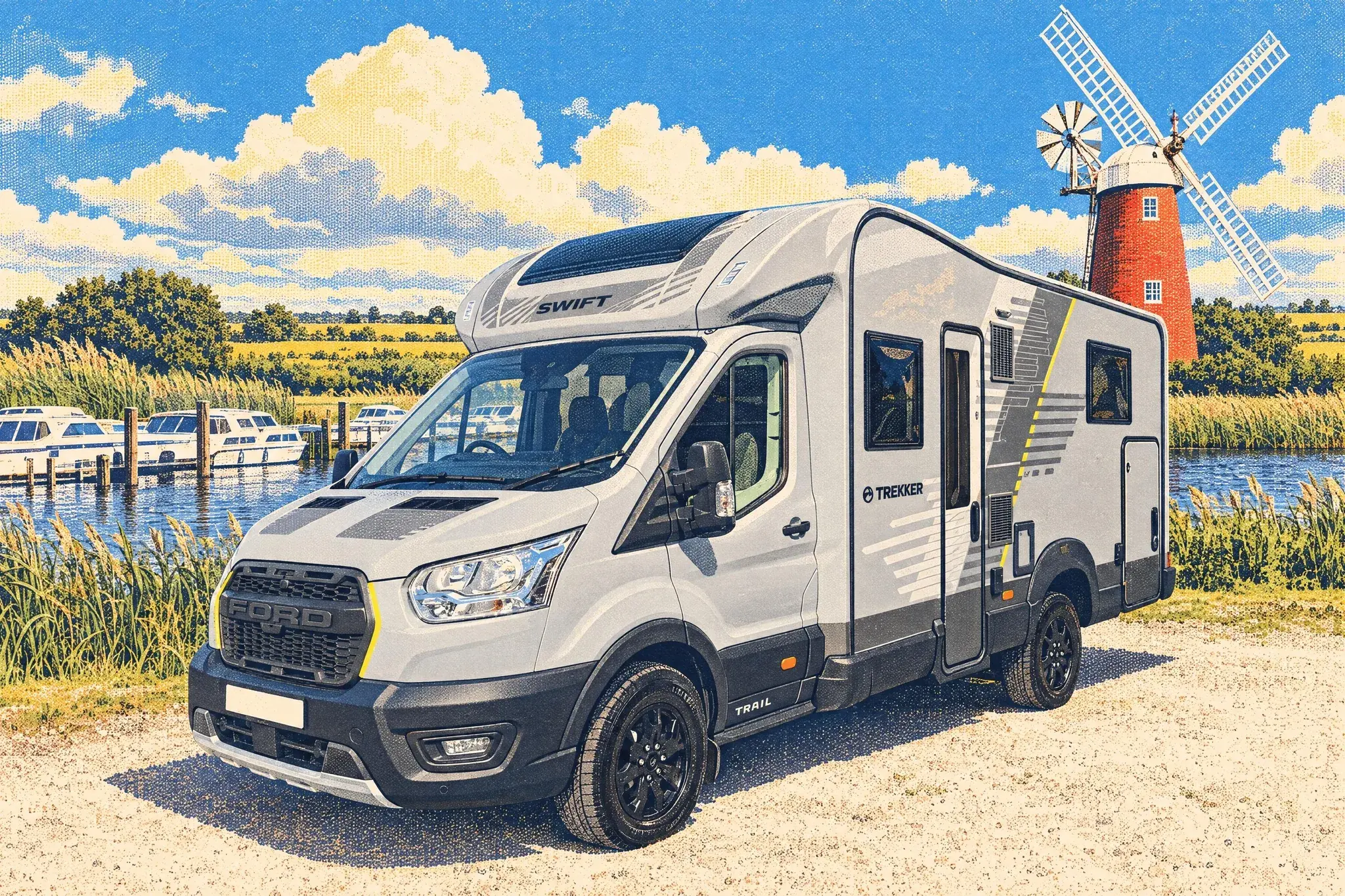
Picture a motorhome small enough to park in a normal bay, but big enough to sleep, cook and shower properly. That is the promise of the compact coachbuilt, and the Swift Trekker 594 is one of the better known attempts at it. It is short, it is tidy, and it tries to give you a real fixed bed and a real washroom inside a footprint that does not frighten you on a Cornish lane.
So is it the sweet spot for UK touring, the happy middle between a cramped campervan and a barge of a coachbuilt? This is the long, honest answer. We will go through the chassis, the layout, the weights and the licensing, the heating and electrics, what it is like to actually drive and live in, and what it costs to run. We will be specific about numbers, and we will be honest about the compromises, because every motorhome is a set of compromises and the only question that matters is whether you can live with these particular ones.
What the Trekker badge actually means
Swift sells motorhomes across several ranges, and the Trekker sits as a more rugged, adventure-flavoured version of its mainstream coachbuilt models. The badge is not just stickers. The Trekker treatment typically brings a higher specification as standard, with things like upgraded upholstery, more substantial wheels and tyres, and a presentation aimed at people who want the van to look ready for a windswept beach car park rather than a tidy retirement park.
That said, you should be clear-eyed about what "adventure" means here. This is not an off-road expedition vehicle. It is a road-going coachbuilt on a standard light commercial chassis, with the same fundamental limits as any other motorhome of its size. The Trekker styling and trim make it feel purposeful, and the practical kit is genuinely useful, but you are not buying a go-anywhere truck. You are buying a well-equipped compact motorhome with a confident look.
The 594 part of the name follows Swift's usual logic. The first digits relate to the overall length, so you are looking at a van around the six-metre mark, and the final digit indicates the number of berths, which here is four. That naming alone tells you the pitch: a four-berth motorhome in a footprint that many four-berths cannot match.
Why compact coachbuilts exist at all
The compact coachbuilt is a response to a real problem. A lot of UK buyers want the fixed facilities of a coachbuilt, a proper bed you do not make up every night, a separate washroom, a kitchen with an oven, but they do not want a seven-and-a-half-metre vehicle they are nervous to take anywhere. The roads here are narrow, the car parks are tight, the lanes have hedges that brush both mirrors, and a lot of the prettiest places have height barriers and modest pitches.
So manufacturers shrink the coachbuilt. They keep the overcab or low-profile shell, keep the molded GRP body, and squeeze the living space into something close to a long-wheelbase van's length. The 594 is squarely in this category. The appeal is obvious. The trick, as always, is whether the shrinking has cost you too much inside.
The chassis, engine and the bits that drive
Like most coachbuilts in this class, the Trekker 594 is built on a front-wheel-drive light commercial chassis, the kind that underpins a huge proportion of European motorhomes. In practice that means a Peugeot or Citroen Boxer style base, with the familiar 2.2-litre turbo diesel engine. Power outputs in this family usually sit around 140bhp as a sensible middle option, with a lower 120bhp and a higher 165bhp available depending on the spec and year.
For a compact coachbuilt, 140bhp is the figure most people end up happy with. The 120bhp will move the van perfectly well but feels a little breathless on long motorway climbs when fully loaded. The 165bhp is genuinely relaxing if your budget stretches and you do a lot of distance, particularly if you tow or carry bikes and gear. None of these are fast. They are torquey, gear them down for hills, and you get along fine.
Manual or automatic
This base offers a manual gearbox and an automated option. The automated gearbox in this family has improved a great deal over the years and takes the strain out of town driving and slow campsite manoeuvres. If your touring includes a lot of stop-start traffic, hills, or simply a driver who would rather not change gear on a narrow descent, the auto is worth the premium. The manual is cheaper, slightly more economical in some hands, and perfectly pleasant if you enjoy driving.
Front-wheel drive and grass pitches
Front-wheel drive has one real-world consequence worth knowing. On wet grass, especially when the van is loaded with the weight over the front, traction can be marginal. It is rarely a disaster, but a soggy field exit in April can need a gentle approach, a set of grip mats in the locker, and a willingness to ask for a tow if it comes to it. This is not a Trekker fault, it is a feature of the whole class. The Trekker's chunkier tyres help a little, no more.
How it feels on the road
Compact coachbuilts drive better than their boxy looks suggest, and the short overall length really helps. You sit high, the visibility forward is good, and the mirrors are large. Side and rear visibility is the usual coachbuilt story, which is to say limited, so a reversing camera earns its place and many buyers add extra blind-spot mirrors. Crosswinds on exposed motorway bridges will move a tall, light van around, and you learn to relax your grip and let it settle rather than fighting it.
The shorter wheelbase makes the 594 genuinely easy in towns and tight car parks compared with a longer coachbuilt. You can place it accurately, the turning circle is reasonable, and you stop worrying about overhang on mini-roundabouts. This is the entire point of the format, and on this measure it delivers.
Dimensions and the all-important footprint
The headline figure is the length, which sits right around the six-metre mark. That number matters more than almost anything else for UK touring. It is the difference between fitting in a standard parking bay with the nose poking out slightly and not fitting at all. It is the difference between a relaxed pootle down a single-track road and a sweaty reverse to a passing place.
- Length: approximately 5.99m, which is the magic sub-six-metre figure many buyers chase.
- Width: around 2.3m excluding mirrors, typical for the class, wide enough to be aware of on narrow lanes.
- Height: roughly 2.8 to 2.9m depending on roof fittings such as air conditioning or a solar panel and a satellite dome.
That height number is the one people forget and then regret. A great many UK car park height barriers are set at 2.0m or 2.1m, which rules out almost any coachbuilt. Multi-storey car parks are simply off the menu. You learn to plan around this, using on-street parking, park-and-ride sites with no barrier, dedicated motorhome bays where they exist, and campsites. Measure your own home access too. A 2.9m van will not fit under a typical domestic garage door or a low carport, and some residential parking with overhanging trees or low cabling needs thought.
The two-metre width in practice
A 2.3m body feels wide the first few times you meet a bus on a B road. After a fortnight it feels normal. The thing to remember is that the mirrors add to that, so your true working width is closer to 2.5m or a touch more. On the prettiest, oldest UK lanes, the ones with stone walls and no give, that width is the limiting factor, not the length. The compact coachbuilt helps with length, but it cannot make you narrow. Plan routes accordingly and you will be relaxed. Blunder into the wrong lane and you will have a tense ten minutes.
The 594 layout: what you get inside
The 594 is a four-berth, and the layout is the heart of the decision. Swift's compact coachbuilts in this family typically use a front lounge that converts, a central kitchen and washroom, and a sleeping arrangement at the rear. The exact configuration of the 594 centres on getting a usable bed and a proper washroom into the short body, and the way it does that defines daily life on board.
The front lounge and travel seats
Up front you get a half-dinette or parallel sofas arrangement that, combined with the swivelled cab seats, gives you a sociable lounge. The cab seats turning to face into the living space is one of the quiet pleasures of a coachbuilt over a panel-van conversion, because it instantly adds two comfortable armchairs to the room. With the table up you have somewhere to eat, work on a laptop, play cards on a wet afternoon, or simply sprawl with a book.
Travel seats matter here. The 594 provides four belted travel seats, two in the cab and two in the habitation area, which is what makes it a genuine four-traveller vehicle rather than a four-berth that can only legally carry two on the move. If you intend to travel as a family or as two couples, count the belts and check the seat positions suit how you actually use the van.
The kitchen
The galley in a compact coachbuilt is always a balancing act between worktop and walkway. Expect a three-burner gas hob, a combined oven and grill, a sink with a drainer, and a decent fridge, often a three-way unit running on gas, mains or 12 volts, or in newer specs a larger compressor fridge. Worktop space is at a premium, so most owners learn to use a chopping board over the sink or hob to extend it, and to cook in stages rather than spreading out.
It is a perfectly workable kitchen for real cooking. You can roast a chicken, do a proper fry-up, make a curry. What you do not get is the sprawling galley of a long coachbuilt, so if you are the kind of cook who needs every dish prepped and laid out before you start, you will find it tight. Most people adapt within a few trips.
The washroom
The washroom is where the compact format works hardest. In six metres, a fully separate shower is a luxury, and many vans this size combine the functions, with a shower that shares the room with the toilet and basin. Swift's compact designs are clever here, often using a swivel or fold arrangement to create a usable shower space. You will be showering in a compact cubicle, not a spa, but it works, it keeps you off the campsite shower block when it is raining, and that alone changes how you tour.
The toilet is the standard cassette type, accessed from outside for emptying, with a swivel bowl to make the most of the floor space. The cassette holds a few days for two people if you are sensible about what goes in it. The fresh and waste water tanks are sized for the body, so they are smaller than a big coachbuilt's, and you will fill and empty more often. More on water capacity below, because it is one of the genuine trade-offs of going compact.
The beds
This is the single biggest question for any four-berth this short. The rear sleeping arrangement is the defining feature. Compact coachbuilts achieve four berths in a couple of ways. Some have a fixed rear bed, often a transverse double or a French bed angled into a corner, with a second double made up from the front lounge. Others use a drop-down overcab bed plus a made-up lounge bed.
The honest position is this. If you want a permanent, climb-straight-in bed that you never make up, check carefully which bed in the 594 is fixed and which is made up nightly. A fixed rear bed is a daily joy and worth a lot. A nightly lounge conversion is fine if it is quick, but it means you cannot leave the bed made and use the lounge at the same time, which is a real limit for two people living aboard for weeks. Sit in the van, make up every bed yourself, and time how long it takes. Do this before you buy, not after.
The best bed in a motorhome is the one you will actually use. A magnificent fixed double you have to clamber over your partner to reach at 3am can be worse in practice than a simple made-up bed with steps. Try it for real.
Storage: the compact compromise
Storage is where the laws of physics catch up with the compact coachbuilt. A shorter van has less space for lockers, less under-bed garage, and a smaller wardrobe. This is not a criticism of the 594 specifically, it is the cost of the format. What matters is how cleverly the space is used.
Look for the under-bed area, which in many compact layouts doubles as an external-access garage for folding chairs, a barbecue, levelling ramps, hookup cable and the inevitable bag of "might need it" items. Even a modest garage transforms practicality, because it keeps muddy outdoor kit out of the living space. Check the access hatch size and whether the bed slats lift to load from inside too.
Inside, count the overhead lockers and open the wardrobe. For a fortnight's touring for two, you will be fine if you pack like a sailor rather than a holidaymaker. For a couple living aboard for a season, storage becomes the daily discipline. Soft bags rather than hard cases, a capsule wardrobe, and a ruthless attitude to duplicate kit. The people who struggle in compact vans are usually the ones who packed for a house move.
Payload is storage's twin
There is no point having a locker if you cannot legally fill it. This brings us to the most important section of the whole review, the one too many buyers skim and later regret.
Weights, payload and licensing: read this twice
The single most important number on any motorhome is the one most likely to catch you out. It is the maximum technically permissible laden mass, the MTPLM, and it governs both what you can legally carry and, crucially, who in your household is allowed to drive the van at all.
The 3,500kg line and your driving licence
Most compact coachbuilts, including the 594 in standard form, are plated at 3,500kg MTPLM. That figure is not an accident. It is the upper limit for what a standard category B car licence can drive if you passed your test on or after 1 January 1997. If your licence is post-1997 and shows only category B, you can drive a vehicle up to 3,500kg. The moment a motorhome is plated above that, you need category C1, which most younger drivers do not hold and have to pass as an additional test.
If you passed your test before 1 January 1997, you almost certainly have so-called grandfather rights, category C1 on your licence, allowing you to drive up to 7,500kg. Check your licence to be sure, and note that C1 grandfather rights are reviewed at 70 and require a medical to retain. This is a real factor for older buyers, because losing C1 at 70 can suddenly make a heavier van unlawful for you to drive.
The practical upshot is that the 594 staying at 3,500kg is a genuine selling point. It keeps the van accessible to the widest range of drivers, including the partner who might need to take over, and it avoids the cost and hassle of a C1 test.
The payload trap
Here is where it gets uncomfortable. The MTPLM is 3,500kg. The mass in running order, the MIRO, is what the van weighs ready to go with fluids, gas and a notional driver. The difference between those two numbers is your payload, everything you are allowed to add: passengers, water, food, clothes, gear, the awning, the bikes, the dog and its bed.
On a compact coachbuilt with a generous standard specification, that payload can be tighter than you expect. By the time you have added passengers at the conventional 75kg each, a full fresh water tank at potentially 70 to 100 litres which is 70 to 100kg, a full gas bottle, an awning, an outdoor furniture set and a fortnight's food and clothing, you can be brushing the limit faster than feels reasonable. Add a bike rack with two e-bikes and you can blow straight through it.
Before you buy, do this:
- Ask for the actual weighbridge ticket or the documented MIRO for the specific van and spec, not the brochure figure.
- Subtract the MIRO from the 3,500kg MTPLM to find your true payload.
- Add up everything you intend to carry, honestly, including water and people.
- If the sums are tight, look at whether the chassis can be uprated. Some bases can be replated to a higher MTPLM by the manufacturer or a specialist, though that may then push you over 3,500kg and into C1 territory, which defeats the licensing advantage.
This is not scaremongering. Overloaded motorhomes are common, and an overloaded van handles worse, brakes worse, and is uninsured and illegal if stopped and weighed. Police and DVSA do weigh motorhomes, particularly on routes to ferry ports in summer. A weighbridge visit with the van loaded as you actually travel costs a few pounds and is the single best money you can spend after purchase.
Why the Trekker spec affects payload
The very things that make the Trekker appealing, the upgraded trim, bigger wheels and tyres, extra kit, all add weight to the MIRO. Higher specification almost always means lower payload, because the ceiling stays at 3,500kg. It is worth weighing this against the appeal of the kit. A lighter, plainer van you can load fully may suit a heavy-packing family better than a beautifully specified one with no payload left.
Heating, hot water and staying comfortable
UK touring is not a fair-weather pursuit. We tour in spring frosts, autumn gales and the odd surprisingly cold summer night, so heating matters far more here than in a Mediterranean market. The good news is that the 594, like most quality coachbuilts, comes well equipped for our climate.
The heating system
Expect a Truma combi system, the workhorse of the European motorhome world. It heats the air and the hot water from a single unit, runs on gas as standard, and can often be specified or upgraded to run on gas and mains electric together, which is the dual-fuel arrangement many UK owners prefer. On a cold site with a hookup, running the heating on mains electric saves your gas for off-grid days and is cheaper than swapping bottles.
The combi blows warm air through ducted outlets around the floor, and a well-insulated compact body warms up quickly precisely because there is less air to heat. This is a genuine compact advantage. A small van gets cosy fast. A huge coachbuilt takes longer and burns more gas to hold temperature.
Hot water and the morning routine
The combi stores a tankful of hot water, enough for washing up and a sensible shower or two before it needs to reheat. The reheat is quick. The discipline of a compact van is that you do not stand under the shower for fifteen minutes, you do the navy shower: wet, off, soap, on, rinse. Do that and the system keeps two people clean comfortably.
Insulation and winter use
Swift builds for the UK and Northern European climate, and the body construction is designed to handle cold, damp conditions far better than a warm-climate build. If you intend genuine winter touring, check the grade of insulation, whether the water tanks and pipes are inside the heated envelope or at least protected, and whether the waste tank can be heated or insulated. Frozen pipes are the classic winter motorhome misery, and a van with tanks slung underneath unprotected will catch you out on a frosty Cairngorms morning. Compact coachbuilts vary, so ask the specific question for the 594.
Electrics: living off the hookup
How you power your touring shapes everything. There are two broad styles. One is the campsite-and-hookup approach, where you plug into mains electric most nights and the van's battery is really just for transit and the odd overnight. The other is the off-grid or wild-friendly approach, where you want to spend nights away from hookups, on aires, certificated locations, or quiet park-ups, and rely on your own power.
The standard setup
A compact coachbuilt typically leaves the factory with a single leisure battery and a basic charger, sized for hookup-based touring. That is fine for many people. Plug in, and you have light, water pump, heating control, fridge on mains, and charging for phones, all night, no thought required.
Upgrading for off-grid
If you want to wake up by a Welsh estuary with no hookup in sight, you need to think about three things: how much power you store, how you put it back in, and how much you draw out.
- Storage: a second leisure battery, or better a lithium battery, dramatically increases usable capacity. Lithium gives you more usable amp-hours for the weight and charges faster, which matters on a payload-limited van where every kilo counts.
- Generation: a roof solar panel is close to essential for off-grid touring. Even a modest panel keeps the batteries topped in summer and slows the decline in winter. A larger array transforms how long you can stay out.
- Draw: the big consumers are the fridge on 12 volts, the heating fan, and any kettle or toaster you try to run through an inverter. A gas hob and a gas fridge option sidestep much of this. Run a 2kW kettle off a battery and inverter and you will watch your reserves vanish.
A realistic off-grid build for the 594 is a lithium battery, a couple of hundred watts of solar, a decent battery-to-battery charger so the engine tops the leisure battery as you drive, and the discipline to boil water on gas rather than electric. Do that and three or four nights away from hookup is comfortable for two. Push for a week and you are managing power carefully and watching the weather.
Gas
The van runs gas for cooking, the fridge if it is three-way, and the heating. UK touring usually means refillable bottles or the standard exchange bottles. A refillable system, where you fill at certain forecourts with LPG, is cheaper per use and convenient on long trips, but it is an upfront cost and not every forecourt has the right nozzle. Many owners run two bottles with an automatic changeover so you never run dry mid-shower. Check what the 594 has and what fits in the gas locker.
What it is genuinely like to live in
Specifications are one thing. Daily life is another. Here is the honest texture of living in a compact coachbuilt like the 594.
Two people, two weeks
For a couple on a fortnight's tour, the 594 is close to ideal. The lounge is sociable, the kitchen does proper meals, the washroom keeps you independent of the campsite block, and the bed, if it is the fixed type, means you climb in tired and climb out rested without faffing. The compact size means you park easily, you nip to the shops without planning, and you take the lane to the hidden beach that a big coachbuilt would never attempt. This is the use case the van was designed for and it shines.
Two people, two months
Living aboard for a season changes the calculus. Storage discipline becomes daily life. The smaller water tanks mean more frequent fills and emptyings, which is a small chore but a regular one. If the second bed is a nightly conversion, you feel the lack of a permanent spare space. Two people who get on well and pack light can absolutely live in a 594 for months, and many do, but you trade some comfort for the manoeuvrability. It is a genuine choice, not a free lunch.
A family of four
Four berths sounds like a family van, and for short trips and holidays with younger children it works. The reality of four adults or two adults and two teenagers living in six metres is more intense. Bedtime becomes a logistics exercise if beds are made up, storage for four people's clothes is tight, and the single small washroom queues in the morning. For a week in the school holidays, great. For extended family touring, be realistic about the squeeze. Many families step up to a longer van precisely for this reason, and that is fine. Know which camp you are in.
The dog question
A dog and a compact van get along well, with two caveats. The dog takes payload and floor space, and a wet dog in a small van after a beach walk is a damp, sandy presence you cannot escape. A microfibre towel by the door, a fitted mat in the footwell, and a tolerance for a bit of mess solve most of it. The compact size actually helps, because the dog is never far from you, which most dogs prefer.
Running costs: the honest numbers
A motorhome is not a cheap thing to own, and pretending otherwise helps nobody. Here is a realistic picture of what running a compact coachbuilt like the 594 costs in the UK. These are structural costs of the format and the era, not anyone's fault, and they apply broadly across the class.
Fuel
A 2.2 diesel coachbuilt at this weight returns somewhere in the region of 28 to 34mpg in real touring use, depending on how you drive, how loaded you are, and how hilly your route is. Sit at 60mph on the motorway and you will see the better end. Thrash it up Highland passes fully loaded and you will see the worse. At current UK diesel prices, budget accordingly for the miles you plan. A 2,000-mile summer tour is a meaningful fuel bill, but the compact body is more aerodynamic and lighter than a big coachbuilt, so it sips less than the giants.
Insurance
Motorhome insurance is generally reasonable compared with the value of the vehicle, especially through specialist insurers who understand the limited annual mileage most owners do. Factors that lower your premium include secure storage, a tracker, limited mileage, age and experience, and membership of an owners club or one of the big motorhome organisations. Expect a specialist quote rather than trying to bolt it onto a car policy. Declare any modifications, including solar, bike racks and lithium batteries, because an undeclared modification can void a claim.
Servicing, habitation checks and the MOT
There are two sides to maintaining a motorhome, and you must budget for both.
- The base vehicle needs servicing like any van, on the manufacturer's schedule, and an MOT once it is old enough. This is conventional commercial-vehicle work.
- The habitation needs an annual habitation service, which checks the gas system for leaks, the electrical safety, the damp readings around the body, the operation of the heating, fridge and water systems, and the integrity of seals. This is not optional if you care about catching damp early.
Damp is the great enemy of any coachbuilt. Water ingress through a failed seal can rot the structure quietly for years before you notice. An annual habitation check with documented damp readings protects the van and protects its resale value, because a full damp-check history is gold when you come to sell. Budget a few hundred pounds a year for the hab service alone, more if something needs attention.
Depreciation and value
Motorhomes hold value better than most vehicles, and quality coachbuilts from established UK builders tend to be sought after secondhand, particularly compact layouts that suit our roads. You will still lose money over time, as with anything, but a well-kept 594 with a full service and damp history, low mileage and tidy condition will find a buyer readily. Buy the layout that genuinely suits you, look after it, keep the paperwork, and depreciation is gentler than you might fear.
Site fees and the day-to-day
Campsite fees vary hugely by season and location. A premium coastal site in August is a different world from a quiet certificated location in shoulder season. The compact size opens up cheaper and smaller options, including pub stopovers and farm pitches that cannot take big vans, which can genuinely lower your touring costs. Off-grid capability lowers them further. The van that can stay out without a hookup is the van that tours cheaply.
Common mistakes buyers make
Having walked through the whole thing, here are the errors that catch people out, drawn from the patterns you see again and again.
Ignoring payload until it is too late
We have laboured this, but it is the number one regret. People buy on layout and looks, then discover they cannot legally carry their own kit. Check payload first, with real figures, against a real packing list.
Not measuring their own access
The 2.9m height and 2.3m width are abstract until you try to get the van home. Measure your drive, your gateposts, the overhanging branches, the height barrier at your nearest supermarket. People have bought vans they cannot park at home.
Buying four berths they will never use as four
If you are a couple, a four-berth gives flexibility for occasional guests, but it can also mean a nightly bed conversion you resent. A two-berth with a fixed bed and more storage might suit you far better. Be honest about how you will actually travel for ninety percent of your trips.
Underestimating the off-grid build cost
People buy the van expecting to wild-camp, then find the standard single battery lasts one cloudy night. The lithium, solar and charger upgrade is a real cost. Factor it into the purchase budget if off-grid touring is the dream, rather than discovering the limit at a beautiful park-up with a dead battery.
Skipping the test drive and the overnight
A car park inspection tells you about the kit. It tells you nothing about whether you can sleep in the bed, shower in the cubicle, and live in the space. Where you can, arrange a proper test, ideally an overnight, before committing serious money. Many dealers and some private sellers will accommodate this. The way a van feels at 7am with the kettle on is the real test.
What to check before you buy a used 594
Compact coachbuilts hold value, so a lot of buyers shop used. Here is the checklist for a used example.
- Damp readings: insist on a recent professional damp report, or budget for one. Check around windows, rooflights, the rear corners, the overcab if fitted, and any panel joints. Soft spots, staining, or a musty smell are warnings.
- Service history, both kinds: base vehicle servicing and annual habitation checks. Gaps in the hab history are a red flag for hidden damp.
- Seal condition: look at every external seal and seam for cracking, lifting or fresh sealant that might be hiding a repair.
- Everything working: run the heating, the fridge on all fuels, the hob, the water pump, the lights, the leisure battery charge, the reversing camera. Cold-test the fridge by leaving it running.
- Tyres and their age: motorhome tyres often age out before they wear out, because the van does low mileage and sits still. Check the date codes. Tyres over five or six years old should be on your radar regardless of tread, because the rubber degrades and a blowout on a loaded coachbuilt is serious.
- The plated weights: confirm the MTPLM and work out the payload for that specific van with its fitted extras.
- Documented mileage and condition: low mileage is common and good, but a van that has sat unused for long periods can have its own issues, from perished seals to a tired base battery.
Who the 594 is genuinely for
Let us be straight about the verdict, because a review that will not commit is useless.
It suits you well if
- You are a couple, or a couple who occasionally carry two more, who tour the UK and Europe for holidays and shoulder-season trips.
- You value being able to park, manoeuvre and take small roads without anxiety, and you would rather have a van you actually drive everywhere than a palace you leave on a pitch.
- You want real facilities, a proper washroom, a kitchen with an oven, and ideally a fixed bed, in the smallest sensible package.
- Your licence situation makes the 3,500kg ceiling valuable, either because you hold only category B, or because you want the widest pool of drivers in the household.
- You pack light, or you are willing to learn to.
It suits you less well if
- You genuinely tour as four adults or a family of four for long stretches and need space, storage and a second permanent bed.
- You carry a lot of heavy gear, two e-bikes, masses of kit, and need a big payload, which a fully specified compact van struggles to give.
- You want a sprawling lounge and a separate shower room, in which case a longer coachbuilt is honestly the better tool and you should accept the bigger footprint.
- You only ever stay on hookup at large sites and never take small roads, in which case the compact advantage is wasted on you and a larger van costs little more in hassle.
The bottom line
So, is the compact coachbuilt the sweet spot for UK touring, and is the Swift Trekker 594 a good way into it? For a large number of British tourers, yes on both counts, with eyes open.
The format is genuinely clever. It gives you the things that make a coachbuilt worth having, the fixed facilities, the proper bed, the swivel-seat lounge, the build quality suited to our weather, while keeping a footprint that fits our roads and our parking. The Trekker treatment adds kit and a confident look, and the standard 3,500kg plate keeps it drivable on a normal licence, which is a quiet but significant advantage.
The compromises are real and they are the compromises of the class, not failings unique to this van. The payload needs checking with care, because the smart specification eats into it. The water tanks are modest, so you fill and empty more often. Storage rewards the disciplined packer and frustrates the hoarder. Four berths is a flexible badge, not a promise of family-of-four comfort for the long haul. And the height still locks you out of multi-storey car parks like every other coachbuilt.
Get the layout, the bed type and the payload sums right for how you actually tour, look after the seals and book the annual habitation check, and a compact coachbuilt like the 594 can be the van that finally gets you out on the road without the anxiety. That is the whole point of touring, and it is a good reason this format has become so popular. The sweet spot is real. Just make sure the trade-offs are ones you genuinely want to live with, and you will be glad you chose small.
Enjoyed this post?
Get more honest campervan guides like this one in your inbox.
You’re in!
Check your inbox. We’ve just sent you a welcome email.

About the author
Jasper
Jasper writes campervan reviews, travel guides, and practical advice, with a focus on everyday use and relaxed touring around the UK.
Keep Reading
Related Reading
Thoughtful articles that build on what you’ve just read.
Motorhome Reviews
20 min read
Hymer GT S review: the pricey motorhome that still makes surprisingly good sense
The Hymer GT S is a new Mercedes Sprinter based motorhome that starts just over £92,000 in the UK. It is expensive, but it delivers a genuinely premium driving and living experience without feeling over done. In this review, we look closely at the layouts, winter capability, Hymer Connect tech, real world storage, and why the GT S can be strong value compared with other Mercedes based Hymer motorhomes.

Van Life How-Tos
28 min read
Building a low-VOC campervan: the honest guide to safer materials
VOCs are the invisible fumes that come off glues, foams, plywood and finishes inside a hot van. Here is how they affect you, why a truly zero-VOC build is almost impossible, and the off-the-shelf materials that get you genuinely close.

New & Noteworthy
27 min read
Ahorn campervan conversions explained, and will they reach the UK on the new Renault Master?
A plain-English look at who Ahorn are, what their campervans and motorhomes are really like, whether they will properly arrive in the UK, and whether any British converters are building on the new Renault Master yet.

Campervan Kit & Gear
24 min read
Campervan leveling options: what's best, what's best value, and what should you choose?
A plain-English, in-depth look at every way to level a campervan or motorhome on a sloping pitch, from £20 ramps to fully automatic hydraulic systems, with honest UK prices and advice on which one actually suits you.