
Chausson X640: is a 2.1 m wide coachbuilt from £74,990 the answer for UK lanes?

Written by
Arthur
Arthur writes buying guides, comparisons, and in-depth explainers to help readers choose the right campervan or motorhome with confidence.
The short answer
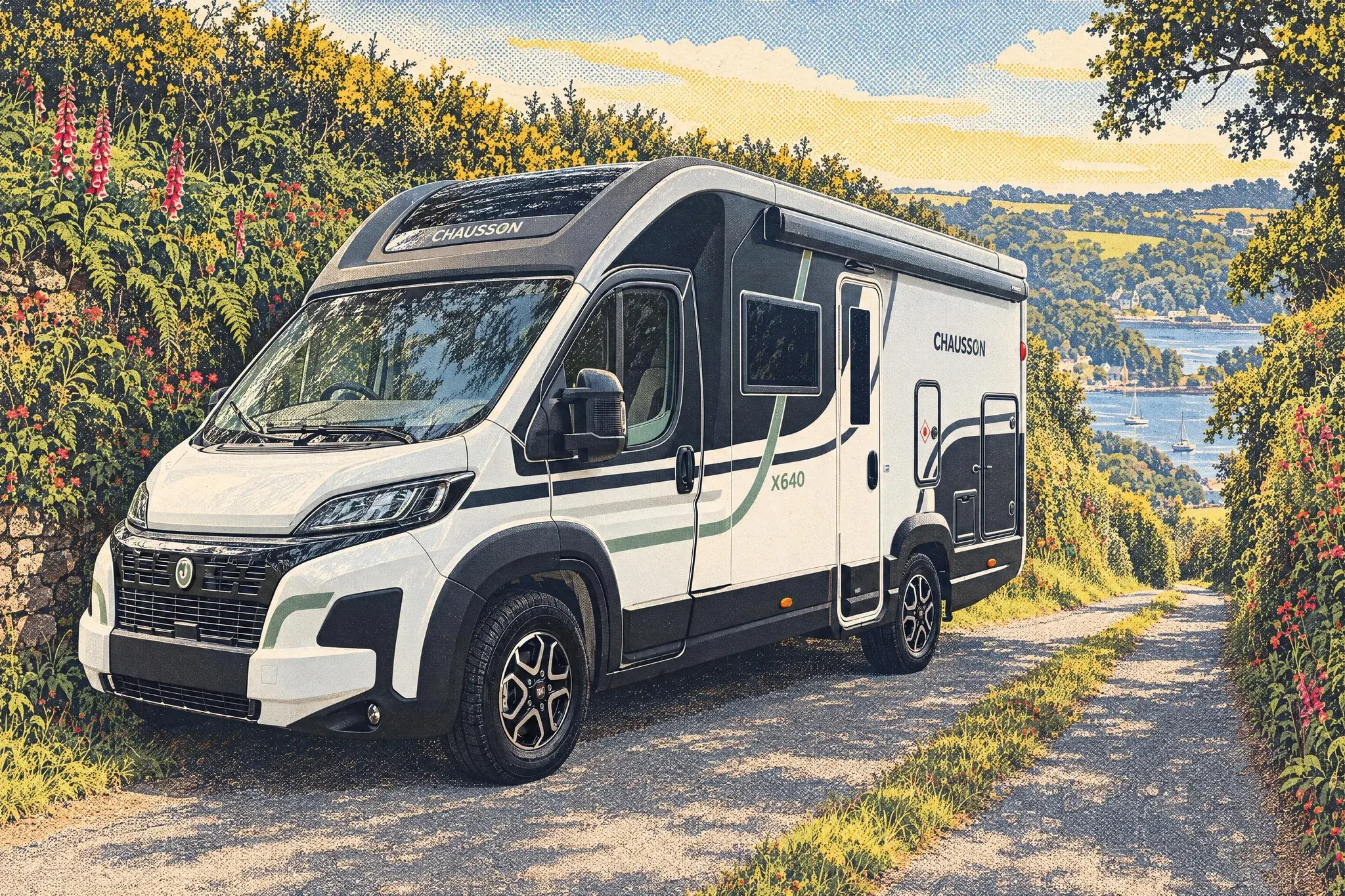
The Chausson X640 is a 2027 model year low-profile coachbuilt on a Fiat base, 6.55 m long and 2.10 m wide, priced from £74,990 in the UK. Its slim body is only about 5 cm wider than a panel van yet keeps a rear garage, an electric drop-down double and 1.98 m headroom. The catch is payload: roughly 537 to 678 kg at 3,500 kg, and the 4,400 kg uprating needs a C1 licence for post-1997 drivers.

A motorhome as slim as a van, but with a proper garage and a bed that drops from the ceiling. That is the pitch for the Chausson X640, and it is a tempting one if you have ever met a tractor on a Cornish lane in something 2.3 m wide. The X640 is new for the 2027 model year, it is on Chausson UK's price list from £74,990, and it brings the brand's 640 layout into its narrow X-series body. This piece is not a road test. It is a careful read of the published figures, so you can decide whether a narrow coachbuilt really solves the problems UK roads throw at a motorhome, and what it asks you to give up in return.
What the X640 actually is
The X640 sits in Chausson's Exclusive Line and replaces the X650, according to the German site womo.blog. It was shown at Caravan Salon Düsseldorf 2026, which ran from 28 August to 6 September, and Chausson UK's model page says it "combines the agility of the X range and the successful 640 layout". Chausson UK lists it with a Fiat base and a choice of 140 HP or 160 HP engines. The starting price is for the 140 HP with a manual gearbox, and an 8-speed automatic is a priced option with either engine.
It is a low-profile coachbuilt, not a panel van conversion. That distinction matters. A panel van keeps the donor vehicle's steel body. A coachbuilt like this has its own habitation body built onto a chassis cab, which is how Chausson gets a flat floor, a full-width garage and standing headroom that a steel van cannot match. The unusual part is that Chausson has built that body to a width of 2.10 m, where most coachbuilts are 2.2 m or more.
The key numbers at a glance
Everything below comes from Chausson UK's X640 page, checked on 6 October 2026, unless stated otherwise.
- Price: from £74,990
- Length 6.55 m, width 2.10 m, height 2.75 m excluding roof rack
- Interior headroom 1.98 m
- MTPLM 3,500 kg; mass in running order 2,822 kg, plus or minus 5%
- Uprating available to 4,400 kg, which requires the 160 HP automatic
- 4 berths, 4 travel seats with Isofix, 5 dining places
- Electric drop-down bed 140 x 190 cm, maximum load 250 kg
- Dinette converts to a second 140 x 190 cm bed
- Full-width rear garage
- 119 L compressor fridge, two-burner hob
- Eberspächer fuel-fired heating, 4,000 W or 6,000 W
- 10 L gas water heater
- 95 L fresh water, 100 L waste water, 90 L fuel tank
- Maximum towing 2,000 kg
For context, dealer Elite Motorhomes has a 2027 X640 in stock at £83,490, with the 140 bhp engine and the automatic. That is £8,500 above the headline starting price, so expect the gap to be about specification and options on that particular van, and compare line by line before you decide one is better value than the other.
What 2.10 m wide really means
Width is the number Chausson wants you to notice, so here it is next to two sourced comparisons. Knaus UK quotes the Knaus Sky TI, a conventional coachbuilt on a VW base, at 2.30 m wide. It quotes the Knaus Boxtime 600 ME panel van at 2.05 m. The X640 sits at 2.10 m. So it is 5 cm wider than a panel van, roughly the thickness of a chunky paperback, and 20 to 25 cm narrower than a typical coachbuilt, which is usually 2.30 to 2.35 m wide (Chausson's own 640 is 2.35 m).
One caveat: manufacturers normally quote body width without mirrors, and mirrors are what actually touch the hedge. Check whether any width you are comparing includes them.
On single-track lanes
On a lane with passing places, 20 cm is the difference between tucking in next to a hedge with room to spare and holding your breath. It is also the difference between squeezing past an oncoming car on a wide-ish lane and both of you reversing. A 2.10 m body is close to what the Transit and Ducato-sized panel vans that run those lanes every day already measure, so the X640 should go wherever a long-wheelbase delivery van goes. What it does not shrink is length. At 6.55 m it is longer than a 6.36 m panel van, and length, not width, is usually what bites at tight junctions and when reversing into a passing place. Narrow helps a lot. It does not make a 6.5 m vehicle feel small.
In car parks
A standard UK parking bay is about 2.4 m wide and 4.8 m long. In width, the X640's body fits with roughly 15 cm each side, though that is before mirrors, which the quoted width leaves out. It means opening doors carefully but not hunting for two bays side by side. In length it overhangs by around 1.75 m, exactly like any other 6.5 m motorhome, so you will still want the end of a row or a dedicated long-vehicle bay. Height is the other limit. At 2.75 m before anything goes on the roof, the X640 is as excluded from barrier-protected car parks as every other coachbuilt. Many of those barriers sit around 2 m, so a high-roof panel van is shut out too. On this point the narrow body buys you nothing.
On ferries
Ferry operators generally price motorhomes by length and height band rather than width. So the figures to declare are 6.55 m and 2.75 m, plus anything on the roof rack, and the 2.10 m width is unlikely to change your fare. It does help on the car deck, where marshals pack vehicles tightly and a slim body is easier to thread between lanes. Always confirm the bands with the operator before you book, because they vary between routes.
What a coachbuilt still gives you over a 6.36 m panel van
If the X640 is only 5 cm wider than a panel van and 19 cm longer, the obvious question is why not just buy the panel van. The answer is in three things the van body cannot easily offer.
The garage
The X640 has a full-width rear garage. In a panel van conversion, rear storage lives under a fixed bed and is shaped by the van's tapering steel sides and wheel arches. A coachbuilt garage has square sides and a flat floor, which is what makes bikes, an awning, a folding table and a set of levelling ramps live together without a jigsaw every morning. For couples who tour with e-bikes, this alone often decides the body type.
The drop-down double
The electric drop-down bed measures 140 x 190 cm and carries up to 250 kg. At 140 cm it is a touch wider than a standard UK double mattress, and 190 cm is enough for someone around 1.85 m tall with a little room to spare. Anyone much over 1.9 m should lie on it at a show before signing anything. The point of a drop-down bed is that it disappears in the daytime, so the lounge below stays a lounge. In a 6.36 m panel van you usually choose between a fixed bed that eats floor space or a make-up bed that eats your evenings.
Headroom and a second bed
Chausson quotes 1.98 m of headroom. That is standing room for almost everyone, with hands free to cook and dress rather than ducking around the roof line. The dinette also converts to a second 140 x 190 cm bed, giving four berths to match the four travel seats with Isofix. The dinette seats five for meals, but only four can travel.
The honest trade: 19 cm of extra length and the usual coachbuilt height, in exchange for a real garage, a double that vanishes in the day and headroom you can stretch in.
The weight sums at 3,500 kg
This is where every compact coachbuilt gets found out, so let us do it properly with Chausson's own figures. MTPLM is 3,500 kg. Mass in running order is 2,822 kg, quoted with a tolerance of plus or minus 5%.
- Nominal payload: 3,500 kg minus 2,822 kg equals 678 kg.
- Heavy end of the tolerance: 5% of 2,822 kg is about 141 kg, so the van could leave the factory at around 2,963 kg. Payload drops to roughly 537 kg.
- Light end of the tolerance: around 2,681 kg, giving roughly 819 kg.
You do not get to choose which end your van lands at, so plan around 537 kg and treat anything better as a bonus. Also ask Chausson or the dealer exactly what the running-order figure includes. Industry convention usually counts a driver and some fluids, but conventions differ, and you should not rely on an assumption for a legal limit.
A realistic loading example
Take the cautious 537 kg figure and assume the driver is already counted. Three more people at 75 kg each is 225 kg. A full 95 L fresh tank is another 95 kg. That leaves 217 kg for gas bottles, bedding, clothes, food, chairs, a barbecue, tools, and whatever goes in that lovely garage. A pair of e-bikes alone can account for around 50 kg.
There are two sensible ways round this. Travel with the fresh tank mostly empty and fill on site, which many owners of 3,500 kg vans do anyway. Or put the van on a weighbridge once it is loaded for a typical trip, and let the real number guide you. The 2,000 kg towing limit is also worth a mention: a trailer's nose weight counts against your payload, so towing anything substantial at 3,500 kg needs the same careful sums.
Going to 4,400 kg: the licence catch
Chausson offers an uprating to 4,400 kg, and on paper it solves everything. At the heavy end of the tolerance, using the 3,500 kg van's running-order figure, that is a payload of around 1,437 kg. The uprated van carries the heavier 160 HP automatic chassis, though, so its real mass in running order will be higher, and no figure is published for it. There are also three conditions attached.
- It needs the 160 HP automatic. Chausson UK states the uprating requires the more powerful engine, so budget for that option before you count on the extra weight.
- It needs the right licence. If you passed your car test on or after 1 January 1997, a standard category B licence covers vehicles up to 3,500 kg MAM. Anything heavier requires category C1, which means a medical, a theory test and a practical test in a vehicle over 3,500 kg. If you passed before that date you usually have C1 already, with a medical renewal from age 70.
- It changes the rules on the road. A motorhome over 3,500 kg revenue weight is taxed as a private HGV (TC10), at £177 a year against £375 for the car class, so on VED the heavier van is actually cheaper. Speed limits for motorhomes depend on unladen weight (above 3,050 kg means lower limits), which an uprating does not change, and the 3,500 kg X640, at around 2,822 kg in running order, stays under that threshold. Some tolls and ferry categories also step up with weight. None of this is a reason not to uprate, but it is a reason to go in with your eyes open.
For a household where one driver passed before 1997 and the other after, remember that only the licensed driver can legally take the wheel at 4,400 kg. That can quietly reshape how you share a long drive.
Living with it: the systems
The spec sheet points to a van designed for off-grid nights as much as serviced pitches. The 119 L fridge is a compressor unit, which runs on 12 V and does not need a level pitch to work, but it does lean on your leisure battery, so ask about battery capacity and solar when you spec the van. Heating is Eberspächer fuel-fired, in 4,000 W or 6,000 W outputs, which typically draws from the vehicle's own 90 L diesel tank and spares your gas bottles for the two-burner hob and the 10 L gas water heater. For a UK winter the 6,000 W option is the one to ask about.
Tanks are 95 L fresh and 100 L waste, a comfortable couple of days for two people with normal showering, and you have seen above why you may choose to travel with the fresh tank light.
Price, gearbox and the right-hand drive question
At £74,990 the X640 is a mid-market coachbuilt price, and that figure is for the 140 HP engine with a manual gearbox, the UK base specification. The 8-speed automatic is a priced option with either the 140 HP or 160 HP engine, and the 4,400 kg uprating requires the 160 HP automatic. UK dealer stock, such as Elite's £83,490 van, happens to be automatic, so check the gearbox on any specific van and price the automatic option before you compare figures.
One more thing to confirm in writing: right-hand drive. The UK page does not state it, and left-hand-drive stock does reach UK dealers from continental brands. Before you pay a deposit, get it confirmed on the order form.
If you want to see one rather than read about it, Chausson is exhibiting at the NEC from 13 to 18 October 2026. Take a tape measure, lie on the drop-down bed, stand under the 1.98 m ceiling, and open the garage with your own bikes in mind.
Who the X640 is really for
The X640 makes most sense for one or two people who tour the narrow bits of Britain, want a garage and a bed that disappears, and are willing to manage payload with care or hold a C1 licence. It makes less sense for a group of four who travel with full tanks and heavy kit at 3,500 kg, because 537 kg at the heavy end of the tolerance goes quickly, and for anyone whose main problem is height barriers, because 2.75 m is as tall as any other coachbuilt.
Measured against a 6.36 m panel van, the X640 gives up almost nothing in width and a little in length, and gains the three things panel vans struggle with. Measured against a 2.3 m coachbuilt, it gives up 20 cm of interior width that you will notice at the dinette and in the washroom, and gains lanes you would otherwise avoid. That is the trade-off. The narrow coachbuilt is not a magic answer for UK roads, but on the roads where width is the thing that stops you, it deserves a close look.
Chausson UK's X640 page carries the full specification and current prices.
Common questions
How wide is the Chausson X640 compared with a panel van campervan?
Chausson UK quotes the X640 at 2.10 m wide. For comparison, Knaus UK lists the Boxtime 600 ME panel van at 2.05 m and the Sky TI coachbuilt at 2.30 m, so the X640 is about 5 cm wider than a panel van and 20 to 25 cm narrower than a conventional coachbuilt.
What is the real payload of the Chausson X640 at 3,500 kg?
Chausson quotes a mass in running order of 2,822 kg plus or minus 5% against a 3,500 kg MTPLM. That gives a nominal payload of 678 kg, but at the heavy end of the tolerance the van could weigh around 2,963 kg, leaving roughly 537 kg for people, water and kit.
Do I need a special licence for the 4,400 kg uprated X640?
Yes if you passed your car test on or after 1 January 1997. A standard category B licence covers up to 3,500 kg, so the 4,400 kg version needs category C1. Drivers who passed before that date usually already hold C1. The uprating also requires the 160 HP automatic.
Is the Chausson X640 available with a manual gearbox in the UK?
Yes. Chausson UK's £74,990 starting price is for the 140 HP engine with a manual gearbox, which is the UK base specification. The 8-speed automatic is a priced option with either the 140 HP or 160 HP engine, and the 4,400 kg uprating requires the 160 HP automatic. UK dealer stock, such as Elite Motorhomes' £83,490 van, happens to be automatic, so check the gearbox on any specific van.
How big is the bed in the Chausson X640?
The electric drop-down bed measures 140 x 190 cm with a maximum load of 250 kg, and the dinette converts to a second 140 x 190 cm bed. That gives four berths, while the van has four travel seats with Isofix and five dining places.
How much does the Chausson X640 cost in the UK?
Chausson UK lists the X640 from £74,990 as of October 2026. Dealer Elite Motorhomes has a 2027 X640 with the 140 bhp automatic in stock at £83,490, so compare specification and options carefully between the two figures.
The reachable bit
The camper you fall for is rarely the one you can afford. That gap is the whole reason Campervan.win exists. Right now we’re giving away the Sunlight Vanlife, worth around £65,000, and closing that gap is the point: capped entries so the odds stay honest, £10 a ticket, a maximum of five per person, £500 to a UK charity from every full draw, the winner picked by a public randomness beacon anyone can re-check, and one person driving away in the van itself.

Enjoyed this post?
Get more honest campervan guides like this one in your inbox.
You’re in!
Check your inbox. We’ve just sent you a welcome email.

About the author
Arthur
Arthur writes buying guides, comparisons, and in-depth explainers to help readers choose the right campervan or motorhome with confidence.
Keep Reading
Related Reading
Thoughtful articles that build on what you’ve just read.
Motorhome Reviews
13 min read
Dethleffs Globebus Performance 4x4 T16: a 6.25m VW Crafter 4x4 under 3.5t, judged for UK use
Dethleffs has put four-wheel drive under a compact coachbuilt motorhome. We look at what the 2027 Globebus Performance 4x4 T16 actually is, what the VW Crafter 4x4 base gives you, and whether a 6.25m, 3.5-tonne, roughly £98,000 all-wheel-drive motorhome makes sense on British roads.
Motorhome Reviews
10 min read
Rapido 8096dF: an honest look at this island-bed A-class for UK touring couples
A clear-headed guide to the Rapido 8096dF, a large island-bed A-class motorhome, and whether its layout, weight and running costs really suit a UK touring couple.
Motorhome Reviews
29 min read
Swift Trekker 594 review: a full-size family coachbuilt for UK touring
An honest review of the Swift Trekker 594, a full-size four-berth coachbuilt motorhome about 7.85m long on the rear-wheel-drive Ford Transit, with a fixed rear island bed, centre washroom and a 3,500kg category B weight.
Motorhome Reviews
20 min read
Hymer GT S review: the pricey motorhome that still makes surprisingly good sense
The Hymer GT S is a new Mercedes Sprinter based motorhome that starts just over £92,000 in the UK. It is expensive, but it delivers a genuinely premium driving and living experience without feeling over done. In this review, we look closely at the layouts, winter capability, Hymer Connect tech, real world storage, and why the GT S can be strong value compared with other Mercedes based Hymer motorhomes.