
Dethleffs Globebus Performance 4x4 T16: a 6.25m VW Crafter 4x4 under 3.5t, judged for UK use

Written by
Leo
Leo covers campervan technology, maintenance, kit, and ownership advice, with a clear, practical focus on how things work in real life.
The short answer
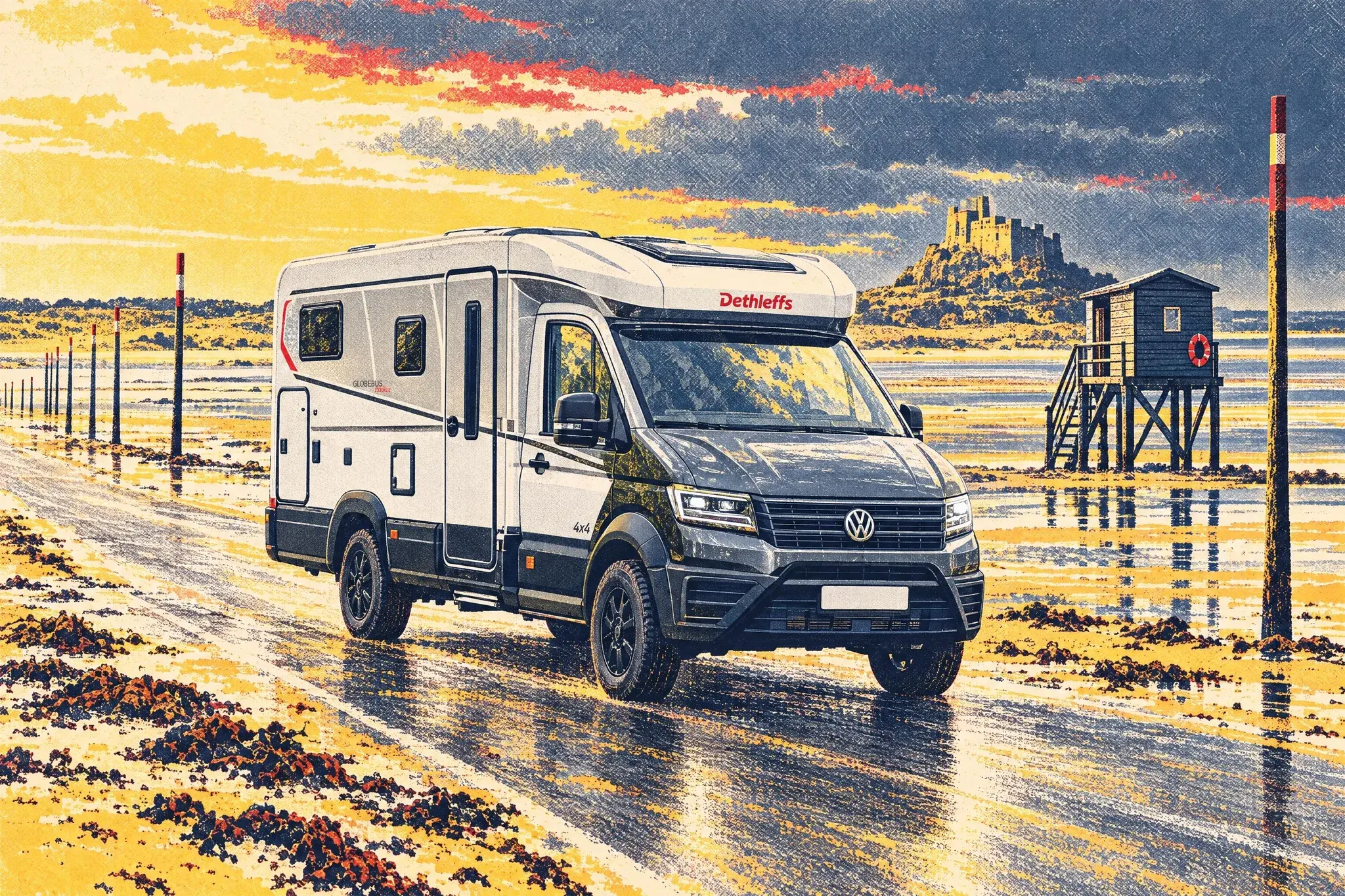
The 2027 Dethleffs Globebus Performance 4x4 T16 is a 6.25m long, 2.2m wide coachbuilt motorhome built on a Volkswagen Crafter 4x4 chassis with a 163hp 2.0 TDI engine, 8-speed automatic, differential lock, raised suspension and rear air suspension, all under 3.5 tonnes. At around £98,000 it suits winter and rough-track touring; summer campsite users will pay for capability they rarely use.

Dethleffs has built a motorhome with four-wheel drive. That is the simple version. The more interesting version is that the new Globebus Performance 4x4 T16 is short, slim, stays under 3.5 tonnes and comes with an automatic gearbox and air suspension as standard, which is a rare combination in any motorhome, let alone one with a driven front and rear axle. The question for a UK buyer is not whether it is clever. It clearly is. The question is whether around £98,000 of 4x4 motorhome earns its keep on the roads, tracks and campsites you will actually use. Here is the honest picture.
What the T16 actually is
Let us start with what Dethleffs itself says, because this is a brand-new model and the detail matters.
- Range: Globebus Performance 4x4, which Dethleffs describes as its first all-wheel-drive motorhome range. The T16 is the new addition announced for the 2027 model year.
- Base vehicle: a Volkswagen Crafter 4x4 chassis. Dethleffs' launch material and early coverage describe it as a short-wheelbase Crafter.
- Engine and gearbox: a 2.0-litre TDI SCR diesel with 163hp (120kW), paired with an 8-speed automatic as standard.
- Drivetrain extras: a differential lock, raised suspension and a reinforced front axle rated at 2,100kg, according to Dethleffs.
- Suspension: air suspension on the rear axle is part of the standard package.
- Size: 6.25m long and 2.20m wide.
- Weight: a gross vehicle weight of 3,500kg.
- Price: around £98,000 in the UK at launch, with final pricing depending on spec and exchange rates.
One point of clarity on body type. At 2.2m wide, the T16 is wider than the Crafter's own steel panel-van body, which is roughly 2.05m across. That tells you this is a coachbuilt motorhome with its own habitation body sitting on a chassis cab, in the slim low-profile style the Globebus range is known for. It is not a panel-van conversion, and it is not an A-class. That distinction shapes almost everything that follows, from storage to width on country lanes.
Why a VW Crafter 4x4 base matters
Plenty of motorhomes claim capability. Very few have a factory-engineered driven front axle. Dethleffs has gone to the trouble of using a proper 4x4 Crafter chassis rather than a conversion, and then adding the pieces that make all-wheel drive useful rather than decorative.
The differential lock
Four-wheel drive on its own only sends power to the axle that needs it. A differential lock stops a spinning wheel from stealing all the drive, which is the difference between crawling off a sodden rally field and sitting there polishing the grass. For UK touring, this is the single most practical element of the whole package.
Raised suspension and the reinforced front axle
Raised suspension adds ground clearance. On a coachbuilt motorhome, that protects the rear overhang and underslung tanks on rutted farm tracks, steep ferry ramps and the lumpy approach to a Highland lochside. The reinforced front axle rated at 2,100kg matters because a diesel engine, automatic gearbox and front drive components all sit over the nose. Giving that axle more headroom means you are less likely to overload the front even with a full fuel tank and two adults aboard.
Rear air suspension
Air suspension at the back is often a costly option on motorhomes. Here it is standard. The benefits are a more settled ride when loaded, a level stance when you fill the garage and water tank, and some ability to raise or lower the rear to help with awkward approach angles. It also tends to reduce the body roll that makes a slim, tall motorhome feel nervous in crosswinds on the M6.
The 8-speed automatic
An automatic gearbox used to be a compromise in motorhomes. An 8-speed box with 163hp should make the T16 relaxed on motorways and easier to manage on hill starts and tight manoeuvres. For anyone who has crept a manual coachbuilt up a wet Cornish lane with a queue behind them, the appeal is obvious.
6.25m by 2.2m on British roads
This is the part that makes the T16 genuinely interesting for UK use. Many 4x4 motorhomes are big, heavy and wide. This one is compact by coachbuilt standards.
Length. At 6.25m it is in the sweet spot for UK touring. It will fit most standard campsite pitches without negotiation, and the shorter overhangs help on steep campsite entrances and ferry ramps. Ferry operators generally price by length band, and anything under about 7m tends to sit in a lower bracket than larger coachbuilts. Check the exact bands with the operator you use.
Width. At 2.2m, Dethleffs calls it nimble, and relative to most coachbuilt motorhomes it is. Be honest with yourself, though. 2.2m is wider than any family car and about 15cm wider than a panel-van conversion. On single-track roads in the Lake District or the Yorkshire Dales that 15cm is the difference between passing a tractor in a passing place and reversing 200 metres. It is manageable, and far easier than a 2.3m or 2.35m body, but it is not car-like.
Height. Dethleffs had not published a confirmed UK height for the T16 at the time of writing, and the raised suspension means it will stand taller than a standard Globebus. Ask for the exact figure before you commit to storage, because many secure compounds and height barriers are set around 3m, and you need to know which side of that line you are on.
The 3.5-tonne question
Keeping a 4x4 coachbuilt under 3,500kg gross is a deliberate choice, and it is the right one for the UK market. Here is why it matters, and where the catch is.
Licences
If you passed your car test on or after 1 January 1997, your standard category B licence covers vehicles up to 3,500kg. Anything heavier needs C1 entitlement, which means a medical and a separate test. Drivers who passed before 1997 usually have C1 already, but it falls away at 70 unless you renew with a medical. A 3.5t T16 sidesteps all of that. Anyone in the household with a full car licence can drive it.
Speed limits
A motorhome with an unladen weight above 3,050kg is limited to 50mph on single carriageways, 60mph on dual carriageways and 70mph on motorways. A coachbuilt with 4x4, air suspension and an automatic gearbox is very likely to sit above that unladen figure, so assume the lower limits apply. It is a small thing, but it catches out drivers who assume a 3.5t motorhome shares car limits.
Payload is the number to scrutinise
Here is the honest catch. Four-wheel drive, a differential lock, raised suspension, air suspension and an automatic gearbox all add weight compared with a two-wheel-drive van, typically well over 100kg combined. Every kilogram of that comes out of your payload under the 3,500kg ceiling. Dethleffs had not published a confirmed UK mass in running order for the T16 at the time of writing, so we will not guess at a payload figure. What we will say is this:
- Ask the dealer for the mass in running order and the payload for the exact build you are ordering, including any options.
- Remember that the quoted mass in running order usually includes a driver allowance, a part-full fuel tank and a limited amount of fresh water, not your bikes, awning, full water tank, food and passengers.
- Weigh the van on a public weighbridge once it is loaded for a real trip. It costs a few pounds and removes the guesswork.
- If the payload looks tight, ask whether a chassis upgrade or re-plating option exists, and understand that going over 3,500kg brings the licence and speed-limit consequences above.
A short, two-berth-style motorhome with light owners and modest kit will be fine. Two adults, a dog, two e-bikes, a full tank and a week of winter clothes is where you need to do the maths.
Do you actually need 4x4 in the UK?
This is where a calm friend earns their tea. Most UK motorhome touring does not need four-wheel drive. Campsites have hardstanding or well-drained grass, the roads are tarmac, and a decent set of all-season tyres and a pair of grip mats will get a front-wheel-drive van out of most soggy pitches.
So who genuinely benefits from the T16?
- Winter tourers. If you head to the Alps or Scandinavia for skiing, or tour the Scottish Highlands between November and March, four-wheel drive with a diff lock changes what you can safely attempt on snow and ice. This is the strongest case for the T16.
- Off-grid and track users. Owners who stay on farm Certificated Sites, forestry tracks and rough estate roads, where a wet autumn turns the approach into something a two-wheel-drive coachbuilt would refuse.
- Rally and show regulars. Anyone who has watched a tractor tow a line of motorhomes off a field at a bank holiday rally will see the appeal.
- Coastal and island touring. Steep slipways, gravel car parks and tidal causeways in the Hebrides or the far south-west, where ground clearance and traction remove stress.
And who should think twice?
- Anyone who tours mainly between Easter and September on established campsites. You will be paying a premium, carrying extra weight and burning slightly more fuel for capability you rarely use.
- Anyone imagining UK green-laning. Byways open to all traffic exist, but many are narrow, overgrown and unsuitable for a 6.25m coachbuilt, and the law on what you can drive where is complex. The T16 is for getting to remote places with confidence, not for recreational off-roading.
Four-wheel drive does not make a motorhome go anywhere. It makes the places you already want to go more reliably reachable in bad weather. Buy it for the weather, not the fantasy.
Living with it: the habitation side
Dethleffs had not released the full UK layout and equipment list for the T16 at the time of writing, so we will stick to what a 6.25m by 2.2m low-profile body realistically gives you rather than inventing a floor plan.
At this length you should expect a compact arrangement built around a fixed rear bed, a washroom, a galley and a front lounge that uses the swivelled cab seats. Space will be sensible rather than generous, and the 2.2m width means the interior is slimmer than most coachbuilts, which shows most in the washroom and in how much of the bed sits beside the wall. The upside is a body that heats quickly in winter, which suits exactly the sort of owner this van is aimed at.
Things worth confirming with Dethleffs or your dealer before you order:
- The exact layout, bed dimensions and whether the bed is practical for two taller adults.
- Heating type and whether the fresh and waste tanks are insulated or heated, which matters far more on a van sold on its winter ability.
- Gas locker capacity and bottle sizes, since continental vans sometimes arrive set up for bottle types that need a UK adapter or regulator change.
- Leisure battery capacity and whether lithium or solar are options, because off-grid winter touring eats power.
- The current body and water-ingress warranty terms and the UK servicing network.
Running costs in the real world
Fuel
A 163hp 2.0 TDI in a 3.5t coachbuilt with 4x4 and raised suspension will not be frugal. Expect real-world economy somewhere in the mid to high 20s mpg on a mixed UK tour, lower into a headwind on the A9 and higher on a gentle 55mph cruise. The 4x4 hardware and taller stance cost a little against a two-wheel-drive equivalent, but the 8-speed automatic should help by keeping revs low at speed.
Road tax
A motorhome under 3,500kg normally falls into the Private/Light Goods class for vehicle excise duty, which currently costs in the mid £300s a year. It is not linked to emissions for motorhomes, so the figure does not change because of the engine.
Clean air zones
The 2.0 TDI SCR engine is Euro 6, so it should be compliant with London's ULEZ and the clean air zones in cities such as Birmingham, Bristol and Bath without a daily charge. Always check the specific zone's rules for motorhomes before you drive in, because a few zones treat vehicles differently by registration class.
Insurance
A new motorhome valued near £100,000 is firmly in specialist-insurer territory. Many insurers require a tracker above a certain vehicle value, and some will want secure overnight storage for a new vehicle at this price. Four-wheel drive and a VW base will not frighten insurers, but the value will. Budget for a tracker and get quotes before you order rather than after.
Servicing
The base vehicle can be serviced through the VW commercial network, and the 4x4 system and air suspension add components that need inspection. The habitation side needs an annual service and damp check from a Dethleffs dealer or an approved workshop to keep the body warranty intact. Factor in both.
Is around £98,000 fair?
It is a lot of money for a 6.25m motorhome. There is no way to dress that up. What you are paying for is a factory-engineered 4x4 chassis, a differential lock, raised and air suspension, an automatic gearbox and a reinforced front axle, all of which would be either impossible or very expensive to add to a standard coachbuilt afterwards. Dethleffs describes the standard specification as comprehensive, and the fact that the air suspension and automatic are included rather than optional matters when comparing quotes.
Judge it this way. If you would otherwise be buying a well-specified 6m-class coachbuilt and then spending on an automatic, air suspension and winter preparation, the gap to the T16 narrows considerably. If you would be happy with a standard two-wheel-drive van on summer campsites, the premium buys you very little you will use.
Residual values are the unknown. Specialist vehicles with genuine capability often hold value well because supply is small and the buyers who want them know exactly what they want. But it is a new model, and nobody can honestly promise you how it will depreciate.
What to check before you order
- Payload. Get the mass in running order and payload for your exact build in writing. This is the make-or-break number for a 3.5t 4x4 coachbuilt.
- Height. Confirm the UK figure with the raised suspension and check it against your storage and any height barriers you regularly use.
- Layout and bed length. Lie on the bed. Sit in the washroom. Do it at a show or a dealer, not from a brochure.
- Winter kit. Insulated or heated tanks, heating type, battery capacity. A 4x4 motorhome that freezes its waste tank in the Cairngorms has missed the point.
- Tyres. Ask what tyres it arrives on. All-terrain or all-season tyres transform winter grip and are far cheaper to change at order time.
- Insurance and tracker. Get quotes early and understand any storage conditions.
- Delivery timing. It is a 2027 model year launch, so ask for a realistic build slot rather than an optimistic one.
The bottom line
The Dethleffs Globebus Performance 4x4 T16 is a thoughtfully specified motorhome that solves a real problem for a specific kind of owner. If you tour in winter, head to the mountains, stay on rough tracks or simply want the confidence that a wet field or a snowy pass will not end your trip, the combination of a VW Crafter 4x4 chassis, a differential lock, raised and air suspension and an automatic gearbox, all under 3.5 tonnes in a 6.25m body, is genuinely hard to find.
If your touring looks like a warm campsite in July, be honest about that too. You would be paying around £98,000 and carrying extra weight for capability that stays switched off. The T16 is a specialist tool, and like any good specialist tool it is wonderful in the right hands and an expensive indulgence in the wrong ones. Work out which you are first, then check the payload, then go and sit in it. You can find the current UK information on the Dethleffs UK website.
Common questions
What is the Dethleffs Globebus Performance 4x4 T16 built on?
According to Dethleffs and early launch coverage, the T16 is built on a Volkswagen Crafter 4x4 chassis, described as short wheelbase, with a 2.0-litre TDI SCR engine producing 163hp and a standard 8-speed automatic gearbox.
Can I drive the Globebus Performance 4x4 T16 on a normal UK car licence?
Yes. It has a gross vehicle weight of 3,500kg, so a standard category B car licence covers it, including for drivers who passed their test after 1 January 1997 and do not have C1 entitlement.
How big is the Dethleffs Globebus T16?
It is 6.25m long and 2.20m wide. Dethleffs had not published a confirmed UK height at the time of writing, and the raised suspension means it will stand taller than a standard Globebus, so check before booking storage.
How much does the Dethleffs Globebus Performance 4x4 T16 cost in the UK?
UK pricing at launch is around £98,000, though the final figure depends on specification and exchange rates. The standard package includes the 4x4 drivetrain, differential lock, raised suspension, rear air suspension and automatic gearbox.
Do I really need a 4x4 motorhome for UK touring?
For summer campsite touring, no. Four-wheel drive earns its keep for winter and mountain trips, wet farm sites, rough estate tracks and remote coastal or island touring where traction and ground clearance matter.
What is the biggest thing to check before buying the T16?
Payload. The 4x4 hardware, air suspension and automatic gearbox all add weight under the 3,500kg limit, so get the mass in running order and payload for your exact build in writing and weigh the van once loaded.
The reachable bit
The camper you fall for is rarely the one you can afford. That gap is the whole reason Campervan.win exists. Right now we’re giving away the Sunlight Vanlife, worth around £65,000, and closing that gap is the point: capped entries so the odds stay honest, £10 a ticket, a maximum of five per person, £500 to a UK charity from every full draw, the winner picked by a public randomness beacon anyone can re-check, and one person driving away in the van itself.

Enjoyed this post?
Get more honest campervan guides like this one in your inbox.
You’re in!
Check your inbox. We’ve just sent you a welcome email.

About the author
Leo
Leo covers campervan technology, maintenance, kit, and ownership advice, with a clear, practical focus on how things work in real life.
Keep Reading
Related Reading
Thoughtful articles that build on what you’ve just read.
Motorhome Reviews
12 min read
Chausson X640: is a 2.1 m wide coachbuilt from £74,990 the answer for UK lanes?
Chausson's new X640 squeezes a drop-down double, a full-width garage and 1.98 m of headroom into a body only 2.10 m wide. We run the real numbers on width, weight, licences and price to see who it suits.
Motorhome Reviews
10 min read
Rapido 8096dF: an honest look at this island-bed A-class for UK touring couples
A clear-headed guide to the Rapido 8096dF, a large island-bed A-class motorhome, and whether its layout, weight and running costs really suit a UK touring couple.
Motorhome Reviews
29 min read
Swift Trekker 594 review: a full-size family coachbuilt for UK touring
An honest review of the Swift Trekker 594, a full-size four-berth coachbuilt motorhome about 7.85m long on the rear-wheel-drive Ford Transit, with a fixed rear island bed, centre washroom and a 3,500kg category B weight.
Motorhome Reviews
20 min read
Hymer GT S review: the pricey motorhome that still makes surprisingly good sense
The Hymer GT S is a new Mercedes Sprinter based motorhome that starts just over £92,000 in the UK. It is expensive, but it delivers a genuinely premium driving and living experience without feeling over done. In this review, we look closely at the layouts, winter capability, Hymer Connect tech, real world storage, and why the GT S can be strong value compared with other Mercedes based Hymer motorhomes.