
Dethleffs Trend I 7027: a six-seat rear lounge but only two seatbelts

Written by
Felix
Felix covers campervan technology, layouts, and modern conversions, with a focus on design-led thinking and practical performance
The short answer
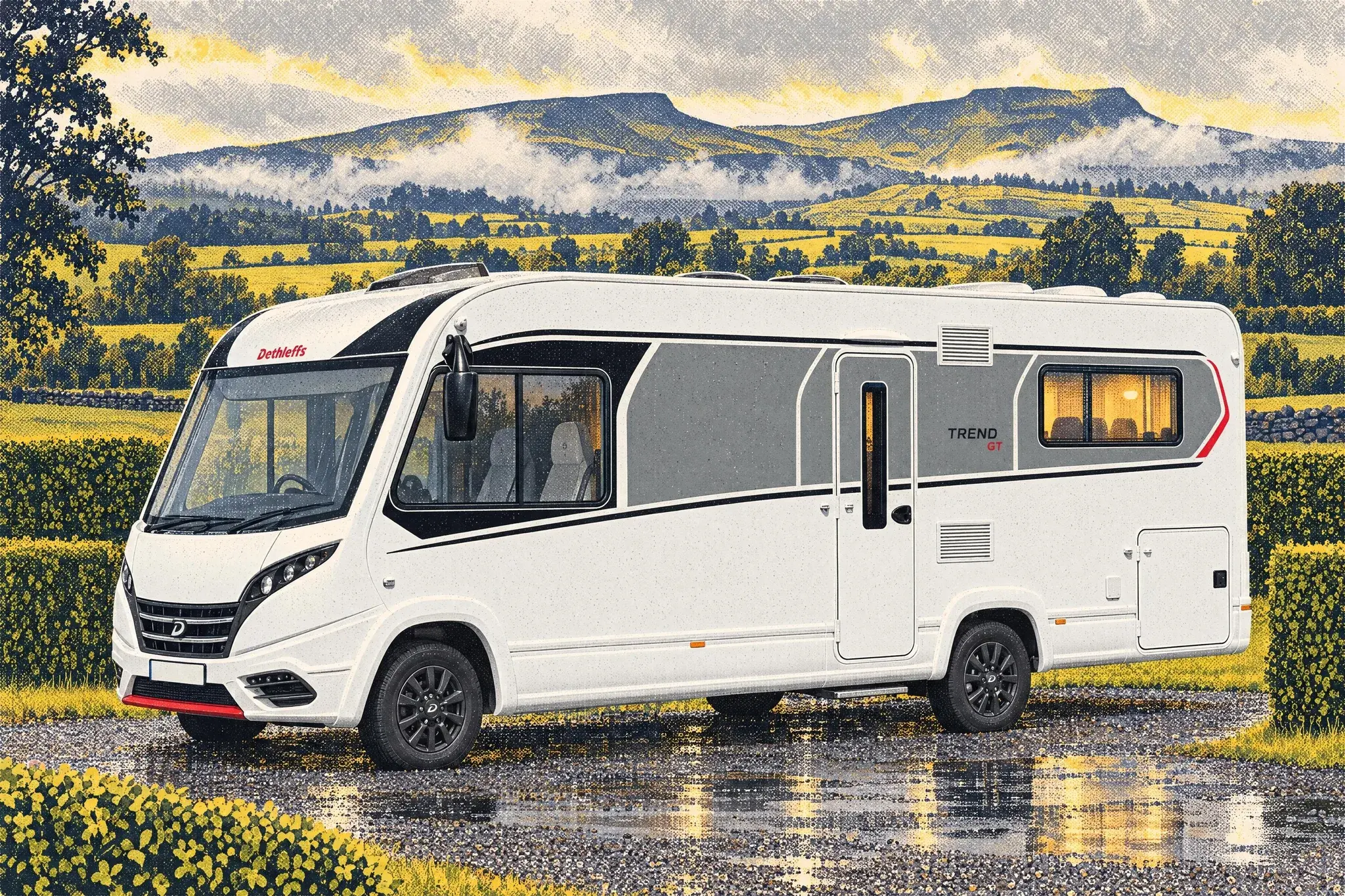
The Dethleffs Trend I 7027 Active is a 7.4 m A-class motorhome with a U-shaped rear lounge that promobil says seats up to six, twin electric drop-down beds over the cab and a centre bathroom. It has two belted seats as standard (a third is optional), so it suits couples who host and stay put, not families who need to travel together. It is a 3,499 kg car-licence vehicle, listed in the UK at £96,990, although that is not a confirmed UK price.

Most A-class motorhomes put the lounge at the front and the bed at the back. The new Dethleffs Trend I 7027 Active does the opposite. The sofa is at the back, the bed hides above the cab, and the bathroom sits in the middle. It is a clever idea for the right owner, and a frustrating one for the wrong owner, because a lounge that can seat six is paired with just two seatbelts as standard. Here is what Dethleffs has built, who it makes sense for, and what to weigh up before you put a deposit down.
What the Trend I 7027 Active is
The Trend I 7027 Active is a model year 2027 A-class, shown for the first time at the Caravan Salon in Düsseldorf from 28 August to 6 September 2026. Dethleffs describes the Trend range as its value-for-money line, and the I in the name tells you it is the fully integrated version, with the maker's own body wrapped around the cab rather than a van's front end bolted to a habitation box.
The headline numbers from Dethleffs UK are straightforward:
- Length 740 cm, width 233 cm, height 300 cm, with a 4,035 mm wheelbase.
- Interior headroom 205 cm.
- Fiat Ducato light low-platform chassis, 140 MultiJet 3 engine (103 kW, 140 bhp), Euro 6e-bis.
- Maximum permissible mass 3,499 kg.
- Berths: two as standard, four as an option.
- Seats for driving: listed as 2 to 3, meaning two belted seats as standard and a third as an option.
The layout is the story. Walking in from the habitation door, you pass the kitchen and a full-width centre bathroom with a separate shower cubicle and a toilet, then arrive at a U-shaped rear lounge wrapped in windows and topped with skylights. Dethleffs lists an extendable table and rear storage under the seating, and promobil says the lounge seats up to six. There is a 137 litre fridge with a 15 litre freezer, a 230 V socket and lashing rails as standard. The bed is a pair of electric drop-down singles over the cab, each 210 cm long by 75 cm wide. Dethleffs' own words are that this pull-down bed makes an additional fixed bed unnecessary, which is exactly what frees up the back of the van for that lounge.
The two-seatbelt catch
This is the line that will decide the whole purchase for many readers. The I 7027 comes with two belted travel seats as standard. A third is an option. The lounge may seat six for a meal, but the van is designated and insured for two people travelling, or three with the option.
If you were hoping this was the family A-class, it is not. UK law requires a seatbelt to be worn where one is fitted, children under three need a child seat, and the NCC advises that seats not designated for travel in motorhomes built after 2007 should not be used on the move. Insurance is worth checking too. Even with the optional third seat you are looking at a couple plus one. The Trend range does include family-friendly layouts with up to five berths, according to Dethleffs, and the I 7057 DBL in the same line is a four-person van with a height-adjustable double bed, so the family option exists within the brand. It just is not this layout.
A rear lounge for six and belts for two is not a mistake. It is a design choice. Dethleffs has built a van for people who travel as a couple and entertain as a crowd.
Who this layout suits
Once you accept that it is a two-person touring vehicle, the I 7027 starts to make a lot of sense for a particular kind of owner.
Couples who host
If your idea of a good evening is friends from the next pitch coming round for dinner, a U-shaped lounge with an extendable table and seating for six suits you well. The people you host do not need seatbelts. They need somewhere comfortable to sit, and a view. A rear lounge with wraparound glazing gives them both.
Long stays and slow touring
The reversed layout rewards people who stay a week in one place rather than moving every day. The lounge is a proper room, not a dinette you fold away before bed. Because the bed drops over the cab rather than the lounge, you can go to bed without dismantling the sofa, and you can get up in the morning without putting it back. Making up the lounge as a bed every night and putting it back every morning is a known drawback of a conventional UK rear-lounge motorhome, and this layout avoids it.
Wet days
British touring involves rain. A lot of it. On a wet Tuesday in Keswick, the difference between a lounge you can both stretch out in, with a book and the heating on, and a cab-end dinette where you are sitting upright on a bench seat is enormous. Daylight comes from three panoramic windows at the rear and the roof hatches.
Who should look elsewhere
- Families, or grandparents who want to bring the grandchildren along for the drive.
- Anyone who does not want steps at bedtime (more on that below).
- People who like a bed they can walk around, or who get up in the night a lot.
- Buyers who need a van narrower than 2.33 m for a tight driveway or a narrow lane home.
Beds over the cab: the trade-offs
A drop-down bed is the trick that makes this layout work, and it is worth understanding what you give up to get it.
Climbing in
The bed lowers electrically over the cab seats, but it does not come down to floor level. You get in by the access steps, every night, and you get out the same way. For most able-bodied couples that is a non-issue. For anyone with a dodgy knee, a hip replacement on the horizon, or a habit of visiting the loo at 3 am, it is a daily nuisance rather than a one-off. Try it at a show, properly, in your socks, before you decide.
Headroom and daytime space
Interior headroom is listed at 205 cm, which is generous. Dethleffs does not publish, in the material we have, how much clearance remains beneath the bed when it is lowered or how much it takes from the cab when stowed, so ask the dealer to lower it for you and stand underneath. The flip side is a real strength: because the bed lives over the cab, the entire rear lounge stays usable all day and all night. Nothing in the living area has to move to make the bed.
Twin singles, not a double
The two beds are 210 cm by 75 cm each. That is long, long enough for tall sleepers, but 75 cm is a single. If you are a couple who sleep close, check whether the two can be used together. If you prefer separate beds, this is one of the few A-class layouts that gives you singles without turning the whole rear into a bedroom.
Two berths, four optional
Dethleffs lists two berths as standard and four as an option. Dethleffs' own specification lists an optional rear bed of 209 x 195 to 170 cm, which means the rear lounge converts to provide the extra two, so if you plan to sleep visiting friends, ask exactly what the four-berth option involves. Remember the belt count does not change with the berth count: four people can sleep in it, but only two or three can ride in it.
How it compares with the familiar UK end-lounge
British buyers know the rear lounge well. It has been a staple of UK coachbuilt motorhomes for decades, even though A-classes usually put the lounge at the front: a horseshoe of seating at the back, a kitchen and washroom in the middle, and a front cab with swivel seats, often with a small dinette and extra belted seats behind.
The I 7027 borrows the idea and changes the rules in three ways.
- The bed is not in the lounge. A classic UK rear lounge converts to a double or two singles every night. The Dethleffs keeps its lounge as a lounge and sends you upstairs to sleep. Less faff, more steps.
- It is an A-class. A UK rear-lounge coachbuilt usually sits on a chassis cab with the van's own cab at the front. The I 7027 has an integrated body with a big front screen, which generally means a more spacious, more car-like front end and a more imposing shape.
- Fewer belts. Many UK rear-lounge coachbuilts carry four belted seats, because the front dinette gives you somewhere to put them. The Dethleffs puts the bed over the cab and the lounge at the back, leaving no obvious space for a belted dinette, and the spec sheet reflects that.
So if you already love the end-lounge idea but hate making the bed each night and travel as a couple, this is a genuine step forward. If you love the end-lounge idea because it lets you carry the family, stay with the UK layout.
Weight, licence and the chassis choice
At 3,499 kg maximum, the I 7027 sits just under the 3,500 kg line, so it can be driven on a standard category B car licence. That is a big deal for a 7.4 m A-class and clearly deliberate. But the sums deserve a careful look.
Dethleffs gives a mass in running order of 3,035 kg, with a tolerance range of 2,883 kg to 3,187 kg. Against the 3,499 kg maximum, that leaves a headline payload of 464 kg. At the heavy end of the tolerance, 3,187 kg, the payload falls to 312 kg. At the light end, 2,883 kg, it rises to 616 kg.
Then there is the mass for optional equipment, which Dethleffs lists at 287 kg. That is the allowance for the options a buyer might add. Take the full 287 kg from the headline 464 kg and you are left with 177 kg for passengers, personal belongings, extra water and everything else. Two adults at 75 kg each are 150 kg before a single bag goes in. This is not unusual for a 3,499 kg A-class of this size, and it is why Dethleffs offers the heavier chassis: promobil lists a 3.65 t and a 4.25 t chassis as options.
The catch with uprating is the licence. In the UK, anything over 3,500 kg needs category C1, which you have automatically if you passed your car test before 1 January 1997 and must take a separate test for if you did not. Speed limits are a separate matter: the motorhome split is at 3.05 tonnes unladen, not the plated weight, so with a running-order mass of around 3.0 to 3.1 t this van is likely to stay in the car-limit class even plated at 4,250 kg. Heavier vans can face higher ferry and toll classes. So the decision is this: stay at 3,499 kg and pack like a minimalist, or go heavier and check your licence first.
Engine, gearbox, heating and electrics
The standard engine is the 140 MultiJet 3 at 103 kW, or 140 bhp, meeting Euro 6e-bis. That is adequate for a 3.5 t A-class on British A-roads and perfectly normal for the class. promobil lists a 180 PS engine and an 8-speed automatic as options. Dethleffs UK lists a 6-speed gearbox, and dethleffs.de and promobil give a 6-speed manual as standard with the 8-speed automatic optional; the 180 PS engine is automatic only.
For heating, Dethleffs' own specification lists a 6 kW gas warm-air system, which is the right sort of output for a 7.4 m body in a British winter. Electrics are more modest: Dethleffs specifies a 95 Ah AGM leisure battery, with 150 Ah or 300 Ah lithium as an option. For a van aimed at long stays and wet days indoors, that is on the small side if you ever pitch without hook-up, so budget for either a bigger battery, a lithium upgrade or solar if off-grid nights are part of the plan. The 137 litre fridge with a 15 litre freezer, on the other hand, is a proper size for a week away without shopping.
What the £96,990 price does and does not mean
Dethleffs UK shows the I 7027 Active at £96,990. Read the footnote before you repeat that number to anyone. It is described as a recommended retail price based on German retail prices, with actual costs varying with currency conversion, VAT, fees and import duties. In plain English, it is a guide converted from the German list, not a confirmed UK on-the-road price. In Germany, the €97,999 reported by promobil is for the base Trend I 7027; dethleffs.de lists the Trend Active I 7027, the version the UK figure refers to, at €100,999.
So treat £96,990 as a rough placemark. The real UK figure will come from Dethleffs' UK dealers once the 2027 model year is priced for this market, and it could land above or below. German dealer listings quote deliveries from about March 2027 for the 140 bhp automatic and late 2026 for the 180 PS version. The sensible move is to ask for a written UK quote with the options you want, including whichever chassis you need, and compare that to the other A-class and rear-lounge vans on your list. Dethleffs is listed among the brands at the NEC Motorhome and Caravan Show from 13 to 18 October 2026, which is the obvious place to ask, though nothing yet confirms the 7027 will be there, so ask whether the 7027 is on the stand before you make the trip.
The bottom line
The Trend I 7027 Active is a well-aimed van, not a compromised one. Dethleffs has looked at how a lot of couples use a motorhome, which is as a comfortable base for days at a time with friends dropping by, and built the layout around that instead of around the drive. The rear lounge is big, bright and permanent. The beds are long and separate. The bathroom is full-width. The whole thing fits under 3,500 kg on a car licence, with heavier chassis options if you want a real payload.
The price of all that is two seatbelts, steps at bedtime and a 2.33 m wide, 3 m tall body you will need somewhere to keep. If you are a couple who host, stay put and tour in all weathers, it belongs on your shortlist. If you want to bring the family along for the ride, it is not your van, and no amount of lounge seating changes that.
Common questions
How many people can travel in the Dethleffs Trend I 7027?
Two as standard. Dethleffs lists seats for driving as 2 to 3, meaning two belted seats come fitted and a third is an option. The rear lounge can seat up to six for a meal, but the van is designated and insured for two people travelling, or three with the option.
Can I drive the Trend I 7027 on a normal car licence?
Yes, in standard form. Its maximum permissible mass is 3,499 kg, which is under the 3,500 kg category B limit. The optional 3.65 t and 4.25 t chassis listed by promobil would need category C1 unless you passed your car test before 1 January 1997.
Where is the bed in the Dethleffs Trend I 7027?
It is a pair of electric drop-down single beds over the cab, each 210 cm by 75 cm, reached by access steps. Because the bed is at the front, the U-shaped rear lounge stays usable day and night without any conversion.
How much payload does the Trend I 7027 have?
Dethleffs gives a mass in running order of 3,035 kg against a 3,499 kg maximum, so around 464 kg of payload. The listed 287 kg allowance for optional equipment can eat most of that, which is why heavier chassis options exist.
Is £96,990 the UK price of the Dethleffs Trend I 7027?
Not yet confirmed. Dethleffs UK shows £96,990 but footnotes it as a recommended figure based on German retail prices, subject to currency, VAT, fees and import duties. The €97,999 German price reported by promobil is for the base Trend I 7027; dethleffs.de lists the Trend Active I 7027, the version the UK figure refers to, at €100,999. Ask a UK dealer for a written quote.
When can I see the Trend I 7027 in the UK?
Dethleffs is listed among the brands at the NEC Motorhome and Caravan Show from 13 to 18 October 2026, but it is not confirmed that the 7027 will be there, so ask whether the 7027 is on the stand before you travel. The model made its debut at the Caravan Salon in Düsseldorf from 28 August to 6 September 2026.
The reachable bit
The camper you fall for is rarely the one you can afford. That gap is the whole reason Campervan.win exists. Right now we’re giving away the Sunlight Vanlife, worth around £65,000, and closing that gap is the point: capped entries so the odds stay honest, £10 a ticket, a maximum of five per person, £500 to a UK charity from every full draw, the winner picked by a public randomness beacon anyone can re-check, and one person driving away in the van itself.

Enjoyed this post?
Get more honest campervan guides like this one in your inbox.
You’re in!
Check your inbox. We’ve just sent you a welcome email.

About the author
Felix
Felix covers campervan technology, layouts, and modern conversions, with a focus on design-led thinking and practical performance
Keep Reading
Related Reading
Thoughtful articles that build on what you’ve just read.
Motorhome Layouts & Berths
10 min read
Carthago chic c-line T 4.9 LE: how a 7.5m Sprinter motorhome fits a full-size fixed bed for two
A close look at the Carthago chic c-line T 4.9 LE, a 7.5m low-profile motorhome on a Mercedes Sprinter base, and the layout thinking that lets two people have a proper fixed double bed without giving up the living space.
Motorhome Layouts & Berths
27 min read
Twin beds vs island bed: which motorhome layout really suits UK touring couples?
An honest, detailed look at the two most popular motorhome bed layouts for couples, with real UK figures, daily-living trade-offs, and how to choose the one that fits your touring style.
New & Noteworthy
12 min read
Knaus Boxtime 600 ME (2027): twin singles in 6 m, and the payload figure to question
Knaus's new Boxtime 600 ME squeezes two lengthways single beds into a 5.99 m van from £81,725. We lay out what that layout gives a couple, run the weight sums with Knaus's own figures, and explain why the 211 kg 'maximum payload' line needs a question before you sign.
New & Noteworthy
10 min read
Swift Carrera goes gas-free for 2027: 340Ah lithium, diesel heat and induction cooking
Swift has taken the gas out of its Carrera campervan for 2027, swapping bottles for a 340Ah lithium battery, diesel heating and an induction hob. Here is what that means across a real UK year, how it compares with the cheaper Merlin, and the one question to ask at the NEC.