
Westfalia Nansen (2027): two new Fiat Ducato campervans, in full detail

Written by
Felix
Felix covers campervan technology, layouts, and modern conversions, with a focus on design-led thinking and practical performance
The short answer
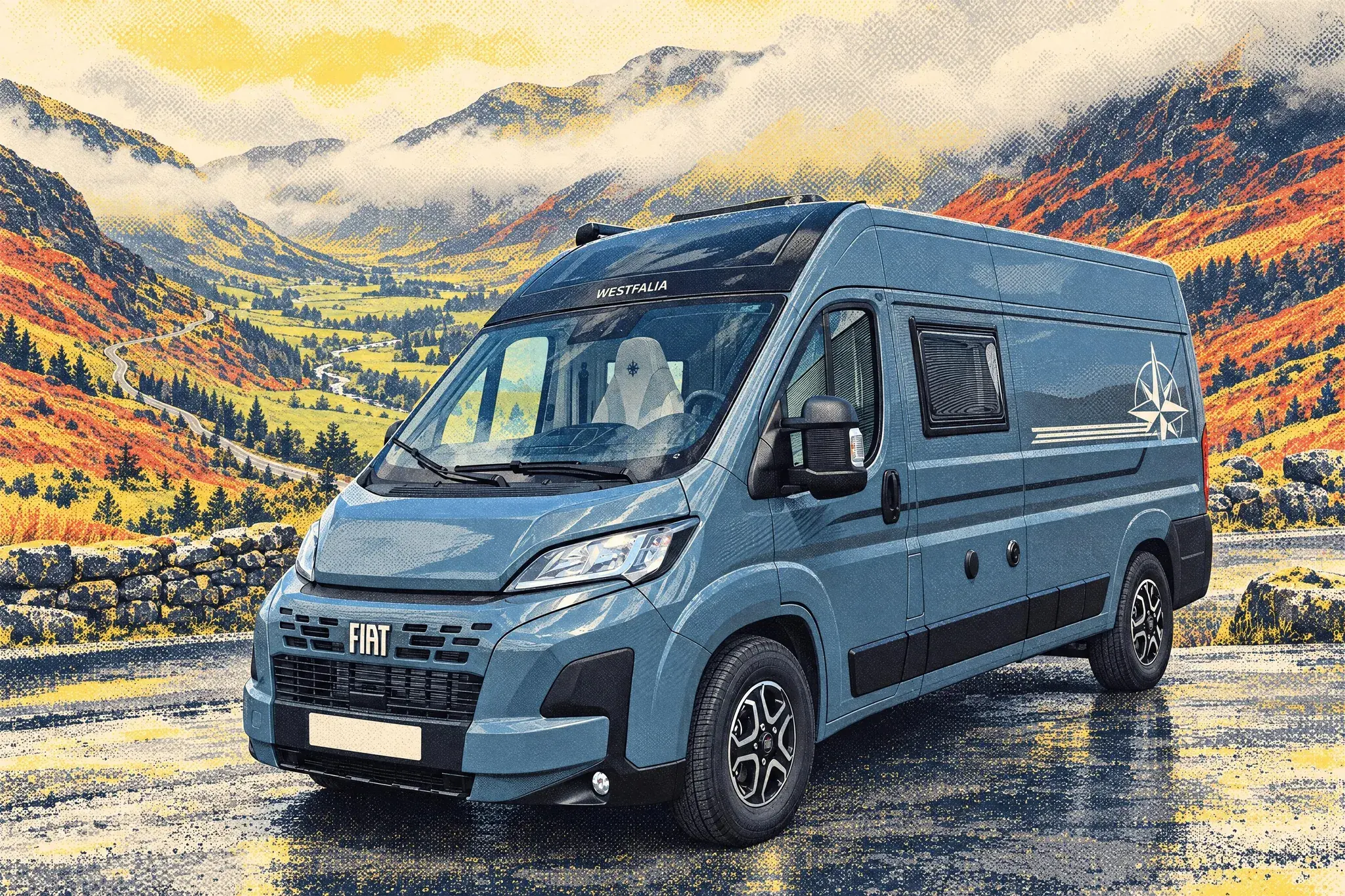
The Westfalia Nansen is a pair of new 2027 panel-van campervans on the Fiat Ducato, revealed in 2026 (revealed, note, not yet driven): the family-focused 600 L with an unusually room-sized bathroom, and the couple's 640 LS with a lift-up bed over a proper rear garage. Both use the current 2024-on Ducato with a 140 PS diesel as standard (180 PS optional) and the much-praised eight-speed automatic; there is no electric or hybrid version yet. There is a lovely symmetry to it, since Westfalia effectively invented the campervan and is now French-owned under the Rapido Group. The one thing still up in the air is UK availability and right-hand drive, not yet confirmed. Here are both vans in full detail, and what is genuinely clever about them.

If any name has the right to call itself the inventor of the campervan, it's Westfalia. So when Westfalia reveals not one but two genuinely new vans, it's worth paying attention, and for 2027 it has done exactly that. Meet the Nansen 600 L and the Nansen 640 LS: a pair of fresh panel-van campervans built on the Fiat Ducato, with at least one layout that does something we've honestly not seen done this way in a van this size.
This is a detailed look at both, based on Westfalia's own announcement and the early coverage from the European motorhome press. A word of straight-talking before we start, because it matters: these vans have been revealed, not yet driven, and the fine print comes from German and French trade reporting rather than a UK price list. So we'll be clear throughout about what's confirmed, what's reported, and what we'd still want to check, especially if you're reading this from the UK. With that understood, there's a lot here that's genuinely interesting.
What's confirmed, and what isn't (the honest bit first)
We'd rather you trusted the rest of this piece, so here's exactly where the information comes from.
The existence of the Nansen is confirmed by Westfalia itself. The company introduced it at its 2026 dealer conference, describing it (in German) as "der neue WESTFALIA Nansen, der erste in Frankreich entwickelte Kastenwagen der Marke", that is, the brand's first panel van developed in France. That announcement is dated late May 2026.
The detail, the two model names, the Fiat Ducato base, the dimensions, the layouts, the prices and the 2027 model year, comes from the specialist motorhome press, principally the German titles promobil (Germany's biggest motorhome magazine) and CamperVans Magazin, with corroborating French coverage from Camping-car Magazine and others. All of it was published within a day or two of Westfalia's reveal, and the sources agree with one another to a reassuring degree.
So: the Nansen is real and official. The two-model, two-layout, Ducato-based, 2027 story is reported consistently by reputable outlets, but the granular specs were not yet on Westfalia's own website at the time of writing, which is completely normal for a model this freshly announced. A few specific numbers (notably the exact prices and the heating spec) differ slightly between sources, and we'll flag those as we go. Prices are euro figures for the European market; any pounds figure you see below is our own rough conversion, not a UK price, and there's no confirmed UK release yet. Treat this as a thorough preview, not a road test.
Who Westfalia are, and why this matters
It's hard to overstate Westfalia's place in this story. The company's roots run back to a wagon-making workshop founded in Rheda-Wiedenbrück in 1844, but the part that matters to us began in 1950, when Westfalia built a removable "Camping Box" for the Volkswagen Type 2. That, more or less, was the birth of the modern campervan as a product you could buy. The VW Westfalia campers that followed, through the split-screen Type 2, the bay-window T2, the boxy T3 and the T4, became the definitive image of van life for two generations. If you've ever pictured a campervan with a pop-top roof and a little kitchen in the back, you've pictured a Westfalia, whether you knew it or not.
The modern company is a different beast from that heritage, and it's worth being precise about it. The historic works ran into trouble and the business was restructured around 2010; the camper division was bought by France's Rapido Group, one of Europe's biggest leisure-vehicle manufacturers, and trades today as Westfalia Mobil GmbH, based in Gotha in Germany. (Quick note to avoid a common mix-up: Westfalia-Automotive, the towbar and bike-rack company, is a separate business. Same regional name, different firm.)
Rapido ownership is the key to understanding the Nansen. Within the group, the German operation has tended to build the larger, more traditional Westfalia models, while a French operation handles vans, and the Nansen is the first Westfalia panel van developed on that French side. That's why Westfalia is making a point of the "developed in France" line. It signals a fresh design effort rather than a reskin of an existing van.
There's also a small, pleasing piece of continuity in the name. Westfalia has long named its vans after explorers, Amundsen, James Cook, Sven Hedin, Columbus, and Nansen keeps the tradition going: Fridtjof Nansen was the Norwegian polar explorer and scientist who, among other things, pioneered the techniques that later got Amundsen to the South Pole. It's a fitting badge for a van pitched at people who like to go a bit further.
Where the Nansen fits in Westfalia's range
It helps to know what else Westfalia builds, because it tells you what the Nansen is and, just as usefully, what it isn't. Today's range spans several base vehicles. Ford's Transit and Transit Custom underpin vans like the Kipling, Kelsey and Club Joker; the VW Transporter carries the Kepler models; and Mercedes provides the basis for the Vito-based Jules Verne and the long-running James Cook, Westfalia's flagship, on the Sprinter. And, importantly for this story, Westfalia already builds on the Fiat Ducato: the Columbus range of panel vans is Ducato-based, and the Amundsen, discontinued a few years back, was too.
So the Nansen is not Westfalia's first Ducato camper, and it's worth being accurate about that rather than letting the launch hype imply otherwise. What's genuinely new is the approach. This is the first Westfalia panel van developed on the group's French side, with layouts that don't simply echo the existing Columbus. Think of it as a fresh, design-led Ducato line sitting alongside the established one rather than replacing it. Westfalia revealed it as part of a wider 2027 refresh that, according to the company's own announcement, also includes a new "Columbus Liner" and a 50th-anniversary edition of the Sven Hedin, so the Nansen is one part of a busy year for the brand, not its only piece of news.
The base vehicle: the Fiat Ducato (and a myth worth busting)
Both Nansens sit on the Fiat Ducato, and if you follow this world at all, that won't surprise you. The Ducato is the default base for European motorhomes and panel-van campers, to a degree that's genuinely remarkable: it's repeatedly voted base vehicle of the year by motorhome readers (it topped promobil's 2026 reader poll with around 46% of the vote), and something in the order of 31,000 Ducato-based motorhomes were registered in Germany alone in 2025. There's a reason builders keep choosing it, from the cab ergonomics and the huge dealer and parts network to the way the platform is designed from the outset with conversion in mind.
It's worth dwelling on why that dominance exists, because it isn't an accident. The Ducato gives converters a famously flat, square load area to build into, a front-wheel-drive layout that keeps the floor low (which buys you precious standing height without making the van absurdly tall), and a cab that's comfortable and car-like over long distances. For owners, the bigger upside is the network: wherever you happen to break down or need a service across Europe, the Ducato is a vehicle every garage knows, with parts on the shelf and technicians who've seen it a hundred times. For a van you intend to take a long way from home, that ubiquity is a feature in its own right, and it's a large part of why a maker as heritage-rich as Westfalia builds on it rather than something more exotic.
The current Ducato is the version Stellantis launched for the 2024 model year, sometimes called the "Series 10" update. It brought a cleaner design, the latest mandated driver-assistance systems (the GSR2 safety package, which is required on new vans from mid-2026 anyway), updated infotainment, and, importantly, a smooth eight-speed torque-converter automatic gearbox that has been widely praised. Both Nansens get that eight-speed auto as standard, which for a touring van is a real plus.
Now the myth, because it's worth being straight about. The premise that these are "new-platform 2027 Ducato" vans isn't quite right. There is no all-new next-generation Ducato confirmed for 2027; the Nansen uses the current (2024-on) Ducato. And although Fiat does now build an all-electric e-Ducato (a roughly 110kWh battery, a real-world range in the region of 320km, and a 4.25-tonne weight limit), there is no electric or hybrid Nansen. Every source reports the same thing: 140 PS diesel as standard, with a 180 PS diesel available for around €2,900 more, and the eight-speed auto. Diesel only.
We'll be honest about how we feel about that. Part of us would love to see Westfalia, of all brands, lead on an electric camper. But for a van designed to cover long distances fully loaded and then sit off-grid for days, the current electric reality, range, payload sacrifice and cost, still makes diesel the pragmatic choice in 2027, and we'd rather a maker shipped a genuinely good diesel van than a compromised electric one for the sake of a headline. It's a fair call. It's just not the EV story some will have hoped for.
Nansen 600 L: the family van with the extraordinary bathroom
The 600 L is the one that made us sit up, and it's all about a single, bold decision.
In dimensions it's a fairly standard proposition: built on the Ducato L2, it measures 5.99m long, 2.05m wide and 2.59m high, so it slips under the symbolic six-metre mark and stays a sensible width, while being too tall (like essentially all high-roof vans) for height-barrier car parks. It's a 3.5-tonne van, which in UK terms means you can drive it on an ordinary category B car licence, no C1 test needed, always a welcome thing.
What's unusual is what Westfalia has done with the space inside. The 600 L has a full-width rear bathroom, what the Germans call a "Raumbad", with a separate shower on one side and the toilet and basin on the other, and clever dual-hinged doors that let you either use them as two compartments or throw the whole rear of the van open as one big wet room. promobil's verdict was blunt and admiring: a full room-bathroom like this "ist im Campingbus-Segment eine echte Ansage", roughly, "is a real statement in the campervan segment". CamperVans Magazin went further, saying you'll struggle to find this layout in any other panel van. We'd agree that's the headline: a proper, generous, genuinely usable bathroom is the thing most 6m vans compromise hardest on, and the Nansen 600 L makes it the centrepiece.
Where, then, do you sleep? Above and around that bathroom, in the form of two transverse double bunk beds at the rear, giving the 600 L four berths. Each bunk is roughly 130cm wide by 185cm long, with the mattress frames individually removable, and the lower bunk sits over usable storage. Honest notes: 185cm of length is fine for most but snug if you're tall, and the upper bunk narrows towards one end in the usual "comb" shape, so it's best thought of as a children's or occasional berth rather than a full second master. But as a way to sleep a family of four and still have that remarkable bathroom, it's a clever piece of packaging.
The rest of the van is sensibly sorted. The kitchen runs a two-burner gas hob, a separate sink and a 90-litre fridge, with a tall, ceiling-height storage cabinet opposite to claw back the space the galley gives up. Fresh and waste water come in at a healthy 95 litres and 85 litres respectively, both heated and protected, which is generous for the class and good for cooler-weather touring. Heating is by a Truma diesel system (the exact model has been reported slightly differently across sources, so we'll pin it down when Westfalia publishes the full spec).
Who's it for? Families, clearly, or couples who simply refuse to compromise on the bathroom and want bunks for occasional guests or grandchildren. One thing we'd specifically check before ordering: Westfalia hasn't, as far as we can see, confirmed the number of belted travel seats. Four berths does not automatically mean four people can travel legally belted, so if you need to carry the whole family on the move, get that confirmed in writing.
Nansen 640 LS: the couple's adventure load-lugger
If the 600 L is the family van, the 640 LS is the one for active couples who travel with a lot of kit, and it solves the eternal panel-van problem, where do the bikes go, in the neatest way available.
It's the longer of the two, built on a 6.36m Ducato (the long-wheelbase "maxi" body), at 2.05m wide and 2.59m high. Officially it's a two-berth, with an optional third berth, and the sleeping trick is the headline feature here: a single, electrically height-adjustable drop-down double bed running lengthways, measuring 190cm by 150cm. At its lowest it drops to a comfortable entry height; at its highest it rises out of the way entirely.
And that's the point, because when the bed lifts up, it reveals an enormous rear garage, around 1.6m tall, with an aluminium floor plate and lashing eyes for tying down e-bikes, paddleboards, ski gear or whatever else your hobby demands. It's a genuinely flexible bit of design: park up, drop the bed and you've a proper bedroom; lift it and you've a cavernous, secure load bay you can load through the rear doors. For couples whose camping revolves around bikes or boards, that's close to ideal, and far more elegant than bolting a rack on the back.
The 640 LS is specced a notch up to suit the longer-trip, off-grid-leaning buyer. The fridge grows to a 157-litre compressor unit (with a small freezer compartment), there's an optional oven, and a full-height wardrobe wall with sliding doors handles clothes for longer stays. Water capacities match the 600 L at 95 litres fresh and 85 litres waste. The washroom is a more conventional, configurable "Vario"-style affair with a pivoting wall, and we'll be honest that the early coverage describes it only lightly, the 640 LS clearly puts its drama into the bed-and-garage trick rather than the bathroom.
Who's it for? Couples who travel light on people and heavy on gear, who want a real bed and a real garage in the same van without towing a trailer, and who tend to stay put for days at a time. It's a focused, grown-up piece of design.
Prices, engines and the option packs
Here's where the euro-versus-pounds caveat earns its keep, so read the numbers as indicative.
The German launch prices reported by promobil and CamperVans are around €69,490 for the Nansen 600 L and €72,390 for the 640 LS. French coverage quotes slightly higher figures (around €70,500 and €73,500), which is almost certainly a market and specification difference rather than a contradiction. Converted very roughly at the exchange rate as we write (about 85p to the euro), the German prices land around £59,000 and £61,500. But please treat that as a back-of-envelope figure only: there is no UK price, and a UK-market van, once you account for right-hand drive, import, any VAT differences and dealer setup, would very likely land higher. We'll update with real figures if and when a UK price appears.
Both vans come better equipped than the bare numbers suggest, thanks to a sensible standard fit (the eight-speed auto, air conditioning, the GSR2 safety suite, a 90-litre fuel tank, four-season tyres and two ISOFIX points) plus two optional packs that are worth knowing:
- The Pack Nansen, around €1,450, adds a 150Ah lithium (LiFePO4) leisure battery, a Pioneer multimedia system with a reversing camera, 16-inch alloy wheels and a fly-screen door. Given the modest standard electrical setup (the base system centres on a 40-amp charge booster rather than a big battery), this is the pack we'd consider close to essential for anyone planning to spend nights away from hook-up.
- The Pack 4 Season, around €2,490, adds a panoramic Skyview roof window, a 160-watt solar panel, external and cab thermal blinds, and an awning with two camping chairs. For genuine all-weather, off-grid use, it's the one that turns the van into a proper basecamp.
Add both packs and the 180 PS engine and you can see how the on-the-road figure climbs well past the entry price, which is exactly how this segment works. It's worth pricing the van you'd actually order, not the headline.
At a glance: Nansen 600 L vs 640 LS
| Spec | Nansen 600 L | Nansen 640 LS |
|---|---|---|
| Base / length | Fiat Ducato L2, 5.99m | Fiat Ducato maxi, 6.36m |
| Width / height | 2.05m / 2.59m | 2.05m / 2.59m |
| Berths | 4 | 2 (3 optional) |
| Bed | Two transverse bunks, ~130 x 185cm | Electric drop-down double, 190 x 150cm |
| Headline feature | Full-width "room" bathroom | XXL garage (~1.6m) under the bed |
| Fridge | 90 litres | 157 litres (compressor); optional oven |
| Water (fresh / waste) | 95L / 85L | 95L / 85L |
| Engine | 140 PS diesel (180 PS option) | 140 PS diesel (180 PS option) |
| Gearbox | 8-speed automatic | 8-speed automatic |
| Licence | Category B (3.5t) | Category B (3.5t) |
| Best for | Families, no-compromise bathroom | Active couples, bikes and gear |
| Price (German list, approx) | ~€69,490 (around £59,000) | ~€72,390 (around £61,500) |
Figures are from European trade reporting of Westfalia's launch and are not yet a UK price list. The pounds figures are rough conversions, included only for a sense of scale.
When can you get one, and will it reach the UK?
This is the part where honesty is most useful, because the romance of a new model tends to outrun the logistics.
Timing: the Nansen is a 2027-model-year product, built in France, and was revealed in late May 2026. No source gives a firm first-delivery date. Our reasonable expectation is a public show debut at the Caravan Salon in Düsseldorf (Europe's giant motorhome show, held late each summer) with deliveries from late 2026 into 2027, but we want to be clear that the show appearance and the delivery window are our inference, not a confirmed schedule.
UK availability: unconfirmed, and this is the big one for our readers. Westfalia does sell some models into the UK through importers, but we have seen nothing confirming that the Nansen specifically will be brought to the UK, nor whether it would be offered in right-hand drive. As a French-developed, European-market van, that's a genuine open question. If you're a UK buyer and you want one, the sensible move is to contact a UK Westfalia importer directly and ask two blunt questions: will the Nansen be sold here, and if so, in right-hand drive? Until that's answered, treat this as a "watch this space" rather than a "join the queue".
What's genuinely clever, and what we'd want to check
Time for the balanced verdict, because a good preview should tell you where to be excited and where to keep your wits.
What we genuinely rate:
- The 600 L's full-width bathroom is the standout idea here, a real innovation in a six-metre van, and it tackles the exact compromise most panel vans get wrong. If it works in the metal as well as it reads on paper, it could be a class-defining layout.
- The 640 LS's drop-down bed over a 1.6m garage is the cleanest answer we've seen to the bikes-and-boards problem in a van this size, and the kind of thing that genuinely changes how you use the van.
- The eight-speed automatic as standard, on a base vehicle this well-proven, is the right call for relaxed, loaded, long-distance touring.
- A fresh design effort (Westfalia's first French-developed panel van) rather than a warmed-over existing model suggests real intent.
What we'd want to check before getting carried away:
- No electric option, on the current Ducato rather than a new platform. Fine by us, as argued above, but know what you're buying.
- The standard electrical system is modest; the useful lithium battery and the solar both live in the option packs, so budget for them.
- Belted travel seats are unconfirmed on the four-berth 600 L. Don't assume four can travel legally; confirm it.
- Real-world payload. A 3.5-tonne van is welcome for the licence, but load a big garage in the 640 LS with two e-bikes and a family's worth of gear in the 600 L and the margin disappears fast. Get the plated payload of your exact, optioned van and weigh it loaded.
- The upper bunk width and length in the 600 L, fine for children, snug for adults.
- The heating spec and the exact prices, both reported with minor inconsistencies that only Westfalia's own final spec sheet will settle.
- Build quality in the metal. These are French-built vans from a fresh line; Westfalia's reputation is strong, but a hands-on look is always the final word, and we haven't had one yet.
How it fits the bigger picture
Step back and the Nansen tells you something about where this market is. The six-metre panel van, not the big coachbuilt motorhome, is where the energy is, because it's the format that's usable day to day as well as on holiday. Almost everyone builds on the Ducato, so the way to stand out isn't the badge on the nose, it's the cleverness of the layout, and that's precisely the game Westfalia is playing here: a bold bathroom in one van, a bold bed-and-garage in the other. It's also a reminder that the electric transition in big touring vans is real but slow; the tech exists, but the use case isn't quite there yet, and even the inventor of the campervan is, sensibly, taking its time.
For a UK buyer, the Nansen is a van to watch rather than one to bank on, at least until availability and a right-hand-drive answer firm up. But it's a genuinely thoughtful pair of vans from a name that's earned the right to our attention, and if even one of these layouts crosses the Channel, the British six-metre market will be more interesting for it.
Frequently asked questions
Is the Westfalia Nansen electric or hybrid?
No. Both the 600 L and the 640 LS are diesel only, with a 140 PS engine as standard and a 180 PS option, paired with Fiat's eight-speed automatic. Fiat does build an all-electric e-Ducato, but Westfalia has not announced an electric or hybrid Nansen.
How many people can sleep and travel in it?
The Nansen 600 L sleeps four, on two transverse bunk beds. The longer 640 LS sleeps two, with an optional third berth. One thing to confirm before ordering: the number of belted travel seats hasn't been published, so if you need to carry four people legally on the move, check that specifically rather than assuming the berth count answers it.
Can I drive it on an ordinary UK car licence?
Yes. Both are 3,500kg vans, which sit within category B, so anyone with a standard car licence can drive one and no C1 test is needed. As always, keep an eye on the real loaded weight against that 3.5-tonne ceiling, especially on the 640 LS once the garage is full of bikes.
What's so special about the 600 L's bathroom?
It's a full-width rear "room" bathroom, with a separate shower and a separate toilet that clever dual-hinged doors let you combine into one large wet room. A bathroom this generous is genuinely rare in a six-metre panel van, where the washroom is usually the first thing to be shrunk, and it's the model's standout feature.
What is the garage in the 640 LS?
The 640 LS has an electrically height-adjustable drop-down bed. Raise the bed and it reveals a large rear garage, around 1.6 metres tall, with an aluminium floor and tie-down points, designed to swallow e-bikes, paddleboards or bulky kit and to load through the rear doors.
How much does the Nansen cost?
The German launch prices are roughly €69,490 for the 600 L and €72,390 for the 640 LS, with French-market figures a little higher. Converted very approximately, that's around £59,000 and £61,500, but there is no official UK price, and a UK van would likely cost more once import, right-hand drive and dealer setup are accounted for.
Will the Nansen come to the UK, and in right-hand drive?
Unconfirmed, and it's the big open question for British buyers. Westfalia sells some models in the UK through importers, but we've seen no confirmation that the Nansen will be offered here, or that a right-hand-drive version is planned. If you want one, the sensible move is to contact a UK Westfalia importer and ask both questions directly.
When can I buy one?
It's a 2027-model-year van, revealed in May 2026 and built in France. No firm delivery date has been published. Our expectation is a public debut at the Caravan Salon in Düsseldorf with deliveries from late 2026 into 2027, but that timing is our inference, not a confirmed schedule.
Is the Nansen the same as the Westfalia Columbus?
No. The Columbus is Westfalia's existing Ducato-based panel-van range. The Nansen is a separate, newly developed line, the brand's first panel van designed on its French side, with different layouts, and it sits alongside the Columbus rather than replacing it.
The verdict, for now
Two new vans, two clear ideas, one heritage badge that still means something. The Nansen 600 L's room-sized bathroom is the most interesting thing we've seen in a panel van for a while, and the 640 LS's lift-up bed over a proper garage is the smart answer to a problem every active couple knows. The caveats are real, diesel-only on the current Ducato, modest standard electrics, unconfirmed belted seats, and a UK availability question mark hanging over the lot, but the underlying thinking is exactly the kind we like to see. We'll be first in the queue to actually sit in one, and we'll tell you honestly how it stacks up when we do.
If you're weighing up the base vehicle itself, our guide to the Fiat Ducato versus the Mercedes Sprinter is a useful companion, and whatever van you end up looking at, the options that genuinely matter are worth getting right before you sign.
Common questions
Is the Westfalia Nansen electric or hybrid?
No, the Nansen is diesel only. It uses the current (2024-on) Fiat Ducato with a 140 PS diesel as standard, a 180 PS diesel optional for around 2,900 euros more, and the praised eight-speed automatic. Fiat does make an electric e-Ducato, but for a van designed to cover long distances loaded and then sit off-grid for days, diesel remains the pragmatic choice, so there is no electric or hybrid Nansen.
What is special about the Nansen 600 L's bathroom?
It is the headline feature: the 600 L makes a bold layout decision to give it an unusually room-sized bathroom, the most interesting thing seen in a panel van of this size for a while. The van itself is fairly standard, built on the Ducato L2 at 5.99m long, 2.05m wide and 2.59m high, so it slips under the symbolic six-metre mark while being too tall for height-barrier car parks.
What is the garage in the Nansen 640 LS?
The 640 LS is the couple's adventure load-lugger, with a lift-up bed over a proper rear garage, a smart answer to a problem every active couple knows: where to put bikes and bulky kit. Raising the bed frees a large, accessible storage space at the back, which is unusual to combine so cleverly in a van this size.
Can I drive the Westfalia Nansen on an ordinary UK car licence?
Most likely, but confirm it. As Ducato-based panel vans they are designed around the 3,500kg class that a standard category B licence covers, but the belted travel seats and exact weights were not fully confirmed at announcement. As always with a new model, check the plated weight and the real payload of the specific build before assuming a B licence is enough.
Who makes the Westfalia Nansen, and is it the same as the Columbus?
Westfalia, the company that effectively invented the campervan with its 1950 VW Camping Box, now French-owned by the Rapido Group and trading as Westfalia Mobil GmbH in Gotha, Germany. The Nansen is a new model, not the Columbus, though it was revealed alongside a new Columbus Liner and a 50th-anniversary Sven Hedin as part of Westfalia's busy 2027 refresh.
Will the Westfalia Nansen come to the UK?
It is not confirmed. The Nansen was revealed for 2027 based on German and French trade reporting, and at the time of announcement UK availability and right-hand drive were open questions, as was the full price. If you are a UK buyer, treat the details as reported rather than confirmed, and wait for official UK pricing and a right-hand-drive decision before committing.
The reachable bit
The camper you fall for is rarely the one you can afford. That gap is the whole reason Campervan.win exists. Right now we’re giving away the Sunlight Vanlife, worth around £65,000, and closing that gap is the point: capped entries so the odds stay honest, £10 a ticket, a maximum of five per person, £500 to a UK charity from every full draw, the winner picked by a public randomness beacon anyone can re-check, and one person driving away in the van itself.
Enjoyed this post?
Get more honest campervan guides like this one in your inbox.
You’re in!
Check your inbox. We’ve just sent you a welcome email.

About the author
Felix
Felix covers campervan technology, layouts, and modern conversions, with a focus on design-led thinking and practical performance
Keep Reading
Related Reading
Thoughtful articles that build on what you’ve just read.
New & Noteworthy
12 min read
Knaus Boxtime 600 ME (2027): twin singles in 6 m, and the payload figure to question
Knaus's new Boxtime 600 ME squeezes two lengthways single beds into a 5.99 m van from £81,725. We lay out what that layout gives a couple, run the weight sums with Knaus's own figures, and explain why the 211 kg 'maximum payload' line needs a question before you sign.
New & Noteworthy
10 min read
Swift Carrera goes gas-free for 2027: 340Ah lithium, diesel heat and induction cooking
Swift has taken the gas out of its Carrera campervan for 2027, swapping bottles for a 340Ah lithium battery, diesel heating and an induction hob. Here is what that means across a real UK year, how it compares with the cheaper Merlin, and the one question to ask at the NEC.
New & Noteworthy
10 min read
British campervan converters at the NEC 2026: who builds on what, and for how much
A stand-by-stand map of the British campervan converters at the Motorhome and Caravan Show 2026: the vans they build on, their from-prices, seats, roofs and lead times, plus the four questions to put to every one of them.
New & Noteworthy
9 min read
Plug-in hybrid campervans at the NEC: what a PHEV gives you and why full EVs are rare
Four UK converters have hybrid campers at or around the Motorhome and Caravan Show this October, while fully electric campers remain scarce. Here is what a plug-in hybrid camper does well, what the sellers rarely tell you, and the questions to ask on the stand.