
Sunlight Cliff vs Vanlife: which Sunlight camper is right for you?

Written by
Felix
Felix covers campervan technology, layouts, and modern conversions, with a focus on design-led thinking and practical performance
The short answer
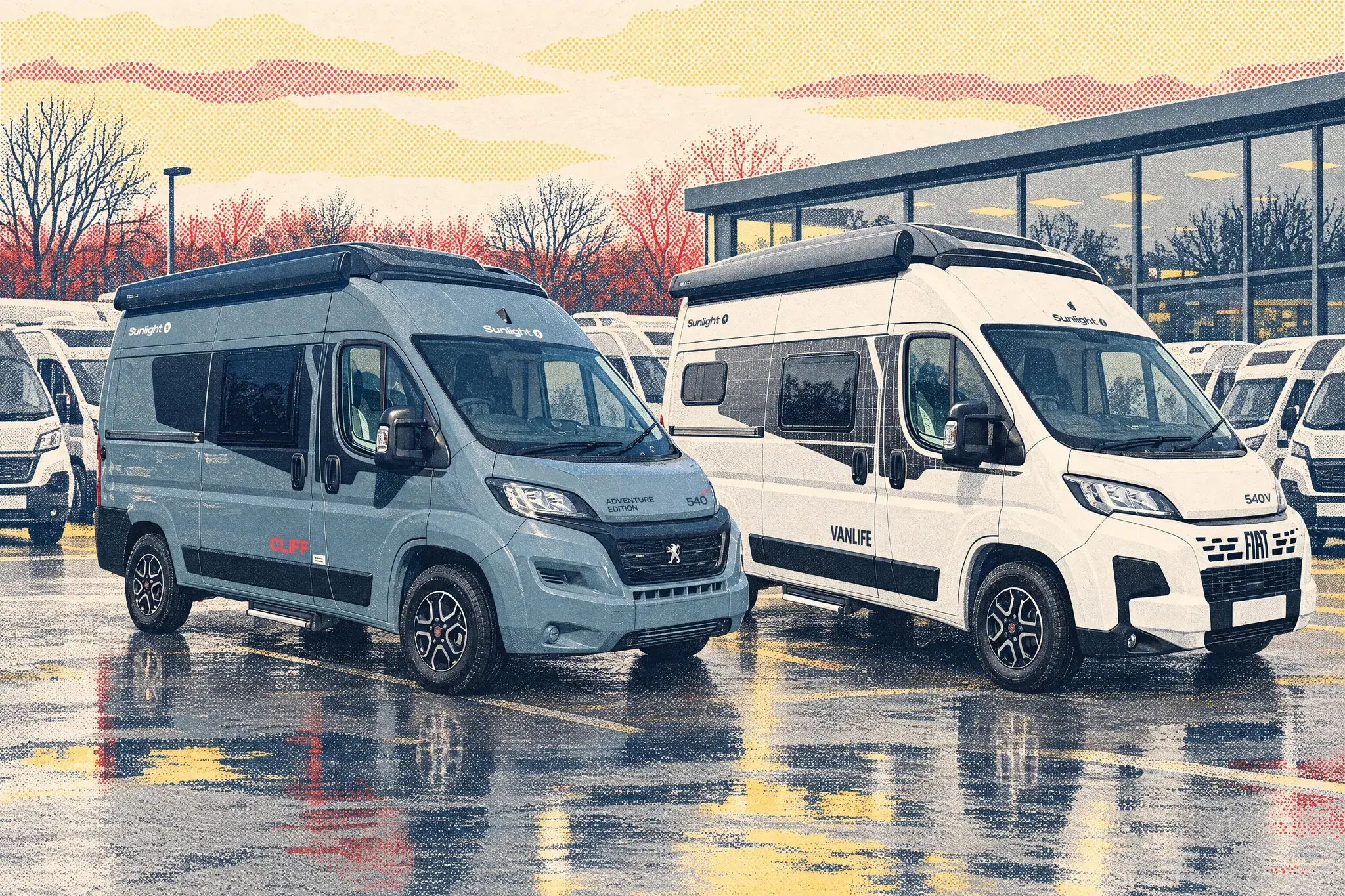
Sunlight makes its campers in two families, the Cliff and the Vanlife, and the happy news is that the choice between them comes down to one simple question: how many people you need to carry. The Cliff is the conventional, family-capable line, with a rear fixed bed, four travel seatbelts including a belted rear bench, a lower roofline and gas heating. The Vanlife is the clever-layout couple's line, with a fixed staircase up to a pop-top bed, a sociable rear lounge, only two travel belts, a taller 2.81m roof and diesel heating. Families take the Cliff 540; couples who fall for the living space take the Vanlife 540 V, from around £61,690 and a few thousand more than the Cliff. Here is how to pick the right Sunlight for you.

Sunlight makes its campervans in two distinct families, and the names are close enough that people muddle them all the time: the Cliff and the Vanlife. They share a maker, a closely-related Stellantis base and a great deal of engineering, but they're built around two quite different ideas about how you should live in a van, and choosing the wrong one is an expensive mistake. The good news is that telling them apart, and working out which is right for you, is genuinely simple once you understand the one question that splits them.
That question is: how many people do you need to carry? Almost everything else, the layout, the bed, the height, the feel, flows from the answer. The Cliff is the conventional, practical, family-capable line; the Vanlife is the clever-layout, couple's line. So this is a clear guide to the two ranges, what each is like, and which Sunlight camper you should actually buy, with the 540-size models of each as the worked example, since that's where the two ranges meet head-on.
The two ranges: Cliff and Vanlife
Start with the lie of the land. The Cliff is Sunlight's established, conventional panel-van camper line. It comes in several lengths, from the compact 540 up through longer models, and uses the familiar, practical layouts that have defined campervans for years: typically a fixed bed at the rear (a transverse double or twin singles) with a kitchen and washroom ahead of it, and a belted travel bench so the van can carry a family. It even extends to more adventurous variants like the Cliff 590 4x4 for those who want all-wheel-drive capability. The Cliff is the sensible, do-everything Sunlight.
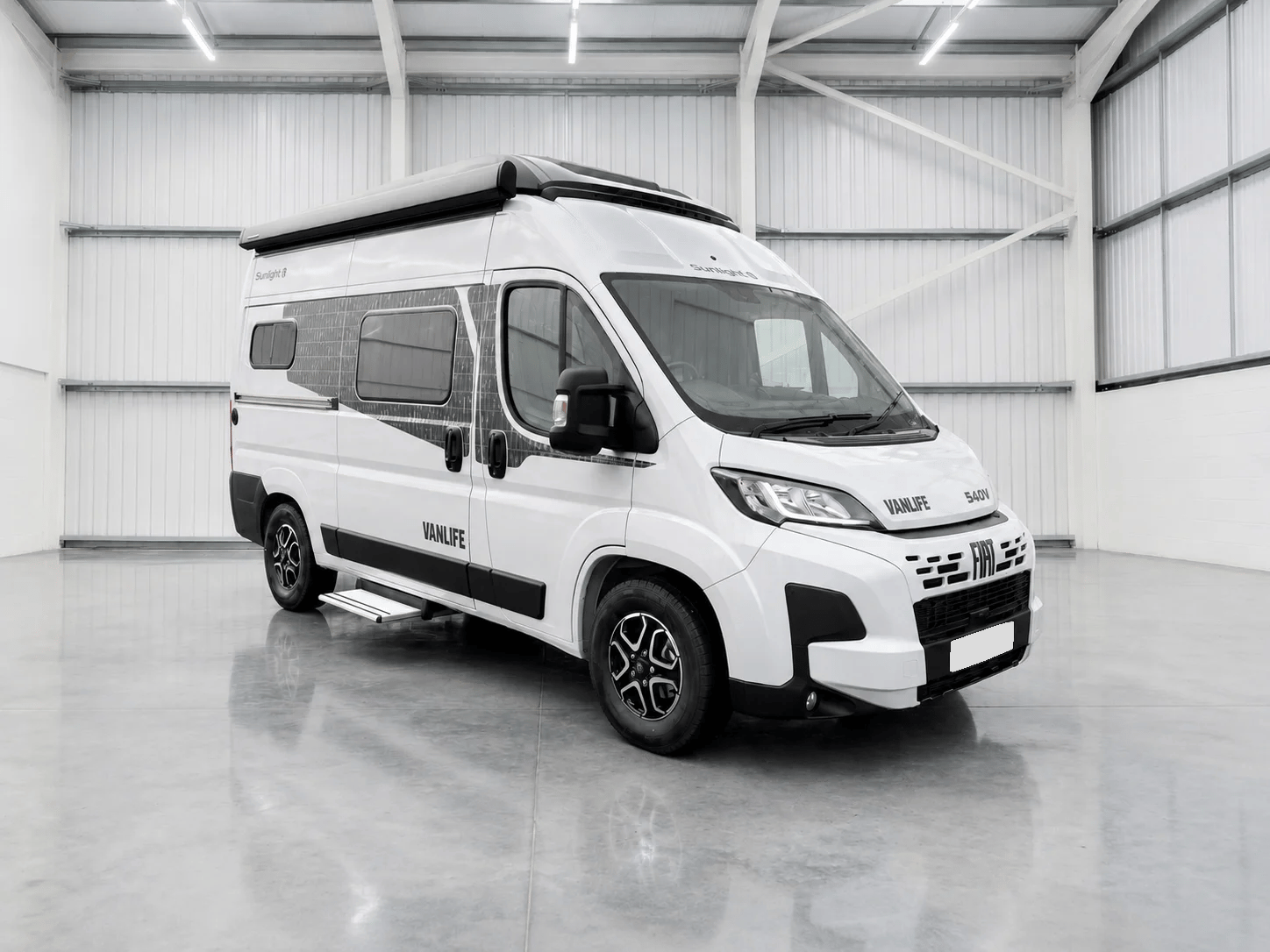
The Vanlife is the newer, more radical idea. Rather than a fixed bed at the rear, it walls off the cab, sends the main bed up into the pop-top via a permanent staircase, and frees the rear of the van for a sociable lounge, the layout we explore in detail in our staircase piece. It's designed to make a compact van feel like a small flat, and it's aimed squarely at couples. So at the simplest level: the Cliff is the conventional camper, the Vanlife is the clever one. Now for what that means in practice.
The decision that splits them: how many do you carry?
If you take one thing from this guide, take this, because it settles the choice for most people before any question of taste comes into it. The Cliff carries four; the Vanlife carries two. The Cliff 540 has four travel seatbelts, including a belted rear bench, so a family of four can legally and safely travel in it. The Vanlife 540 V has only two travel belts, both in the cab, because its lounge layout leaves no room for belted rear seating, so it carries two on the road, however many it sleeps. We've given this berths-versus-belts distinction its own piece because it catches so many buyers out, but here it's the very thing that divides the two ranges.
So the first filter is brutally simple. If you need to carry more than two people, the Vanlife is out, full stop, and you want the Cliff. No amount of preferring the Vanlife's layout changes the fact that you can't put your two children in belted seats in a van that doesn't have them. If you only ever carry two, both ranges are open to you, and the choice becomes the more enjoyable one of layout and living style. Settle the carrying question first, and you've done the hard part.
Layout and living: fixed bed versus lounge
For those who can choose either, the real difference is in how the two feel to live in day to day. The Cliff gives you a permanent, always-made-up bed at the rear, the great convenience of which is that you can fall straight into it at any hour with no setting up; the trade-off is that the bed occupies the back of the van all day, so your living and dining space is the dinette ahead of it, which is pleasant but modest. It's the classic, proven compact-camper arrangement, and for many people it's exactly right.
The Vanlife trades that ground-floor bed for a sociable rear lounge, putting the main bed upstairs. The reward is a genuinely different living experience, a proper place to sit and relax that doesn't have to be cleared away, and a van that feels more spacious and apartment-like than its length suggests. The cost is that you climb (civilised, via the staircase) to your main bed, and the second bed is a conversion of the lounge. Neither is better in the abstract; it's a genuine choice of priorities. Do you value an effortless, permanent bed and family-carrying practicality (Cliff), or a sociable living space and a distinctive feel, as a couple (Vanlife)?
In daily life the difference shows up in small, telling ways. In the Cliff, arriving late and tired, you simply climb into a bed that's already there, and in the morning you sit in the dinette with the bed still made behind you; it's low-effort and familiar. In the Vanlife, you walk up the staircase to bed and wake to a van that's a proper sitting room downstairs, but the second bed, if you have guests, is a make-up job each night, and the main bed is a short climb away rather than a roll. Over a week away, those little rhythms matter more than they look on paper, and which one suits you is really a question of how you like to live, not which van is cleverer.
The other differences
A few more distinctions help separate them. Height: the conventional Cliff 540 has a lower roofline (around 2.58 metres) than the pop-top Vanlife (around 2.81 metres tall), so the Cliff clears more height barriers and feels a little less affected by crosswinds, while the Vanlife's pop-top gives standing-height sleeping quarters up top. Base and heating: the two lines sit on closely-related Stellantis vans rather than the identical one, the current Cliff 540 on the Peugeot Boxer and the Vanlife on the Fiat Ducato, and where the Vanlife heats on diesel from its own fuel tank, the Cliff 540 uses a conventional gas heating setup, so the Cliff relies on bottles for heating where the Vanlife doesn't. Price: the Vanlife, as the newer, more elaborate concept, typically costs a bit more than the equivalent Cliff. And feel: the Cliff is the safe, familiar, family-friendly Sunlight, while the Vanlife is the design statement, the one that turns heads at the campsite and makes people climb the stairs to have a look.
It's also worth remembering that both lines have Carado counterparts, the Cliff 540 pairs with the Carado CV 540, and the Vanlife 540 V with the Carado CV 541 Pro, so whichever Sunlight you choose it's worth checking the Carado equivalent, as we explain in our Vanlife versus Carado piece. One caveat: the Cliff's Carado twin is usually a little cheaper, but the Vanlife's is priced almost level, so the saving isn't uniform across the pair.
Price and value between them
Price tracks the difference in concept. The conventional Cliff is the more affordable of the two lines: the Vanlife 540 V starts from around £61,690 on the road, while the equivalent Cliff starts several thousand pounds lower, so you're paying a premium for the staircase layout and the lounge. Exact Cliff pricing varies by layout, length and model year, so confirm both current figures with a dealer, but that's the shape of it: the Vanlife costs more for its more elaborate design.
Whether that premium is worth it is the same question as the layout choice. If the sociable living space genuinely changes how you'd use the van, it's money well spent; if you'd be just as happy with a fixed rear bed, the Cliff saves you the difference, which could go towards options or simply trips. And remember both lines have Carado counterparts from the same group: the Cliff's Carado twin is usually a little cheaper, so if value is your priority on the rear-bed layout, the keenest route may wear a Carado badge; the Vanlife's Carado twin, the CV 541 Pro, is priced almost level with it, so on that pair the saving largely isn't there. The point is that the Cliff-versus-Vanlife premium buys you a different way of living in the van, not a better-built one; both are the same quality underneath.
Cliff vs Vanlife at a glance
| Sunlight Cliff (540) | Sunlight Vanlife 540 V | |
|---|---|---|
| Layout | Conventional, rear fixed bed | Walled cab, staircase, rear lounge |
| Travel seats | 4 | 2 |
| Main bed | Fixed, at the rear, always ready | In the pop-top, reached by staircase |
| Living space | Dinette ahead of the bed | Dedicated rear lounge |
| Roof height | Lower | Taller (pop-top, ~2.81m) |
| Best for | Families, and those who want a permanent bed | Couples who want living space and a distinctive feel |
| Carado twin | Carado CV 540 | Carado CV 541 Pro |
The 540 pair, head to head
Because both ranges offer a 540-size model, the clearest way to see the choice is to put those two specific vans side by side. The Cliff 540 is a rear-transverse-fixed-bed van with four travel belts, a lower roofline of around 2.6 metres, and a kerb weight that leaves a slightly more generous payload margin than its taller sibling; it's the practical, family-capable, drive-under-more-barriers Sunlight. The Vanlife 540 V is the same 5.41-metre length on the drive but stands around 2.81 metres tall with its pop-top, carries two, and trades the fixed rear bed for the staircase-and-lounge layout.
So in the same footprint, you're choosing between a four-belt family van with a permanent rear bed and a lower roof, sleeping two to four depending on the exact layout and options, and a four-berth, two-belt couple's van with a sociable lounge and a taller pop-top roofline, for a few thousand pounds more. Put like that, the decision is rarely agonising: families and those who want fuss-free practicality take the Cliff 540; couples who fall for the living space take the Vanlife 540 V. They're the same length on the drive and worlds apart inside, which is exactly why Sunlight builds both.
So which Sunlight should you buy?
The honest summary writes itself once you've answered the carrying question. If you need to travel with more than two people, buy a Cliff, almost certainly the 540 if you want the compact size, because it has the four travel belts a family needs and the practical, permanent-bed layout that suits family touring. There's no decision to agonise over; the Vanlife simply can't do the job.
If you only ever carry two, the choice is yours to make on living style. Buy the Cliff if you value an effortless, always-made-up bed, a lower and slightly more practical roofline, and the familiar arrangement, and you'd rather put the money saved towards options or trips. Buy the Vanlife if the sociable lounge, the small-flat feel and the distinctive staircase layout speak to you, and you're happy to climb to bed and pay a little more for a more characterful van. Both are well-built Sunlight campers from the same maker; they're just built around different priorities. Match the van to yours, and either is a genuinely good buy. Our full Vanlife 540 V review goes deeper on that side of the choice.
Common questions
What is the difference between the Sunlight Cliff and the Sunlight Vanlife?
They share a maker and a closely-related Stellantis base but are built around different ideas. The Cliff is the conventional, family-capable line, with a rear fixed bed, four travel belts including a belted rear bench, and a lower roofline. The Vanlife is the clever couple's line, with a fixed staircase up to a pop-top bed, a sociable rear lounge, and only two travel belts. How many you need to carry decides it.
Should I buy a Sunlight Cliff or a Vanlife?
Buy the Cliff if you need to carry more than two people, as it has the four travel belts and the practical permanent-bed layout a family needs, almost certainly the compact 540 if you want the smaller size. Buy the Vanlife 540 V if you are a couple who fall for its staircase-and-lounge living space and do not need rear seats. How many you carry is the deciding question.
Which Sunlight campervan is best for a family?
The Cliff, specifically the Cliff 540 in the compact size, because it has four travel seatbelts including a belted rear bench, so a family of four can legally and safely travel in it, plus a practical rear fixed-bed layout. The Vanlife 540 V carries only two on the road, so despite sleeping four it is not a family-travel vehicle.
Is the Vanlife just a Cliff with a different roof?
No, they are fundamentally different layouts. They sit on closely-related but different bases, the Cliff 540 on the Peugeot Boxer and the Vanlife on the Fiat Ducato, and heat differently too: the Vanlife uses diesel heating from its own fuel tank, while the Cliff 540 uses conventional gas heating from bottles. The Vanlife's staircase-and-lounge layout and pop-top make it a different van, not just a re-roofed Cliff.
Is the Sunlight Cliff or Vanlife more expensive?
The Vanlife is the dearer of the two. The Vanlife 540 V starts from around 61,690 pounds on the road, while the equivalent Cliff starts several thousand pounds lower, a premium for the staircase-and-lounge layout. Both also have Carado twins from the same group: the Cliff's Carado is usually cheaper again, while the Vanlife's (the CV 541 Pro) is priced almost level with it.
Which is taller, the Sunlight Cliff or the Vanlife?
The Vanlife, because of its pop-top roof, stands around 2.81 metres tall, while the conventional Cliff 540 is lower at around 2.58 to 2.6 metres. The lower Cliff clears more height barriers and feels a little more settled in crosswinds, while the taller Vanlife gives standing-height sleeping quarters up in the pop-top. If car-park barriers are a daily concern, the Cliff has the edge.
The reachable bit
The camper you fall for is rarely the one you can afford. That gap is the whole reason Campervan.win exists. Right now we’re giving away the Sunlight Vanlife, worth around £65,000, and closing that gap is the point: capped entries so the odds stay honest, £10 a ticket, a maximum of five per person, £500 to a UK charity from every full draw, the winner picked by a public randomness beacon anyone can re-check, and one person driving away in the van itself.
Enjoyed this post?
Get more honest campervan guides like this one in your inbox.
You’re in!
Check your inbox. We’ve just sent you a welcome email.

About the author
Felix
Felix covers campervan technology, layouts, and modern conversions, with a focus on design-led thinking and practical performance
Keep Reading
Related Reading
Thoughtful articles that build on what you’ve just read.
Campervan Buying Guides
10 min read
Swift Merlin 2027: nine layouts from £64,190 and how to pick the right one
Swift's all-new Merlin campervan arrives for 2027 with nine layouts on the Fiat Ducato panel van. We sort them into four families, work the payload sum on a four-seat version, and explain what the roof, the automatic and the prices mean for your choice.
Campervan Buying Guides
11 min read
Bailey Endeavour B68: the end-lounge Transit campervan where the pop-top costs 143 kg
Bailey's new Endeavour B68 puts a rear lounge in a 5.98 m Ford Transit campervan. We compare it with the B65 and B62, check the 1.86 m bed, and do the payload sums if you add the £7,500 pop-top.
Campervan Buying Guides
12 min read
New campervans under £60,000 for 2027: what the NEC shows and what the price leaves out
A fair look at the new 2027 campervans listed under £60,000 ahead of the Motorhome and Caravan Show at the NEC, with each price given as its maker words it, and the differences between ex-works, delivered and German-retail-based figures explained so you can compare real on-the-road totals.
Campervan Buying Guides
14 min read
Eura Mobil Vancona 2027: a €57,400 campervan with just 84 to 118 kg left for options
Eura Mobil's new Vancona is a well-equipped Fiat Ducato campervan from €57,400, but its 84 to 118 kg options allowance means you need to order it with the weight sheet open. We explain what the figure means, what the 4.25 t uprate costs you in licence terms, and which options to prioritise.