
BikeStow review: the clever British in-van bike rack

Written by
Felix
Felix covers campervan technology, layouts, and modern conversions, with a focus on design-led thinking and practical performance
The short answer
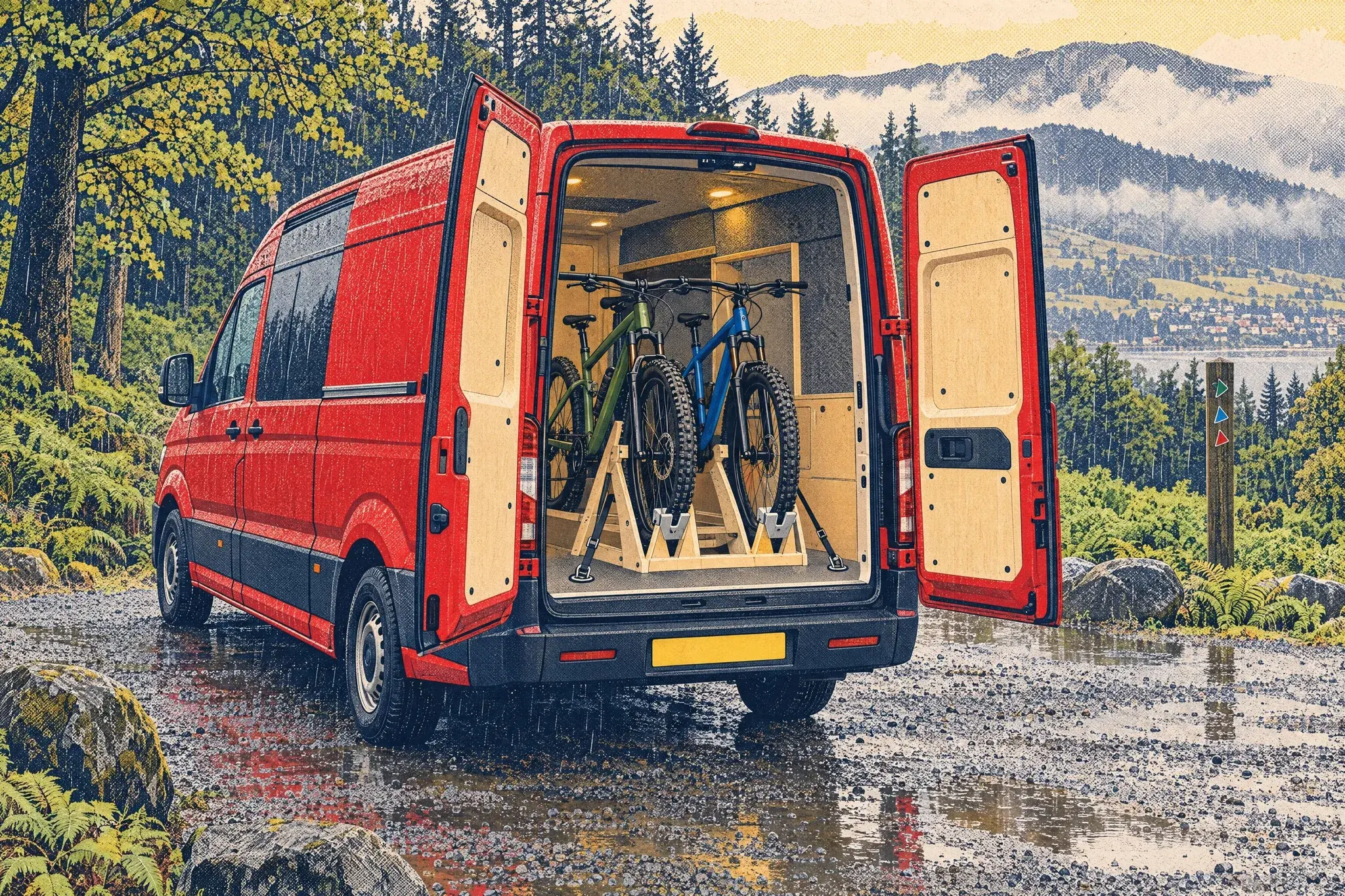
BikeStow is a clever British interior bike rack: a beautifully made plywood stand that lives inside your van and holds bikes upright and secure by the wheel, with both wheels on, rather than dangling them off a towbar or roof. That keeps the bikes clean, secure, and crucially off the rear overhang, where their weight quietly harms handling. The Original range runs from around £179 for one bike to £359 for four, fits 26 to 29-inch and 700C wheels (20-inch with an adapter, though not fat bikes), and handles e-bikes happily, though BikeStow does not publish a weight limit, so confirm it for a heavy e-bike. It is a properly thought-out bit of kit. Here is the full review, and who it suits best.

Anyone who carries bikes with a campervan knows the problem, because there's no perfect answer. Hang them off a towbar rack and they're exposed to road grime, theft and the surprising amount of weight a couple of bikes add behind the rear axle. Stick them on the roof and you add height, drag and the joy of lifting a bike over your head. Chuck them loose in the back and they slide around, fall over and scratch each other and your lovely conversion to bits. Carrying bikes well is one of the genuinely unsolved problems of van life.
It's also one of the most common, because so many people who buy a campervan do so precisely to get themselves and their bikes somewhere good, whether that's a Welsh trail centre, a Scottish gravel route or a coastal path at dawn. The bikes and the van go together, and yet the standard ways of carrying them all involve a real compromise, so most owners simply put up with whichever one annoys them least. That's the gap BikeStow set out to fill, and it's worth understanding the problem properly before looking at the solution, because the appeal of an interior rack only makes sense once you've felt the pain of the alternatives: the bike stolen off a layby rack while you grabbed a coffee, the salt-crusted, gritty drivetrain after a wet motorway run, the scratched frame and scuffed van lining after the bikes slid about in the back on the first sharp bend.
BikeStow is one of the more elegant answers, and the first thing to say about it is what it isn't, because the name leads people astray. BikeStow is not a towbar rack, not a roof rack, and not an external carrier of any kind. It's an interior rack: a beautifully made plywood stand that lives inside your van, campervan, motorhome garage or home, and holds your bikes upright and secure by the wheel, with both wheels still on. It's a different way of thinking about the problem, and for a certain kind of owner it's close to ideal. This is an honest review of what it is, how it works, what it costs, the genuine gaps in it, and exactly who should and shouldn't buy one.
What BikeStow actually is
Let's clear up the category first, because it matters. BikeStow is an interior, freestanding bike rack. Picture a furniture-grade plywood A-frame that folds out and stands on the floor inside your van; each bike's wheel drops into a slot and is clamped in place, so the bike stands upright on its own, held by the wheel, without leaning on anything or touching another bike. It's the indoor answer to carrying bikes, and its closest competitor isn't a Fiamma or a Thule towbar rack but Thule's interior VeloSlide garage system. Get that straight in your head and everything else makes sense.
It's made by BikeStow, the trading name of Laight Designs Limited, a small family firm based in Stourbridge in the West Midlands. The origin story is a good one and explains the product. Simon Laight, frustrated by years of bikes sliding around, falling over and scratching the inside of his new van, built himself a rack to hold them securely. Being, conveniently, a patent agent by profession, he then patented the design, and the family spent around three years refining materials and components before launching it, debuting a prototype at the Cycle Show in 2018. It's since become a proper family business, with Simon's sons involved (one of them, George, designed a spin-off vertical home-storage product, the BikeStow Up), and it carries Made in Britain certification.
That British, hand-made character isn't just marketing flavour; it shows in the product. The main structure is CNC-routed in-house from furniture-grade birch plywood in Stourbridge, then hand-finished, and the brushed-aluminium parts are laser-cut and finished near Birmingham. It's small-batch, considered, properly made kit, and it looks it: BikeStow racks have an architectural, almost furniture-like quality that's a world away from the bent-tube-and-plastic look of most bike carriers. For a lot of owners, that it looks good enough to leave on show is part of the appeal.
It's a story that resonates with the van crowd precisely because it's so familiar: a real person, with a real van, hitting a real, annoying problem, and refusing to accept the bodged solutions everyone else put up with. The three years of prototyping show, too. This isn't a quick flip of an off-the-shelf design with a logo slapped on; the V-slider, the three-point hold, the fold-flat magnets and the strap-down system are all the result of someone iterating until it actually worked, and the patents reflect that there genuinely was something new here. In an accessory market full of near-identical bent-tube racks from anonymous factories, a considered, patented, British-made product with an actual inventor behind it stands out, and it's a large part of why the cycling press took to it so warmly. You're paying for that design effort and that small-batch UK manufacturing, which is both why it costs what it does and why it feels the way it does.
How it works
The mechanism is clever in its simplicity, and it's the heart of why the thing works so well.
The plywood A-frame hinges open and stands on the floor. To load a bike, you drop one wheel (the front or the rear, though the front is recommended if your bike has mudguards) into a V-shaped slot. The wheel is then held at three equally spaced points: two fixed contact points forming the V, plus a sliding brushed-aluminium "V" piece that drops down over the top of the tyre, which one reviewer aptly likened to a guillotine. A locking thumb screw clamps that slider in place, fixing the wheel regardless of its diameter or tyre width. Because the wheel is gripped at three points, the bike simply doesn't move. Cross-supporting struts keep the frame rigid in use, and magnets hold it together and keep it folded flat when it's not.
Two design choices make it especially van-friendly. First, the whole rack is secured to the van floor using two supplied tie-down straps to your existing floor anchor points, with no drilling and no permanent fixing, which means it's also portable: you can move it between vehicles, or take it out and use it at home. Second, the bike is held purely by the wheel, so there's no contact between the rack and the bike's frame or paintwork, and no bike touches another. You keep both wheels on, you don't have to remove anything, and your expensive frames stay pristine. It's the kind of solution that makes you wonder why it took someone until 2018 to build it properly, and the answer, of course, is that someone had to be annoyed enough, and patent-minded enough, to do it.
In practice, the system is forgiving in the ways that matter on a wet, tired post-ride evening. Because it grips any wheel size and tyre width, you don't fiddle with settings between your road bike and your mountain bike; you just drop whichever one in and clamp it. Because both wheels stay on, there's no greasy faff with quick-releases or thru-axles, and no muddy wheel rolling around the van. And because the rack straps to existing floor points, fitting it the first time is a five-minute job, not a conversion project, and removing it to free up the space is just as quick. The fold-flat design means that when the bikes are at home, the rack collapses against a wall or stows in a locker rather than dominating the van. These are small things individually, but together they're the difference between a rack you use every trip and one that ends up abandoned in the garage because it's too much hassle.
It's worth dwelling on that point, because it's where a lot of cheaper bike-carrying solutions quietly fail. A rack that's awkward to fit, or that demands you strip the wheels off and wrestle greasy quick-releases every single time, is a rack you'll find excuses not to use, and before long the bikes are back to sliding around loose in the boot. The genuine achievement of BikeStow isn't any single clever part; it's that the whole sequence of using it, fold out, drop the wheel in, clamp, strap down, drive, is quick and pleasant enough that you'll actually do it properly every trip. Kit that removes friction gets used; kit that adds it gets abandoned, and BikeStow lands firmly on the right side of that line.
The range, and what it costs
BikeStow's main van range is the "Original" line, sized by how many bikes you need to carry:
| Model | Bikes | Price (from) |
|---|---|---|
| Original One | 1 | £179 |
| Original Two | 2 | £239 |
| Original Three | 3 | £299 |
| Original Three PLUS | 3 (plus-size) | £359 |
| Original Four | 4 | £359 |
A note on price, because it's relevant to the value question: these are higher than they were at launch. Older reviews quote the two-bike at around £179 and a raw four-bike under £200, so prices have risen materially over the years, and you should treat the live figures as current rather than the numbers in dated reviews. The racks come in a range of finishes (Volcanic Black, Ceramic, Storm Grey, Orange, Cactus Green, Midnight Blue, among others) with different slider options, and there's a cheaper raw-plywood option historically on the larger models.
Beyond the freestanding Originals, BikeStow makes a separate fork-mount system, a Tilting Fork Mount (from around £79) and a Fork Mount Rail (from around £59), for smaller campers and DIY conversions where a freestanding rack won't fit; these mount the bike by its fork (front wheel off) and integrate with BikeStow's flat-pack plywood van bed module. And there's a whole range of home and garage storage products (the Up, Flip, Stance and Store), which feeds a nice "buy once, use at home too" logic. You buy mainly direct from bikestow.com, with an official eBay store as well; it's largely a direct-to-consumer brand, so you won't find it on the shelf in a big chain, which is worth knowing if you like to see things before you buy.
That direct-sale model is a double-edged thing. On one hand, it keeps the price of a small-batch British product as keen as it can be by cutting out the retail markup, and BikeStow's own site and videos do a thorough job of showing how it works. On the other, for a few-hundred-pound purchase that depends on fitting your specific van and bikes, not being able to see and handle one first is a genuine drawback, and you're relying on the return policy if it doesn't suit. If you can find an owner locally or catch BikeStow at a show, it's worth doing before you commit, simply because the right size and configuration for your setup is easier to judge in person.
More than a rack: the BikeStow ecosystem
What started as a single in-van rack has grown into a small system, and it's worth knowing the whole range because it changes the value calculation.
For van conversions where a freestanding rack won't fit the layout, there's the fork-mount line, a Tilting Fork Mount and a Fork Mount Rail, which hold the bike by its front fork (front wheel removed) and bolt to the van. The clever touch is that the tilt compensates for a bike's natural lean so the handlebars don't clash, and the mounts integrate with BikeStow's own flat-pack plywood van-bed module, so a self-builder can design bike storage into the conversion from the start rather than bolting it on afterwards. For anyone building or fitting out their own camper, that's a genuinely useful, considered bit of kit, and it speaks to a company that understands the conversion crowd it sells to.
Then there's the home and garage side, the Up, the Flip and various stands, which store bikes vertically or fold flat against a wall. On their own they're just nice bike storage, but combined with the van rack they make a quietly compelling argument: buy into BikeStow and the same family of products holds your bikes at home, in the garage and on the road, all in the same well-made plywood-and-aluminium style. For a household where the bikes are a big part of life, that "one system everywhere" coherence is part of the appeal, and it softens the sting of the price, because you're not just buying a van accessory, you're buying storage you'll use every day.
Build quality, and how it lasts
A fair question about any plywood product that lives in a van and carries heavy, sometimes muddy bikes is how it holds up over years of use, and here BikeStow's furniture-grade approach earns its keep. The structure is CNC-routed birch ply, a material that's strong, stable and far more resistant to the knocks and flexing of van life than the chipboard or MDF you'd find in cheaper kit, and the moving parts are laser-cut brushed aluminium rather than plastic, so the bits that actually take the wear are metal. Owners who've had theirs for several years report them staying solid and rattle-free, which is the real test, and the fold-flat magnets and clamps don't seem to loosen or wear out in normal use.
Care is straightforward, too. The ply is sealed and finished, so a wipe-down after a muddy trip is all it needs, and because the bikes are held by the wheel there's no padded frame-contact point to perish or compress over time, as there is on many clamp-style racks. If anything does eventually wear or break, the modular, made-in-Britain nature of the thing means parts can in principle be replaced rather than the whole rack binned, and a small family firm tends to be more reachable for spares and advice than a faceless brand. None of this is to claim plywood is indestructible: it can be scratched, and a really hard impact might mark it where a steel rack would shrug it off. But for the loads and the life it's designed for, the build quality is reassuringly substantial, and it's a big part of why the thing feels worth its price rather than merely looking it.
What's compatible, and what isn't
The Original racks are impressively accommodating on wheel and tyre size, holding 26-inch, 27.5-inch, 29-inch and 700C wheels as standard, and down to 20-inch with a separately sold small-wheel adapter for kids' bikes. On tyre width they take up to 2.6 inches on a 29er and up to 3.0 inches on 26 and 27.5-inch wheels. That covers mountain bikes, road bikes and gravel bikes happily, and BikeStow lists e-bikes as compatible too. The one hard exclusion is fat bikes, whose enormous tyres won't fit, which is the single most-cited limitation.
There is, however, an important gap to flag honestly, and it's the e-bike one. BikeStow doesn't publish a maximum bike weight or a maximum total rack load, unlike Thule's VeloSlide, which gives an explicit 35kg-per-bike figure. Reviewers have used BikeStow successfully with e-bikes, and the site lists them as compatible, but the absence of a stated weight limit is a real unknown if you're carrying heavy e-bikes (which run 22 to 28kg each). If e-bikes are your plan, our honest advice is to contact BikeStow directly and get a weight limit confirmed before you rely on it, and to remember that the bikes' weight still counts against your van's payload wherever you carry them.
This is the one area where a rival, Thule's VeloSlide, has a clear documented edge, with its explicit per-bike weight rating, and it's a fair criticism of BikeStow that for a product increasingly used with heavy e-bikes, a published limit would give buyers real peace of mind. In fairness, plenty of owners carry e-bikes on theirs without issue, and the sturdy plywood-and-aluminium construction doesn't look marginal, but "looks fine" isn't a spec, and on anything safety-related we'd always rather see the number. It's the single most useful improvement BikeStow could make to the product's documentation, and the one question we'd most want answered before buying for e-bike use.
Living with it: the good and the fiddly
In use, the thing reviewers and owners praise most is how fast and easy loading is, even with a muddy bike after a ride: drop the wheel in, slide the clamp down, turn the thumb screw, done, in seconds. The bikes are genuinely stable in transit, with independent testing in a VW van reporting minimal movement, and the no-frame-contact design means no rubbing or scratching. It folds flat when you're not carrying bikes, reclaiming the space, and it's drill-free and portable. And it's simply lovely to look at and to use, with a tactile, well-engineered quality that justifies a lot of the price.
It's not perfect, though, and the honest niggles are worth knowing. On the three and four-bike models, fitting the middle bike is fiddly: you have to angle it in and rotate the handlebars ninety degrees to clear the others, which is more awkward with big 29ers and e-bikes. And the grab-hole in the aluminium slider isn't really a proper handle, so it's a little uncomfortable to operate. The biggest practical trade-off, though, is the obvious one: an interior rack consumes interior space. Whatever room the bikes take up inside is room you don't have for anything else, and that's the fundamental tension at the heart of choosing an interior rack over an external one. For some vans and some trips that's a deal-breaker; for others it's a price well worth paying.
It's worth being realistic about that space trade-off, because it's the crux of the whole interior-rack idea. In a smaller campervan, two or three bikes standing inside take up a meaningful chunk of your living and storage space, so the practical reality is that the rack tends to go in for the journey and the bikes come out and get locked up (or ridden) once you're parked, freeing the space for camping. In a bigger van or a motorhome with a garage, the bikes can often just live in the rack for the whole trip. Either way, it pays to think honestly about your layout before you buy: measure where the rack will stand, picture the bikes in place, and be sure you can live with what they displace. The people who love BikeStow are the ones for whom that trade, some interior space in exchange for secure, clean, scratch-free bikes, is obviously worth it. The people who regret any interior rack are the ones who didn't think the space through first.
The big advantage: bikes inside, not hanging off the back
Here's where BikeStow's whole philosophy pays off, and where it has genuine, concrete advantages over the external racks most people default to.
The first is security. Your bikes are inside the locked van, out of sight, rather than displayed on the back of the vehicle for any passing opportunist. It's worth being precise: BikeStow has no integrated lock, so its security is passive rather than active, the bikes are safe because they're inside a locked vehicle, not because they're chained to the rack. But for most owners that "they're inside, out of sight" protection is worth far more than a flimsy lock on an exposed external rack, and motorhome owners with expensive bikes consistently say they'd rather keep them inside for exactly this reason.
The second is that the bikes stay clean and dry, out of the road spray, salt and weather that coat anything carried outside. The third, and least appreciated, is about weight and safety. Bikes hung off a towbar or rear-wall rack sit well behind the rear axle, where they act as a lever: the cantilever effect means a couple of bikes can pile a surprising amount of weight onto the rear axle while actually lifting weight off the front, hurting steering and braking, and on a heavy enough load it can exceed axle limits and even invalidate your insurance. E-bikes make this dramatically worse, since two of them can be 50kg before you add the rack. By carrying the bikes inside, over or ahead of the rear axle rather than hanging off the back, BikeStow sidesteps that rear-overhang problem entirely, which is a real and rarely-mentioned advantage for a motorhome's weight distribution. The honest caveat remains that the bikes' weight still counts against your overall payload, so you have to have the kilos spare, but where you put that weight matters, and inside is far kinder to how the van drives than hanging off the back.
This weight-and-handling point deserves a little more emphasis, because it's the one most buyers overlook and it can be the most important. A van that's heavy at the very back, behind the rear axle, doesn't just carry more weight; it handles worse, with lighter, vaguer steering and a tendency to pitch and sway, and on a windy motorway a couple of bikes on the back of a tall van can make a noticeable difference to stability. Carrying the same bikes inside, lower down and further forward, keeps the van's weight where the designers intended it and the van driving as it should. For motorhomes especially, where rear overhangs can be long and payloads tight, that's a genuine safety and handling benefit, not just a theoretical one. It's the kind of advantage that doesn't show up in a showroom but that you feel on a long, blustery drive home, and it's a real, if rarely-mentioned, argument for the whole interior-rack approach BikeStow is built around.
A weekend with it, from loading to arriving
To bring it to life, picture a typical bikes-and-van weekend. Friday evening, you wheel the bikes up to the open side door, drop the rack down (it lives folded in a locker or against the wall the rest of the time), and clip it to the floor anchors with the straps. Each bike's front wheel goes into a slot, the slider drops over the tyre, a turn of the thumb screw, and it's locked solid; two bikes take a couple of minutes, and you've not touched a frame or removed a wheel. The bikes stand there, upright and separate, not leaning on the furniture or each other.
You drive off, and the difference from the back-of-the-van scramble is immediate: nothing slides, nothing clatters, nothing rubs a hole in your upholstery on the first roundabout. There's no rack on the back catching crosswinds or blocking the number plate, and the van handles normally because the weight is inside and forward, not hung off the tail. You stop for fuel without worrying whether someone's eyeing your bikes on a layby rack, because they're locked inside, out of sight.
At the site, you've a choice. In a big van you can leave the bikes in the rack and just go camping around them. In a smaller camper, you lift them out, lock them up or ride off, fold the rack flat, and reclaim the floor for the weekend. Either way, when you head home the bikes are as clean and unscratched as when you left, having spent the trip indoors rather than being sandblasted by motorway spray. It's an undramatic, friction-free experience, and that lack of drama is exactly the point. The best van kit is the kind you stop thinking about, and once it's set up, BikeStow largely disappears into the routine.
How it compares
The fair comparison is against the other ways of carrying bikes, and it's really a choice of philosophy.
| BikeStow | Fiamma Carry-Bike | Thule VeloSlide | Towbar rack | |
|---|---|---|---|---|
| Type | Interior, freestanding | External, rear wall | Interior, garage slide-out | External, behind van |
| Bikes kept | Inside, secure, clean | Outside, exposed | Inside garage | Outside, exposed |
| Price (from) | £179 to £359 | ~£270 | ~£1,000 to £1,700 | ~£200 to £600+ |
| Capacity | 1 to 4 | 2 (to 4 with extras) | 2 | 2 to 4 |
| Fitting | Straps, no drilling | Bolt to rear wall | Rails in garage | Towbar |
| Rear-overhang weight | None (inside) | High | Low | High |
| Theft exposure | Lowest (inside) | High | Low | High |
The Fiamma Carry-Bike is the external market standard, ubiquitous and cheaper, but it hangs your bikes outside, exposed to theft and weather, and loads the rear overhang. The Thule VeloSlide is the other interior option and a brilliant bit of engineering, a slide-out garage rail with a proper one-handed locking handle and an explicit e-bike weight rating, but it costs three to six times what a BikeStow does and needs a motorhome with a garage. So BikeStow's pitch is clear: interior security and zero rear-overhang weight, at a fraction of the VeloSlide's price, for campervan and van-conversion owners who'd rather give up some interior space than hang their bikes outside. Against chucking them loose in the back, which is the real-world alternative for many van owners, it's simply in a different league.
It's worth saying that the honest comparison for most campervan owners isn't BikeStow versus a four-figure Thule garage system, it's BikeStow versus the messy, damaging, slightly dangerous habit of just laying the bikes down in the back on a blanket and hoping. Measured against that, which is genuinely how a lot of people carry bikes in a van, BikeStow transforms the experience: no scratched frames, no scratched van, no bikes shifting and falling on a corner, no chain oil on the bedding. For a few hundred pounds it turns a recurring source of irritation and damage into a non-event, and when you frame it that way, against the real alternative rather than the premium one, the value looks a lot more obvious.
Who it's for
BikeStow suits a fairly specific but very real owner: van-lifers and keen cyclists with PVC campervans or van conversions, and motorhome owners with a garage, who own bikes they care about and won't hang outside, who want a drill-free, portable solution, and who value keeping their bikes secure, clean and off the rear overhang. If that's you, it's close to ideal, and the fact it doubles as smart home storage sweetens the deal.
It's not for everyone, though. If you need that interior space for other cargo, an external rack that keeps the inside clear may suit you better. If you carry three or four heavy e-bikes, the combination of the fiddly middle-bike loading, the interior space they'd consume and the unstated weight limit means you should look hard at a heavy-duty external or garage solution and confirm the figures first. And if you only carry bikes occasionally and don't mind them outside, a cheaper external rack will do the job for less. As with most van kit, it's not about which is best in the abstract, but which trade-off suits how you actually travel.
A useful way to decide is to ask yourself three honest questions. First, how much do you care about your bikes? If they're expensive and beloved, the case for keeping them inside, secure and unscratched, is strong; if they're cheap knockabouts you wouldn't mind losing, an external rack is fine. Second, how much interior space can you genuinely spare? If your van is small and you already cram it for every trip, the room the bikes take may simply be too dear; if you've a garage or a roomy conversion, it's no hardship at all. Third, how do you feel about your bikes being on display when you stop? If the thought of them hanging off the back at a motorway services makes you uneasy, an interior rack solves that at a stroke. Answer those three honestly and whether BikeStow is for you tends to become obvious.
The verdict
BikeStow is a genuinely lovely thing: a clever, beautifully made, patented British solution to the real problem of carrying bikes inside a van without them sliding around and getting wrecked. It loads in seconds, holds bikes rock-steady without touching their frames, needs no drilling, folds away, doubles as home storage, and keeps your bikes secure, clean and off the rear overhang, which is a combination no external rack can match. For the campervan cyclist who treasures their bikes, it's an easy thing to recommend.
The honest caveats are that it consumes interior space (the fundamental cost of any interior rack), the middle bike is fiddly on the bigger models, it has no published weight limit (a real question mark for heavy e-bikes, so confirm before you buy) and no integrated lock, it's pricier than a basic external rack, and it's mostly sold direct, so you're unlikely to see one in the flesh first. None of those should put off the right buyer; they're simply the things to know going in. Buy it for what it is, the best-made way to carry bikes you care about inside your van, and you'll be delighted. Just check the e-bike weight question with BikeStow if that's your plan.
And do the wider sums on weight while you're at it, because bikes, rack and everything else all count against your van's payload, so it's worth knowing your real spare capacity before you load up. That's exactly the kind of often-overlooked figure our guide to what to check when buying a used van or campervan walks through, and it's a consideration BikeStow shares with heavier add-ons like hydraulic self-levelling, where the payload maths matters just as much. Bike storage is one of those van decisions that seems minor until you're living with the wrong answer, so it's worth getting right, and it sits among the other choices we weigh up in our rundown of the options that matter most when buying a campervan. Get it right, and carrying your bikes quietly stops being the worst part of every trip.
Frequently asked questions
Is BikeStow a towbar or roof rack?
No, and this is the most common misunderstanding. BikeStow is an interior rack: a freestanding plywood stand that holds your bikes upright inside the van, campervan, motorhome garage or home, secured to the floor with straps. It's the indoor alternative to external towbar and roof racks.
How does BikeStow attach to the van?
It doesn't bolt in. The freestanding rack stands on the floor and is held in place with two supplied tie-down straps to your existing floor anchor points, so there's no drilling and no permanent fixing, and you can move it between vehicles or use it at home.
Can BikeStow carry e-bikes?
BikeStow lists e-bikes as compatible and reviewers have used it with them, but it doesn't publish a maximum bike weight, unlike some rivals. Given e-bikes weigh 22 to 28kg each, we'd advise confirming a weight limit with BikeStow directly before relying on it for heavy e-bikes, and remembering that the weight counts against your van's payload.
How much does a BikeStow cost?
The Original range runs from around £179 for the one-bike rack to £359 for the four-bike or plus-size three-bike, with two and three-bike models in between. Prices have risen since launch, so check the current figures, and note there are also cheaper fork-mount options for smaller vans.
What bikes does it fit?
Mountain, road and gravel bikes with 26-inch, 27.5-inch, 29-inch or 700C wheels as standard, and kids' bikes down to 20-inch with an adapter. It handles tyres up to 2.6 inches (on 29ers) or 3.0 inches (on smaller wheels), but it does not fit fat bikes.
Is BikeStow secure against theft?
Its security is passive: the bikes are inside your locked van, out of sight, which is far less tempting to thieves than bikes displayed on an external rack. There's no integrated lock on the rack itself, so for extra peace of mind you'd add your own lock, but the main protection is simply that the bikes aren't on show.
Is BikeStow worth it?
For owners who want to carry bikes they care about inside their van, securely and without scratches, it's well worth it, and far cheaper than the only comparable interior system. If you'd rather keep the interior space clear and don't mind bikes outside, a cheaper external rack may suit you better. It's a question of whether you value interior security over interior space.
Can I use BikeStow at home as well as in the van?
Yes, and many owners do. The freestanding rack works just as well in a garage or shed, and BikeStow makes a wider range of home-storage products (the Up, Flip, Stance and various stands) in the same plywood-and-aluminium style, so you can store your bikes the same way at home and on the road. For keen cyclists, that everyday usefulness is a large part of what justifies the price.
Does fitting a BikeStow need drilling?
No. The freestanding Original racks aren't bolted in; they stand on the floor and are held with two supplied straps to your van's existing floor anchor points, so there's no drilling and no permanent modification, and you can remove or move the rack in minutes. The separate fork-mount products do bolt to the van, but the main range doesn't.
Will the bikes damage my van interior?
That's rather the point of the design: no. The bikes are held upright by the wheel, not leaning on the furniture, and no bike touches another, so there's no rubbing, no falling over on corners, and no chain oil or mud transferred to your upholstery, which is exactly the damage that carrying bikes loose in the back tends to cause.
Is BikeStow better for motorhomes or campervans?
Both, in different ways. In a campervan or van conversion it stands in the living space, often going in for the journey and coming out at the pitch; in a motorhome it's well suited to the garage. In both, its big advantage over an external rack is keeping the bikes secure, clean and, crucially, off the rear overhang where their weight harms handling.
Common questions
Is BikeStow a towbar or roof rack?
Neither. BikeStow is an interior rack: a plywood stand that lives inside your van, campervan, motorhome garage or home and holds bikes upright by the wheel, with both wheels still on. It is a completely different approach from external towbar or roof carriers, designed to keep the bikes inside, clean and secure rather than exposed.
How does BikeStow attach to the van?
The Original racks are freestanding, so they stand in the living space without drilling, often going in for the journey and coming out at the pitch. BikeStow also makes fork-mount options (a Tilting Fork Mount from around 79 pounds and a Fork Mount Rail from around 59 pounds) for smaller campers and DIY builds where a freestanding rack will not fit, which mount the bike by its fork with the front wheel off.
Can BikeStow carry e-bikes?
Yes, reviewers have used it with e-bikes and the site lists them as compatible, but BikeStow does not publish a maximum bike or total rack weight, which is a real unknown for heavy e-bikes (typically 22 to 28kg each). Confirm a weight limit with BikeStow directly before relying on it for heavy e-bikes, and remember their weight counts against your van's payload.
How much does a BikeStow cost, and what bikes does it fit?
The Original range runs from around 179 pounds for the one-bike rack to 359 pounds for the four-bike or plus-size three-bike. It fits mountain, road and gravel bikes with 26, 27.5, 29-inch or 700C wheels as standard, and kids' bikes down to 20-inch with an adapter, taking tyres up to 2.6 inches on a 29er or 3.0 inches on smaller wheels, but it does not fit fat bikes.
Will bikes in a BikeStow damage my van interior?
No, that is the point of the design. The bikes are held upright by the wheel, not leaning on the furniture, and no bike touches another, so there is no rubbing, no falling over on corners, and no chain oil or mud transferred to your upholstery, which is exactly the damage that carrying bikes loose in the back tends to cause.
Is BikeStow worth it?
For owners who want their bikes inside, clean and secure rather than hanging off the back, it is close to ideal. Its big advantage over an external rack is keeping bikes safe from theft and grime and, crucially, off the rear overhang where their weight harms handling. The fiddly part is fitting the middle bike on three and four-bike models, which is more awkward with big 29ers and e-bikes.
The reachable bit
The camper you fall for is rarely the one you can afford. That gap is the whole reason Campervan.win exists. Right now we’re giving away the Sunlight Vanlife, worth around £65,000, and closing that gap is the point: capped entries so the odds stay honest, £10 a ticket, a maximum of five per person, £500 to a UK charity from every full draw, the winner picked by a public randomness beacon anyone can re-check, and one person driving away in the van itself.
Enjoyed this post?
Get more honest campervan guides like this one in your inbox.
You’re in!
Check your inbox. We’ve just sent you a welcome email.

About the author
Felix
Felix covers campervan technology, layouts, and modern conversions, with a focus on design-led thinking and practical performance
Keep Reading
Related Reading
Thoughtful articles that build on what you’ve just read.

Campervan Kit & Gear
24 min read
Campervan leveling options: what's best, what's best value, and what should you choose?
A plain-English, in-depth look at every way to level a campervan or motorhome on a sloping pitch, from £20 ramps to fully automatic hydraulic systems, with honest UK prices and advice on which one actually suits you.
Campervan Kit & Gear
27 min read
Lock'n'Level review: a great little tool, and why a smart 'Pro' version makes sense
An honest review of Lock'n'Level, the British inflatable air levelling system: you drive onto a tough air bag and inflate it with a 12V tyre compressor to raise each corner, and a valve holds the level. It covers how it works, the range, the real pros and cons, who it suits, and the case for a smart 'Pro' version that reads the angle for you.

Campervan Kit & Gear
25 min read
ARB awning vs Thule awning: one's for 4x4s, one's for campervans
ARB and Thule both make excellent awnings, but they're built for different vehicles and different lives. One is a rugged, rack-mounted pull-out for 4x4s and overlanders; the other is the wind-out cassette awning that defines campervan and motorhome touring. Here's how they really compare, and which one you actually want.

Campervan Kit & Gear
25 min read
Campervan thermal blinds: the cure for cold nights and wet windows
Thermal screens keep a campervan warm on a frosty night, cool in summer, and free of streaming condensation, and the cab and the pop-top are where you win or lose that battle. Here's the full guide to internal, external and magnetic thermal blinds, with honest pros, cons and prices.